
Sea moss gel is the most common way people buy and eat sea moss, and it is also the format with the widest gap between what is claimed and what is known. This guide covers what the gel actually is, what the research does and does not support, how much iodine you are realistically taking, and how to use and store it without wasting it.
We sell raw sea moss wholesale rather than finished gel, so we have no jar to push here. What follows is what we would want a buyer to know.
What sea moss gel actually is
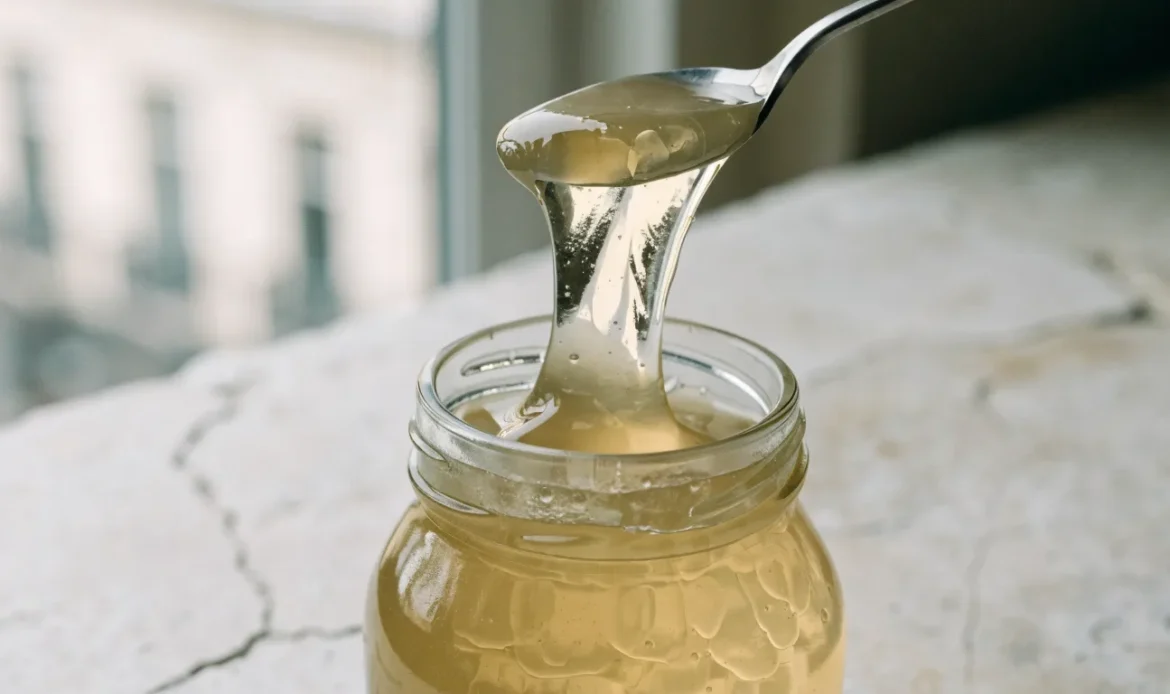
Sea moss gel is dried seaweed that has been rinsed, soaked in water until it swells, then blended with water until smooth. That is the whole process. There is no extraction, no concentration and no fermentation. The gel is simply hydrated seaweed with the fibre broken down small enough to pour.
The thickening comes from carrageenan, a family of sulphated polysaccharides that red algae produce in their cell walls. Carrageenan is why the gel sets in the fridge and why the same seaweed has been used as a commercial gelling agent for well over a century. It is the mechanism behind the texture, not an additive.
Most gel is made from Eucheuma cottonii, the thick, branched warm-water species farmed and wildcrafted across the Caribbean and Indo-Pacific. A smaller amount is made from Chondrus crispus, the flat cold-water Atlantic species that the name “Irish moss” properly refers to. The difference between the two is real but smaller than the marketing suggests.
What is actually in it
Because gel is mostly water, the nutrition per spoonful is modest. Analytical studies of Chondrus crispus find calcium, iron, zinc, amino acids, fatty acids, carotenoids, polyphenols and polysaccharides including carrageenan. Those are real constituents. The question is how much of each survives into a tablespoon of gel that is roughly 95% water.
This is where the most repeated claim in the category falls down.
Sea moss does not contain 92 of the 102 minerals the human body needs. The figure traces back to Dr Sebi’s teaching, not to any published analysis, and the human body does not require 102 minerals.
There is no nutritional framework in which the body needs 102 minerals. The essential mineral list runs to roughly two dozen. Any seaweed will contain trace amounts of a great many elements simply because it grew in seawater, but “contains a detectable trace of” is not the same as “is a meaningful dietary source of”. A brand repeating the 92-minerals line is telling you something about its research standards. We cover this in more detail in our guide to the minerals in sea moss.
What sea moss gel genuinely is a good source of: soluble fibre, iodine, and water. That is a shorter list than the labels suggest, but the first two are worth having.
The iodine question, with real numbers
Iodine is the single most important thing to understand about sea moss, and most product pages skip it entirely.
A 2020 risk assessment published in Environmental Science and Pollution Research analysed 30 samples of red seaweeds and reported iodine in Chondrus crispus averaging around 3.86 mg/kg dry weight, with a standard deviation of ±1.49 mg/kg. That is roughly 3 to 7 micrograms per gram of dried seaweed — and the variation between batches is the important part of that sentence.
For context, the Tolerable Upper Intake Level for iodine in adults is 1,100 micrograms per day. At the averages above, ordinary gel servings sit well inside that. The problem is that averages hide outliers: the same assessment noted that a large serving of dried red seaweed could approach or exceed the upper limit on its own, and brown seaweeds such as kelp run far higher than red ones.
- Batch variation is the risk, not the average. Two jars from the same brand can differ if the raw material came from different harvests.
- Ask for a certificate of analysis. A supplier who tests will show you iodine and heavy metals per lot. One who does not is guessing along with you.
- More is not better. Iodine has a U-shaped risk curve: too little and too much both cause thyroid problems.
If you have a thyroid condition, are pregnant or breastfeeding, or take thyroid medication, this is a conversation for your doctor rather than a comment section. Sea moss and thyroid health goes further into why.
What the evidence actually supports
Here is the honest position, and it is not what most of this industry will tell you.
There are no large, well-designed human clinical trials of sea moss supplementation for meaningful health outcomes. Only two small randomised controlled trials have examined Chondrus crispus in humans. Each enrolled fewer than 60 adults and ran for less than 12 weeks. They reported modest reductions in fasting glucose, improved stool frequency, and slight increases in serum antioxidant capacity.
Those are genuine findings and they are also small, short and preliminary. Everything else — the immunity claims, the thyroid claims, the libido claims, the skin transformations — rests on laboratory and animal work, or on the plausible-but-untested logic that a food containing a nutrient must deliver the effects of that nutrient.
The claims made for sea moss substantially outpace the human evidence. That does not make it useless. It makes it a food, not a medicine.
Judged as a food, sea moss gel is a reasonable thing to eat: a low-calorie source of soluble fibre and iodine that thickens what you put it in. Judged as the cure-all it is sold as, it is oversold. Both things are true at once, and a seller who will only tell you the first half is not being straight with you.
We go through the claims one by one in sea moss benefits and side effects.
How to use sea moss gel
The gel is close to flavourless when it is made well — faintly of the sea, no more. That is the point: it is a thickener and a nutrient carrier, not a flavour.
- Smoothies. One to two tablespoons. It thickens the texture noticeably and disappears into fruit.
- Teas, coffee and warm drinks. Stir in off the boil. Very high heat will thin the set.
- Soups, stews and sauces. Use it as you would a roux or cornflour slurry — it thickens without clouding.
- Oatmeal, yoghurt and overnight oats. Fold in cold.
- Baking. Replaces some of the fat or egg in dense bakes; expect a softer crumb.
- On the skin. Applied as a mask it is a humectant. Pleasant, not medicinal.
A typical serving is one to two tablespoons a day. There is no evidence that more produces more benefit, and given the iodine content there is a reasonable argument that it produces less. The best way to take sea moss compares gel against the other formats.
Storing it, and how to tell when it has turned
Fresh gel with no preservative keeps roughly three to four weeks refrigerated in a sealed glass jar, and around three months frozen. Freezing in an ice cube tray gives you portioned servings and avoids repeatedly warming the whole jar.
Throw it out if you see fuzzy growth, if it smells sour or sharply fishy rather than faintly marine, if the colour has gone notably darker, or if the texture has broken and separated into water and solids. A little surface water is normal and can be stirred back in. How long sea moss gel lasts covers the detail.
Buying gel, or making it
Ready-made gel costs several times what the equivalent raw sea moss costs, and you are paying for water, a jar and shipping weight. It is convenient, and for many people that is worth it.
Making it yourself takes about ten minutes of work spread over a day of soaking, and one pound of dried moss makes 12 to 15 jars. Our step-by-step gel method walks through it. The main thing people get wrong is skipping the rinse — raw sea moss carries sand and sea salt, and a proper rinse is what stands between you and a gritty jar.
If you are buying finished gel, the questions worth asking are the same ones that matter for the raw material:
- What species, and where was it harvested? “Irish sea moss from Saint Lucia” is a contradiction.
- Was it grown in open ocean or in tanks? Wildcrafted versus pool-grown explains why this changes the product.
- Is there a certificate of analysis? Iodine and heavy metals, per lot, dated.
- What else is in the jar? Fruit purees add sugar. Preservatives are fine but should be declared.
Colour, and whether it matters
Gel comes out pale gold, deep purple, greenish or somewhere between, depending on the raw moss. Gold is sun-dried and makes the most neutral gel. Purple keeps more of its pigment and sets thicker. Green is less common and mostly a differentiation play for brands that want a distinctive shelf presence.
Nutritionally the differences are modest and within-batch variation often exceeds them. Choose on the basis of the colour you want in the finished product, not on a claimed potency ranking. Caribbean sea moss varieties compares them properly.
The short version
Sea moss gel is hydrated, blended seaweed. It is a genuine source of soluble fibre and iodine and a poor source of almost everything else it is credited with. Two small human trials found modest effects; everything beyond that is preliminary. One to two tablespoons a day, kept cold, used within a month, from a supplier who will show you a lab report — that is the whole sensible practice.
If a jar promises 92 minerals and a transformation, you now know enough to price that claim correctly.