
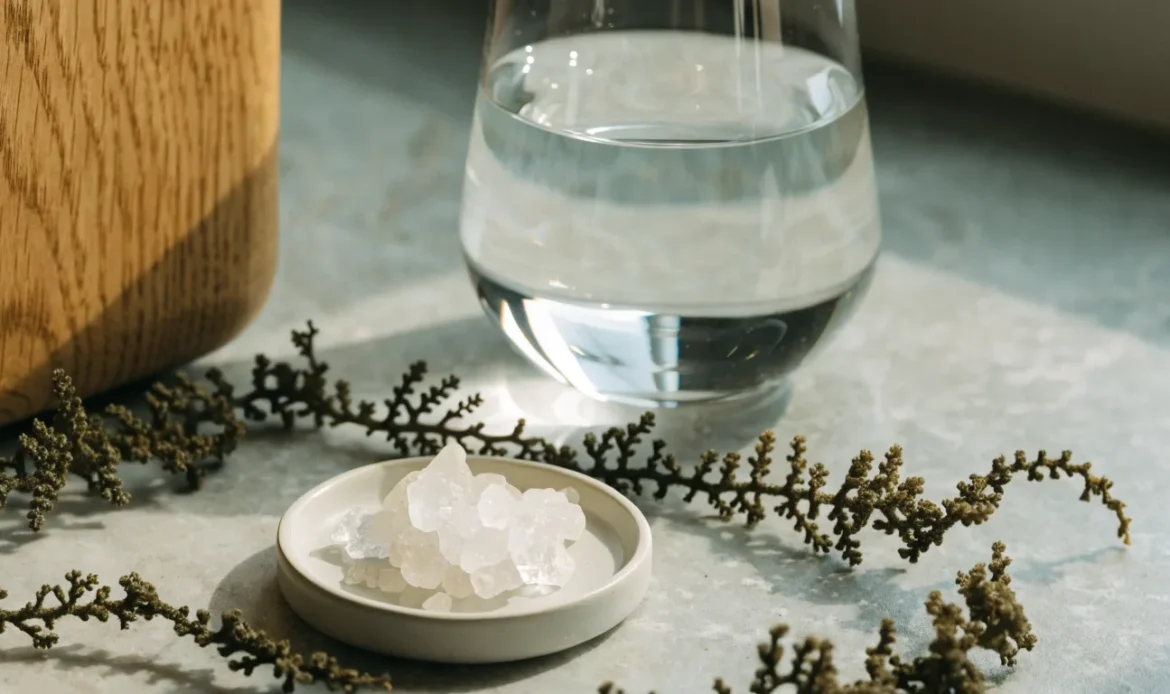
Short answer
Sea moss is often said to contain “up to 92 minerals.” That number is a traditional way to say sea moss holds many mineral types. It is not a precise scientific inventory for every sample. The exact minerals and their amounts depend on species, water, and testing. Read on for what we do know, what to check, and how to choose safer products.
What people mean by “sea moss minerals”
Many sellers and sources say sea moss contains a wide range of minerals. This idea comes from the fact that seaweed in general contains many elements that come from seawater and the plants’ own biology. Sea moss belongs to a group of seaweeds. Seaweeds can hold minerals like iodine, calcium, and iron. They can also contain trace elements such as selenium and zinc [1].
The claim “92 minerals” is a shorthand. It suggests a long list of minerals and trace elements that have been reported in various types of seaweed over time. But no single test on one sample proves that every sea moss batch has exactly 92 minerals. Mineral content changes by species, location, season, and lab methods.
How many minerals does sea moss have?
Short answer: There is no single, fixed number.
- Some sources list many elements found across many seaweed studies. When you add up all elements reported across many species, you can reach high counts.
- A single sample of sea moss will usually show a subset of those elements. Which ones appear and in what level depends on the plant and the water it grew in.
- For reliable answers about a specific product, look for third-party lab tests (often called certificates of analysis) that report the minerals measured in that batch.
What this means for you: Treat “92 minerals” as a general statement about variety, not a lab guarantee for a product.
What minerals are commonly found in sea moss?
Sea moss and other seaweed species commonly contain a range of macro- and trace minerals. Common items reported across the seaweed literature include:
- Iodine — often the most discussed. Seaweed can have a lot of iodine, and levels vary widely [1][2]. Excessive iodine can be a health concern in some people [5].
- Calcium — a common mineral found across many seaweed types.
- Magnesium — found in many seaweeds and related to seawater chemistry.
- Potassium — common in plant tissues.
- Iron — present in varying amounts.
- Zinc — a trace mineral often reported.
- Selenium — a trace element sometimes reported in seaweed.
- Copper and manganese — common trace minerals.
- Phosphorus and sodium — also commonly present.
- Other trace elements — molybdenum, chromium, boron, cobalt and others may be present at low levels depending on species and location.
These names are examples of elements often reported in studies of seaweed. The presence and concentration depend on species and environment [1]. If you need a lab report for a product, the lab will list which elements were tested and the values found.
Why counts vary: species, place, and method
Three main reasons explain the variation in mineral counts and amounts:
- Species differences
- Different seaweed species (and different species called “sea moss”) absorb and store elements in different ways. Some species are known to take up more iodine. Others may store more calcium.
- Environment and season
- Where the plant grows matters. Water chemistry, local pollution, and seasonal growth cycles change mineral content.
- Lab testing methods
- The number of minerals reported depends on what the lab tested for. Some tests focus on a few key minerals. Others use broad screens that can identify many elements. Different instruments have different detection limits.
Because of these three factors, two samples of sea moss from different places or times can have very different mineral profiles.
How laboratories measure minerals
Labs use several common methods to measure minerals in food and supplements. The most common for many elements is ICP-MS (inductively coupled plasma mass spectrometry) or ICP-OES (optical emission spectrometry). These methods can test for many elements at once. A lab report will usually list:
- Which elements were tested.
- The measured amount for each element.
- The method used.
- Detection limits and units.
If you are evaluating a product, ask the seller for the certificate of analysis (COA). A COA should come from a reputable third-party lab. If the seller cannot provide testing details, the product’s mineral profile is uncertain.
Safety notes — iodine and heavy metals
Iodine
- Iodine is a mineral that seaweed often contains in high and variable amounts [2]. Iodine affects the thyroid. Both too little and too much iodine can cause problems in some people [5].
- Public health agencies and scientific reviews recommend caution with seaweed because of iodine variability [3][5]. If you have thyroid disease, are pregnant, or take thyroid medications, talk to a healthcare professional before using seaweed products.
Heavy metals and contaminants
- Seaweed can contain metals or contaminants if it grows in polluted water. Heavy metals include arsenic, cadmium, lead, and mercury. The risk depends on the environment and the species.
- Reliable products test for heavy metals and other contaminants. Ask for third-party lab results that list heavy metal tests and show the values found.
Operation Supplement Safety notes that sea moss sold as dietary supplements may vary and that testing helps identify contents and contaminants [4]. Testing is how buyers can know what is actually in a product.
What are the 92 minerals in sea moss?
Short answer: The “92 minerals” list is not a single standardized list used by science. It is a conventional claim that comes from adding up many elements reported across studies of different seaweeds. The exact elements counted vary between sources.
If you want a practical list, ask for the product’s lab report. A lab will list exactly which elements it measured and their amounts. That concrete data is far more useful than a single broad claim.
How to read a mineral test (COA)
If a seller gives you a certificate of analysis, here’s what to check:
- Lab name and accreditation. Prefer third-party labs with accreditation.
- Date of test and batch number. The COA should match the product batch.
- List of elements tested. Does it include iodine and heavy metals?
- Units and detection limits. Values should use clear units (e.g., mg/kg or µg/g).
- Results and whether they are above safety thresholds for contaminants. A COA often compares results to regulatory limits or guidance. If not, ask the lab or seller what the numbers mean.
- Method used (e.g., ICP-MS). This tells you how the lab measured the elements.
If a seller won’t provide a COA, treat the mineral claims as uncertain.
Formats and mineral availability
Sea moss is sold in many formats. The mineral content per gram may stay similar during gentle processing. But processing can change moisture, concentration, and lab test results. Below are common formats and what to look for:
- Raw/whole dried sea moss
- Often the least-processed. Mineral content reflects the plant as harvested. Ask for batch testing.
- Gel (prepared sea moss)
- Made by soaking and blending sea moss with water. This changes moisture and can dilute or concentrate minerals per serving. Ask for testing on the final gel product.
- Powder
- Dried and milled sea moss. Powder may concentrate minerals if water is removed. Check COA for the powder.
- Capsules or tablets
- May contain extracts or powdered sea moss. Carrier ingredients can change concentration. Ask for COA on the finished product.
Do not assume one format has more or fewer minerals without test results.
Practical decision checklist: What to ask or look for
Use this checklist when choosing a sea moss product. This helps you make a safer, more informed choice.
| Must ask / look for | Why it matters |
|---|---|
| Third-party COA with element list | Shows which minerals and contaminants were measured |
| Batch number and test date | Confirms the test matches the product you are buying |
| Iodine level reported | Iodine can be high and varies widely [2][5] |
| Heavy metals results (arsenic, lead, cadmium, mercury) | Detects environmental contamination |
| Species name and harvest location | Species and place affect mineral profile |
| Processing description (dried, gel, powder) | Processing changes concentration per serving |
| Storage and expiry guidance | Helps preserve product safety and quality |
| Clear ingredient list if in capsules | Confirms product composition and fillers |
Good to see
- Tests for microbes and labelling that matches the COA.
- A return policy or customer support contact for COA questions.
Warning signs
- Vague claims like “contains 92 minerals” without a matched COA.
- No test results or unwillingness to provide them.
- No species or harvest location listed.
How to compare two products
When you have two options, compare their COAs. Use this approach:
- Check whether both COAs were done by accredited labs.
- Compare iodine levels per serving.
- Look at heavy metal values and whether they fall below safety guidance.
- Compare species and harvest locations if available.
- Consider how you will use the product (raw, gel, capsule) and which COA matches that form.
If one product lacks a COA or the COA is older, prefer the product with current, clear testing.
Practical tips for consumers
- If you have thyroid issues or are pregnant, speak with a healthcare provider before using seaweed products because of iodine [2][5].
- Do not assume “natural” means “safe.” Natural seaweed can concentrate elements from water.
- Start with small servings if you decide to try sea moss products and watch for any new symptoms. This is general safety advice, not medical advice.
- Keep records of the product batch and COA in case questions arise later.
Suggested next questions to ask sellers
- Can you provide the COA for the specific batch I will receive?
- What lab performed the test, and when was it done?
- What species is this sea moss? Is it wild-harvested or farmed?
- How was the product processed and stored?
- Are there heavy metal and microbiological tests available for this batch?
If the seller answers clearly and provides documents, you will have a much better basis for choosing.
Useful next guides and links
- Read more about seaweed basics at our learning section: Learn about sea moss.
- If you want product options, see our catalog: Shop sea moss.
- For bulk or business orders, view our wholesale program: Wholesale.
- If you need product documents or have questions, contact us: Contact us.
- Visit our home page for general info: Zen Wholesalers.
Conclusion
Sea moss may contain many minerals. The traditional “92 minerals” claim summarizes that variety. But the exact minerals and their amounts vary by species, place, and processing. For solid answers about a product, ask for a recent third-party lab report that lists which elements were measured and the values found. Pay special attention to iodine and heavy metals. Use the checklist above when you compare sellers. That will give you the clearest, safest information to make your next decision.
Frequently asked questions
Is the “92 minerals” number true?
It’s a common claim. It reflects a long list of elements reported across many seaweed studies. But it is not a guaranteed count for any single product. For a specific answer, request a lab report for that product.
Which mineral in sea moss should I worry about most?
Iodine is the most discussed because seaweed can have very high and variable iodine levels. People with thyroid conditions should be especially cautious and consult a healthcare professional [2][5].
Can lab tests find all minerals?
Labs can test for many elements, but what they report depends on which tests the lab runs. Common methods like ICP-MS test many elements at once. Always check the COA to see what was measured.
Does processing change the minerals in sea moss?
Processing can change concentration per serving by removing or adding water. It can also change serving size. The total elemental content of the dried plant is tied to the original material and processing. Ask for tests on the final product form.
Should I avoid sea moss if I have thyroid disease?
Talk to your healthcare provider. Because of variable iodine content, people with thyroid disease or those taking thyroid medication should get professional advice before using seaweed products [2][5].
Where can I find safe sea moss products?
Look for sellers who provide recent, batch-specific third-party COAs that list iodine and heavy metal tests. Ask questions about species, harvest area, and processing. Use this site’s resources for more learning: Learn about sea moss (/learn/).
References
- Harvard T.H. Chan School of Public Health, “Seaweed.” https://nutritionsource.hsph.harvard.edu/seaweed/
- Smyth PPA. “Iodine, Seaweed, and the Thyroid.” European Thyroid Journal, 2021. https://pmc.ncbi.nlm.nih.gov/articles/PMC8077470/
- Food Standards Australia New Zealand, “Survey of iodine levels in seaweed and seaweed containing products,” updated 2025. https://www.foodstandards.gov.au/science-data/monitoring-safety/surveyofiodinelevels
- Operation Supplement Safety, “Sea Moss in Dietary Supplements.” https://www.opss.org/article/sea-moss-dietary-supplements
- Blikra MJ et al. “Consequences of acute and long-term excessive iodine intake: A literature review focusing on seaweed as a potential dietary iodine source.” 2024. https://doi.org/10.1111/1541-4337.70037