
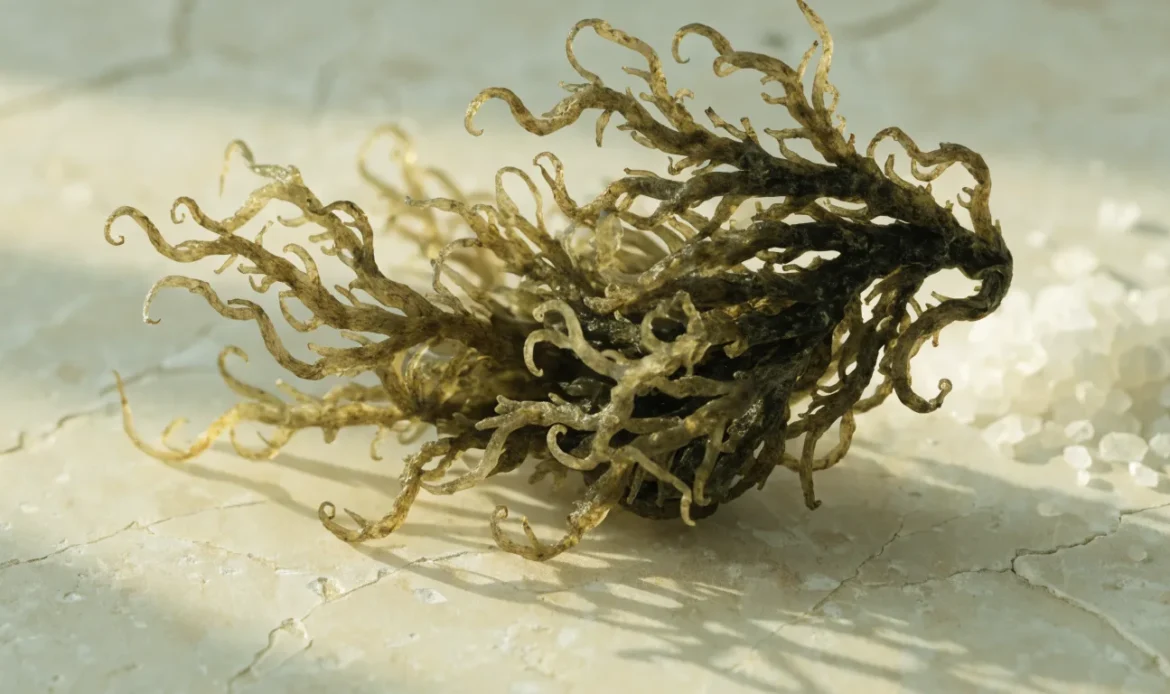
Sea moss is edible seaweed. That is the whole of it, and almost everything else you have read about it is either an elaboration on that fact or a claim that does not survive checking. It grows on rocks and lines in shallow coastal water, it is harvested, dried, and either sold as-is or turned into gel, capsules or powder.
This page is the honest version. It covers what sea moss is, what the evidence actually supports, how the varieties differ, and how to buy it without paying a premium for a story. If you are here because you saw a claim about ninety-two minerals, read the section on that specifically — it is the single most repeated untruth in this category.
What sea moss is, biologically
The name covers several red algae species. The one most often meant is Chondrus crispus, which grows in cold North Atlantic water around Ireland, Britain and the north-east coast of North America. That is the species behind the term Irish moss.
Most sea moss sold today is not Chondrus crispus. It is Eucheuma cottonii (also called Kappaphycus alvarezii), a warm-water species grown across the Caribbean, Indonesia and the Philippines. It is thicker, more branched, and it is what you are almost certainly buying if the packet says the moss came from Saint Lucia, Jamaica or Grenada.
Neither species is a plant in the strict sense. Algae have no roots, stems or leaves, and they absorb what they need directly from seawater across their whole surface. That absorption is the reason sea moss carries minerals at all, and it is also the reason where it grew matters.
The ninety-two minerals claim
You will see it everywhere: sea moss contains 92 of the 102 minerals the human body needs. It is not true, and the arithmetic behind it does not hold.
The human body does not require 102 minerals. Nutrition science recognises roughly 16 to 20 minerals as essential, depending on how you count trace elements. There is no list of 102, so nothing can supply 92 of them.
The claim appears to trace back to a misreading of seawater chemistry — seawater does contain traces of a great many elements, and seaweed absorbs from seawater, so a certain kind of marketing logic concluded that seaweed must contain them all in useful amounts. Presence at a trace level and nutritional usefulness are different things. Detecting an element in parts per billion tells you almost nothing about whether eating it helps you.
Sea moss is genuinely nutritious. It does not need a number attached to it, and the number that got attached is wrong.
What sea moss does contain
The honest nutritional picture is narrower and more interesting than the myth. Sea moss is a reasonable dietary source of:
- Iodine. Genuinely significant, and the main reason to pay attention to dose. Red seaweeds vary widely, and iodine content depends on species and water.
- Soluble fibre, largely as carrageenan, which is what makes it gel when blended.
- Potassium, magnesium and calcium, in amounts comparable to other vegetables rather than to a supplement.
- Small amounts of iron and zinc, again at food levels.
What it is not is a concentrated source of protein, of vitamin B12 in a form humans reliably absorb, or of anything that would justify treating it as a replacement for a varied diet.
Iodine is the reason to be careful
This is the part most articles skip. Iodine is essential, and both too little and too much cause thyroid problems. Seaweed is one of the very few foods that can push you over an upper limit if you are enthusiastic about it.
Iodine content in sea moss varies enormously between batches and species — published figures for red seaweeds range across more than an order of magnitude. That variability is precisely why a daily habit of large quantities is worth thinking about, and why anyone with a thyroid condition or on thyroid medication should talk to their doctor before starting. We cover this properly in sea moss side effects.
Gold, purple, green: what the colours mean
Colour comes from the species and the growing conditions, not from processing. None of ours is dyed or bleached.
- Gold is the most common. Mild in taste and smell, with a near-neutral gel. It is gold because sun-drying bleaches the natural pigment.
- Purple keeps more of its anthocyanin pigment — the same compound family that colours blackcurrants. It makes a thicker, more strongly coloured gel.
- Green is less common and has a fresher, more marine flavour.
- Mixed full-spectrum is simply unsorted harvest, which is why it costs less.
There is no good evidence that one colour is meaningfully more nutritious than another. Choose on taste, gel colour and what suits the product you are making. If you want the detail, see Caribbean sea moss varieties.
Wildcrafted, pool-grown and why it changes your cost
Sea moss is either harvested from open water or cultivated in tanks and enclosures where salt is sometimes added to imitate seawater. Pool-grown is cheaper per pound and tends to be saltier, less mineral-dense and less consistent in how much it expands when soaked.
That last point is the practical one. If a pound of wildcrafted expands further, it makes more gel, and the cheaper pound can cost you more per finished jar. If you are buying in volume this is the calculation that matters — wildcrafted vs pool-grown works through it.
How to buy it without being sold a myth
- Ask for the species and the origin. A supplier who will not name either has told you something.
- Ignore mineral counts. Any number in the nineties is a marketing artefact.
- Look for a Certificate of Analysis, especially for heavy metals. Seaweed absorbs what is in the water, including what you would rather it did not.
- Judge dried moss by smell. It should smell faintly of the sea. A heavy salt crust usually means pool-grown or under-rinsed.
- Be suspicious of health claims. Anything presented as a treatment for a named condition is being sold illegally in most markets.
Where it comes from and how it is processed
Understanding the supply chain explains most of the quality differences you will encounter. Sea moss is either cut from wild growth on rocks and reef, or grown on lines and ropes suspended in open coastal water. Both count as wildcrafted when the water is real ocean; the distinction that matters is open water versus an enclosed tank.
After cutting, it is rinsed and laid out to dry in the sun. Sun-drying is what turns naturally dark moss pale gold — the pigment bleaches out. It is then cleaned, usually more than once, to remove sand, shell fragments and salt crust, and packed dry for shipping. Dried properly, it is stable for a long time; dried badly, it holds moisture and spoils.
Every step in that chain is somewhere a corner can be cut. Under-drying adds weight you pay for. Skipping a cleaning phase leaves grit your customers find. Bleaching with chemicals rather than sun produces an unnaturally uniform colour. You can see our own process on our farm in Saint Lucia.
A long history that predates the marketing
Sea moss is not a new discovery. Chondrus crispus has been eaten in Ireland for centuries, boiled with milk into a thickened drink and used as a folk remedy during and after the Famine. The same gelling property made carrageenan — extracted from red seaweeds — an industrial food ingredient from the mid-twentieth century onward, and it is still in ice cream, plant milks and processed meats today.
In the Caribbean, sea moss drinks blended with milk, cinnamon, nutmeg and sweetener are an everyday item, not a wellness trend. That tradition is genuinely old, and it is a better argument for sea moss than any mineral count.
Sea moss compared with other seaweeds
It helps to know where sea moss sits among edible seaweeds, because the differences are real:
- Kelp and kombu are brown algae and contain dramatically more iodine — often ten to a hundred times more per gram. If iodine is your concern, kelp is the bigger risk.
- Nori, the sheet seaweed used for sushi, is a red alga like sea moss but much lower in iodine and higher in protein by dry weight.
- Bladderwrack, frequently sold alongside sea moss, is a brown alga with its own high iodine load. Taking both daily compounds the same concern.
- Sea moss sits in the middle: meaningful iodine, high soluble fibre, mild flavour, and a gelling ability the others lack.
That gelling ability is the practical reason sea moss became the popular one. Nothing else in the group turns into a neutral-tasting gel you can hide in a smoothie.
Who should be cautious
Most people can eat sea moss without issue. A few should be more careful, and this is worth saying plainly rather than burying:
- Anyone with a thyroid condition, or taking thyroid medication, because of the iodine. Speak to your doctor first.
- People who are pregnant or breastfeeding, where iodine requirements change and upper limits still apply.
- Anyone already taking a kelp, bladderwrack or iodine supplement — the totals add up.
- People on blood thinners, since seaweeds contribute vitamin K.
None of that makes sea moss dangerous. It makes it a food with an active nutrient in it, which is a normal thing for a food to be.
What it should cost
Dried sea moss is sold by weight, and weight is where the confusion starts. A pound of well-dried moss expands substantially when soaked — commonly several times its dry volume — so a pound goes considerably further than people expect. Gel sold ready-made is mostly water by weight, which is why it looks cheaper per jar and is not.
If you are comparing suppliers seriously, convert everything to cost per finished jar of gel rather than cost per pound of raw material. That single calculation removes most of the noise from the market.
How people actually use it
Most people soak dried sea moss, blend it with water and keep the resulting gel in the fridge, adding a spoonful to smoothies, soups or oats. The gel is flavour-neutral enough to disappear into most things. If you want the method, how to make sea moss gel covers it step by step, and how long sea moss gel lasts answers the question everyone asks next.
If you want the gel specifically, sea moss gel benefits covers what that form does and does not change. Capsules and powder exist mainly for convenience. They are the same seaweed, dried and milled, and they carry the same iodine considerations as the gel.
The honest summary
Sea moss is a nutrient-dense sea vegetable with a long history of use in Caribbean and Irish cooking, a genuinely useful fibre and mineral profile, and one nutrient — iodine — that deserves respect. It is not a cure, it does not contain 92 minerals, and no reputable seller should tell you otherwise.
That is a good enough reason to eat it. It does not need the rest.