
“Irish sea moss” is one of the most misleading phrases in this market. Almost none of the product sold under that name is Irish, and a good deal of it is not the species the name refers to. That is not always dishonesty — the term has drifted — but it does mean you should know what you are actually buying.
What Irish moss properly means
Irish moss is Chondrus crispus, a red alga native to cold North Atlantic waters around Ireland, Britain, Brittany and the north-east coast of North America. It is a flat, fan-shaped seaweed, typically a few inches across, that grows on rocks in the intertidal zone.
It has been eaten in Ireland for centuries — boiled with milk into a thickened drink, and used as a household remedy for coughs and sore throats. It is also the original commercial source of carrageenan, the gelling agent still used across the food industry.
What is usually sold instead
The overwhelming majority of sea moss on the market is Eucheuma cottonii, also classified as Kappaphycus alvarezii. It is a warm-water species farmed on lines across the Caribbean, Indonesia, the Philippines and East Africa.
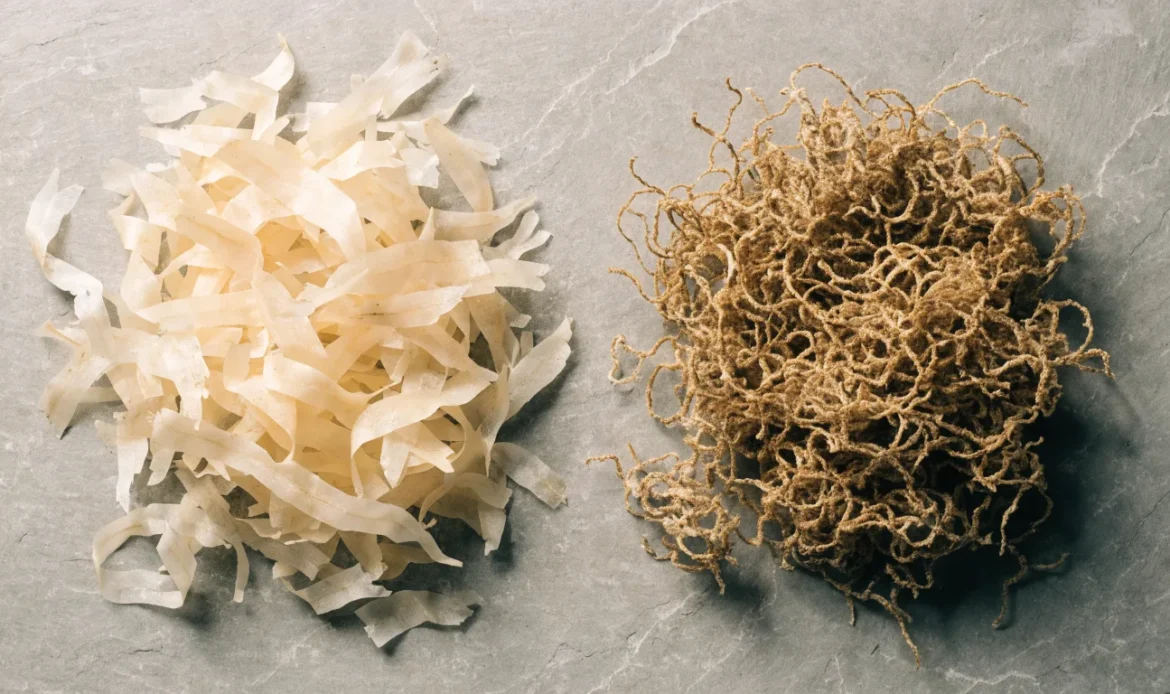
It looks different: thicker, rounder, heavily branched, more like a bundle of fingers than a flat fan. Ours from Saint Lucia is this species. We call it sea moss rather than Irish moss for exactly that reason.
- Chondrus crispus — cold Atlantic, flat and fan-shaped, darker purple-red when fresh, smaller.
- Eucheuma cottonii — warm Caribbean and Indo-Pacific, thick and branched, gold, purple or green, larger.
Does the species change the nutrition?
Less than the marketing implies. Both are red algae, both are high in soluble fibre and carrageenan, both carry iodine and minerals absorbed from seawater. Published composition figures overlap substantially, and within-species variation between batches and locations is often larger than the difference between species.
Where they differ practically is texture and yield. Eucheuma is thicker and generally expands more when soaked, which is one reason it dominates commercial supply. Chondrus produces a firmer, more strongly setting gel, which is why traditional Irish recipes rely on it.
Why the naming got muddled
Two reasons. First, carrageenan’s commercial history began with Irish moss, so “Irish moss” became a generic trade term for carrageenan-bearing seaweed regardless of species. Second, in the wellness market the word Irish reads as heritage and authenticity, and heritage sells.
The result is that “Irish sea moss” now usually means “sea moss” with a decorative adjective. If the listing also says it is from Saint Lucia or Jamaica, the two halves of the description contradict each other.
If a product is described as Irish sea moss from the Caribbean, one of those two words is doing marketing rather than describing.
Which should you buy?
For most uses, the warm-water species is the sensible choice: it is more available, expands further per pound, and makes a milder, more neutral gel that disappears into food. Genuine Chondrus crispus is worth seeking out if you specifically want the traditional Irish moss drink or a firmer set, and you should expect to pay more for it.
What matters more than species is the same short list that always matters — real ocean growth rather than tanks, honest origin, proper drying, and lab testing. Wildcrafted versus pool-grown makes more difference to your result than Chondrus versus Eucheuma.
How to check what you have
- Look at the shape. Flat fans are Chondrus. Thick branched fingers are Eucheuma.
- Read the origin. Ireland, Maine or Nova Scotia suggests Chondrus. Caribbean or South-East Asia means Eucheuma.
- Ask the seller for the species name. A supplier who knows their product can answer in one word.
Once you know which you have, the main sea moss guide covers what to expect from it, and Caribbean sea moss varieties explains what the colours mean.