
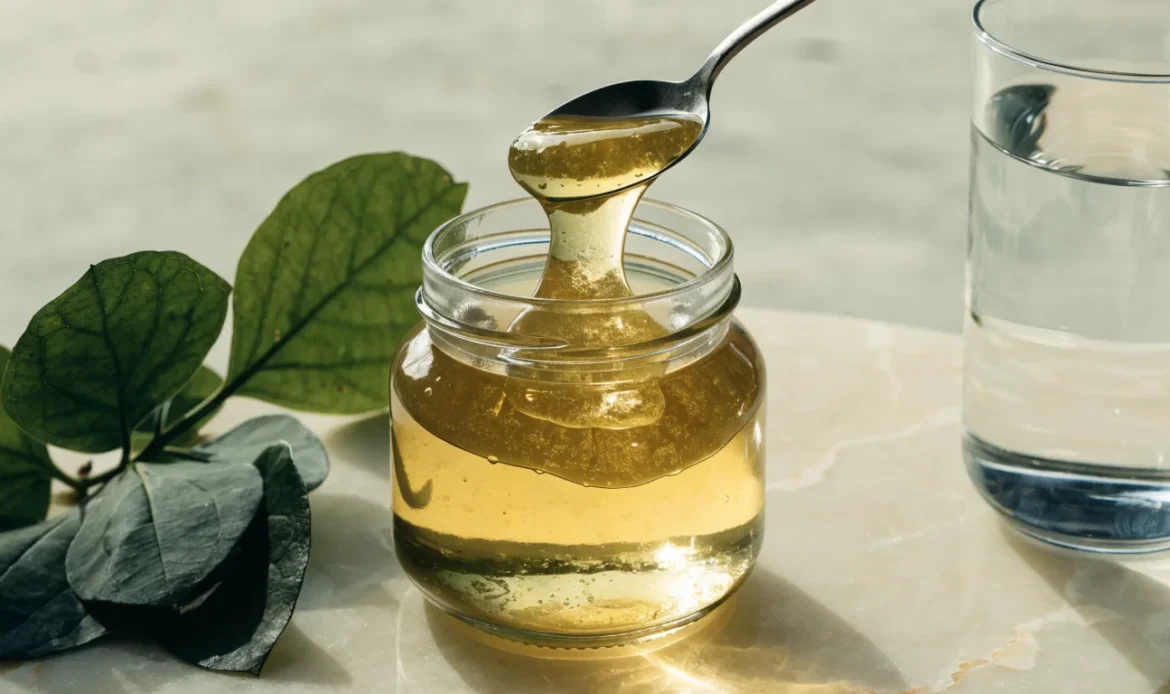
Sea moss gel is the same seaweed as dried sea moss, soaked and blended with water. That is worth stating plainly at the top, because a great deal of writing about gel implies the form itself does something. It does not. The gel and the dried moss it came from have the same nutrition.
What the gel form genuinely changes is how much of it you eat, how easily, and how consistently — and those turn out to matter more than they sound.
What the gel form actually changes
- Portioning. A spoonful of gel is a repeatable amount. A handful of dried moss is not, and iodine varies enough that consistency is worth something.
- Absence of prep. No soaking, no blending, no planning a day ahead. Most people who quit sea moss quit at the soaking step.
- It disappears into food. Neutral gel stirs into smoothies, oats, soups and sauces without announcing itself. Dried moss does not.
- Hydration. Gel is mostly water, which is trivially true and occasionally useful if you are otherwise poor at drinking.
None of that is a nutritional benefit. All of it is an adherence benefit, and adherence is the thing that decides whether any dietary change does anything at all.
The nutrition, honestly
Because gel is diluted with water, it is less nutrient-dense by weight than the dried moss. A tablespoon of gel contains rather less of everything than a tablespoon of dried moss would. That is not a flaw — it is what makes the portion manageable — but it does mean gel is not a concentrated supplement.
What you get, at food levels, is soluble fibre, iodine, and modest amounts of potassium, magnesium and calcium. The full picture and the claims that do not hold up are in sea moss benefits.
Digestion: the most defensible claim
The gel is largely carrageenan, a soluble fibre. Soluble fibre slows gastric emptying, feeds gut bacteria and adds bulk — effects that are well established for soluble fibre in general and that sea moss has no reason to be exempt from.
People often describe the gel as “soothing”. That is plausible as a texture effect rather than a pharmacological one: a viscous gel coats, and coating feels soothing. Expect it to behave like oats or psyllium, not like a medication.
Iodine still counts, and gel makes it easier to overdo
This is the caution that belongs on any page about gel specifically. Because gel is pleasant and easy, it is far easier to eat a lot of it than to eat a lot of dried moss. The iodine comes along with it.
Most authorities put the adult tolerable upper limit near 1,100 micrograms of iodine per day, and seaweed can approach or exceed that in a generous serving. One to two tablespoons daily is the sensible convention. sea moss side effects covers who should be more careful.
Gel versus capsules versus powder
- Gel — easiest to eat regularly, mildest flavour, needs refrigeration, shortest shelf life.
- Capsules — most convenient and most portable, no taste, but you are swallowing a small amount of dried material and it is easy to take more than you would eat.
- Powder — most flexible for baking and smoothies, long shelf life, but the flavour is more assertive than gel.
- Dried moss — cheapest per serving by a wide margin, and the only option that lets you control the gel’s thickness yourself.
There is no nutritional hierarchy here. Choose on what you will actually keep doing.
How to use it
A tablespoon into a smoothie is the default and the reason most people buy it. It also stirs into porridge, thickens soups and sauces without flour, and can replace some of the fat in baking. It does not need to be eaten off a spoon, and it is not more effective that way.
Buying gel versus making it
Ready-made gel is mostly water by weight, so you are paying to ship water and to refrigerate someone else’s labour. Making it yourself from dried moss is dramatically cheaper per serving and takes about ten minutes of active work spread over a day of soaking — how to make sea moss gel has the method.
Buying it made is entirely reasonable if you know you will not do the soaking. Gel you actually eat beats dried moss in a cupboard.
How long it keeps
Plain homemade gel keeps three to four weeks refrigerated and several months frozen. Anything fresh blended in — fruit, ginger, juice — cuts that to one or two weeks. how long sea moss gel lasts covers the details and the spoilage signs worth trusting.