

Short answer: Irish moss and sea moss are labels people use in different ways. Irish moss often means one type of red algae. Sea moss is a broader name for several red algae. Their nutrient content overlaps. Which is “better” depends on the species, where it grew, how it was processed, and what you want to use it for.
This article explains what each name usually means. It shows what the science can and cannot prove. It gives a simple checklist you can use when you buy seaweed products. It also lists safety concerns and when to talk with a clinician.
What people mean by “Irish moss” and “sea moss”
- “Irish moss” is commonly used to name a single red algae species in many food and herbal traditions. But labels are not always precise.
- “Sea moss” is a broader, everyday term. Sellers and communities use it for several types of red algae.
- Names, colors, and trade labels vary by region and seller. That means the same name can refer to different species or mixes.
Why this matters: two products labeled the same may have different minerals, textures, or flavors. That makes it hard to say one label always has a certain set of benefits.
What the evidence shows about nutrients and benefits
Short version: seaweeds can be nutritious, but their composition varies a lot. Early research and traditional use suggest possible food value. Clinical proof for specific health effects from sea moss is limited.
- Seaweeds are a source of minerals, fiber-like carbohydrates, and small amounts of protein. They can provide micronutrients that are not common in land plants. [1]
- Iodine is one mineral that often appears in seaweeds. Levels can be high in some species. Too much iodine can affect thyroid function. The amount of iodine in seaweed products varies by species and harvest location. [1][2]
- Some lab and animal studies look at individual compounds in seaweeds. These studies are useful for early research. But lab results do not equal proven benefits in people. We have few high-quality clinical trials on sea moss as commonly sold. That means clear medical claims are not supported by strong human evidence. [1]
What this means for claims about “benefits”:
- Food composition is factual: seaweed contains minerals and other compounds. [1]
- Early research may suggest possible effects for certain compounds. Those are preliminary.
- Traditional use is a type of evidence about cultural practices. It does not prove a specific health outcome.
- Clinical proof for sea moss supplements in people is limited or lacking.
Use this distinction when you read product pages or news reports. If a seller claims a product cures or treats conditions, ask what human trials support that claim.
(References: general nutrition and variability of seaweed composition) [1]
Iodine and safety — what to watch for
Iodine is a key safety topic with seaweed products.
- Iodine helps the thyroid work normally. Both too little and too much iodine can cause thyroid problems. [2]
- Some seaweeds contain very high iodine levels. Iodine concentration depends on seaweed type, where it grew, and how it was processed. [2][5]
- Surveys show iodine in seaweed products can vary widely. Testing of products often finds that iodine levels are inconsistent across samples. [3]
What to check for with iodine:
- Ask the seller if they test iodine on finished products.
- If a product lists lab tests or a certificate of analysis (COA), review the iodine result. But remember a COA from a batch is only for that batch. It does not guarantee all batches are the same. [4]
(References for iodine risk and variability) [2][3][5]
Supplements, standards, and what testing matters
Many sea moss items are sold as foods, gels, or dietary supplements. Rules and oversight differ by country and product type.
- Dietary supplements are less tightly regulated than prescription medicines in many places. This can lead to variability in content and testing. [4]
- Key tests you can ask about: iodine, heavy metals (like arsenic and lead), microbiological safety (bacteria and molds), and pesticide residues where relevant. Labs that issue COAs should be accredited. [4]
What testing cannot prove:
- A COA from one batch cannot prove every batch is identical.
- Testing cannot fully rule out environmental contamination that may occur after harvest or during storage.
(Reference: supplement oversight and testing concerns) [4]
Common differences people notice between types (summary)
Below is a practical comparison to help you understand common differences that matter for buyers. These are general patterns, not hard rules. Labels and products vary.
| Feature | “Irish moss” (label) | “Sea moss” (general label) | Why it matters |
|---|---|---|---|
| Typical usage in recipes | Often used for gels and traditional puddings | Used for gels, smoothies, and cooking | Texture and gel strength can vary |
| Species variability | Often refers to a narrower set of red algae in some markets | May refer to several red algae species or mixes | Nutrient and iodine levels differ by species |
| Color and texture | May be more consistent in some product lines | Color and texture can vary widely | Affects culinary use and appearance |
| Likely iodine variability | Variable — depends on species and processing | Often variable | Safety check needed for both |
| Testing frequency (by sellers) | Varies | Varies | Ask for COA and harvest info |
Notes: This table is a guide. Do not assume a label guarantees a specific nutrient level or safety profile.
Sourcing and origin: what to ask and what to verify
Sourcing matters. But provenance labels alone are not proof. Ask specific questions and look for documents.
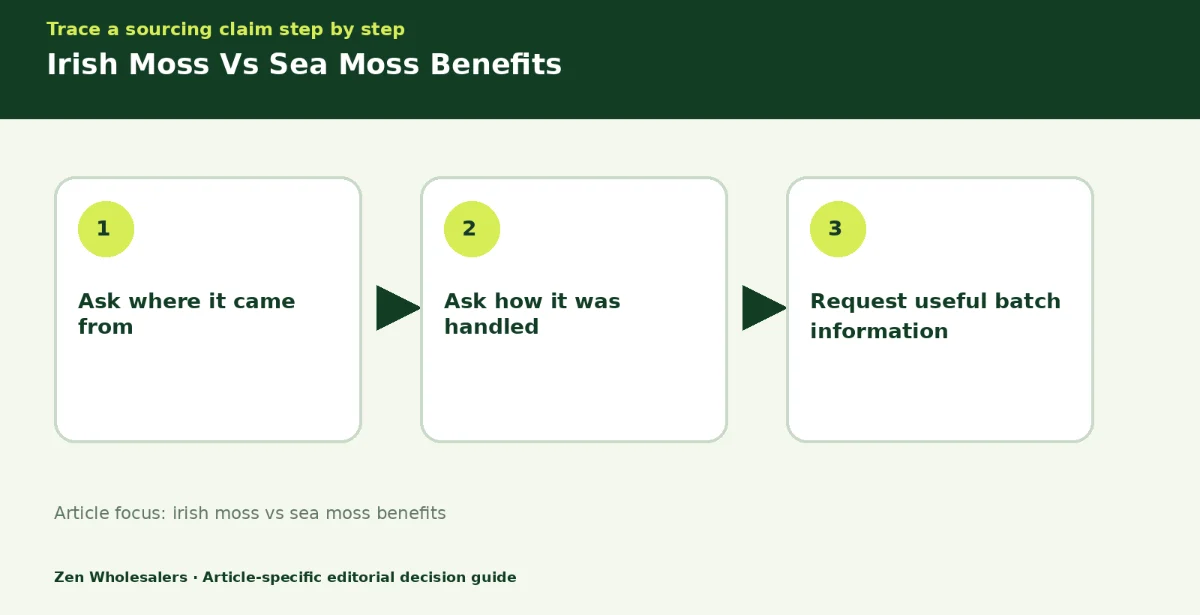
Use this checklist when you talk with a supplier or seller:
- Which species is this product? (Scientific name helps reduce confusion.)
- Where and when was it harvested? (Season and general area; exact GPS claims are rare.)
- How was it harvested? (Wild-harvest vs. farmed vs. grown on ropes—each has different risk profiles.)
- How was it processed? (Sun-dried, kiln-dried, steamed, or cold-processed can affect quality.)
- Do you test finished batches? Can I see a recent COA? Which lab did the testing?
- What tests are on the COA? (Look for iodine, heavy metals, and microbiology.)
- Do you have a lot code or batch identifier for traceability?
- What are the storage and shelf-life conditions? How should I store it at home?
- Is the product sold as a food or a dietary supplement? The rules differ. [4]
Explain why you ask: answers help you judge product consistency and safety. A seller that cannot answer basic questions may still have a good product. But transparent answers and documentation are stronger evidence of care.
A practical decision guide: choose by need
This short guide helps you pick the right product for common goals. It avoids health claims. Use it with the sourcing checklist above.
- If you want a culinary ingredient for thickening or texture:
- Look for products labeled for cooking or gel-making.
- Check processing: some drying methods preserve gel-forming polysaccharides better.
- Ask how it behaves in recipes; a small test batch at home can show texture.
- If you want a general food source of minerals and fibers:
- Choose products with a COA showing basic minerals and low contaminants.
- Prefer sellers who can identify species and processing.
- If you need low iodine:
- Ask for iodine test results on the COA. Some species and products have lower iodine than others. [2][3]
- If iodine result is not available, consider smaller amounts and consult a clinician if you have thyroid issues.
- If you plan to resell or use at scale:
- Ask about batch variability, supply consistency, and a supplier’s quality-control process.
- Consider independent lab testing for each supplier batch.
This guide is for sourcing and selecting. It is not medical advice.
Practical checklist: quick buying questions to use now
- What is the scientific name or species?
- Is this wild or farmed? When was it harvested?
- How was it processed and dried?
- Do you have a COA for heavy metals, microbiology, and iodine? Which lab?
- What is the lot number or batch code?
- How should I store this product? What is the shelf life?
- Do you sell sample sizes for testing in my recipes?
- Is this product sold as food or a dietary supplement? [4]
Keep this checklist on your phone when shopping or contacting sellers.
Forms and uses: how people typically use each product
Sea moss and similar seaweeds appear in these common forms:
- Raw dried seaweed. You rehydrate it before use.
- Gel or blended product sold ready to add to drinks or recipes.
- Powder or capsules sold as dietary supplements. Note: processing can change texture and compounds. [4]
- Culinary preparations in soups, stews, and desserts in some cuisines.
Each form has pros and cons. Gels are convenient but may include added water or preservatives. Powders and capsules concentrate material but may concentrate iodine or contaminants if testing is not adequate.
Safety and when to ask a clinician
Evidence is limited. Here are clear safety steps.
- If you have thyroid disease, are pregnant, or are breastfeeding, talk with your clinician before adding seaweed products to your diet. Iodine can affect thyroid health. [2][5]
- If you take medications that interact with thyroid function or require steady iodine intake, get medical advice. [2]
- If a product lacks testing or the seller cannot show a recent COA, consider choosing another product or ask an independent lab to test a sample. [4]
- If you notice unusual symptoms after starting a product (such as new heart palpitations, fatigue, or skin changes), stop use and seek medical advice.
What clinicians might ask you:
- How much and how often are you taking it?
- Do you have pre-existing thyroid disease or other medical conditions?
- Are you pregnant or breastfeeding?
- Are you taking medicines that affect thyroid hormones?
Safety sources: iodine risk analyses and supplement oversight [2][4][5]
Conclusion
Irish moss and sea moss are useful food names, but they are not single, consistent products. Nutrient content and safety depend on species, where it grew, and how it was processed and tested. The scientific evidence on specific health effects in people is still limited. If you plan to buy or use these products, use the sourcing checklist above. Ask for clear testing for iodine and contaminants. Talk with a clinician if you have thyroid issues, are pregnant, or take medications that might interact.
If you want to learn more about sea moss uses and sourcing, see our learn pages: Learn more about sea moss (/learn/). To browse product forms and samples, visit our shop: Shop sea moss products (/shop/). If you are interested in larger quantities, see our wholesale options: Wholesale inquiries (/wholesale/). For any questions or sourcing details, contact us: Contact Zen Wholesalers (/contact/). Return to our homepage for company info: Zen Wholesalers (/).
Frequently asked questions
Are Irish moss and sea moss the same thing?
Not always. “Irish moss” often names a narrower set of red algae in popular use. “Sea moss” is a broader term. Labels differ by region and seller, so the same name can mean different species.
Can sea moss provide important minerals?
Seaweed can be a source of minerals, including iodine. Mineral amounts vary a lot by species, location, and processing. Look for testing data on a product. [1]
Is it safe to take sea moss every day?
Safety depends on the product’s iodine and contaminant levels and your personal health. Because iodine levels can be high, daily use should be discussed with a clinician if you have thyroid issues, are pregnant, or are on certain medications. [2][5]
How can I check if a sea moss product is tested?
Ask the seller for a certificate of analysis (COA). Check which lab did the testing and what tests were run (iodine, heavy metals, microbiology). A COA shows results for the tested batch. [4]
Do processing methods change the benefits?
Processing can change texture and possibly some compounds. For example, drying method can alter gel strength and shelf stability. Processing may also affect levels of volatile components. Ask sellers about their methods.
Are there risks of heavy metals or microbes?
Seaweeds can accumulate environmental contaminants including some heavy metals. Microbial contamination is possible if products are not dried or stored properly. Good testing and handling practices reduce these risks. [1][4]
References
- Harvard T.H. Chan School of Public Health, “Seaweed.” https://nutritionsource.hsph.harvard.edu/seaweed/
- Smyth PPA. “Iodine, Seaweed, and the Thyroid.” European Thyroid Journal, 2021. https://pmc.ncbi.nlm.nih.gov/articles/PMC8077470/
- Food Standards Australia New Zealand, “Survey of iodine levels in seaweed and seaweed containing products,” updated 2025. https://www.foodstandards.gov.au/science-data/monitoring-safety/surveyofiodinelevels
- Operation Supplement Safety, “Sea Moss in Dietary Supplements.” https://www.opss.org/article/sea-moss-dietary-supplements
- Blikra MJ et al. “Consequences of acute and long-term excessive iodine intake: A literature review focusing on seaweed as a potential dietary iodine source.” 2024. https://doi.org/10.1111/1541-4337.70037