
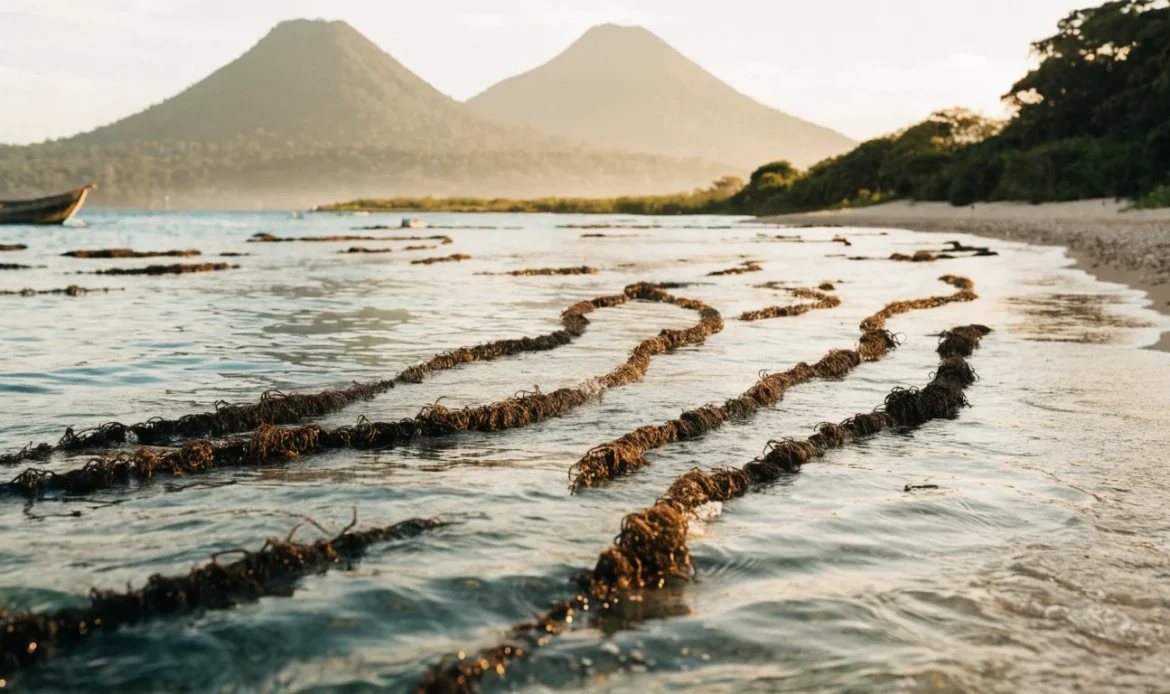
Short answer: “Sea moss” and “Irish moss” are common names that can point to different algae. In many stores, “Irish moss” usually means Chondrus crispus, a red seaweed from colder waters. “Sea moss” often refers to several types of red algae, especially Gracilaria species used in the Caribbean. Names overlap. The best way to know what you have is to check the scientific name, harvest notes, and lab tests.
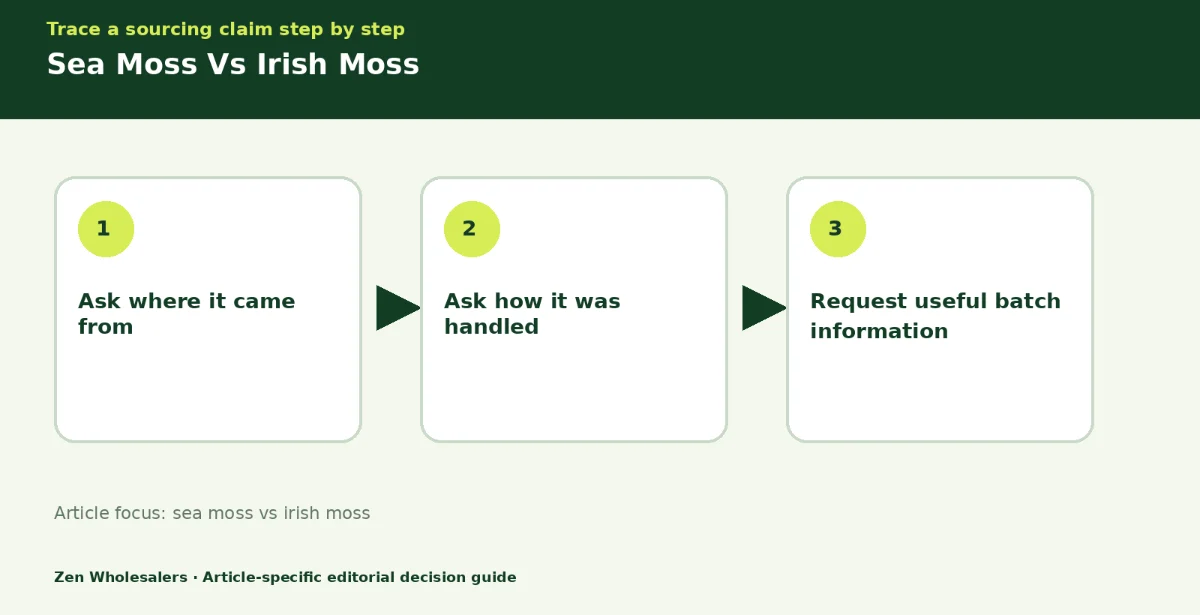
This guide explains the main differences you can check, and what you cannot prove from a label. It helps you ask the right sourcing questions when you buy seaweed products.
Why the name matters
Common names change by place and seller. A single name like “sea moss” can include more than one species. That matters because:
- Different species look and feel different.
- Different species can be processed in different ways.
- Iodine and other trace elements can vary by species and by where the seaweed grew.
You can often learn the most by finding the Latin name (for example, Chondrus crispus). If a product only says “sea moss” with no further info, you will need to ask the seller for more details.
Species and science: what those names mean
H3: Irish moss (Chondrus crispus)
- This is a red algae species commonly called Irish moss in many Atlantic, colder-water sources.
- It has a branched, fan-like shape when fresh. When dried, it can look brittle and darker.
- It has a long history of use in food and industry as a gelling agent (carrageenan comes from some red algae, though not all red algae are used the same way).
- A product labeled “Irish moss” that includes the scientific name gives you clearer information than one that does not.
H3: Sea moss (often Gracilaria or mixed red algae)
- Many suppliers use “sea moss” to mean Gracilaria species, especially for Caribbean-style sea moss sold for gels and supplements.
- Gracilaria tends to have smoother, stringier fronds and can dry into lighter colors.
- In practice, “sea moss” is a broader catch-all. Sellers may include a mix of species under that label.
H3: Why a Latin name helps
- Latin names (genus and species) reduce confusion. They tell you exactly what kind of algae was used.
- If a product does not list a Latin name, ask for it.
Note: Scientific names and species lists can change with research. Always accept some uncertainty unless a product provides good documentation.
Appearance, texture, and common uses
You can learn a lot from sight and feel. These are general patterns, not rules.
- Color: Dried seaweed colors range from light brown or gold to deep purple or dark brown. Color can change based on drying method, sunlight exposure, and age.
- Shape and texture: Some species dry into wiry strands. Others form flat, leaf-like pieces.
- Smell: Fresh-smelling seaweed has a marine scent. A strong off-odor or rotten smell is a red flag for spoilage or poor processing.
Common uses:
- Traditional food uses (soups, jellies, thickeners).
- Homemade gels or blended preparations.
- Ingredient in supplements and topical products.
What you can check:
- Photos of the product at harvest and after drying.
- A description of processing (sun-dried vs. oven-dried vs. freeze-dried).
- How the product is packaged and stored.
What you cannot tell by sight alone:
- Exact species unless the seller tells you.
- Iodine level or heavy metal levels without lab tests.
Where they grow and sourcing language
Both “Irish moss” and “sea moss” refer to seaweeds that grow in different parts of the world. Sellers may use regional names to market products. Buyer checks you can do:
- Ask for the harvest location. A harvest location gives context, but it is not proof of species identity without additional info.
- Ask whether the product is wild-harvested or farmed. Farming practices and wild collection carry different sustainability and contamination concerns.
- Ask for photos from harvest time. Clear pictures of the fresh seaweed tied to a location and date help verify sourcing claims.
What labels can’t fully prove:
- Whether harvesters followed local rules or used clean methods.
- The exact environmental conditions (pollution, currents) that affected the seaweed.
Safety and testing: iodine and contaminants
Seaweeds concentrate minerals from seawater. That includes iodine and trace elements. Iodine can be useful in small amounts, and it can be excessive in large amounts. You should treat seaweed products like any concentrated food ingredient: know what you are buying.
What the research shows (short, plain points supported by sources):
- Seaweed iodine content varies a lot by species and location. Do not assume all seaweeds have the same iodine. [1][2]
- Surveys show some seaweed products and foods made with seaweed have high iodine. Testing by food authorities can find that levels range from low to high in different products. [3]
- Excessive iodine intake can have consequences for thyroid health in some people. This is a medical area; ask a clinician if you have concerns. [5]
- Sea moss sold as a dietary supplement sometimes lacks consistent labeling. Quality concerns have been raised by consumer-safety groups. Ask for lab reports. [4]
What to ask sellers for:
- Recent third-party lab testing (heavy metals, arsenic, lead, cadmium, and iodine content). A lab report should have sample ID and date.
- Certificates of analysis (COA) tied to a specific lot number or batch.
- Testing that covers the final form you will use (dried seaweed vs. gel vs. powder), since processing can concentrate or change levels.
If a seller cannot or will not share lab test results for batches, treat that as a red flag for concentrated products.
Processing: dried, powdered, or gel? How it changes the product
Processing affects color, texture, and sometimes concentration.
- Dried whole seaweed: Often sold in bags. Easier to store and inspect. You can rehydrate it.
- Powdered seaweed: Ground into a powder. This form can mix into foods easily, but you lose visibility on what the product looked like whole. Powders can concentrate minerals.
- Gel: Sea moss prepared into a gel is common in home use. Gel often combines the seaweed with water and heat. If a gel came from a lot of seaweed, the concentration of minerals depends on how much seaweed was used and how it was processed.
Ask:
- Which form was tested in the lab report?
- Was any additional ingredient added to the product?
Processing questions sellers should answer:
- Drying method and temperature.
- How long since harvest.
- Storage conditions (cool, dry, sealed).
Practical checklist: What to ask or check before you buy
Use this checklist when you shop. If you are buying from a store or online seller, ask for these details. If a seller provides them, you will have better information to decide.
| Check item | Why it matters | Acceptable evidence |
|---|---|---|
| Scientific name (genus & species) | Confirms the exact kind of seaweed | Product label or seller statement with Latin name |
| Harvest location & date | Helps assess environment and season | Harvest region + approximate date on product page or seller note |
| Wild-harvested or farmed | Different environmental and trace element risks | Clear statement on label or seller info |
| Processing method | Affects color, texture, and concentration | Description of drying, powdering, or gel prep |
| Lot-numbered third-party lab tests | Shows measured iodine/heavy metals for that batch | Certificate of Analysis (COA) with lab name and date |
| Photos of raw and processed product | Helps verify condition and type | Harvest photos and product photos tied to batch |
| Storage and packaging details | Affects shelf life and quality | Packaging type and storage temp recommendations |
| Return policy and contact info | Consumer protection | Clear return/refund policy and reachable contact |
If a seller cannot supply at least the scientific name and a recent lab test for products intended as supplements, consider looking elsewhere.
A short decision guide: Which one might fit your use?
- You want to make a traditional gel or home food recipe and prefer a stringy texture: Ask about Gracilaria-type sea moss and for photos of the prepared gel.
- You want a leafier, more robust seaweed for culinary thickening: Ask if the product is Chondrus crispus or another carrageenophyte and request species info.
- You need low risk of high iodine or heavy metals: Request recent lab results for the final product and check the COA.
- You are buying for topical use: Ask about any additives and for processing details. Some dried seaweed is treated or blended with other botanicals.
These are practical choices. They do not predict safety or health benefits. Lab tests and clear sourcing info matter most.
Red flags to watch for
- No scientific name or harvest details.
- No lot-specific lab testing for products sold as supplements or concentrated forms.
- Vague claims like “wildcrafted from the purest waters” without support. Ask for proof.
- Strong off odors or visible mold on dried product.
- Sellers who refuse to answer questions about processing or testing.
How to verify lab reports and COAs
A Certificate of Analysis should show:
- The lab name and contact.
- Date of testing.
- A batch or lot number matching your purchase.
- Tests run (iodine, arsenic, lead, cadmium, mercury, microbial tests if relevant).
- Units used (mg/kg, ppm) and acceptance criteria.
If the COA looks generic, or if the lab is unknown, ask for:
- A copy of the lab accreditation (ISO or national accreditation).
- The raw data or a lab contact to confirm the result.
If you are unsure how to read a COA, ask the seller to walk you through it, or seek help from an independent lab or food-safety professional.
Buying tips and next questions to ask sellers
When you contact a seller, here are clear, short questions to use:
- What is the Latin name (genus and species) of the seaweed in this product?
- Where and when was it harvested?
- Is it wild-harvested or farmed?
- Can you provide a recent COA for this exact batch?
- What processing steps did the seaweed undergo?
- Are there any added ingredients in the final product?
- What is your return policy if the product is not as described?
Good sellers will answer these clearly and provide documents when asked.
Conclusion
“Sea moss” and “Irish moss” are useful labels, but they do not always tell the full story. The best buyer decisions come from clear, verifiable information: a scientific name, harvest details, processing notes, and lot-specific lab tests. If you want to use seaweed regularly or in concentrated forms, ask for a Certificate of Analysis and be ready to compare products on evidence, not just labels. That approach gives you the clearest view of what you are buying.
If you want more background or help with product options, explore our pages:
- Learn about sea moss basics at Learn.
- Browse product options at Shop.
- If you are buying for a business, see our Wholesale terms.
- Return to our Home page for more links and resources.
- Contact our team for sourcing questions at Contact.
Frequently asked questions
Are sea moss and Irish moss the same?
Sometimes. “Irish moss” usually refers to Chondrus crispus in many contexts. “Sea moss” is a broader term that can include different red algae such as Gracilaria. Always check the scientific name.
Can I tell species by color alone?
Not reliably. Color changes with drying, light, and processing. Color is a clue, not proof.
Should I worry about iodine?
Iodine levels in seaweed vary a lot by species and where it grew. Ask for lab testing if you need to manage iodine intake. [1][2][3][5]
What if the seller won’t provide lab tests?
Treat that as a risk. For concentrated products or supplements, prefer sellers who provide lot-specific third-party testing. [4]
Is farmed seaweed safer than wild-harvested seaweed?
Safety depends on farming practices, water quality, and testing. Farming can control some risks, but both farmed and wild-harvested seaweed should be tested.
How do processing and storage affect quality?
Drying method, time since harvest, and storage conditions affect color, smell, and possibly concentration of elements. Ask sellers for processing details.
References
- Harvard T.H. Chan School of Public Health, “Seaweed.” https://nutritionsource.hsph.harvard.edu/seaweed/
- Smyth PPA. “Iodine, Seaweed, and the Thyroid.” European Thyroid Journal, 2021. https://pmc.ncbi.nlm.nih.gov/articles/PMC8077470/
- Food Standards Australia New Zealand, “Survey of iodine levels in seaweed and seaweed containing products,” updated 2025. https://www.foodstandards.gov.au/science-data/monitoring-safety/surveyofiodinelevels
- Operation Supplement Safety, “Sea Moss in Dietary Supplements.” https://www.opss.org/article/sea-moss-dietary-supplements
- Blikra MJ et al. “Consequences of acute and long-term excessive iodine intake: A literature review focusing on seaweed as a potential dietary iodine source.” 2024. https://doi.org/10.1111/1541-4337.70037