
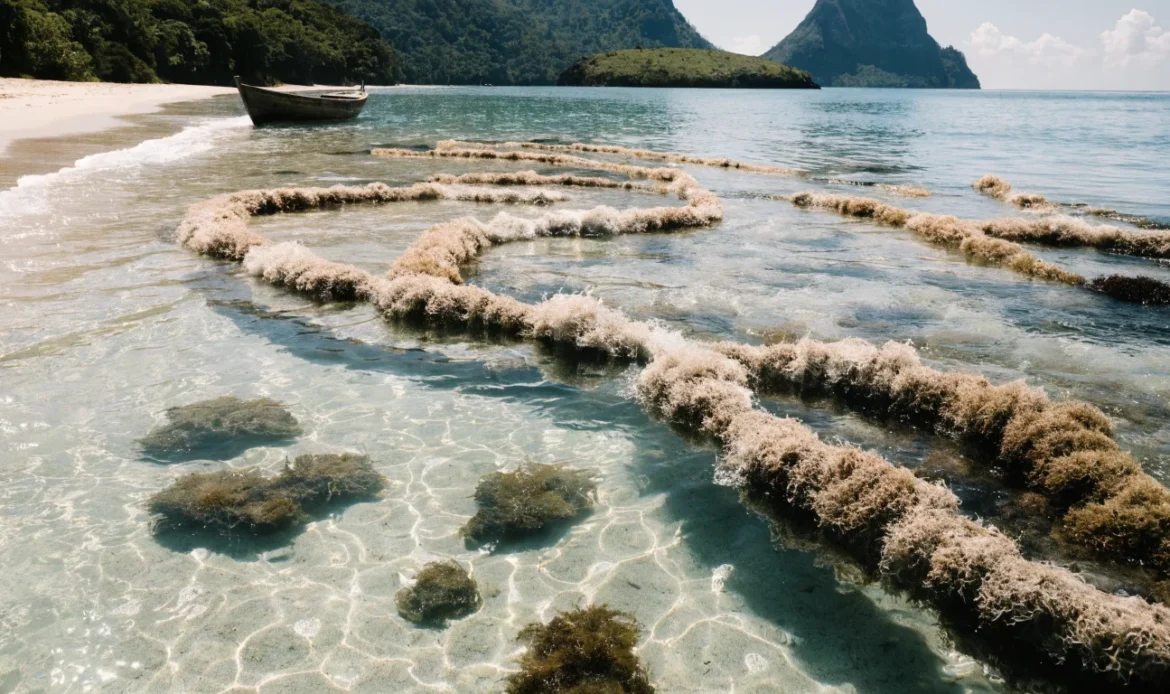
Short answer: “Irish sea moss” usually names a specific species, Chondrus crispus. “Sea moss” is a broad, common term. It can mean many red algae species sold as food or supplement. The words are not strict scientific labels. Check species names, harvest info, and lab tests when you buy.
What people mean by these terms
- Irish sea moss: Often used for Chondrus crispus. This is a red alga found in cold, rocky shores of the North Atlantic. People use the common name because it has a history of use in Ireland and nearby coasts.
- Sea moss: A general term. Sellers use it for many red algae. That can include Chondrus crispus and other species such as Gracilaria. It can also refer to seaweed sold in different forms: dried, raw, gel, or powdered.
Why this matters: Different species and harvest places can affect texture, color, and how you use the product. They can also affect things that matter for safety, like natural iodine content. But the name alone cannot prove anything about safety or quality.
How species, color, and form differ
H3: Species and names
- Scientific names (like Chondrus crispus or Gracilaria spp.) are the clearest way to know what you are buying.
- Common names vary by region and seller. “Irish” can be used to signal origin, history, or a species, but it does not guarantee either.
H3: Color and texture
- Sea moss comes in colors from pale gold to deep purple, and red to green-brown. Color can vary by species, age, light exposure, and how the product was dried or stored.
- Color alone does not tell you about safety or exact nutrients. It gives clues about species and freshness.
H3: Forms you will find
- Dried sea moss: Whole or cut, shelf-stable if stored dry.
- Raw/fresh: Often sold wet. Needs refrigeration or freezing.
- Gel: Made by soaking and blending dried or raw sea moss. A common home preparation.
- Powder and capsules: Made from dried sea moss, ground or processed.
Each form has pros and cons for storage and use. For example, gels are ready to mix into foods. Dried sea moss lasts longer and is easy to store.
Safety and testing — what to check and what we know
Short, honest point: Seaweed can contain useful minerals and also high iodine or environmental contaminants. The amounts vary a lot by species and location. You cannot tell content by sight. Ask for factual tests.
- Iodine variability: Seaweed is a major natural source of iodine. Levels can be very different across species and harvest sites. Too much iodine can affect thyroid function in some people (see refs [2], [5]). If you need to manage iodine intake, check lab results or ask a health professional.
- Contaminants: Seaweed can pick up pollutants or heavy metals from the water where it grows. The presence and level depend on local water quality and the species. Sellers who test for contaminants can share results.
- Labeling and claims: Watch for products that make strong health claims. Rules differ by country. Claims about curing diseases or guaranteed health effects are not supported here.
- Supplements vs food: Products labeled as dietary supplements may be regulated differently than foods. Look at product labeling and third-party testing when possible (see ref [4]).
Useful checks: Ask the seller for species identification, harvest area or source region, and recent third-party lab reports for iodine and heavy metals. Sellers may or may not have all this information. If they do not, that is a clear limit on what you can verify.
References that support these points include general overviews of seaweed nutrition and risks (Harvard) and reviews on iodine and seaweed (refs [1], [2], [5]) and safety advice on supplements (ref [4]).
How to choose between Irish sea moss and broader sea moss options
Start with your intended use. Do you want it for texture in a recipe? For general culinary use? For home-made gel? Your intended use changes which factors matter.
H3: Quick guide — when to pick which
- Choose a product labeled Chondrus crispus (Irish sea moss) if you want that specific species for texture or a traditional recipe.
- Choose a product labeled with species Gracilaria if you need a milder-flavored or different-textured sea moss.
- Choose dried whole sea moss if you want shelf life and flexibility.
- Choose gel if you want immediate use in smoothies or recipes.
Remember: Labels can help, but they are not proof. Ask for species name and test results if safety or iodine content is important to you.
Decision guide — checklist for buying sea moss
Use this checklist when you shop. Tick items you can confirm before buying.
- Product identity
- [ ] Scientific species name printed (e.g., Chondrus crispus, Gracilaria spp.)
- [ ] Common name matches species (e.g., “Irish sea moss” corresponds to Chondrus crispus)
- Sourcing and handling
- [ ] Harvest region or at least general origin given
- [ ] Product form specified: dried, raw, gel, powder
- [ ] Storage instructions provided
- Safety and testing
- [ ] Third-party lab test for heavy metals available
- [ ] Iodine testing or guidance available
- [ ] Clear labeling if product is sold as a dietary supplement
- Transparency and seller info
- [ ] Clear contact information for the seller
- [ ] Return or refund policy stated
- [ ] Batch or lot numbers on product (useful for traceability)
- Practical factors
- [ ] Clear recipes or use instructions (optional but helpful)
- [ ] Packaging size suits your needs
- [ ] Shipping and storage conditions known
If several boxes are unchecked, ask the seller to provide the missing information. If they cannot, consider a different source, especially if you have health concerns.
What you can test at home and what needs lab proof
- At-home checks:
- Smell: Fresh sea moss has a marine, not rotten, smell.
- Texture: Dried pieces should rehydrate; gels should have smooth texture.
- Visible debris: Sand or bits are expected in wild-harvested seaweed but large amounts may indicate poor cleaning.
- Needs lab proof:
- Iodine levels and heavy metals (lead, arsenic, cadmium, mercury).
- Microbial contamination.
- Exact species confirmation if that matters to you.
Do not rely only on look or smell for safety.
Storage and basic preparation notes
- Dried sea moss: Store in a cool, dry place. Follow seller instructions.
- Raw/washed sea moss: Keep refrigerated or frozen; follow seller guidance.
- Homemade gel: Use clean water and follow basic food-safety steps. Keep refrigerated and use within the timeline recommended by the seller or reliable recipes.
Avoid vague storage advice. If a seller does not give clear instructions, ask.
Conclusion
“Irish sea moss vs sea moss” is mostly a question of naming and species. The simple words do not guarantee origin, safety, or nutrition. Look for clear species names, source details, storage guidance, and lab testing when needed. If you need help finding tested products or bulk options, check trusted sellers and ask direct questions. Use the checklist above to make a safer choice.
Useful links:
- Home: /
- Learn more about sea moss: /learn/
- Shop sea moss products: /shop/
- Wholesale inquiries: /wholesale/
- Contact us: /contact/
Continue reading
Frequently asked questions
Is Irish sea moss the same as sea moss?
Not always. “Irish sea moss” usually refers to Chondrus crispus. “Sea moss” is a broad term that can cover multiple species. Check the scientific name to be sure.
Does color mean one is better than another?
No. Color shows species, age, or drying method. It does not prove safety or better nutrition.
Can I tell iodine or heavy metals by tasting or smelling?
No. You need lab tests to know iodine levels or heavy metal content. Sight and smell are not reliable for these.
Should I buy gel or dried sea moss?
It depends on your needs. Dried lasts longer. Gel is ready to use. Choose the form that fits your storage and cooking preference.
What should I ask the seller before buying?
Ask for the species name, harvest region, storage advice, and any lab tests for iodine and contaminants.
Are there regulations for sea moss?
Regulations vary by country. Products labeled as dietary supplements may be regulated differently than foods. Read labels and follow local guidance.
References
- Harvard T.H. Chan School of Public Health, “Seaweed.” https://nutritionsource.hsph.harvard.edu/seaweed/
- Smyth PPA. “Iodine, Seaweed, and the Thyroid.” European Thyroid Journal, 2021. https://pmc.ncbi.nlm.nih.gov/articles/PMC8077470/
- Food Standards Australia New Zealand, “Survey of iodine levels in seaweed and seaweed containing products,” updated 2025. https://www.foodstandards.gov.au/science-data/monitoring-safety/surveyofiodinelevels
- Operation Supplement Safety, “Sea Moss in Dietary Supplements.” https://www.opss.org/article/sea-moss-dietary-supplements
- Blikra MJ et al. “Consequences of acute and long-term excessive iodine intake: A literature review focusing on seaweed as a potential dietary iodine source.” 2024. https://doi.org/10.1111/1541-4337.70037