
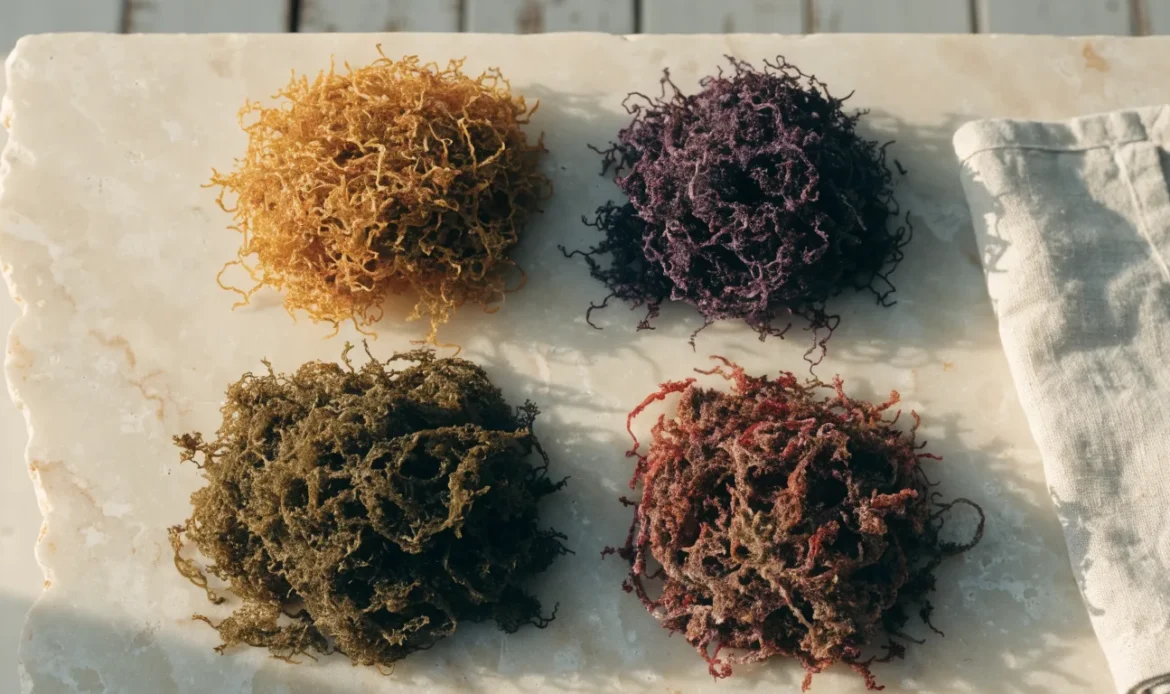
Short answer: Sea moss texture refers to how the seaweed feels and behaves in each form. Dried sea moss is firm and crisp. Rehydrated sea moss is soft and slightly springy. Sea moss gel is smooth, slippery, and spreadable. Powder feels dry and fine. Texture helps you pick the right format, but it cannot prove safety, iodine content, or lab testing.
Why this matters: texture affects how you use sea moss. It also gives clues about handling and freshness. Read on to learn how to check texture, what it can (and cannot) tell you, and how to choose the best format for your needs.
What does “sea moss texture” mean?
Texture is the look and feel of sea moss when you touch, bite, or mix it. People notice texture when they buy, soak, blend, cook, or eat sea moss. Texture changes with form. It also changes with processing and storage.
Key texture ideas:
- Firmness: hard, brittle, soft, or rubbery.
- Moisture: dry, damp, wet, or gel-like.
- Mouthfeel: chewy, slippery, smooth, or grainy.
- Behavior: does it hold shape, stretch, or dissolve?
Texture is a simple check you can do at home or in a store. But texture alone cannot tell you everything about quality or safety.
Common sea moss formats and their textures
Sea moss comes in several formats. Each format has a typical texture and set of common uses. Below are the main formats you will see.
Dried sea moss (raw dried)
Texture: firm and slightly brittle. Pieces snap or bend. They look dry and may feel rough.
Use: drying keeps sea moss light and shelf-stable. People buy dried sea moss to rehydrate later. Dried pieces can be cut or broken into smaller bits.
What to check: look for clean pieces without sand or heavy debris. Smell for any strong off-odor. Color and texture vary by type and drying method.
What it cannot show: dried texture cannot prove the sea moss was tested, free of heavy metals, or safe for people who need to watch iodine intake.
Rehydrated sea moss (soaked and rinsed)
Texture: soft, slightly springy, and flexible. It should not be slimy in a way that smells bad.
Use: rehydrated sea moss is ready for recipes. People use it where a strand or the plant form is wanted.
What to check: rehydrated sea moss should feel clean and not have a foul odor. It should hold together but not be slimy.
Sea moss gel
Texture: smooth, slippery, jelly-like, and spreadable. It can be thick or runny depending on the recipe.
Use: gels are common for smoothies, spreads, and topical uses. They are easy to mix.
What to check: the gel should be uniform and not separate into liquid and solids. Smell and color should be neutral for plain gel.
What it cannot show: gel texture does not reveal how much iodine or other minerals are present. It also cannot prove the starting sea moss was free of contaminants.
Sea moss powder
Texture: dry, fine, or slightly sandy. Powders mix into liquids or can be blended into food.
Use: powders are handy for capsules or adding to recipes without altering texture much.
What to check: powder should be dry and free of hard bits. No strong off-odor.
What it cannot show: powder texture can’t reveal the original species or the lab testing history.
Capsules and tablets
Texture: you will feel the hard capsule, not the sea moss inside. The texture of the finished product masks the raw seaweed texture.
Use: capsules make dosing simple.
What to check: check the product label and any third-party testing information rather than texture.
Fresh or wet sea moss (rarely sold)
Texture: wet, soft, and often slippery. Fresh sea moss is more fragile.
Use: used by makers who make their own gel or cook with fresh sea moss.
What to check: fresh sea moss spoils faster. Smell and color are key checks.
A practical format comparison table
| Format | Typical texture | Main uses | What texture can tell you | What texture cannot tell you |
|---|---|---|---|---|
| Dried sea moss | Firm, brittle, rough | Long-storage, rehydrate later | Whether it was dried cleanly; presence of sand or debris | Safety tests, iodine level, contaminants |
| Rehydrated sea moss | Soft, springy, plant-like | Recipes, cooking, blending | Cleanliness, smell, basic freshness | Species ID, lab results, mineral counts |
| Sea moss gel | Smooth, jelly-like, slippery | Smoothies, spreads, topical use | Uniformity, separation, off-odors | Exact mineral content, testing history |
| Powder | Dry, fine, slightly sandy | Capsules, mixing into foods | Dryness, presence of hard bits | Original processing, iodine levels |
| Capsules/tablets | Hard, smooth shell | Convenience, dosing | Little to none (shell masks texture) | Internal content purity, testing, mineral quantity |
Use this table to match how you plan to use sea moss with the texture that suits you.
How to check sea moss texture — a practical checklist
Use this short checklist when you inspect sea moss in any format. Do the quick checks before you buy or use.
- Visual check:
- Look for uniform pieces or color.
- Avoid heavy dirt, sand, or foreign matter.
- Smell check:
- Fresh sea moss has a mild ocean smell.
- Strong sour or rotten smells are a red flag.
- Touch check:
- Dried should snap or bend, not crumble into dust.
- Rehydrated should be soft, not slimy with a bad odor.
- Gel should be smooth and hold together.
- Separation check (for gels and powders):
- Gel should not separate into a watery layer and solids.
- Powder should be dry and not clump from moisture.
- Packaging check:
- Sealed packaging reduces exposure to contaminants.
- For bulk or wholesale, check how it was stored.
- Ask questions:
- Where was it harvested or sourced?
- Was it rinsed and handled well?
- Are there test results or a certificate of analysis?
This checklist helps you spot obvious issues. It does not replace lab testing or safety checks.
What sea moss texture can tell you — and what it cannot
Texture gives useful clues. It can tell you about handling and basic freshness. But it cannot prove many important things. Below are clear limits.
What texture can suggest:
- Clean handling: lack of sand, crisp dried pieces, and neutral smell suggest basic cleanliness.
- Water damage or spoilage: sliminess or strong smell can suggest spoilage.
- Processing choices: a smooth gel likely was blended and strained. A coarse powder was ground less finely.
What texture cannot prove:
- Mineral levels: you cannot tell iodine or mineral content by texture. Seaweed can be high in iodine, depending on species and where it grew [1][2][5].
- Contaminants: heavy metals or toxins are invisible in texture. Only lab testing finds them.
- Species or origin: texture alone cannot reliably identify the seaweed species or where it was grown.
- Compliance and safety: texture does not show whether the product followed food-safety steps, testing, or labeling rules.
Important note on iodine and seaweed:
Seaweed can contain high and variable amounts of iodine. People with thyroid conditions or who monitor iodine should be cautious. Testing and clear labeling are the only ways to know exact iodine amounts in a product [1][2][3][5].
Important note on supplement safety:
Dietary supplements and some seaweed products are not always tested equally. Check for third-party testing or clear product information. Texture cannot replace testing or safe handling practices [4].
How to choose the right texture for your needs
Start with your use case. Here is a simple decision guide.
If you want to:
- Make your own gel or control ingredients: choose dried or fresh sea moss. Dried is easier to store.
- Use sea moss quickly in smoothies or topical recipes: choose pre-made gel.
- Add to capsules or keep a neutral mouthfeel: choose powder or capsules.
- Buy large amounts for a business: consider bulk dried sea moss and check storage and handling practices.
Decision checklist:
- Do you need long storage? Pick dried or powder.
- Do you want ready-to-use? Pick gel or capsules.
- Will you cook with it? Choose rehydrated or fresh textures that hold up to heat.
- Do you need to mix it seamlessly into drinks? Powder or well-blended gel is best.
- Are you buying wholesale? Ask about storage, handling, and testing, not just texture.
Think about convenience, storage, and how you plan to use the product. Texture should match your plan.
Buying tips tied to texture
When you shop, use texture to inform questions to sellers.
- For dried sea moss:
- Ask how it was cleaned and dried.
- Inspect pieces for sand and foreign matter.
- For gel:
- Ask about ingredients. Some gels use water only. Others add sweeteners or preservatives.
- Check for separation and a short ingredient list.
- For powder:
- Ask how it was milled and screened.
- Look for clump-free packaging and low moisture.
- For capsules:
- Ask about the source of the powder inside the capsule and any testing.
Always ask sellers for tests or certificates if you have health concerns. Texture is only a first check.
What to ask sellers when texture raises a question
If texture seems off, ask these practical questions:
- How was this sea moss cleaned?
- Where was it sourced or harvested?
- Do you have lab results or a certificate of analysis?
- Was any additive used (e.g., preservatives, sweeteners)?
- How was it stored before sale?
Sellers who can answer these clearly will help you make a safer choice.
Next steps and useful links
If you want to learn more, these pages can help:
- Learn about sea moss basics on our learning hub: Sea moss learning resources.
- Browse formats and products in our shop: Shop sea moss products.
- Interested in buying larger quantities? See our wholesale options: Wholesale sea moss information.
- Back to the main site home page: Zen Wholesalers home.
- Have a question or need help? Contact our team: Contact us.
Conclusion
Texture is a practical tool. It helps you pick the right sea moss format. It also helps you spot obvious problems like sand, spoilage, or poor handling. But texture is not a substitute for testing. Texture cannot tell you iodine levels, contaminants, or compliance. When in doubt, ask sellers for clear answers and lab results. Use texture checks with questions and product information to make a safer, better choice.
Frequently asked questions
Can I judge sea moss quality by texture alone?
No. Texture gives quick clues about handling and freshness. It cannot prove lab safety, iodine levels, or contaminants. Ask for tests if you need that information.
Is slimy sea moss bad?
Not always. Fresh or well-made gel can feel slippery. Sliminess plus a sour or rotten smell is a warning. Use smell and color with texture to judge.
Does a good gel mean high quality sea moss?
A smooth gel shows it was blended and strained. It does not show mineral content or testing history. Ask the seller about ingredients and any lab results.
Which format lasts the longest?
Dried and powdered forms generally store longer than fresh or gel forms. Exact shelf life depends on processing and storage. Check packaging and seller guidance.
Can texture tell me the sea moss species?
Texture alone cannot reliably identify species. Shape, color, and texture might hint at differences, but species identification needs more information.
Should people with thyroid issues avoid sea moss based on texture?
Texture offers no information about iodine content. Seaweed can contain high amounts of iodine. People with thyroid concerns should check product labels and ask for testing or consult a health professional [1][2][3][5].
References
- Harvard T.H. Chan School of Public Health, “Seaweed.” https://nutritionsource.hsph.harvard.edu/seaweed/
- Smyth PPA. “Iodine, Seaweed, and the Thyroid.” European Thyroid Journal, 2021. https://pmc.ncbi.nlm.nih.gov/articles/PMC8077470/
- Food Standards Australia New Zealand, “Survey of iodine levels in seaweed and seaweed containing products,” updated 2025. https://www.foodstandards.gov.au/science-data/monitoring-safety/surveyofiodinelevels
- Operation Supplement Safety, “Sea Moss in Dietary Supplements.” https://www.opss.org/article/sea-moss-dietary-supplements
- Blikra MJ et al. “Consequences of acute and long-term excessive iodine intake: A literature review focusing on seaweed as a potential dietary iodine source.” 2024. https://doi.org/10.1111/1541-4337.70037