
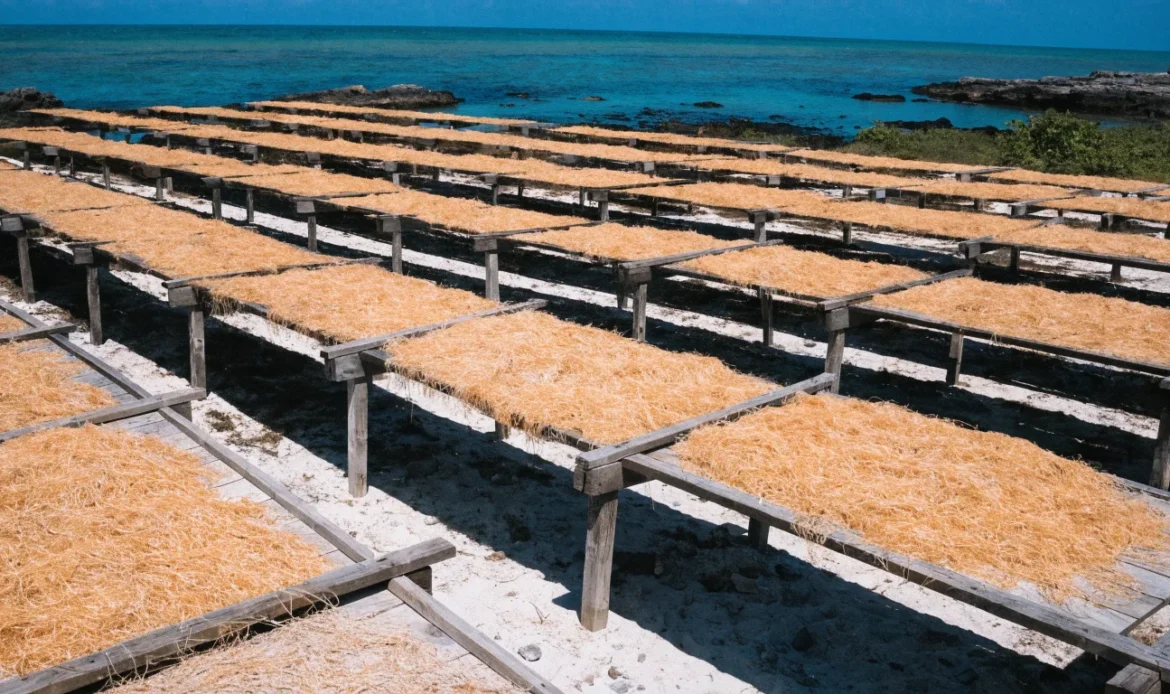
Almost every sea moss wholesale supplier’s website says the same six things: wildcrafted, organic, sun-dried, lab-tested, ethically sourced, direct from the ocean. None of those phrases is regulated, and any of them can be typed by someone who has never seen the harvest.
This is the list of questions that actually separates suppliers, in the order they matter. We supply raw sea moss ourselves, so read this as a competitor’s checklist and hold us to it too.
1. Which species, named in Latin?
This is the fastest filter in the whole process. Ask for the species and see how long the answer takes.
Eucheuma cottonii (also classified as Kappaphycus alvarezii) is the thick, branched warm-water species that makes up most of world supply — Caribbean, Indonesia, Philippines, East Africa. Chondrus crispus is the flat, fan-shaped cold-water Atlantic species that the term Irish moss properly describes.
A supplier who cannot answer in one line is reselling. Worse is the answer that contradicts itself: “wildcrafted Irish moss from Saint Lucia” names a cold-water North Atlantic species and a tropical Caribbean island in the same sentence. We go through the species question in trade terms here.
2. Where, specifically?
“Ocean harvested” is not an origin. A country is the minimum; a coast or region is better. Origin is not romance — it drives two things you are legally exposed to:
- Heavy metal load. Seaweed absorbs what surrounds it. Arsenic, cadmium, lead and mercury accumulate from the water it grew in.
- Iodine content. It varies by species and location, and it varies between harvests from the same site.
If a supplier will not name a harvest region, you cannot assess either. What sourcing at a single origin actually buys you.
3. Wild-harvested or tank-grown — and how would you know?
“Wildcrafted” is unregulated and widely stretched. Genuine wild harvest means the seaweed grew in open ocean. A significant amount of product sold as wildcrafted is grown on lines in shallow pools or tanks, sometimes with added salt and nutrients.
Neither is inherently wrong. Paying a wild premium for tank-grown product is. How to actually verify a wildcrafted claim covers what to ask for, and the difference between the two covers what changes in the product.
4. Will you show me a Certificate of Analysis for the lot I am buying?
The single most useful question on this page, and the one that ends the most conversations.
A serious supplier has a COA ready. What you want on it:
- Heavy metals — arsenic, cadmium, lead, mercury. Research published in 2025 in the Journal of Agriculture and Food Research found seaweed consumption can lead to heavy metal accumulation with real consequences, so this is not a formality.
- Iodine, with the figure stated. Analysis of Chondrus crispus has found roughly 3 to 7 micrograms per gram of dried seaweed, but with a standard deviation near 40% of the mean — the variation is the reason to test.
- Microbiological — total plate count, yeast and mould, salmonella, E. coli.
- The lot number and date, matching the lot you are actually buying.
5. Who carries the FDA burden — and does the supplier know the answer?
This is where most sea moss supplier conversations fall apart, and almost no supplier website mentions it.
If you are importing into the United States, several obligations apply, and they do not all sit with the seller:
- Food Facility Registration. The foreign facility must be registered with the FDA before its first export, which requires a DUNS number.
- Prior Notice. Under 21 CFR Part 1 Subpart I, notice must be submitted before every shipment arrives at a US port of entry — product description and FDA product code, the facility’s registration number, manufacturer, shipper and importer details, port, and arrival time.
- FSVP — the Foreign Supplier Verification Program. This one is yours. The US importer is responsible for identifying hazards, evaluating the foreign supplier’s food safety performance, approving suppliers before importing, carrying out periodic verification, and keeping the records.
FSVP means the compliance liability for your supplier’s practices lands on you, not on them. A supplier who has never heard of it is telling you how many US buyers they actually serve.
Dried seaweed fit for human consumption is classified under HS/HTS 1212.21. The adjacent code 1212.29 covers seaweed not fit for human consumption — worth checking on paperwork, because the wrong code on a commercial invoice creates problems at entry.
None of this is a reason to avoid importing. It is a reason to ask early, and to be sceptical of a supplier who treats compliance as your problem alone.
6. Will you send a paid sample before I commit?
Any supplier confident in their material will sell you a small quantity. Insist on it, and inspect what arrives:
- Grit. Rinse a handful. Sand at the bottom of the bowl means the two-phase cleaning was skipped or rushed.
- Smell. Faintly marine is right. Strongly fishy or sour suggests poor drying or a wet pack.
- Colour consistency. A gold lot should be gold. Heavy colour variation means lots were blended.
- Expansion. Soak a weighed amount and weigh it again. This is your real yield, and it decides your cost per finished jar far more than the price per pound does.
The trade rule of thumb is 12 to 15 jars of 16 oz gel per dried pound, and it is an estimate, not a specification. Measure it against your own process rather than accepting a supplier’s number.
7. What happens when a lot is wrong?
Ask before you need to know. What is the process if a shipment arrives damp, short, or fails your incoming test? Who pays for the return, or is it a credit against the next order? Does the supplier hold retention samples from each lot so a dispute can be resolved against something physical?
A supplier who has thought about this has had it happen and has a process. A supplier who has not will improvise at your expense.
8. What are you not able to supply?
The most revealing question in a first call, and the one that tells you whether you are talking to a harvester or a broker.
Real supply has real limits: a season, a maximum monthly volume, grades that run short at certain times of year. A supplier who says yes to every volume and every specification is either brokering someone else’s material, or will discover the limits after taking your deposit.
“We can do any volume” is not a strength. It means nobody has counted.
The short version
Six questions will sort almost any shortlist: name the species, name the origin, show me a lot COA, tell me who handles FSVP, sell me a sample, and tell me what you cannot do. A supplier who answers all six plainly is worth a trial order. One who deflects on two or more is a website.
If you are earlier in the process, the full wholesale buying guide covers grades, volumes and terms, and buying direct versus through a distributor covers who you should be talking to in the first place.