
If you are buying Irish sea moss wholesale, the first thing to settle is that the phrase describes a trade name rather than a species or an origin. Most product sold under it is neither Irish nor the species the name refers to.
That is not necessarily fraud — the term drifted over a century of commerce — but it becomes your problem the moment you write a purchase specification or repeat the claim on your own label.
The two species, and which one you will actually receive
Chondrus crispus — the real Irish moss
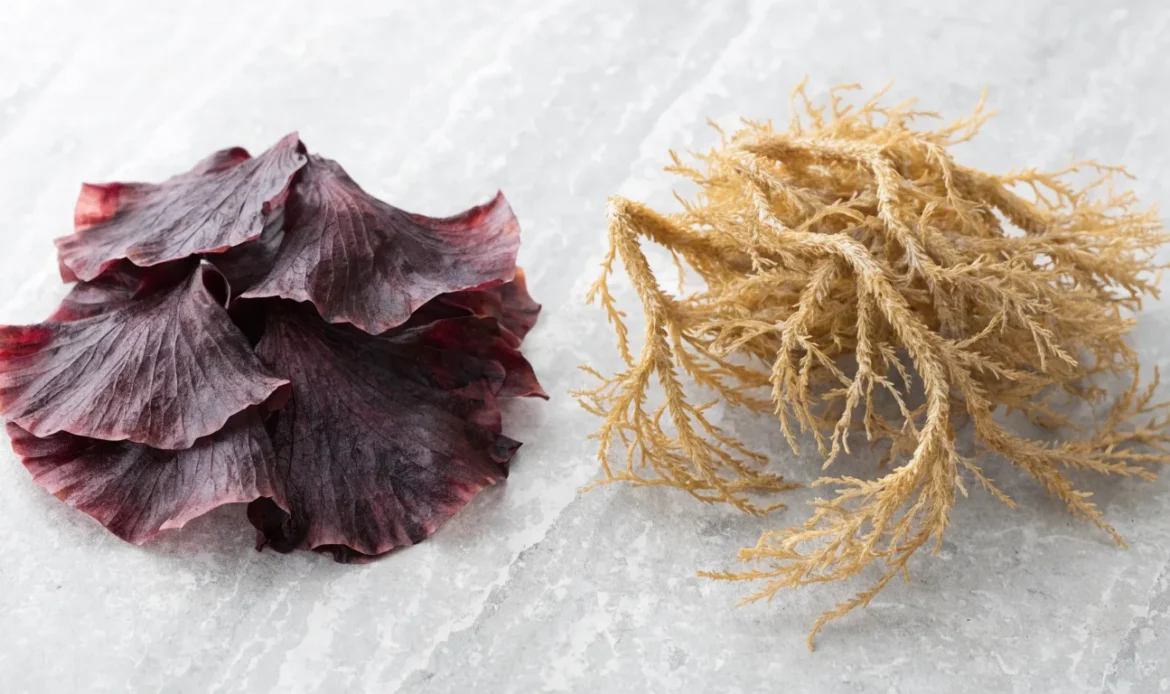
A red alga native to cold North Atlantic waters around Ireland, Britain, Brittany and the north-east coast of North America. Flat, fan-shaped, a few inches across, growing on intertidal rock. Eaten in Ireland for centuries, boiled with milk, and the original commercial source of carrageenan.
It sets a firmer gel. It is harvested in much smaller volumes, from cold-water coasts, at higher cost.
Eucheuma cottonii — what you will almost certainly get
Also classified as Kappaphycus alvarezii. A warm-water species grown on lines across the Caribbean, Indonesia, the Philippines and East Africa. Thick, heavily branched, gold, purple or green. This is the overwhelming majority of world supply, including nearly everything sold as Irish moss.
It generally expands further per pound and produces a milder, more neutral gel — which is exactly why it dominates commercial supply.
“Wholesale Irish moss from Saint Lucia” names a cold-water North Atlantic species and a tropical Caribbean island in the same sentence. One of those two words is doing marketing.
The full species comparison covers how they differ in the finished product.
Why the trade name drifted
Two reasons, both commercial:
- Carrageenan’s history began with Irish moss. Chondrus crispus was the original industrial source, so “Irish moss” became a generic trade term for carrageenan-bearing red algae regardless of species — much as “hoover” became a generic term for a vacuum.
- Irish reads as heritage. In the wellness market the adjective signals tradition and authenticity, and heritage sells. The word migrated onto product it does not describe because it moved units.
Does the species change what you receive?
Less than the price difference implies, and more than a supplier claiming they are interchangeable will admit.
- Nutritionally they overlap heavily. Both are red algae, both largely soluble fibre and carrageenan, both carry iodine and minerals from seawater. Published composition figures overlap, and variation between batches and locations is often larger than the difference between species.
- Gel behaviour differs. Chondrus sets firmer. Eucheuma is milder and more neutral, and generally expands more per pound.
- Yield differs, and yield is your cost. The trade rule of thumb is 12 to 15 jars of 16 oz gel per dried pound. Measure it on a sample rather than accepting a figure.
- Iodine varies either way. Analysis of Chondrus crispus found roughly 3 to 7 micrograms per gram of dried seaweed, with a standard deviation near 40% of the mean. That variation is a testing question, not a species question.
How to specify it so you get what you intend
Do not write “Irish moss” in a purchase order. It is not a specification. Write:
- The Latin binomial — Chondrus crispus or Eucheuma cottonii / Kappaphycus alvarezii.
- The harvest region — a coast, not “ocean harvested”.
- The growing method — wild-gathered, open-water line-grown, or pool/tank grown. Why that claim needs verifying.
- Colour grade if it matters, and whether lots may be blended in a short season.
- A lot-matched Certificate of Analysis with heavy metals and a stated iodine figure.
When genuine Chondrus crispus is worth sourcing
- You are making a traditional Irish moss product — the milk drink, or anything needing a firm set.
- Your brand story is specifically Irish or North Atlantic and you will have to substantiate it.
- You need the firmer gel for a texture your formulation depends on.
Expect to pay considerably more, expect smaller lots, and expect a cold-water season rather than a tropical one. If none of the three applies, you are paying a premium for an adjective.
Buying the warm-water species honestly
There is nothing second-rate about Eucheuma. It is more available, expands further per pound, and makes a milder gel that disappears into food — the reasons it dominates supply. The only problem is calling it something it is not.
If you are buying Caribbean or Indo-Pacific material, specify Eucheuma cottonii and describe it accurately on your own packaging. Buyers who later discover their “Irish” moss is Caribbean tend to conclude the seller was careless everywhere else too, which is an expensive impression to correct.
What we supply
Eucheuma cottonii, grown on lines in open water off the west coast of Saint Lucia and cut by hand, in gold, purple, green and mixed full-spectrum. We do not call it Irish moss, because it is not.
If you need genuine Chondrus crispus, buy from a supplier who names Ireland, Brittany, Maine or Nova Scotia as the harvest region — and hold them to the same specification checklist above.