
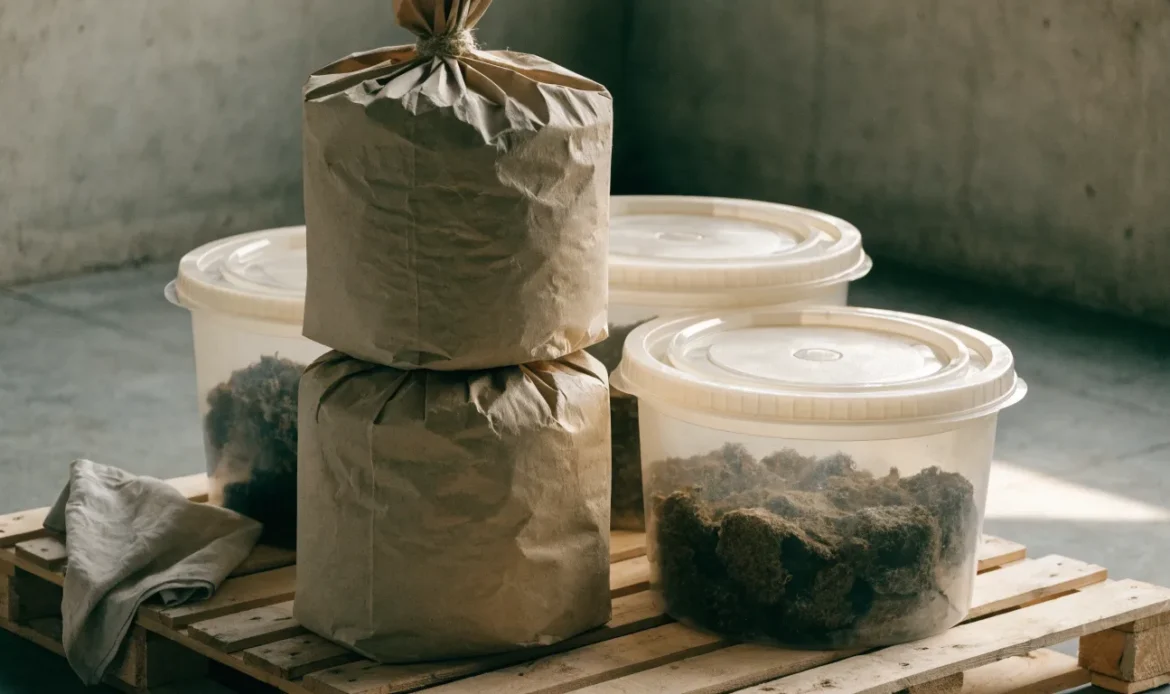
Short answer: If you buy sea moss wholesale, focus first on the product form you need (raw/dried, gel, or powder), then on documentation and handling. Ask for lab reports, clear origin details, and a step-by-step quote and approval workflow before you sign anything.
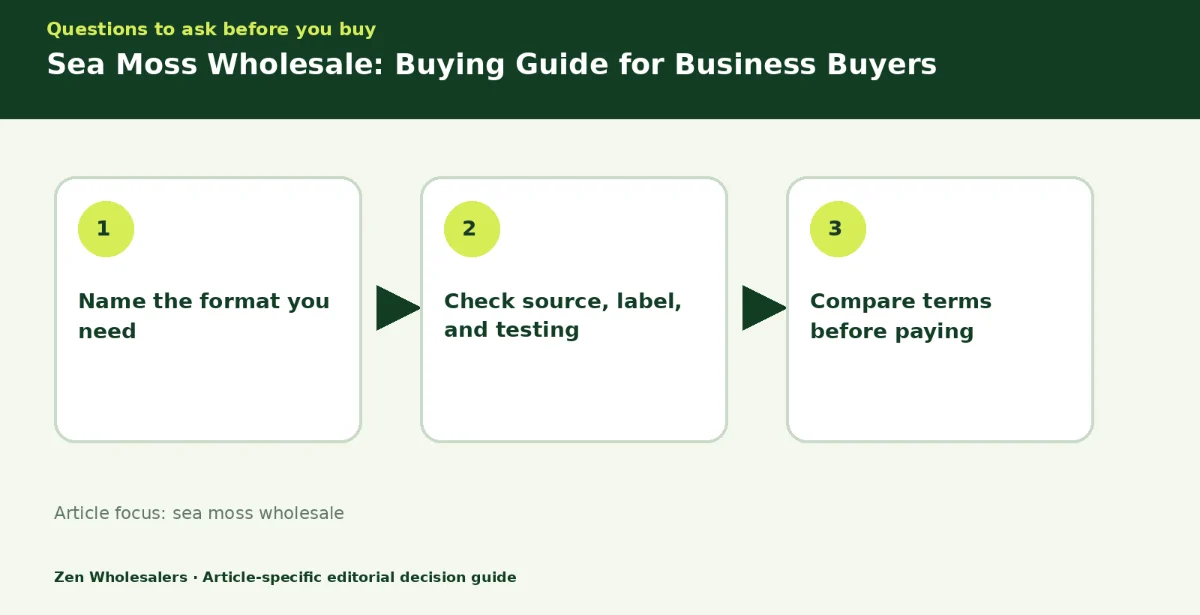
This guide explains what to check, what documents to request, what you cannot prove without testing, and what useful next questions to ask. It is written for businesses that will repackage, resell, or use sea moss in product making. The advice applies whether you look for wholesale sea moss 50 lbs orders or pallet-size shipments. It does not promise health claims or business guarantees.
What “sea moss wholesale” covers
Wholesale sea moss usually refers to bulk purchases of sea moss in one of these forms:
- Raw or dried sea moss (whole or cut).
- Sea moss gel (ready-to-use, hydrated).
- Powdered or powdered extracts.
- Processed ingredients (e.g., blended with other botanical leaves).
Suppliers can be harvesters, processors, or wholesale sea moss distributors. Some sellers list origins such as St Lucia, Jamaica, or Ireland. Sellers may describe product as wildcrafted, organic, or raw. These words matter, but they do not replace testing or paperwork.
Quick primer: what seaweed can contain (and what to ask about)
Seaweeds pick up minerals from their environment. That can include iodine and other elements. Iodine levels can vary a lot between species and places. High iodine intake can affect thyroid function for some people. For these reasons, buyers often ask for iodine data and heavy-metal testing when they buy in bulk [1][2][5].
Food safety surveys also show wide variation in iodine and other elements across products. This means a label claim is not a substitute for a lab report [3]. Industry safety groups recommend clear labeling and testing for seaweed-based supplements and ingredients [4].
Use this as background, not as a health claim. Your buyer requirements should reflect possible variability and the need for testing.
What a business buyer should check — the essentials
- Product form and intended use
- Do you need raw/dried sea moss for further processing? Or ready-to-sell sea moss gel? Or powder?
- Gel needs cold-chain handling or preservatives. Raw dried sea moss may need rehydration and washing steps.
- Ask how the supplier stores and ships the form you buy.
- Origin and chain of custody
- Ask where the sea moss was harvested or grown.
- Ask whether the supplier is the harvester, a processor, or a distributor.
- Request harvest or lot IDs if available so you can trace shipments.
- Product grade and sorting
- Ask about grade categories (cleaned, premium, food-grade, cosmetic-grade).
- Request photos of actual lots. Ask about visual criteria (color, debris, pieces).
- Testing and documentation
- Request Certificates of Analysis (COAs) for each lot.
- Relevant tests: microbiology (total plate counts, yeast/mold), heavy metals, iodine, and any pesticides or algal toxins relevant to the source.
- Ask whether COAs are from supplier labs or independent third-party labs. Third-party is generally stronger evidence.
- Regulatory and claims
- If you need “organic” or other certifications, ask for the certifier name and scope.
- Check whether the supplier can provide export and customs paperwork for the origin country.
- Packaging, units, and minimums
- Ask about packaging options (50 lbs bags are common in requests for bulk sea moss).
- Ask about palletization, inner liners, and whether the product is vacuum sealed or not.
- Shelf-life and storage
- For gel, ask about recommended refrigeration, preservatives, and expected shelf-life.
- For dried raw sea moss, ask recommended humidity and temperature ranges for storage.
- Samples and lead time
- Request a small, representative sample before you commit to a lot.
- Ask about sample cost, lead time for full production or pickup, and minimum order quantity (MOQ).
- Pricing workflow and terms
- Get a written quote with Incoterms, lead time, and payment terms.
- Ask whether the price covers COAs, sampling, and freight.
- Quality agreement
- For repeated orders, ask to sign a quality agreement that spells out acceptance criteria and handling.
What you can check during supplier evaluation — and what you cannot prove
What you can check:
- Existence of COAs and what they tested.
- Whether lab results match the lot or are generic.
- Photos and video of the product, packaging, and handling.
- Shipping records and packing lists.
- Traceability numbers and harvest dates (if provided).
What you cannot prove without testing or inspection:
- Long-term stability of an untested gel batch.
- Contamination that an individual COA did not test for.
- The full chain-of-custody if documents are incomplete.
- Claims of “wildcrafted” or “organic” without certification documents.
Useful next question: “Can you provide a lot-specific third-party COA and representative photos for the actual pallet we will receive?” That narrows uncertainty and forces the supplier to show lot-level evidence.
Practical wholesale buyer checklist
Use this checklist when you request quotes or assess samples.
- Product form needed: raw/dried, gel, powder
- Intended use: resale, ingredient, or cosmetic
- Origin preferred (e.g., St Lucia, Jamaica, Ireland) and reason
- Supplier type: harvester | processor | distributor
- Lot traceability (harvest date, lot ID)
- Sample request: yes/no; sample type
- COA requested: yes — list tests (microbiology, heavy metals, iodine, algal toxins)
- COA lab: third-party / supplier lab
- Certifications required: organic / HACCP / GMP (name certifier)
- Packaging options: 50 lbs bags? bulk drums? vacuum seal?
- Shipping terms and Incoterm requested
- Storage & shelf-life data requested (gel: refrigeration; dried: humidity)
- Minimums and lead time requested
- Insurance and claims process for damaged shipments
- QA / Quality agreement to sign for recurring orders
Copy and edit this list for your RFPs and supplier emails.
Decision guide: choose the right product form
Make this simple decision path in your head or in a short table.
- If you will manufacture other foods or supplements:
- Choose raw/dried or powder. Ask for cleaning and grinding specs.
- If you will sell ready-to-use product to consumers:
- Choose sea moss gel. Ask for shelf-life, preservatives, and cold-chain info.
- If you need a long shelf-life ingredient for dry mixes:
- Ask about powdered extracts with stability data.
- If provenance or specialty origin matters (e.g., St Lucia sea moss wholesale, Irish sea moss wholesale):
- Ask for harvest and export documentation and lot traceability.
Note: “Sea moss wholesale 50 lbs” is a common packaging size request. Always confirm the actual net weight and packaging details with the supplier before ordering.
Account setup and quote-to-order workflow (recommended step-by-step)
- Initial contact
- Send a short RFP or email with product form, volume, and desired lead time.
- Supplier response
- Ask for sample policy, packaging options, and an initial price range.
- NDA and sampling (optional)
- If you plan to share formulas or specifics, consider an NDA.
- Request a representative sample with lot ID.
- Review COAs
- Request lot-specific COAs. Check the lab name and test dates.
- Independent testing (if needed)
- Send sample to your lab for verification, especially for iodine or heavy metals.
- Negotiate terms
- Agree on Incoterms, payment terms, packaging, and lead time.
- Quality agreement
- Create a written quality agreement for repeated shipments.
- Finalize order
- Place a purchase order referencing lot ID and quality agreement.
- Pre-shipment inspection (optional)
- Arrange inspection at supplier facility or through a third-party inspector.
- Receive and verify
- Open and check the first pallet. Match COA to lot received.
- Ongoing QA
- Maintain records. Request periodic COAs for new lots.
This workflow reduces surprises and documents expectations.
Questions to ask every supplier (email template bullets)
- What is the product form and typical packaging options?
- Can you provide lot-specific COAs for the last three lots?
- Are COAs from an accredited third-party lab? Please name the lab.
- Where was the sea moss harvested or grown? Who is the harvester?
- What are your storage and shipping recommendations?
- What is your sample policy and how long does a sample take to ship?
- What are your lead times and minimum order quantities?
- Do you offer cold-chain shipment for gel products?
- Can you provide references from other business buyers (no consumer testimonials)?
These specific questions give you testable answers.
Special notes on origin claims (St Lucia, Jamaica, Ireland and others)
Many buyers search for terms like wholesale sea moss St Lucia, sea moss from St Lucia wholesale, or wholesale Irish sea moss. “Origin” is important for marketing and sometimes quality perception. But origin alone is not proof of quality. Documents, testing, and traceability tell the real story.
If origin matters to your customers:
- Request harvest documentation.
- Ask for photos or videos of harvest or processing.
- Ask whether the supplier can provide export customs paperwork tying product to the origin.
Wildcrafted vs. farmed vs. organic claims
- Wildcrafted means harvested from natural habitats. It does not prove safety or freedom from contaminants.
- Farmed means cultivated. Farming methods and water quality matter.
- Organic requires certification by a recognized body.
Always ask for supporting documents and testing. Do not accept claims alone.
Handling sea moss gel at scale
Sea moss gel wholesale customers often need technical answers:
- How is the gel preserved? (heat, refrigeration, preservatives, low pH)
- What is the pH and recommended storage temperature?
- How long will it remain stable under your planned handling?
- Can the gel be pasteurized or shelf-stabilized for your supply chain?
Ask for stability data and vendor handling instructions. If the supplier cannot provide this, plan to perform your own stability testing.
Packaging, transport, and receiving tips
- Confirm actual net weight per bag or container.
- Ask whether packaging has inner liners or vacuum seals to limit moisture.
- For gel, confirm whether frozen or refrigerated transport is required.
- Inspect shipments on arrival and match lot IDs to COAs.
- Photograph any damage and record temperatures for perishable loads.
Pricing notes and negotiation tips
Do not accept price alone as proof of quality. Lower price can mean less testing, longer lead times, or consolidated lots. Negotiate a clear scope:
- Which tests are included in the price?
- Who pays for sample shipping and independent testing?
- Are there volume discounts for repeat orders under a quality agreement?
Always get written terms.
When to hire a third-party inspector or lab
- When you need confirmatory testing for iodine, heavy metals, or algal toxins.
- For first shipments from a new supplier or origin.
- When product will be used in regulated products (food, supplements, cosmetics).
Third-party testing provides stronger evidence than supplier-supplied lab reports alone.
Conclusion
Buying sea moss wholesale requires clear goals, specific questions, and evidence. Start with the product form you need. Ask for lot-specific COAs, photos, and traceability. Decide whether you need third-party testing. Use a formal quote-to-order workflow and a written quality agreement for repeat buying. These steps reduce risk and make supplier relationships clearer.
If you want to explore wholesale options or start a buying conversation, visit our Wholesale page, read more on how sea moss works on our Learn hub, or view our product options in the Shop. For questions or to request a sample, please Contact us.
- Start here: Wholesale page (/wholesale/)
- Learn about sea moss basics: Learn (/learn/)
- Browse product options: Shop (/shop/)
- General site: Home (/)
- Contact us: Contact (/contact/)
Continue reading
Frequently asked questions
What tests should I ask for on a COA for sea moss?
Common tests include microbiology (total plate counts, yeast and mold), heavy metals (lead, mercury, cadmium), and iodine. Ask if algal toxins are relevant for the harvest region. Request lot-specific COAs and note whether the lab is third-party accredited.
Can I buy sea moss wholesale in 50 lb units?
Many suppliers offer bulk packaging options. If you plan to request “sea moss wholesale 50 lbs,” confirm the net weight, packaging type, and palletization with the supplier. Ask whether the supplier can provide photos of the exact pack you will receive.
Is “wildcrafted” the same as “organic”?
No. Wildcrafted means the seaweed was harvested from a wild source. Organic requires certification from an accredited body. Always ask for supporting documents or certifier names.
How should sea moss gel be shipped?
Gel typically needs temperature control or preservatives. Ask suppliers for storage and shipping recommendations, including whether cold-chain or freezing is needed. If no recommendations exist, plan to verify stability yourself.
How do I verify a supplier’s origin claims (for example, St Lucia or Ireland)?
Request harvest documentation, lot IDs, and export customs paperwork that tie the product to the claimed origin. Photos and videos of harvest and processing also help. Independent lab testing that shows expected regional markers can support the claim but is not a guarantee.
Should I test every lot?
Many buyers test initial lots and randomly test subsequent lots. The decision depends on your risk tolerance, regulatory requirements, and product use. For regulated end products, more frequent testing is common.
References
- [1] Harvard T.H. Chan School of Public Health, “Seaweed.” https://nutritionsource.hsph.harvard.edu/seaweed/
- [2] Smyth PPA. “Iodine, Seaweed, and the Thyroid.” European Thyroid Journal, 2021. https://pmc.ncbi.nlm.nih.gov/articles/PMC8077470/
- [3] Food Standards Australia New Zealand, “Survey of iodine levels in seaweed and seaweed containing products,” updated 2025. https://www.foodstandards.gov.au/science-data/monitoring-safety/surveyofiodinelevels
- [4] Operation Supplement Safety, “Sea Moss in Dietary Supplements.” https://www.opss.org/article/sea-moss-dietary-supplements
- [5] Blikra MJ et al. “Consequences of acute and long-term excessive iodine intake: A literature review focusing on seaweed as a potential dietary iodine source.” 2024. https://doi.org/10.1111/1541-4337.70037