
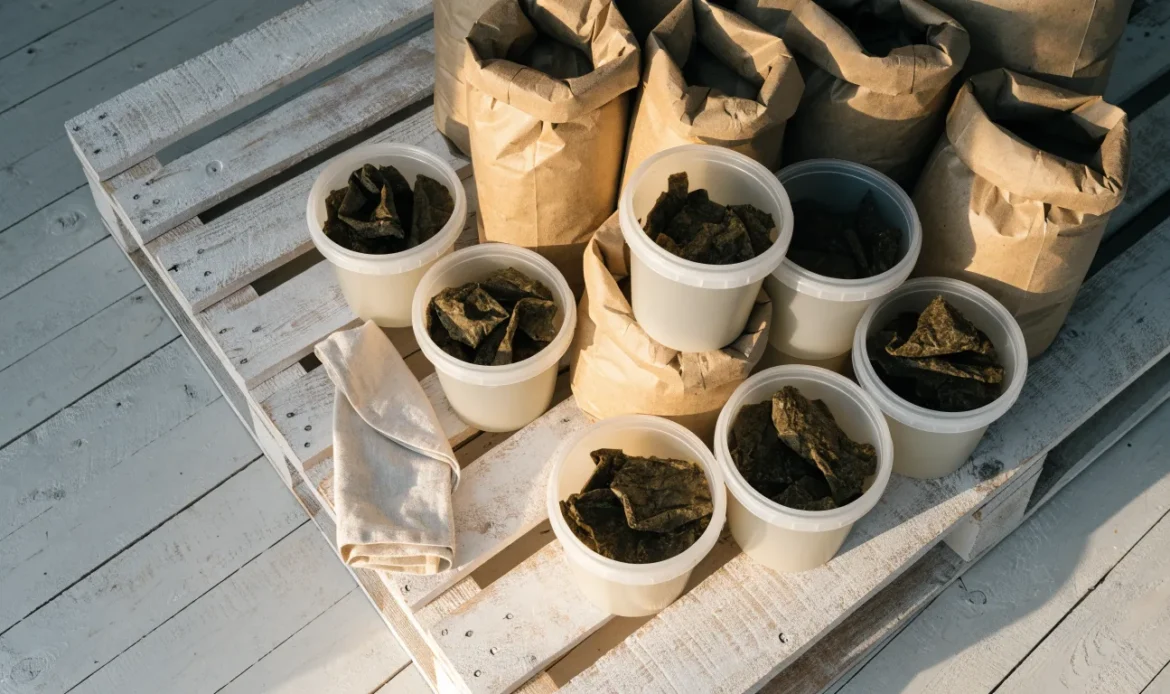
Short answer: Buying bulk sea moss means purchasing large quantities of seaweed for resale or use in products. As a buyer, check species and form, request lab reports, confirm traceability, and plan for sampling and storage. This guide explains what to ask for, how to read a quote, and what steps help lower risk when you buy sea moss in bulk.
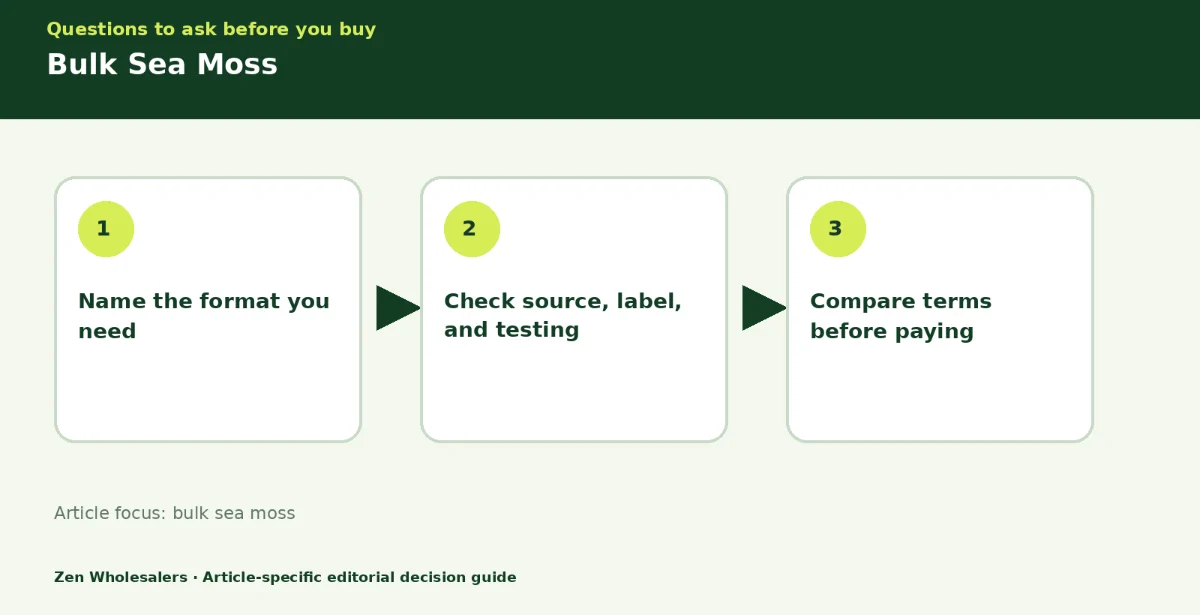
Why this matters: sea moss comes in many forms and quality levels. It can vary a lot by harvest, handling, and testing. The right checks help you make a clearer, safer decision.
What “bulk sea moss” commonly means
“Bulk sea moss” is a trade term. It covers several product forms you can buy in bulk:
- Dried whole strands. These are the seaweed pieces dried for storage.
- Powdered or milled sea moss. For use as an ingredient.
- Wet-packed or raw sea moss. Sold with moisture for food processing.
- Pre-made gels or extracts. Sold in larger containers for formulation.
Each form changes how you store, test, and use the product. Suppliers may use different names. Ask for a full product description and sample before you commit.
Who buys sea moss in bulk
- Food and beverage brands that use sea moss as an ingredient.
- Dietary supplement manufacturers who need consistent input material.
- Wholesalers and distributors that repackage into retail sizes.
- Foodservice operators that use sea moss in recipes.
Your use case should drive what tests and paperwork you require. A retail jar needs different checks than a large-scale ingredient for capsules.
Key buyer concerns to check right away
Below are the main topics you should evaluate. Each item explains what to check and why it matters.
Species and grade
What to check:
- Exact species name or supplier code for the harvest lot.
- Photographs of the raw material.
Why it matters:
- Seaweed types differ in look and handling. Species identification helps with expectations for color, texture, and processing needs.
What it cannot prove:
- Species name alone does not guarantee the same quality between harvests.
Form and processing
What to check:
- Whether the product is dried, powdered, or wet.
- How it was dried or processed (air-dried, sun-dried, mechanically dried, milled).
Why it matters:
- Processing affects shelf stability, water activity, and suitability for your product.
Testing and contaminants
What to check:
- Certificates of Analysis (COAs) for heavy metals, microbial limits, and iodine when available.
- Dates and lab names on COAs.
Why it matters:
- Tests show measured values for the sample tested. They help reduce risk.
What it cannot prove:
- A COA applies only to the tested lot or sample. It cannot prove that all future lots will match those results.
Relevant notes on iodine and variability:
- Seaweeds can have very different iodine levels depending on species and harvest. Authorities and researchers note this variability and advise testing when iodine intake matters for your product design or labeling [1][2][3][5].
- Claims about safe iodine levels require current, lot-specific data. If iodine is a concern for your customers, include iodine testing in your COA requests.
(For broader context on seaweed nutrition and variability, see the Harvard page on seaweed [1]. For scientific reviews and iodine concerns, see [2] and [5]. For survey data on iodine levels, see [3].)
Traceability and documentation
What to check:
- Harvest or lot numbers, harvest date, and location descriptions.
- Supplier traceability systems and whether they can link a COA to a lot number.
Why it matters:
- Traceability helps if you need to investigate a quality issue. It is a core part of risk control for food inputs.
Packaging and storage
What to check:
- Packaging type (bulk bags, drums, moisture-barrier materials).
- Recommended storage conditions and shelf handling.
Why it matters:
- Packaging affects transport cost, shelf life, and contamination risk.
Minimum order quantity (MOQ) and lead times
What to check:
- Supplier MOQ range.
- Typical lead times from order to shipment.
Why it matters:
- MOQ affects cash flow and inventory planning. Lead time affects your scheduling and customer commitments.
Regulatory and labeling needs
What to check:
- Supplier ability to provide documentation you need for your market (e.g., food-grade declarations, allergen statements).
- Any country- or market-specific requirements for seaweed ingredients.
Why it matters:
- Regulatory needs depend on where you sell and how you use the sea moss.
Note on regulation: Seaweed in dietary supplements and foods is handled differently by agencies. Guidance and inspection levels vary by market. Industry resources note the need to confirm regulations and documentation for your application [4].
How to evaluate a supplier: a practical checklist
Use this checklist during first contact and when you receive a quote. Ask for each item. Do not accept vague answers.
- Product name and form (dried, powder, wet).
- Species or supplier product code.
- Lot or batch number for the quoted material.
- Photos of the lot and packing.
- COA for that lot with dates and lab name.
- Tests included in COA (heavy metals, microbial, iodine if relevant).
- Harvest date and general harvest area description.
- Storage and packaging description.
- Supplier traceability procedure.
- Minimum order quantity and sample policy.
- Lead time and production capacity.
- Shipping terms (Incoterms) and common carriers.
- Insurance and product recall policy.
- Third-party audits or certifications (if any) and audit scope.
- References from other commercial buyers (optional).
Do not expect every supplier to supply everything immediately. Use this list to compare offers. Keep records of what each supplier provides.
Table: What to ask for, why it matters, and how to use the result
| What to ask for | Why it matters | What to do with it |
|---|---|---|
| Certificate of Analysis (COA) | Shows measured levels for tested contaminants and parameters | Check dates and lab; if values are close to your limits, request retest or tighter specs |
| Lot/Batch number and harvest date | Ties the COA to a physical shipment | Accept only lots with traceable numbers; record for future recall control |
| Photos of raw and packed material | Visual check for color, foreign matter, packing integrity | Compare photos to received shipments for consistency |
| Third-party audit or GMP statement | Shows supplier process control level | Use as one factor in supplier approval; audits vary in scope |
| Sample (paid or small) | Hands-on check for taste, smell, processing behavior | Test in your process before placing large orders |
| Iodine testing | Iodine can vary a lot across seaweeds | If iodine matters for your product, require lot-specific iodine results [2][3][5] |
| Microbial testing | Food safety and shelf stability | If you use sea moss in ready-to-eat products, include microbial limits in specs |
| Heavy metals testing | Arsenic, lead, cadmium can occur in seaweeds | Require heavy metal testing for raw inputs; check lab accreditation |
Requesting a quote and the typical quote workflow
A clear workflow lowers risk. Here is a common path to follow when you want to buy sea moss bulk:
- Initial inquiry
- Send product needs, estimated order size, and required documents (COA, photos).
- Supplier reply
- Supplier sends product spec, MOQ, lead time, and a preliminary price quote.
- Sample request
- Request a sample tied to a lot number. Ask whether samples come from inventory or current production.
- Lab check (optional)
- Send the sample to your lab or request a third-party test on the supplier’s sample.
- Negotiate terms
- Agree on packaging, lab testing responsibility, payment terms, and Incoterms.
- Account setup
- Supplier may require an account form, trade references, or a purchase agreement.
- Purchase order and deposit
- Place PO and provide deposit if required.
- Production and QC
- Supplier produces and issues COA for the shipping lot.
- Shipping and documents
- Receive bill of lading, COA, packing list, and other customs documents.
- Receipt and inspection
- Inspect shipment on arrival and hold payment balance per agreed terms if conditions allow.
What you can ask for in the quote:
- A sample size and cost.
- A clear breakdown of what tests are included in the price.
- Packaging options and how packaging affects freight.
- An estimated timeline for production and shipment.
What a quote cannot prove:
- A quoted COA for a past lot does not guarantee future lots will test the same.
Account approval and supplier onboarding tips
When you decide to work with a new supplier, add these steps to your onboarding:
- Require proof of business registration and contact details.
- Start with a smaller initial order or trial lot.
- Document agreed specifications in a purchase agreement.
- Agree on how disputes will be resolved and the return policy.
- Ask whether the supplier offers batch photos or pre-shipment inspection.
Keep onboarding documents in a supplier file. That helps you build a predictable supply chain.
Sampling and incoming inspection
When a bulk shipment arrives, do these checks:
- Verify the lot number on the shipping documents against the COA.
- Inspect packaging for damage or moisture entry.
- Open a representative number of packages for visual inspection.
- Smell-check for off-odors or unusual signs.
- Collect and hold a sample for your lab if you plan to test.
- Compare the received product to the sample you approved.
If you find a serious discrepancy, follow the dispute steps in your purchase agreement.
Storage and handling basics
Sea moss in bulk needs sensible handling. These general tips help lower quality loss:
- Keep dried sea moss in a cool, dry space.
- Use moisture-barrier packaging if you will store for longer periods.
- Rotate stock by lot to use older inventory first.
- Avoid exposure to strong odors that could transfer to the product.
- For wet or high-moisture forms, follow supplier guidance and local food safety rules.
If you plan to repackage into retail sizes, include a hygiene plan and record-keeping for traceability.
Pricing and cost drivers to expect
Prices vary widely. Here are the main cost drivers:
- Form (dried, powder, wet) and processing level.
- Testing and documentation requirements.
- Packaging type and unit size.
- Freight costs and Incoterms.
- Seasonality and harvest availability.
- Supplier capacity and demand.
When you compare quotes, make sure each supplier quotes the same form, same packaging, and the same tests. Differences in those items make direct price comparisons misleading.
Decision guide: How to pick the right bulk option for your need
Use this short guide to match your use case to the checks you need.
- You will repackage for retail:
- Priorities: consistent color and size, packaging integrity, shelf guidance.
- Ask for: visual photos, sample lot, COA for key contaminants.
- You will use as an ingredient in finished food:
- Priorities: microbial limits, water activity, consistency in processing.
- Ask for: microbial testing, processing details, sample in your formulation.
- You will use for dietary supplements:
- Priorities: heavy metals, iodine, third-party test documentation.
- Ask for: heavy metals COA, iodine levels, supplier traceability, third-party audit if available.
- You will resell to other businesses:
- Priorities: broad documentation, repeatable supply, MOQ flexibility.
- Ask for: consistent lot supply, favorable MOQ, proof of traceability.
If you are unsure, start with a small trial order and include a clear acceptance test.
Next steps and practical checklist before you buy
- Define use case and required tests.
- Prepare a short supplier info request including required COAs and sample policy.
- Ask for lot photos and batch numbers.
- Request a sample and run it in your process or send to your lab.
- Compare quotes on the same specs (same form, packaging, and tests).
- Start with a trial order and clear acceptance criteria for the lot.
If you want help with supplier checks, sample wording, or building an internal checklist, see our wholesale page or contact our team.
Useful internal links
- Learn more about our wholesale process at Wholesale.
- Read background resources at our Learn section.
- Browse retail options if you need smaller quantities at Shop.
- Return to our home page for company info: Zen Wholesalers.
- Ready to request a quote or ask a question? Contact us.
Conclusion
Buying bulk sea moss requires clear questions and good records. Start with your use case. Ask for lot-specific COAs. Request samples and test them in your process. Check traceability and packaging. Use a small trial order before scaling. These steps reduce surprises and help you build a reliable supply. If you need help comparing quotes or putting together a spec sheet, reach out via our wholesale contact page.
Frequently asked questions
Can I buy sea moss in bulk online?
Yes. Many suppliers accept online enquiries and can send quotes and samples. Treat online quotes the same as any quote. Ask for lot-specific COAs and a sample before you place a large order.
What lab tests should I ask for on a sea moss COA?
Ask for tests that match your product risk and market. Common tests are heavy metals, microbial counts, and iodine when iodine intake is a concern. The exact list depends on your application and your market’s rules [1][2][3][5].
How much should I order for a first test run?
There is no universal number. Many buyers start with a smaller trial lot that is large enough to test in their process but small enough to limit risk. Confirm each supplier’s sample policy and MOQ before deciding.
Do I need to test every incoming lot?
Testing every lot adds cost. For higher-risk applications, buyers test every lot or use a sampling plan. For lower-risk uses, buyers may test randomly or rely on supplier control and periodic third-party testing. Make a plan that matches your risk tolerance.
Is iodine in sea moss a safety concern?
Iodine levels in seaweeds vary a lot by species and harvest. That variability is why testing matters if iodine is relevant to your product or label. Scientific reviews highlight the variability and advise testing when iodine intake matters [2][5]. Regulatory surveys also report wide variation across products [3].
What should I do if a shipment fails my specs?
Follow your purchase agreement. Common steps include contacting the supplier, documenting discrepancies, holding or rejecting the shipment per agreed terms, and arranging testing or return. Keep records for potential recalls and insurance claims.
References
- [1] Harvard T.H. Chan School of Public Health, “Seaweed.” https://nutritionsource.hsph.harvard.edu/seaweed/
- [2] Smyth PPA. “Iodine, Seaweed, and the Thyroid.” European Thyroid Journal, 2021. https://pmc.ncbi.nlm.nih.gov/articles/PMC8077470/
- [3] Food Standards Australia New Zealand, “Survey of iodine levels in seaweed and seaweed containing products,” updated 2025. https://www.foodstandards.gov.au/science-data/monitoring-safety/surveyofiodinelevels
- [4] Operation Supplement Safety, “Sea Moss in Dietary Supplements.” https://www.opss.org/article/sea-moss-dietary-supplements
- [5] Blikra MJ et al. “Consequences of acute and long-term excessive iodine intake: A literature review focusing on seaweed as a potential dietary iodine source.” 2024. https://doi.org/10.1111/1541-4337.70037