
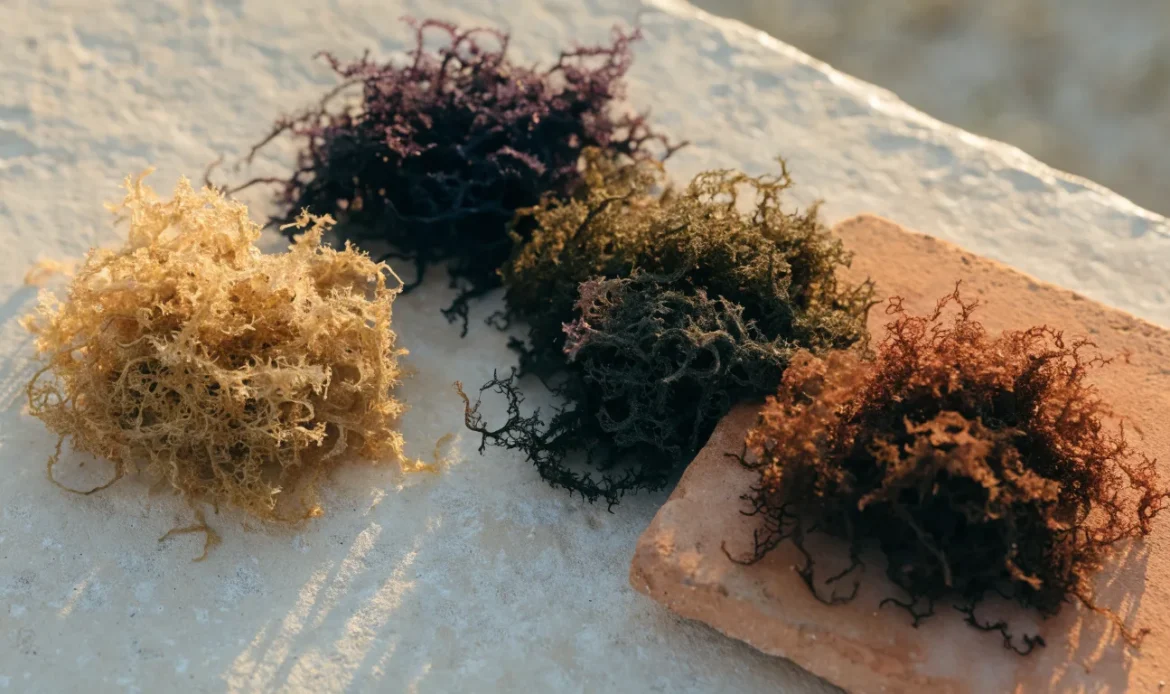
Short answer: Raw sea moss for sale varies a lot. Look for clear information about where it was harvested, how it was handled, what species it is, and whether the seller has test results. Those checks help you make a safer, smarter buy. Read on for step-by-step guidance, what questions to ask, and a practical decision guide.
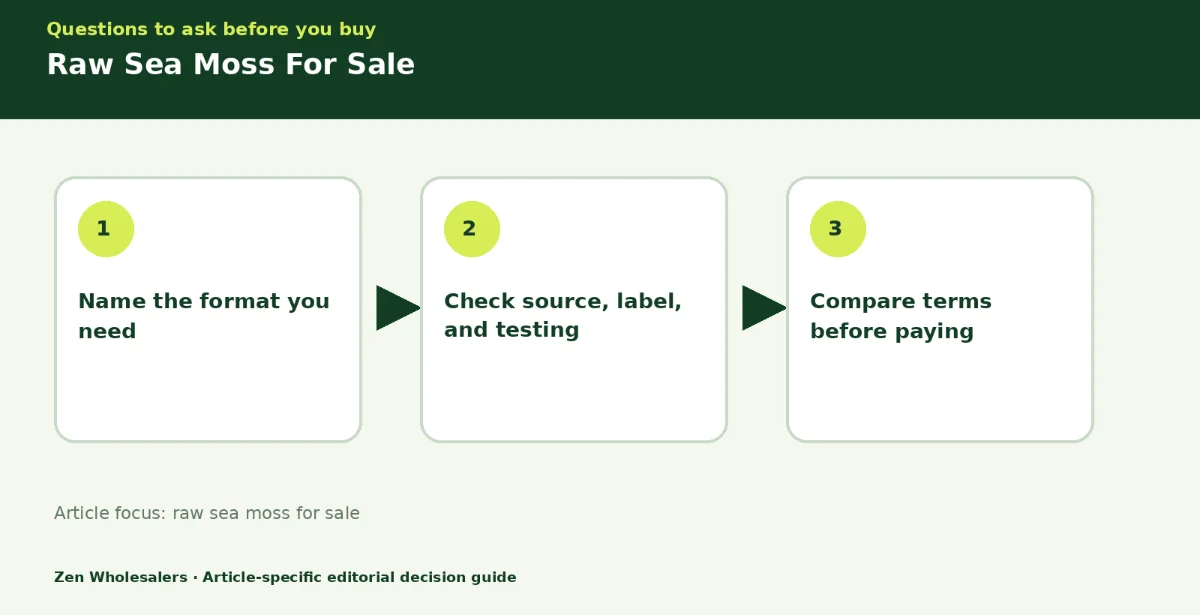
What people mean by “raw sea moss”
“Sea moss” is a common name. It can mean several kinds of marine algae. Sellers may also call it “Irish moss” or “red algae.” Raw sea moss usually means it is minimally processed. That often means it was rinsed and dried, and not heated or mixed into other products. But sellers use terms differently. Always ask what they mean by “raw.”
What “raw” does not prove:
- It does not guarantee the product is free of contaminants. Wild sea plants can pick up iodine, metals, or microbes from water.
- It does not prove strict traceability or lab testing was done.
Why origin, species, handling, and documentation matter
Origin, species, handling, and documentation are the most useful facts a seller can give you. Each tells you something real — but none is a complete guarantee on its own.
- Origin (where it was harvested): Water quality and local regulations differ by place. Knowing origin helps you judge risk. But a named location does not prove water quality or safe handling. The seller must also show testing or controls.
- Species: Different species have different textures and uses. Some species have naturally higher iodine or different mineral profiles. Knowing species helps set expectations. Species names do not prove safety without testing.
- Handling: How sea moss is cleaned, dried, and stored matters for quality and shelf condition. Proper handling reduces spoilage and mold risk. But handling claims need verification; ask for photos or process details.
- Documentation: Certificates of analysis (COA), third-party lab reports, and chain-of-custody records are the most useful proof you can get. A COA shows what was tested and what the results were. But the presence of a COA does not automatically mean the product is perfect. Check who ran the test and what the results say.
For health concerns tied to seaweed, iodine is an important example. Some seaweeds can be high in iodine. If you have thyroid issues or take certain medicines, knowing iodine content matters. Public health sources and reviews discuss iodine in seaweed and the need for caution in some cases [1][2][5]. If iodine is a concern for you, ask for iodine test results or seek guidance from a health professional.
How to evaluate raw sea moss for sale: what to ask and check
Below is a practical list. Use it when you contact a seller or inspect product info online.
- Ask for the species name. Common names vary. A Latin name helps avoid confusion.
- Ask where and when it was harvested. Recent harvest dates are useful for fresh products.
- Ask whether it was wild-harvested or farmed. Each has pros and cons.
- Ask how it was cleaned and dried. Air-dried, sun-dried, mechanically dried — these steps affect texture and microbes.
- Request storage conditions. Ask how it was kept between harvest and sale.
- Ask for lab testing or certificates of analysis. Specifically ask if third-party labs tested for heavy metals, microbiological contamination, and iodine.
- Ask who did the testing and when. Third-party testing is more informative than in-house tests.
- Ask for photos of the product and packaging. Look for consistent color and absence of foreign matter.
- Ask for handling instructions and recommended shelf handling.
- Ask about returns, samples, and quality guarantees.
What seller answers can actually prove:
- A clear COA from an accredited lab proves those specific test results on the sampled lot. It does not prove future lots will match unless the seller tests them too.
- A named harvest site proves where that batch came from. It does not prove water quality without independent testing.
- A documented supply chain increases traceability. It reduces uncertainty but does not eliminate the need for testing.
What seller answers cannot prove:
- That the product is free from all contaminants for life of storage.
- That small samples represent every batch, unless ongoing testing is shown.
- That “traditional processing” or “natural” equals safety.
Cite sources about iodine and testing concerns: seaweed can vary in iodine content and may affect some consumers; testing is the way to know [1][2][5].
Quick guide: Wild-harvested vs. farmed sea moss
Both wild and farmed sea moss are sold as raw. They differ in ways that matter to buyers.
Wild-harvested:
- Pros: Often harvested from natural reefs and rocks. Some buyers prefer wild texture and variety.
- Cons: Greater variability in composition. Potential exposure to local pollution is a concern. Requires spot testing.
Farmed:
- Pros: Farming allows more control over growing conditions and harvest schedules. Traceability is often easier.
- Cons: Farming methods vary. Feed and local water still matter. Farming does not eliminate all risks.
Neither source guarantees safety. Ask for testing and handling details in either case.
Handling and preparation tips for buyers (practical, non-medical)
If you buy raw sea moss, follow basic food-safety steps.
- Inspect on arrival: Look for odd colors, strong bad smells, or visible foreign matter. If something seems wrong, contact the seller.
- Rinse before use: Rinse under running cool water to remove sand and debris.
- Soak as directed: Many raw sea moss items are soaked to soften. Follow the seller’s instructions.
- Cook or make a gel as you plan to use it: Many recipes call for gentle heating or blending. Follow safe food-handling steps.
- Store as directed: Keep in a dry, cool place for dried sea moss. Refrigerate opened sea moss gel. Follow seller advice.
- When in doubt, discard: If you see mold, off smells, or slime, do not use the product.
These steps reduce spoilage risk. They do not change the mineral or iodine content of the product.
Lab testing: what to ask for and how to read results
If you want proof of safety, lab reports are the strongest tool you can ask for. Here are key points to consider.
- Ask for Certificates of Analysis (COAs) from accredited labs. COAs list what tests were done and the results for a specific lot.
- Look for tests for heavy metals (like lead, arsenic, cadmium), microbiological tests, and iodine content.
- Check the lab accreditation. Accredited third-party labs are more trustworthy than undisclosed or in-house tests.
- Check the date and the lot number on the COA. Make sure it matches the product you will buy.
- Understand what the tests do not show. A COA shows results for the tested sample only. It does not automatically mean every future lot will have the same values.
Public health reviews highlight iodine as a variable component in seaweeds and note risks from excessive iodine intake in some contexts [1][2][5]. If iodine matters to you, ask specifically for iodine test values on the COA.
Price, volume, and buying in bulk: practical considerations
When buying raw sea moss for sale, balance cost with documentation and safety.
- Bulk buys can lower per-unit cost. They also raise the need for good storage and clear testing.
- Ask how the seller stores large volumes. Improper storage increases spoilage and contamination risk.
- Ask for sample testing before you buy a large lot. A single lot test is not perfect, but it reduces uncertainty.
- Ask about a return policy or sample program. Reliable sellers often let buyers inspect samples before a big purchase.
- If you plan to resell, ask for documentation you can provide to your customers.
Do not rely on low price alone. Low cost with no documentation increases risk. But price alone does not indicate safety either. Ask questions.
Decision guide: what to check, good answers, red flags
Use this table when comparing sellers. It helps turn vague claims into concrete checks.
| What to check | Good answer (what you can rely on) | Red flag (ask more or walk away) | What this proves / doesn’t prove |
|---|---|---|---|
| Species name | Clear Latin species name (e.g., Chondrus crispus) | Only a marketing name like “wild sea moss” | Proves species claim for that lot if true. Does not prove safety. |
| Harvest location & date | Named region and recent harvest date | “From the Caribbean” with no site or date | Shows origin for that batch. Does not prove water quality. |
| Wild vs farmed | Clear statement with process details | Vague claim like “naturally grown” | Helps predict variability and traceability. |
| Cleaning & drying process | Described steps (rinsed, dried at X temp/method) | No steps or “processed traditionally” only | Shows how product was handled. Not proof of microbial safety. |
| Certificates of Analysis (COA) | COA from an accredited, named lab showing tests (heavy metals, iodine, microbiology) | No COA or COA without lab name/date | Proves specific test results for the sample. Not proof for future lots. |
| Lab accreditation | Named, third-party accredited lab | Unnamed lab or in-house testing only | Increases trust in test results. Does not guarantee all contaminants tested. |
| Storage & packing | Detailed storage instructions and packaging photos | No storage info | Helps you plan storage. Not proof of shelf-free safety. |
| Samples & returns | Seller offers samples or returns for defects | No samples, no returns | Makes it easier to inspect before a big buy. |
Use this table when you compare two or more sellers. Ask for COAs and sample photos early.
Practical checklist before you buy
Use this checklist to move from doubt to decision. Tick the items before buying a significant quantity.
- [ ] Seller gives Latin species name.
- [ ] Seller names a harvest location and date.
- [ ] Seller explains wild vs farmed and shows handling steps.
- [ ] Seller provides a COA from a third-party lab for the lot you will buy.
- [ ] COA lists heavy metals, microbiology, and iodine (if iodine concerns you).
- [ ] Lab name and accreditation are visible on the COA.
- [ ] Seller can provide storage and handling instructions.
- [ ] Seller offers a sample or small test order.
- [ ] Seller explains return or refund policy.
- [ ] You have inspected photos or the sample for visible debris, odd color, or smell.
If several boxes are unchecked, ask questions or seek another supplier.
How to compare sellers when information is limited
If a seller provides limited data, use the following steps:
- Ask for more details. A legitimate seller should answer basic questions about origin and testing.
- Ask for a sample. Handling and texture will tell you a lot.
- Ask for the COA for the current lot. If they cannot provide one, be cautious.
- Check return and dispute policies. That protects you if the product is defective.
- Consider smaller test purchases first. It lowers your risk while you gather evidence.
Even with tests, remember that one sample does not guarantee future lots. Ongoing checks are how professional buyers reduce risk.
Red flags to watch for
- No COA or lab name.
- Vague origin information.
- No photos of product or process.
- Seller refuses to send small samples.
- No clear storage or handling instructions.
- Excessive or impossible claims about health cures or specific medical outcomes. (These are not reliable and should be treated as a red flag.)
Where to learn more and next steps
If you want to learn more about seaweed, science, and safety, see reliable sources such as Harvard T.H. Chan School of Public Health for general guidance on seaweed [1]. For information on iodine in seaweed and the thyroid, see scientific reviews [2][5]. For practical notes on sea moss in supplements, see Operation Supplement Safety [4].
If you want to see how a producer documents harvest and handling, visit our farm page to learn about typical farm practices and traceability reporting: /our-farm/. To explore other educational content, see our learning hub: /learn/. If you are ready to inspect products or request samples, visit /shop/ or contact sellers who provide transparent testing information. For wholesale inquiries, see /wholesale/. For direct questions, use /.
Conclusion
Raw sea moss for sale comes in many forms. No single claim proves safety. The strongest proof is a combination of clear species and origin data, a documented handling process, and a certificate of analysis from a reputable lab. Use the checklist and decision guide here when you compare sellers. Ask for samples and COAs. If iodine or heavy metals are a concern for you, ask specifically about tests for iodine and heavy metals, and consult a health professional if needed. These steps help you make a more informed purchase, whether you buy a small bag or a bulk lot.
Continue reading
Frequently asked questions
How can I tell if raw sea moss is fresh or spoiled?
Check for strong bad odors, sliminess, or visible mold. For dried sea moss, look for odd dark spots not typical to the species. If you are unsure, ask the seller for photos or a small sample.
Should I worry about iodine in sea moss?
Iodine levels vary by species and location. Some seaweeds can be high in iodine. If you have thyroid conditions or take medication affected by iodine, consult a health professional and ask the seller for iodine testing on the lot [1][2][5].
Are lab tests necessary for buying raw sea moss?
Lab tests are the best way to know certain risks, like heavy metals or microbial contamination. A COA from an accredited third-party lab gives you evidence about a specific lot. It is a strong signal of transparency, especially for bulk purchases.
Can I trust a seller who says the sea moss is “wild and natural”?
“Wild” and “natural” are marketing terms. They do not prove safety or quality. Ask for origin details and testing to back up any claim.
Is farmed sea moss safer than wild-harvested?
Farming allows more control of growing conditions, which can help with traceability. But farming practices vary, and farmed sea moss still needs testing. Neither option is inherently guaranteed safe without documentation.
What if the seller has no COA but has good photos and nice packaging?
Photos and packaging help with appearance, but they do not replace lab testing. For small, low-risk purchases you might accept this. For larger or regular buys, insist on testing and traceability.
References
- [1] Harvard T.H. Chan School of Public Health, “Seaweed.” https://nutritionsource.hsph.harvard.edu/seaweed/
- [2] Smyth PPA. “Iodine, Seaweed, and the Thyroid.” European Thyroid Journal, 2021. https://pmc.ncbi.nlm.nih.gov/articles/PMC8077470/
- [4] Operation Supplement Safety, “Sea Moss in Dietary Supplements.” https://www.opss.org/article/sea-moss-dietary-supplements
- [5] Blikra MJ et al. “Consequences of acute and long-term excessive iodine intake: A literature review focusing on seaweed as a potential dietary iodine source.” 2024. https://doi.org/10.1111/1541-4337.70037