
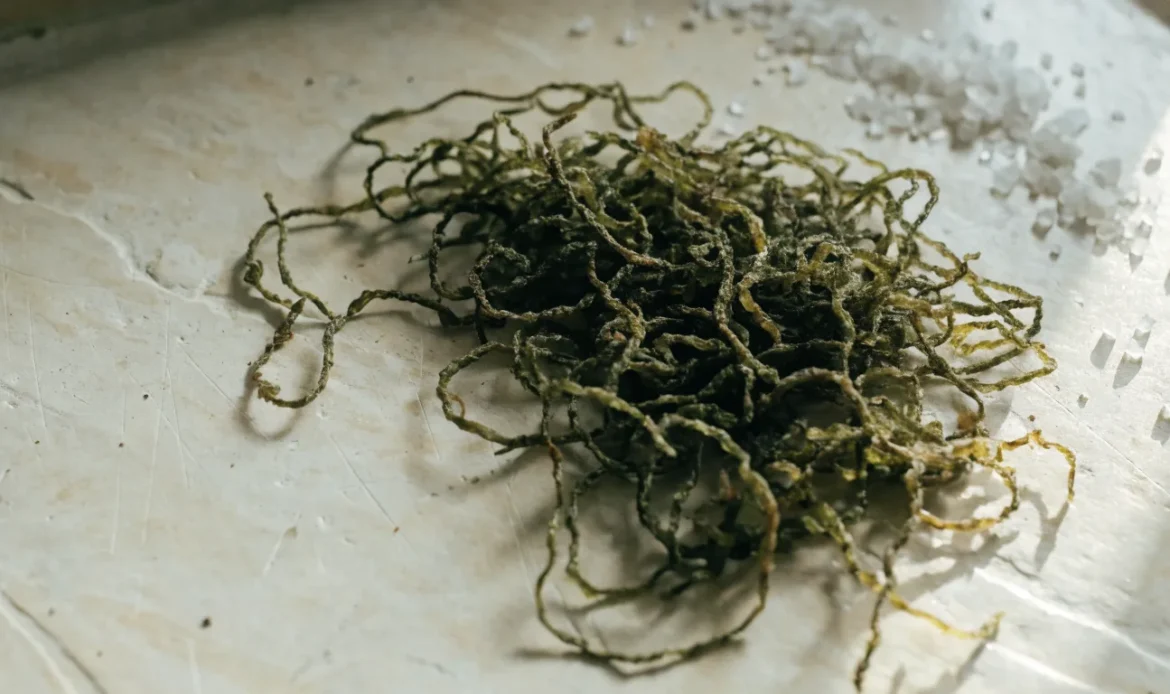
Short answer: Green sea moss is a type of edible seaweed people use as food and in supplements. It contains nutrients found in many seaweeds. Scientific evidence for specific health effects in people is limited. You can, however, check clear markers of quality and safety before you buy.
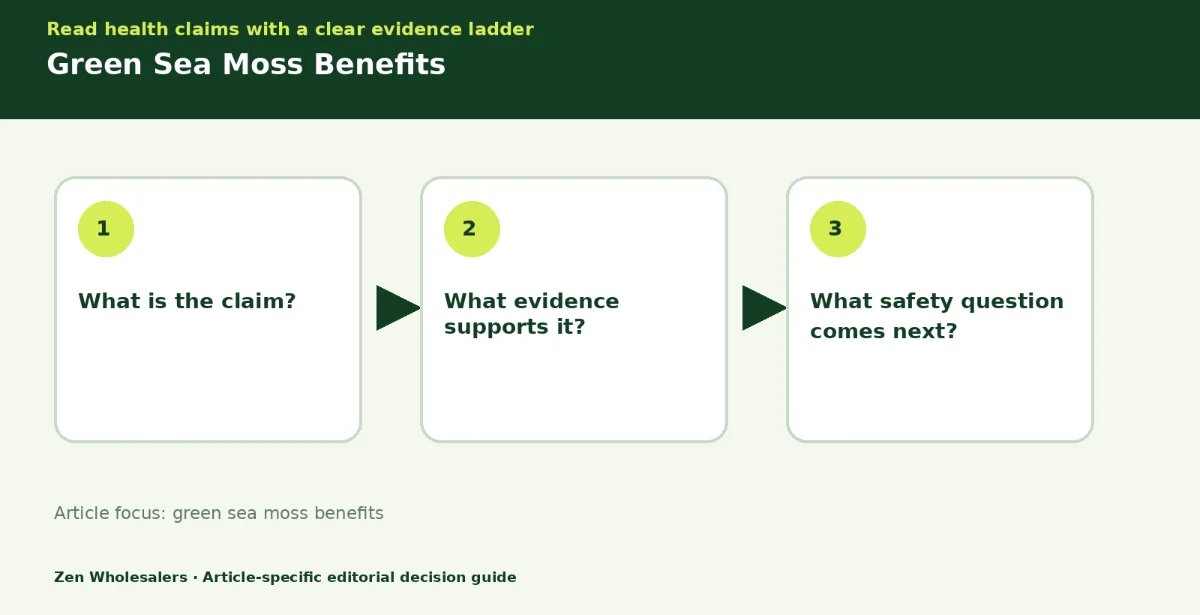
Why this page: You want a clear answer and a practical next step. This page explains what green sea moss is, what basic science says, what we do not know, how to evaluate products, and when to ask a clinician.
What is green sea moss?
Green sea moss usually means a green-colored seaweed used as food. “Sea moss” is a common name. Multiple species and colors exist. The green tone comes from algae pigments and growing conditions. As with other edible seaweeds, green sea moss is largely a food item in traditional diets. Its makeup varies by species, place where it grew, and how it was handled after harvest. General facts about seaweeds can help you understand green sea moss. [1]
What people often claim — and what the evidence actually shows
People often say sea moss provides many benefits. It is useful to separate four categories of information:
- Food composition. What nutrients or compounds are in the seaweed itself.
- Traditional use. How people have used it in food or folk practice.
- Early lab and animal studies. Small or preliminary studies done in cells or animals.
- Clinical proof. Well-designed studies in people that show a real health effect.
Below I summarize what is known in each category for seaweeds and green sea moss specifically.
1) Food composition (what is in seaweed)
Seaweeds contain minerals, fiber-like polysaccharides, and small amounts of protein and vitamins. Iodine is one of the minerals often present in high amounts in seaweeds. The exact amounts vary by species, season, and location. This variability is normal for natural foods. [1]
Many nutrients reported in seaweeds can be measured by labs. Those results tell you what was in a tested sample. They do not alone prove that eating the seaweed will give a health benefit. They do, however, help you judge safety and content.
Citation: basic seaweed nutrient facts are summarized by Harvard School of Public Health. [1]
2) Traditional use
People have eaten seaweeds for centuries in many places. Sea moss is used as a food, thickener, or ingredient in dishes and beverages. Traditional use is valuable context. It does not replace modern safety testing or show clinical effectiveness.
3) Early lab and animal studies
Researchers sometimes test seaweed extracts in lab or animal settings. These studies can suggest biological activity of certain seaweed compounds. Early work helps guide further research. It cannot prove an effect in humans.
4) Clinical evidence in people is limited
High-quality clinical trials that measure specific health outcomes for green sea moss are scarce. Evidence for specific health claims—such as improving a condition or curing a disease—is limited or not available. Where human research exists for seaweeds more broadly, results vary by species, dose, processing, and study design. That means we should be cautious about broad or strong claims.
Overall: green sea moss is a food with measurable nutrients. The evidence that it causes specific health outcomes in people is limited. You can reasonably treat it as a food ingredient whose safety and content depend on origin and handling. [1]
Important safety facts to check: iodine and contaminants
Two safety issues stand out for seaweeds:
- Iodine can be very high in some seaweeds. Excessive iodine intake can affect the thyroid. People with thyroid disease, pregnant people, and those on certain medicines should be especially careful. [2] [5]
- Natural seaweeds can absorb metals and other substances from the water. Proper testing can find heavy metals, pesticides, or microbial contamination.
Regulation and testing for seaweed products vary by country and by whether a product is sold as food or a supplement. Many sellers provide lab reports or certificates of analysis (COAs). These documents help you judge safety. Organizations that review supplements urge caution and recommend testing and clear labeling for seaweed-derived products. [4]
Citations: iodine and thyroid considerations are described in the European Thyroid Journal and a recent review on iodine from seaweed. [2] [5] Information on supplement safety and testing recommendations is discussed by Operation Supplement Safety. [4]
How to evaluate green sea moss before you buy
You can check specific things to judge quality and safety. Below is a practical decision checklist. Use it when you research a seller or product.
Decision checklist for evaluating green sea moss
| What to check | Why it matters | What to ask or look for |
|---|---|---|
| Species and common name | Different species have different nutrient levels and textures. | Ask seller what species or include Latin name. |
| Origin / harvest location | Water quality affects safety and composition. | Ask where it was harvested and if nearby industrial activities exist. |
| Harvest method | Wild-harvest vs. farmed affects consistency. | Was it hand-harvested? Was farming monitored? |
| Handling & drying method | Improper drying allows spoilage. | How and where was it dried? Was it sun- or machine-dried? |
| Processing steps | Processing changes shelf-life and content. | Is it sold raw, powdered, or made into gel? What steps are used? |
| Lab testing (COA) | Tests can show iodine, heavy metals, microbes. | Ask for a recent COA. Look for tests on iodine and heavy metals. |
| Packaging & storage | Proper packaging prevents contamination. | Does packaging protect from moisture and light? Is there a lot/batch date? |
| Supplier transparency | Transparent sellers provide details and contact info. | Can you contact the seller for questions? Do they list lab tests? |
| Intended use label | Food vs supplement rules differ. | Is it labeled as food, ingredient, or supplement? What regulations apply? |
How to interpret answers
- If a seller provides a recent COA showing results for iodine and heavy metals, that adds confidence for that batch. A COA tells you what was tested for that sample. It does not guarantee other batches are identical.
- If a seller cannot tell the species or harvest location, be cautious. Lack of transparency makes it harder to judge safety.
- If no testing exists and you or your group are in a risk category (pregnant, thyroid issues, children), consider avoiding until you have clear information.
A clear COA and transparent harvest details let you compare products. They do not alone prove a health benefit. They help you make a safer purchase.
Buying tips: what documentation to request
Ask sellers for:
- Certificate of Analysis (COA) for the batch. Many labs test iodine, heavy metals (lead, cadmium, arsenic), and microbial contamination.
- Harvest location and date. Freshness and season can affect composition.
- Processing steps and storage advice.
- Species identification or Latin name when available.
What a COA can and cannot prove
- Can: show measured levels of tested substances in that sample.
- Cannot: guarantee all future batches are identical or prove health claims.
Regulatory note: Rules differ by country and by whether the item is sold as food or as a dietary supplement. When sold as supplements, some products may need specific labeling and adherence to good manufacturing practices. Organizations that review supplements advise consumers to ask for independent testing and transparent labeling. [4]
Citation: supplement safety and testing recommendations. [4]
How people commonly use green sea moss
Green sea moss appears in recipes and preparations as:
- A cooked or raw ingredient in dishes.
- A thickener in soups or beverages after blending into a gel.
- A powdered ingredient added to smoothies or baked goods.
As a food, it is often treated like other seaweeds: rinse well, soak or cook as needed, and follow safe storage. If you want to use it regularly, check lab results for iodine and heavy metals first, especially if you are in a risk group.
Safety and when to ask a clinician
If any of these apply to you, talk to a clinician before adding sea moss regularly to your diet:
- You have thyroid disease or irregular thyroid tests.
- You are pregnant, breastfeeding, or planning pregnancy.
- You are taking thyroid medication or other drugs that may interact with iodine.
- You are buying seaweed for a child.
- You have a condition that requires dietary restrictions.
Why this matters: some seaweeds can have very high iodine. Excess iodine can cause thyroid dysfunction in some people. Scientific reviews have documented both short-term and long-term risks of excessive iodine intake from seaweed sources. [2] [5] National and international food authorities monitor iodine in seaweed products and sometimes publish surveys of iodine levels found in products. [3]
If testing shows unusually high iodine in a product, or if you lack reliable testing information, consult a clinician before regular use.
Citations: iodine risk and literature on consequences of excessive iodine; survey data on iodine in seaweed products. [2] [5] [3]
Practical storage and home handling tips
- Rinse seaweed that will be eaten raw. Water removes sand and surface debris.
- Dry thoroughly if you plan to store it long term.
- Store in a cool, dry place or refrigerate per seller instructions.
- Use clean utensils and containers when making gels or blends.
- Label home-made batches with date and what you added (if anything).
These steps help lower the chance of spoilage and contamination.
What you can test at home and what needs a lab
At home you can:
- Inspect for off smells or visual spoilage.
- Note batch dates and storage conditions.
You cannot reliably test for iodine or heavy metals at home. For those you need a laboratory test and a COA from an accredited lab.
Evidence-strength ladder (how to weigh claims)
When you read a claim about green sea moss, think in these levels:
- Level 1 (Food composition): Lab measures show nutrients and minerals in a sample. This is factual for that sample. [1]
- Level 2 (Traditional use): People have used it for food and recipes for a long time. This is cultural knowledge.
- Level 3 (Early research): Lab or animal studies suggest biological activity. This points to possible effects that require more testing.
- Level 4 (Human clinical trials): Randomized trials in people that show clear, replicable benefits. For green sea moss, this level is rare or absent for most specific health claims.
If a product makes health claims, ask which level of evidence it refers to. Many product pages conflate Level 1 or 2 with Level 4. That is not scientific proof.
Practical decision guide (short)
If you want to try green sea moss:
- Step 1: Ask the seller for species and harvest location.
- Step 2: Request a COA for iodine and heavy metals for the batch.
- Step 3: If you are in a risk group (thyroid, pregnancy, child), consult a clinician before use.
- Step 4: If COA looks acceptable and no clinical warnings apply, start by using it as a food ingredient occasionally. Watch for any symptoms and store properly.
Conclusion
Green sea moss is a food that contains nutrients commonly found in seaweeds. The strongest, provable facts are about what can be measured in a particular batch. Evidence that sea moss causes specific health outcomes in people is limited. Before buying, focus on species identification, harvest origin, handling, and independent lab testing for iodine and contaminants. If you are pregnant, have thyroid disease, are giving it to a child, or take related medicines, talk to a clinician first.
If you want more details about where our products come from, how we harvest, or to see our farm practices, visit our farm page at /our-farm/. To read more learning resources, go to /learn/. If you are ready to browse products, see /shop/ or contact us at /contact/ for questions. You can also return to our home page at / to explore other resources.
Continue reading
Frequently asked questions
Is green sea moss better than other colors of sea moss?
Color alone does not determine safety or value. Different species and growing conditions affect color. Better questions are: what species is it, where was it harvested, and are there lab tests for the batch?
Can green sea moss give you too much iodine?
Some seaweeds can contain high iodine. Levels vary widely. Too much iodine can affect the thyroid in susceptible people. If you have thyroid issues or are pregnant, talk to a clinician before regular use. [2] [5]
How do I know if a seller’s lab test is legitimate?
Look for a COA from an accredited independent lab. Check the test date and whether it matches the batch number. If a seller provides vague or no testing, ask follow-up questions. Organizations that review supplements recommend independent testing for seaweed products. [4]
Can I use sea moss gel every day?
This is a personal choice. Because seaweed content varies, daily use raises the question of cumulative iodine and other intake. If you plan daily use, obtain testing and consult a clinician if you are in a risk group.
Is sea moss safe for children?
Children can be more sensitive to high iodine and other contaminants. For children, seek products with clear testing and ask a pediatric clinician before regular use.
Where can I learn more about seaweed safety and research?
Trusted sources include public health and nutrition agencies and peer-reviewed literature. The Harvard T.H. Chan School of Public Health provides a general overview of seaweed nutrition. [1]
References
- [1] Harvard T.H. Chan School of Public Health, “Seaweed.” https://nutritionsource.hsph.harvard.edu/seaweed/
- [2] Smyth PPA. “Iodine, Seaweed, and the Thyroid.” European Thyroid Journal, 2021. https://pmc.ncbi.nlm.nih.gov/articles/PMC8077470/
- [3] Food Standards Australia New Zealand, “Survey of iodine levels in seaweed and seaweed containing products,” updated 2025. https://www.foodstandards.gov.au/science-data/monitoring-safety/surveyofiodinelevels
- [4] Operation Supplement Safety, “Sea Moss in Dietary Supplements.” https://www.opss.org/article/sea-moss-dietary-supplements
- [5] Blikra MJ et al. “Consequences of acute and long-term excessive iodine intake: A literature review focusing on seaweed as a potential dietary iodine source.” 2024. https://doi.org/10.1111/1541-4337.70037