

Short answer first: Caribbean sea moss is a name for red seaweed harvested in tropical Caribbean waters. To judge origin and quality, ask for clear species identification, harvest location and date, handling steps, and independent lab tests. No single location or color proves a product is best. Use documents and testing to make a careful buy.
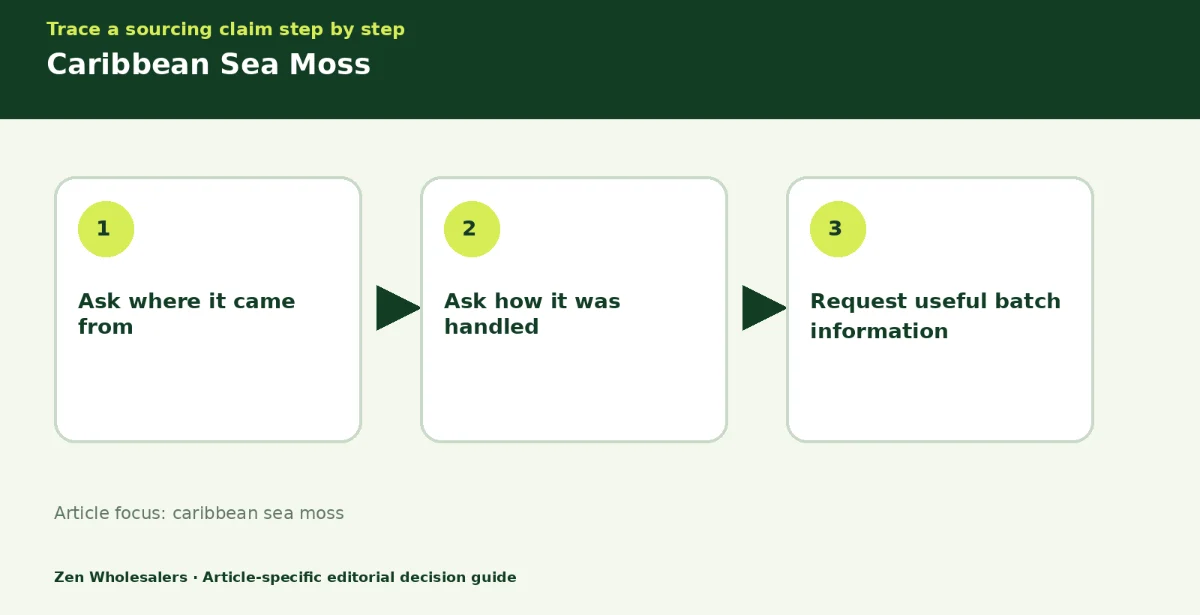
Why this matters: many buyers want to know where sea moss comes from and how it was handled. That affects traceability, safety checks, and the questions you ask a supplier. This guide explains what you can check, what paperwork helps, and what papers cannot prove. It ends with a practical sourcing checklist you can use when talking to growers or sellers.
What people mean by “Caribbean sea moss”
“Sea moss” is a common name. It usually refers to red algae used as food or ingredient. The term covers different species and forms. In the Caribbean, small-scale harvest and farmed seaweed both happen. Sellers may call their product “Caribbean sea moss” to show region of harvest or to describe a style. But that phrase alone does not tell you the species, harvest site, or how it was handled.
Key points:
- “Caribbean” points to a region, not a single farm or species.
- “Sea moss” can mean different algae types. Ask for the scientific name if you need it.
- Color, shape, or a short description on a package may not be enough to verify origin.
This guide focuses on what you can check and which documents help you confirm the origin and handling of Caribbean sea moss.
How origin and handling affect the product
Where and how sea moss is harvested matters for a few reasons:
- Environment: Local water conditions influence what the algae absorb from the sea. These conditions change by place and time.
- Species: Different algae species have different textures and uses.
- Handling: The steps after harvest—rinsing, drying, storage, and transport—change the final product you receive.
What you should know:
- A harvest site near an industrial area will require different checks than one in a low-traffic bay.
- Drying on-site or at a processing facility both have pros and cons. The main issue is control and documentation.
- Tests show what is in a given batch at the time of sampling. Tests are snapshots, not permanent guarantees.
Do not assume:
- That a product labeled “wild-harvested” is the same as one labeled “farm-raised.” Each term has different practices and risks.
- That color or smell can fully reveal safety or origin. Those are helpful clues but not proofs.
What to ask a supplier — practical items
Below is a single practical sourcing checklist presented as a table. Use it when you contact a grower, wholesaler, or retailer. The table shows what to ask, why it matters, and what counts as a helpful reply or a red flag.
| What to ask | Why it matters | Good evidence / Red flags |
|---|---|---|
| Exact species name (scientific and common) | Different species have different uses and nutrient profiles. | Good: scientific name (e.g., Gracilaria sp.). Red flag: only “sea moss” with no species info. |
| Harvest location and date (GPS or named bay) | Location and timing affect contaminant risk and traceability. | Good: GPS coordinates or named, documented site and date. Red flag: vague “Caribbean” with no site or date. |
| Chain of custody / harvest logs | Shows who handled the lot and when. | Good: harvest logs, batch numbers tied to dates. Red flag: no records or inconsistent batch info. |
| Photos or video of harvest and processing | Visual proof of practices. | Good: time-stamped images showing handling. Red flag: only stock photos or no visuals. |
| Drying and storage methods | Affects moisture, mold risk, and shelf stability. | Good: described drying method and storage temp/humidity. Red flag: no details on drying or storage. |
| Certificate of Analysis (CoA) from a third-party lab | Confirms tests for heavy metals, microbes, iodine or other requested analytes. | Good: CoA with lab name, date, tests run, and batch number. Red flag: no CoA or only vendor-internal tests without lab info. |
| Tests available (heavy metals, microbes, iodine) | Certain contaminants and nutrients vary in seaweed. | Good: recent tests for heavy metals and microbes; iodine tests if you need them. Red flag: refusal to test or no recent results. |
| Processing facility location | Helps verify traceability from sea to pack. | Good: processing site identified and documented. Red flag: unknown or changing processing sites. |
| Permits, licenses, or certifications | Legal and market requirements vary by place and buyer. | Good: permits or certifications shown if relevant. Red flag: supplier cannot point to any local regulatory permits when asked. |
| Minimum order, lead time, and sample policy | Practical buying details for planning. | Good: clear sample policy and lead times. Red flag: no samples or unclear lead times. |
Use this table as your conversation script. Keep written records of answers. A supplier who can share documents is more likely to be transparent.
How to read tests and what they do (and don’t) prove
Lab testing is a key part of confirming origin and safety. But tests have limits.
What tests commonly cover:
- Heavy metals (e.g., lead, arsenic). These reflect local contamination and species uptake.
- Microbiology (e.g., pathogens, total plate counts). This checks handling and hygiene.
- Iodine content. Seaweed can have high and variable iodine. Check if iodine testing is included.
- Moisture and ash content. These relate to drying and purity.
What tests can prove:
- If a specific batch had certain measured levels on the sample date.
- That a sample was analyzed by a recognized lab when the CoA shows lab details.
What tests cannot prove:
- That every package from the same supplier at other times has the same results. Seaweed is a natural product. Levels can vary by season and location.
- That the supplier used exactly the same harvest methods across time unless they provide continuous records.
Helpful elements on a Certificate of Analysis (CoA):
- Batch or lot number matching the product you are buying.
- Date of sampling and date of analysis.
- Name and accreditation of the testing lab.
- Limits of detection and units for each test.
- Signatures or digital verification where available.
When you review results, remember:
- A single CoA is a snapshot. Ask for CoAs across multiple batches if you plan a large or recurring purchase.
- For iodine, expect wide variation. Seek tests if your use requires predictable iodine levels. References show seaweed iodine can vary widely by species and location [1][2][5].
- If a supplier refuses to show CoAs or gives vague summaries without lab names, that is a red flag.
References for testing guidance:
- Harvard’s Nutrition Source explains seaweed nutrient variability and notes iodine concentration differences [1].
- Reviews and surveys detail iodine variability and the need for monitoring [2][3][5].
- Industry safety guidance places sea moss among products that should be tested before sale [4].
Verifying species, photos, and traceability
Species identification
- Ask for the scientific name. Common names overlap.
- If you require a specific species for a product or recipe, insist on clear ID.
Photos and videos
- Time-stamped photos and harvest videos help. Ask for metadata where possible.
- Drone or GPS-tagged photos are more useful than generic photos.
Traceability records
- Harvest logs should show date, location, and handler.
- Batch numbers should connect the harvest to processing and to the final packed lot.
- If the supplier uses third-party traceability software, ask how you can verify records.
Be realistic: small growers may use paper logs rather than digital systems. That is acceptable if records are clear and consistent. The important part is that you can tie a final product to a documented harvest and processing chain.
Handling and processing to ask about
Rinse and cleaning
- How many rinses? What water source was used for rinsing? Ask for details.
- If rinsing used local seawater versus fresh water, document that.
Drying
- Methods include sun drying, mechanical drying, or oven drying.
- Each method impacts moisture and shelf stability. Ask the supplier for moisture data or test results.
Storage and packaging
- How was the dried product stored before shipment? Time in storage matters.
- What packaging was used (e.g., breathable sacks, sealed bags)? Ask for photos or descriptions.
Shipping and import handling
- Ask about how the product is packed for export.
- Check for temperature control or humidity control if required.
Remember: a supplier’s verbal descriptions are helpful, but you should seek records or photos when possible. Simple cross-checks—like matching harvest dates to CoA sample dates—improve confidence.
Common claims and what they actually mean
Labels you may see and questions to ask:
- “Wild-harvested”: Means gathered from the natural environment rather than farmed. Ask for harvest location and batch logs. Wild harvest can vary by season and site.
- “Hand-harvested”: Suggests manual collection. Ask how many people, where, and how logs are kept.
- “Dried” or “Sun-dried”: Ask for drying method and moisture content test.
- “Raw”: Often used to mean minimally processed. Ask what steps were taken after harvest.
- “Organic”: Marine organic standards are complex and vary. If a supplier claims an organic certification, ask for the certifying body and certificate.
As a buyer, don’t treat these claims as proof. They are starting points. Verify with documents and tests.
Buying as a retailer or wholesaler: extra checks
If you plan to resell, add these checks:
- Ask for repeated CoAs across multiple batches.
- Request a sample policy and price breaks for testing. Budget for periodic third-party testing.
- Check local import rules where you sell. Different markets have different testing and labeling requirements.
- Ask about recall or problem-response plans. What happens if a batch fails testing? Does the supplier take back or replace goods?
If you need help planning a wholesale purchase, our wholesale page explains how we work with larger buyers: /wholesale/.
Decision guide: when to accept a supplier
Use this simple decision guide to decide quickly if a supplier is worth pursuing.
- Yes, pursue if:
- They provide a CoA with lab name and batch number that matches the product.
- They share harvest logs or GPS coordinates for harvest sites.
- They can describe drying, storage, and packing and provide photos.
- Consider with caution if:
- They give partial information but no lab name.
- They have only one CoA for a long time period.
- Lab tests are old (ask for recent tests).
- Walk away if:
- No documents or tests are provided on request.
- They are evasive about harvest location or processing steps.
- They refuse to allow sample testing before a large order.
This rule-of-thumb helps keep your risks lower. It also helps you build a file of suppliers who are willing to be transparent.
Next steps for buyers
- Prepare your questions from the Sourcing Checklist table.
- Ask sellers for batch-specific CoAs and harvest logs.
- Request time-stamped photos or GPS info where possible.
- Arrange for an independent test if you need extra assurance.
- Keep written records of all supplier replies in case you need to audit later.
If you want help with samples or to learn how farms work, visit our farm page to see how we document harvests and processing: /our-farm/. For general information about seaweed and nutrients, check /learn/. If you are ready to sample or buy, see /shop/ or contact us at /contact/. For wholesale inquiries, start at /wholesale/ or our home page /.
Conclusion
“Caribbean sea moss” is a regional label covering several seaweed products. The name alone does not prove species, handling, or safety. A clear buying plan focuses on species ID, harvest location and date, handling records, and recent third-party lab tests. Use the sourcing table above to guide your questions. Ask for documents, not just claims. Tests and records are snapshots, so request repeated evidence if you plan an ongoing purchase. Being thorough will help you find suppliers who are open and traceable.
Continue reading
Frequently asked questions
How can I be sure the sea moss really came from the Caribbean?
Ask for harvest location details and harvest logs. GPS coordinates or named sites plus matching batch numbers and dated photos are useful. A single label that says “Caribbean” is not proof. You need traceable documents or time-stamped media.
Are lab tests required for sea moss?
Tests are not always required by law in every market, but they are common and useful. Tests for heavy metals, microbes, and iodine give you data about a specific batch. Ask for recent third-party CoAs if you need reassurance [1][4].
Can a CoA prove long-term safety of a product?
No. A CoA proves the test results for a specific sample at a specific time. Seaweed composition varies. For ongoing purchases, ask for CoAs over several batches [2][5].
What if a supplier says their product is “organic”?
Ask for the certifying body and the certificate. Marine organic certification is possible in some systems, but the claim alone is not proof. Verify the documentation.
How often should I test sea moss if I sell it?
Testing frequency depends on volume, source variability, and your market rules. Many resellers test each incoming lot or sample batches regularly. Plan for periodic third-party testing if you are reselling.
Can I rely on photos or videos alone?
Photos and videos help a lot, especially if time-stamped and geotagged. But they do not replace lab tests or harvest logs. Use them as part of a broader verification plan.
References
- [1] Harvard T.H. Chan School of Public Health, “Seaweed.” https://nutritionsource.hsph.harvard.edu/seaweed/
- [2] Smyth PPA. “Iodine, Seaweed, and the Thyroid.” European Thyroid Journal, 2021. https://pmc.ncbi.nlm.nih.gov/articles/PMC8077470/
- [3] Food Standards Australia New Zealand, “Survey of iodine levels in seaweed and seaweed containing products,” updated 2025. https://www.foodstandards.gov.au/science-data/monitoring-safety/surveyofiodinelevels
- [4] Operation Supplement Safety, “Sea Moss in Dietary Supplements.” https://www.opss.org/article/sea-moss-dietary-supplements
- [5] Blikra MJ et al. “Consequences of acute and long-term excessive iodine intake: A literature review focusing on seaweed as a potential dietary iodine source.” 2024. https://doi.org/10.1111/1541-4337.70037