
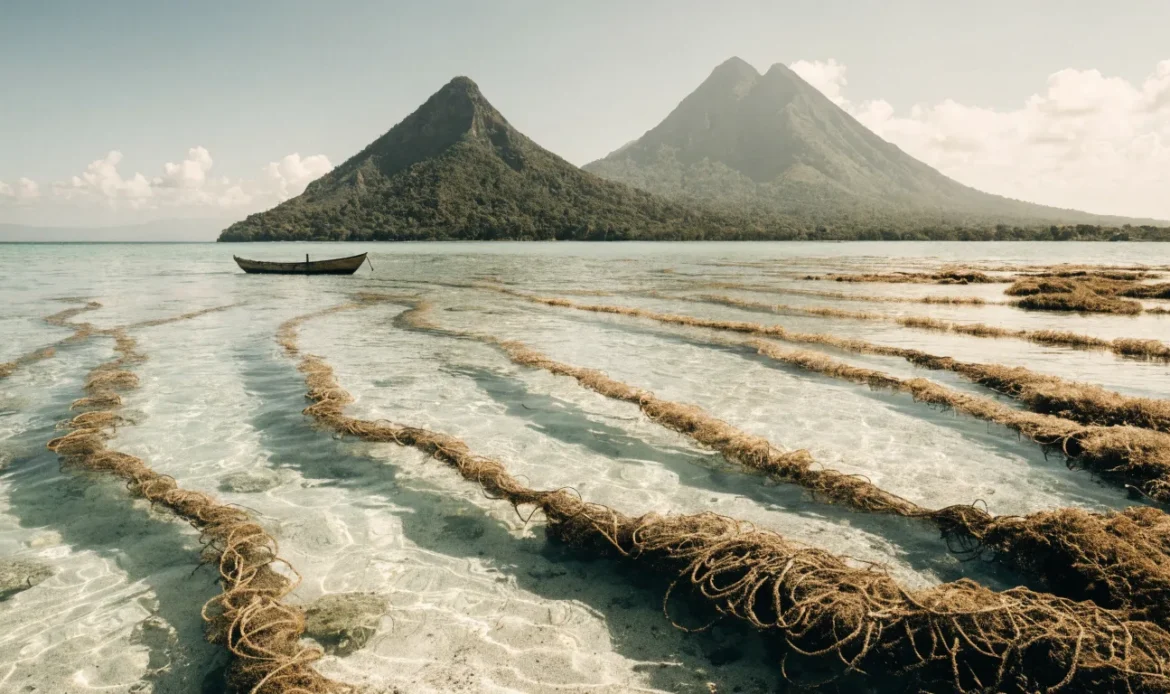
Short answer: Caribbean sea moss is a general name for several seaweed types grown or harvested in Caribbean waters. To choose a reliable supplier, check species identification, precise origin or farm location, harvest and handling methods, and lab testing or documentation. Ask clear questions, request samples and test reports, and accept that some risk remains unless you have third‑party verification.
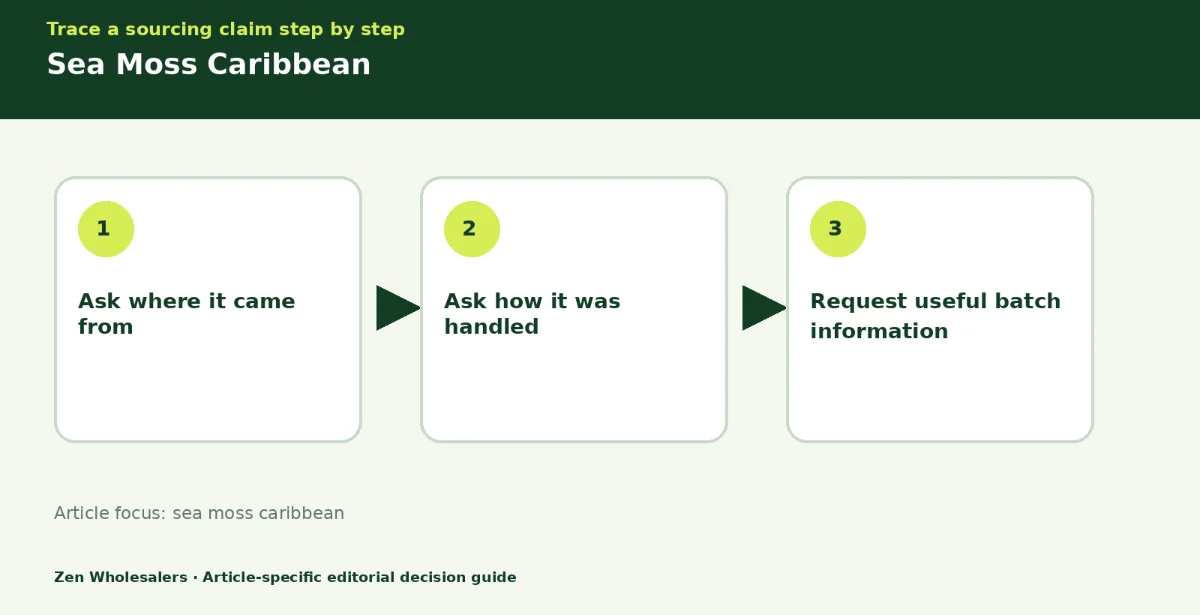
Why this guide: buyers often want to know where a product came from and how it was handled. This guide explains what you can check, what that evidence can — and cannot — prove, and what to ask next.
What “sea moss” and “Caribbean” usually mean
“Sea moss” in sales and conversation is not a strict scientific name. It is a common label used for edible red algae and other seaweeds sold in gel, raw, dried, or powdered form. In the Caribbean, the label often refers to red algae produced in coastal waters, either wild-harvested or farmed.
The term “Caribbean” points to a broad region. It covers many islands, coasts, and different marine conditions. Water, tides, and local practices vary. That matters because species, handling, and water quality all influence the final product.
Important fact: seaweed composition and contaminants can vary by species and harvest site. Iodine content, for example, can differ widely between seaweed types and locations [1][2][3]. Testing is the only reliable way to know what is in a specific batch.
Why origin matters — what it can tell you
Knowing where sea moss was harvested or farmed gives you context. Location can suggest likely species and common local handling practices. It also offers a route to verify permits, testing, and traceability.
What origin can help show:
- The likely species or genus involved.
- Whether the product was wild-harvested or produced on a farm.
- Local handling practices like sun drying, low-temperature drying, or cold-chain packing.
- Which regulatory body may oversee harvest and export paperwork.
What origin cannot prove by itself:
- That a specific batch is free of contaminants. Even a clean region can produce a contaminated lot if handling fails.
- Exact levels of substances like iodine, heavy metals, or microbes. Those require laboratory tests.
- Consistent quality across different lots or seasons.
Common species and naming notes
Buyers should know that the same common name can cover different species. In Caribbean commerce, sellers may use “sea moss” for several red algae genera. Two genera often encountered in tropical seaweed markets are Gracilaria and Eucheuma (including related kappa‑producing types). Local names also vary by island and language.
Why species ID matters:
- Different species have different textures and processing behavior.
- They can differ in natural mineral content and iodine level.
- Species identity helps labs select the right testing methods.
If a supplier cannot name the species or offers inconsistent names, ask for more documentation or a sample.
Handling and processing: what to check
How sea moss is handled after harvest changes the product. Key steps include rinsing, de‑sand removal, drying, and packing.
Things to verify:
- Harvest timing and date for the lot.
- Washing and rinsing methods. Multiple rinses reduce visible sand and debris.
- Drying method. Sun drying is common but can leave the product exposed to dust and animals. Low‑temperature drying or controlled dryers limit contamination risk.
- Packaging and storage conditions. Airtight packaging and cool, dry storage slow spoilage.
- Traceability: whether the lot is tagged with a harvest date, batch ID, or GPS coordinates.
Do not assume that any single handling claim guarantees safety or quality. For example, “sun dried” is descriptive but does not prove a batch was protected from contamination. Ask for details and photo evidence when possible.
Testing and documentation: what to ask for
Testing gives you the facts that origin alone cannot. Ask suppliers for lab reports and certificates linked to the specific lot you plan to buy.
Useful documents to request:
- Third‑party lab reports for heavy metals, microbial tests, and iodine. Independent labs are preferable to supplier-run in‑house tests.
- Chain‑of‑custody records showing when samples were taken and how they were handled before testing.
- Harvest permits or local export paperwork, if applicable.
- Packing list and batch or lot numbers that match the test report.
What test reports can and cannot show:
- A lab report shows results for the sample that was tested. It does not guarantee every future or past lot will match those results.
- Tests do not reveal where a contaminant came from. For example, they cannot always prove whether a heavy metal was present in the water or introduced during processing.
- Report formats and detection limits vary between labs. Ask which method and detection limits were used.
Regulatory and scientific guidance note that iodine and other components can vary widely in seaweed. That is why testing and lot-specific data matter [1][2][3][5].
Practical checklist: what to ask a supplier now
Use this checklist when you talk to a supplier. It is short and action oriented. Ask for documents and photos. Request samples for your own testing if you plan to buy wholesale.
| Question to ask | Why it matters | What to accept | Follow-up if missing |
|---|---|---|---|
| What species or genus is this lot? | Species affects texture and composition | Scientific or accepted common name (e.g., Gracilaria) | Ask for a taxonomy statement or photo; request sample |
| Exact harvest location or farm? | Location gives context for testing and permits | Island/region and GPS or descriptive coordinates | Ask for harvest permit or map; request photos |
| Harvest date and lot number? | Helps trace quality and link to tests | Specific date and lot/batch ID | Do not accept vague ranges; require lot ID |
| Wild or farmed? Harvest method? | Affects contamination risk and availability | Clear statement: wild-harvest vs farmed with brief method | Ask for photos and handling description |
| Drying and packing method? | Affects shelf life and contamination | Drying method and packaging type listed | Ask for photos of processing area |
| Third‑party lab tests for this lot? | Show specific test results for contaminants | Independent lab report with lot ID | Request report; consider independent retest |
| Tests for heavy metals, microbes, iodine? | Important safety markers for buyers | Lab reports for each requested test | Ask which methods were used and limits of detection |
| Chain of custody for sample? | Ensures the sample tested matches the lot | Signed chain‑of‑custody or lab intake form | Request chain‑of‑custody or independent sampling |
| Export or harvest permits? | Needed in many jurisdictions | Copies of permits or authorizations | Ask supplier to connect you with local authority |
| Photos of harvest, drying, and packing? | Visual proof of handling | Recent dated photos tied to lot ID | Ask for timestamped images or a short video |
| Can I get a sample for my own testing? | Final check before large purchase | Small paid sample or shipment | If refused, treat as a red flag |
Use the checklist to compare suppliers. Keep records of questions and answers for future audits.
How to interpret lab results and labels
When you receive lab reports, read them carefully.
Key points:
- Confirm the report matches the lot number and date supplied.
- Look for test methods and detection limits. Reports that do not show methods are less useful.
- Check whether the lab is accredited or independent.
- Understand that one test is a snapshot. Batch variation and seasonal changes mean repeated testing gives better confidence.
- Be cautious with labels that claim “clean” or “detoxified” without reporting tests. Broad marketing words do not substitute for results.
Scientific reviews and monitoring programs highlight that iodine and mineral levels in seaweed vary by species and location [1][2][3][5]. That means interpreting a result requires context: species, harvest site, and time of year.
Red flags when evaluating origin and handling
Watch for these warning signs:
- Vague origin: “from the Caribbean” without island or region details.
- No lot numbers or harvest dates.
- No third‑party tests and refusal to share in‑house data.
- Inconsistent names for the same product between invoices and labels.
- Refusal to provide photos or basic processing information.
- No chain of custody or sample records for lab testing.
- Excessive claims about health effects or cures — these are not acceptable or verifiable.
If you see red flags, ask more questions or consider walking away. For wholesale purchases, insist on sampling and contractual quality checks.
Buying wholesale: steps and best practices
Wholesale purchases raise the stakes. Here are practical steps:
- Start small. Place a pilot order or request a paid sample for independent testing.
- Ask for a quality agreement in the sales contract. Define acceptable test limits and required documentation.
- Include a clause for third‑party testing on arrival and for what happens if a batch fails.
- Plan a sampling scheme that covers different harvests or seasons.
- Consider arranging a site visit if the order size justifies it. Photo and video tours are an alternative when in-person is not possible.
- Keep communications written and logged. Save emails with test reports, batch numbers, and photos.
If you are unsure about how to draft technical test clauses, consult a food safety advisor or legal counsel experienced in international food trade.
Limits of what documentation can prove
Documentation helps, but it has limits:
- Lab reports pertain to the sample tested, not every unit in a shipment.
- Paperwork can be forged. Independent verification and chain‑of‑custody reduce this risk.
- Even with farm GPS and permits, contamination during transport or handling can occur.
- Seasonal changes affect composition; a single report cannot guarantee repeatable results.
In short: documents reduce uncertainty. They do not eliminate it. Use multiple checks — origin details, photos, tests, and samples — to build confidence.
Decision guide: when to accept a supplier
Use this simple decision path:
- Can the supplier name the species and provide a lot number and harvest date?
- No: Ask for details. Do not proceed.
- Yes: continue.
- Can the supplier provide recent photos of harvest and processing tied to the lot?
- No: request photos or a video. Treat absence as a red flag.
- Yes: continue.
- Are there third‑party lab reports for the specific lot covering heavy metals, microbes, and iodine?
- No: consider arranging independent testing on a sample.
- Yes: review methods and limits. Continue if results meet your risk tolerance.
- Will the supplier allow a paid sample for your own testing and a small pilot order?
- No: do not proceed to large purchase.
- Yes: test the sample independently, check packaging, and confirm labeling.
- Can you include quality clauses in the purchase agreement (lot testing, rejection terms)?
- No: negotiate or decline.
- Yes: proceed with pilot, then larger orders if everything checks out.
This guide is conservative. It helps reduce, but not remove, risk.
Conclusion
Buying Caribbean sea moss involves more than a name and a price. Check species identity, harvest location, handling methods, and lot‑specific lab testing. Use a clear checklist. Request samples and third‑party lab reports. Understand that documents reduce uncertainty but do not remove all risk. If you need starting points for verification or to learn more, review supplier photos, ask for chain‑of‑custody documentation, and consult independent labs.
If you want to learn more about how we farm and handle sea moss, visit our farm page for process notes or contact us directly. For general learning about seaweed and safety, our learning resources and shop pages may also help.
Useful links:
- Home: /
- Our farm: /our-farm/
- Learn more: /learn/
- Wholesale information: /wholesale/
- Contact us: /contact/
- Browse products: /shop/
Continue reading
Frequently asked questions
Is Caribbean sea moss always one species?
No. “Sea moss” is a market name for several seaweeds. Different genera and species can be sold under the same common name. Ask the supplier for a scientific or reliable common name.
Can a label that says “wild-harvested in the Caribbean” be trusted?
A label alone is not proof. It is a starting point. Ask for harvest date, location, photos, and lab reports tied to the lot. Verify documentation where possible.
What tests should I expect to see for a wholesale lot?
Common useful tests include heavy metals, microbial contaminants, and iodine content. Ask which lab, methods, and lot ID are on the report. Independent third‑party testing is better than supplier-only tests [1][2][3][4][5].
Do tests guarantee safety?
Tests show results for the tested sample and moment in time. They help you make choices, but they are not an absolute guarantee for every shipped unit. Repeated testing and chain‑of‑custody improve confidence.
How does iodine vary in seaweed?
Iodine varies by species, location, and season. Scientific reviews and monitoring work highlight this variability. That variability is why lot‑specific testing for iodine matters for buyers [1][2][3][5].
What if my supplier refuses to share lab reports?
Treat refusal as a serious concern. For wholesale purchases, insist on seeing third‑party reports or arrange to test an independent sample. Consider other suppliers if transparency is not provided.
References
- [1] Harvard T.H. Chan School of Public Health, “Seaweed.” https://nutritionsource.hsph.harvard.edu/seaweed/
- [2] Smyth PPA. “Iodine, Seaweed, and the Thyroid.” European Thyroid Journal, 2021. https://pmc.ncbi.nlm.nih.gov/articles/PMC8077470/
- [3] Food Standards Australia New Zealand, “Survey of iodine levels in seaweed and seaweed containing products,” updated 2025. https://www.foodstandards.gov.au/science-data/monitoring-safety/surveyofiodinelevels
- [4] Operation Supplement Safety, “Sea Moss in Dietary Supplements.” https://www.opss.org/article/sea-moss-dietary-supplements
- [5] Blikra MJ et al. “Consequences of acute and long-term excessive iodine intake: A literature review focusing on seaweed as a potential dietary iodine source.” 2024. https://doi.org/10.1111/1541-4337.70037