
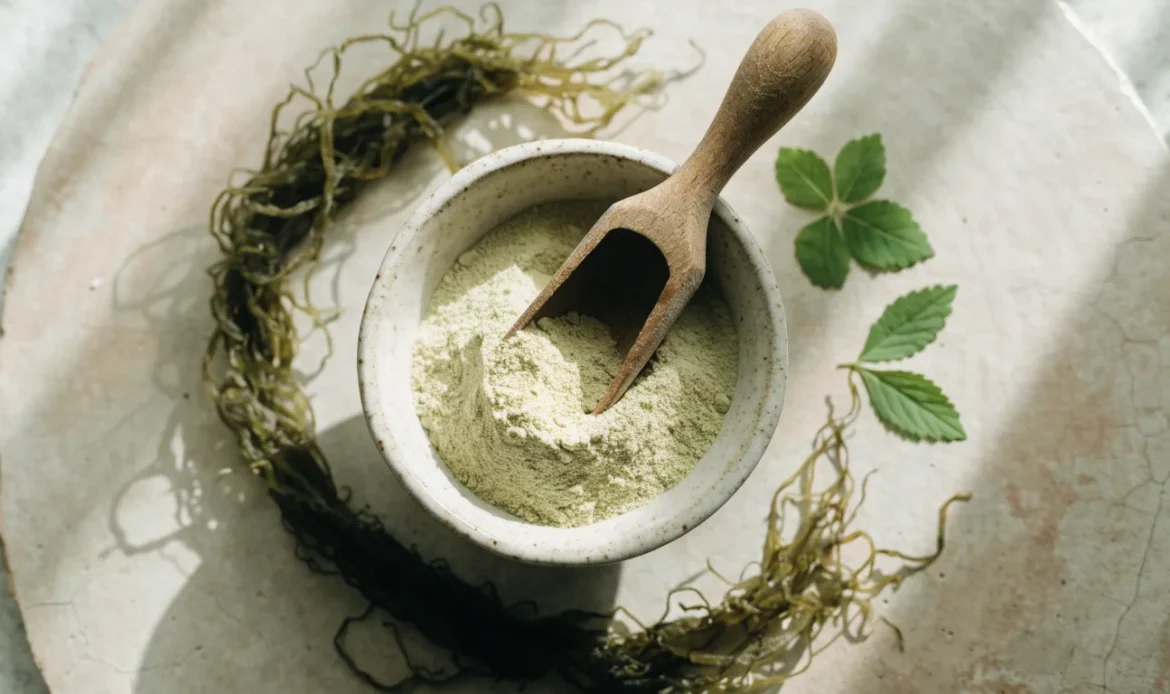
Short answer: Raw sea moss powder is seaweed that has been cleaned, dried, and ground into a powder without heavy processing or added ingredients. “Raw” usually means it has not been cooked, heavily heated, or mixed with fillers. How safe and useful it is depends on where it came from, how it was handled, and what tests or documents the seller can provide.
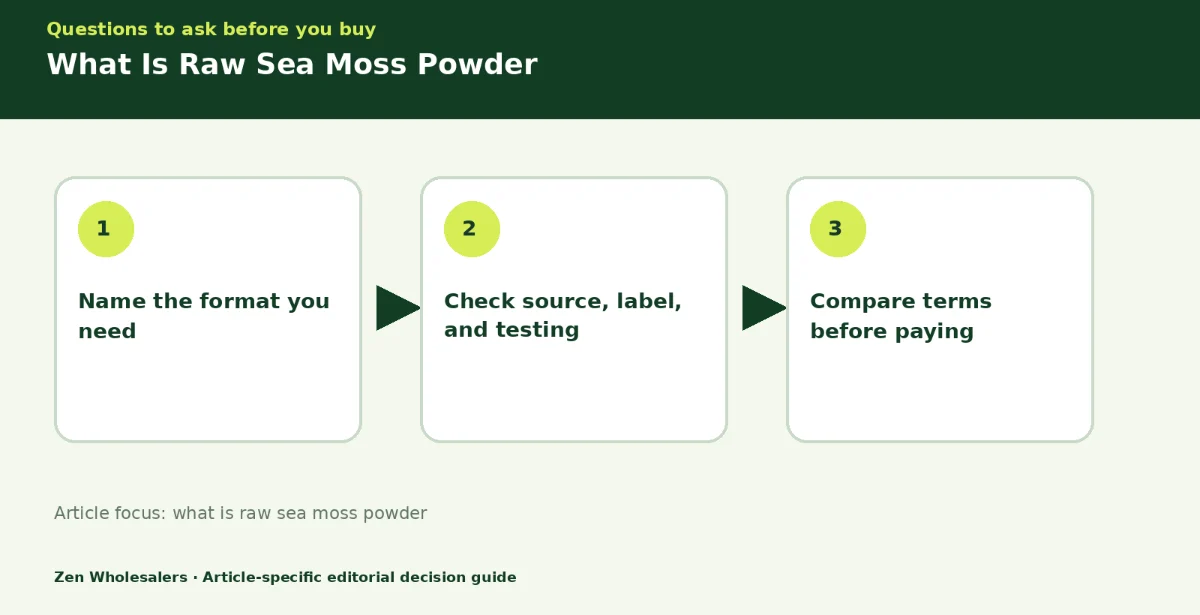
This page explains what “raw” can mean, how powder is made, what to check when you shop, and what questions to ask a seller. Use this to compare suppliers, including farms and wholesale options, and to decide what follow-up checks you want before buying.
What people mean by “raw” sea moss powder
- Raw often means: the seaweed was not cooked, boiled, or chemically treated before drying. It may be air-dried, sun-dried, or low-heat dried.
- Raw does not always mean sterile or free of microbes. Drying reduces water, but it does not replace lab testing for microbes or metals.
- Raw does not guarantee one species, one ocean, or one harvesting practice. Sellers may use different species and different harvest methods.
- “Raw” can be a marketing word. Ask for specific steps used in production rather than trusting the word alone.
Why this matters: drying methods, harvest locations, and handling steps affect flavor, color, and how much testing you might want to ask for.
How raw sea moss powder is typically made
Here is a simple outline of common steps. Individual sellers will vary.
- Harvest
- Seaweed is collected from wild beds or cultivated farms.
- Rinse and sort
- Surface debris, sand, and other sea life are removed. Multiple rinses are common.
- Drying
- The seaweed is dried to stop spoilage. Methods include air drying, sun drying, or mechanical low-heat drying.
- Grinding
- Dried pieces are milled or ground into powder.
- Packaging
- Powder is put into bags or containers, sometimes with a label giving origin and handling notes.
Note: Any of these steps can be done with more or less care. “Raw” usually means minimal heat and no chemical processing. But it does not tell you about testing for contaminants or exact species identity.
Common species and why species matter
There are many types of seaweed used for “sea moss.” Species differ in shape, color, texture, and mineral content. Some common terms you may see:
- Chondrus crispus (often called “Irish moss”)
- Various red algae from Caribbean coasts called “sea moss” or “gracilaria” types
- Other red, green, or brown seaweeds sometimes sold as sea moss
Why species matter:
- Different species can look and taste different.
- Nutrient and iodine content can vary by species and by where it grew [1][2][3].
- If you have specific dietary concerns (for example, you watch iodine intake), the species and source affect how much you might expect to find. If you need precise info, ask for lab data.
What species cannot tell you alone:
- Species name cannot prove the product is free of metals, pollutants, or pathogens. Only testing can provide that evidence.
Safety and testing: what to watch for
Seaweed can concentrate minerals and elements from seawater. That includes both nutrients and things you may want to limit in your diet. Because of that:
- Iodine levels in seaweed can vary widely by species and location. High iodine intake can affect the thyroid in some people [2][5].
- Surveys and reviews note variability and the need for caution if you eat seaweed often [3][5].
- Quality-minded sellers will offer or make available third-party testing for heavy metals, microbiological contamination, and, if relevant, iodine content [4].
What testing can — and cannot — prove:
- A recent third-party lab report can show contamination levels at the time of the tested batch.
- It cannot prove future batches will be the same unless the seller maintains consistent harvest and testing practices.
- A single test does not establish safety for every user. If you have a medical condition, discuss seaweed with a clinician.
References that support these points include general guidance on seaweed as food [1], reviews on iodine and thyroid links [2][5], and guidance about sea moss products and supplements [4]. A national survey highlights variability in iodine among seaweed products [3].
How to evaluate origin, handling, species, and documentation
Below is a practical decision guide you can use when comparing suppliers. Follow it as a short checklist when you contact a seller.
Decision guide: quick steps to evaluate a raw sea moss powder product
- Ask where the seaweed was harvested or farmed.
- Exact location (region or coordinates) is better than a broad country name.
- Ask the species name.
- Scientific name is more precise than a common name.
- Ask how it was harvested.
- Wild-harvested or farmed? Manual or machine harvest? Harvest timing?
- Ask how it was handled on-boat or at-farm.
- Was it rinsed immediately? How many rinses?
- Ask the drying method and temperature.
- Low-heat mechanical vs. sun-dried vs. oven-dried.
- Ask about post-drying handling.
- Was it milled in the same facility as other products? Any allergen exposure?
- Request lab documentation.
- Third-party heavy metals or microbiology reports, and iodine if you need it.
- Ask for batch or lot numbers and shelf handling guidance.
- Check supplier transparency.
- Do they answer directly? Do they provide documents quickly?
- If buying wholesale, ask about traceability and testing frequency.
Use the table below to compare answers across suppliers.
| Item to ask | Why it matters | What to press for |
|---|---|---|
| Exact harvest location | Source water affects contaminants and species | Region, GPS, or detailed area, not just a country name |
| Species (scientific name) | Species vary in composition and appearance | Latin name or clear photo comparison |
| Harvest method | Affects debris and lead time to cleaning | Wild vs. farmed, manual vs. mechanized |
| Cleaning steps | Initial cleanliness affects drying quality | Number of rinses, use of fresh water |
| Drying method and temp | Affects microbes and nutrient changes | Low-heat mechanical or sun drying details |
| Third-party lab tests | Shows current batch contaminant data | Heavy metals, microbes, and iodine tests if needed |
| Batch or lot tracking | Enables traceability if issues arise | Batch IDs and production dates |
| Packaging and storage | Affects shelf life and contamination risk | Sealed, moisture-proof packaging details |
| Supplier transparency | Indicates reliability and quality control | Clear, prompt answers and available docs |
| Wholesale policies | Important for bulk buyers | Minimum orders, lead times, quality checks |
Practical checklist to use before you buy
- [ ] Seller provides a clear harvest location.
- [ ] Seller lists the species by scientific name.
- [ ] Seller describes harvest and rinsing steps.
- [ ] Seller explains drying method and temperature range.
- [ ] Seller can show third-party lab results for recent batches.
- [ ] Seller provides batch numbers, production date, and shelf storage advice.
- [ ] Packaging is sealed and moisture-resistant.
- [ ] Seller answers questions promptly and documents claims in writing.
- [ ] If you have health concerns, you discussed seaweed intake with a clinician.
Use this checklist to score multiple sellers. If several boxes are unchecked, consider requesting the missing information or choosing another supplier.
How to read test reports and documents
If a seller shares test results, here are simple ways to read them:
- Look for third-party lab name and accreditation. Accredited third-party labs reduce conflicts of interest.
- Check test dates and batch or lot numbers to ensure the report matches the exact product batch.
- Note what was tested. Common tests include:
- Heavy metals (lead, arsenic, mercury, cadmium).
- Microbiological tests (total plate count, E. coli, Salmonella).
- Iodine content or elemental analysis.
- If iodine is listed, remember that levels vary by species and location [3]. High numbers in a report mean you may want to limit intake or seek medical advice.
- If no tests are provided, ask why. A responsible seller should be able to explain their quality controls.
What test reports cannot do:
- They cannot guarantee future batches are identical.
- They cannot predict personal reactions for any individual.
Buying from a farm or a retailer: differences to check
Buying from a farm (/our-farm/) or a retailer (/shop/) will have different strengths.
Buying from a farm:
- You may get direct details on farming practices, water quality, and harvest timing.
- Farms might offer more transparency on traceability.
- Ask farms about their rinsing, drying, and packing steps.
Buying from a retailer:
- Retailers may import or repackage multiple farm sources.
- They should still be able to provide documents for the batch they sell.
- If you buy in a store or online shop, request batch test reports if they are not shown.
If you are a wholesale buyer (/wholesale/), ask about regular testing frequency and long-term traceability. Wholesale purchases need extra clarity on lot control and quality assurance.
How to store raw sea moss powder safely at home
- Keep the powder sealed in a cool, dry place.
- Use an airtight container to avoid moisture and odors.
- Follow any shelf guidance the seller gives.
- If the powder smells off, has visible mold, or shows unusual color change, do not use it.
Storage instructions from sellers are useful but do not replace quality checks at purchase.
Making your own powder: what to expect
If you want to make raw sea moss powder at home:
- You need to know the species and harvest it from clean water.
- Rinse thoroughly to remove sand, salt, and epiphytes.
- Dry completely using low heat or dehydrator to avoid mold.
- Grind to powder in a clean mill or blender.
- Home processing can reduce cost but does not replace lab testing.
If you plan to give or sell the product, remember that safety testing and proper labeling are important legal and health steps.
Questions to ask a supplier (copy-paste list)
- Where exactly was this sea moss harvested or farmed?
- What is the scientific name of the species?
- Can you show batch-specific third-party lab test results?
- How was it dried and at what temperature range?
- How soon after harvest was it rinsed and dried?
- Do you provide batch or lot tracking numbers?
- What steps do you take to prevent cross-contamination during milling?
- How should I store this powder to keep it stable?
If a seller avoids these questions or gives vague answers, treat that as a red flag.
Conclusion
Raw sea moss powder means dried and ground seaweed with minimal processing. The word “raw” alone tells you little about safety or consistency. To make a good buying decision, check the harvest location, species, drying and handling steps, and ask for third-party lab results. Use the decision guide and checklist above when comparing suppliers. If you need more detailed help, visit our farm page to see how we describe sourcing, check our learning resources, or contact a seller directly.
Useful links:
- Learn about our farm and practices: /our-farm/
- Browse learning articles: /learn/
- View our shop options: /shop/
- Wholesale information: /wholesale/
- Contact us with questions: /contact/
- Home: /
Continue reading
Frequently asked questions
Is raw sea moss powder the same as seaweed powder?
Often yes, but names vary. “Sea moss” commonly refers to certain red seaweeds. “Seaweed powder” is a broader term. Ask for the species name to be sure.
Can I trust “raw” on the label?
“Raw” is not a legal guarantee. It usually means little processing. Always ask for concrete details like drying method, species, and lab tests.
Should I worry about iodine or heavy metals?
Seaweed can have variable iodine and mineral content. If you need to limit iodine or worry about metals, ask for third-party test reports for those components [2][3][5].
Are lab reports enough to prove a product is safe?
Lab reports for a batch provide useful evidence. They do not guarantee future batches will be the same. Regular testing and supplier transparency matter too [4].
How can I tell if a seller is reliable?
Reliable sellers share clear harvest information, scientific species names, batch numbers, and third-party test results. They answer questions promptly and in writing.
Can I use raw sea moss powder every day?
Frequency is a personal choice. Because elements like iodine vary, discuss regular use with a healthcare professional if you have thyroid concerns or other health issues [2][5].
References
- [1] Harvard T.H. Chan School of Public Health, “Seaweed.” https://nutritionsource.hsph.harvard.edu/seaweed/
- [2] Smyth PPA. “Iodine, Seaweed, and the Thyroid.” European Thyroid Journal, 2021. https://pmc.ncbi.nlm.nih.gov/articles/PMC8077470/
- [3] Food Standards Australia New Zealand, “Survey of iodine levels in seaweed and seaweed containing products,” updated 2025. https://www.foodstandards.gov.au/science-data/monitoring-safety/surveyofiodinelevels
- [4] Operation Supplement Safety, “Sea Moss in Dietary Supplements.” https://www.opss.org/article/sea-moss-dietary-supplements
- [5] Blikra MJ et al. “Consequences of acute and long-term excessive iodine intake: A literature review focusing on seaweed as a potential dietary iodine source.” 2024. https://doi.org/10.1111/1541-4337.70037