
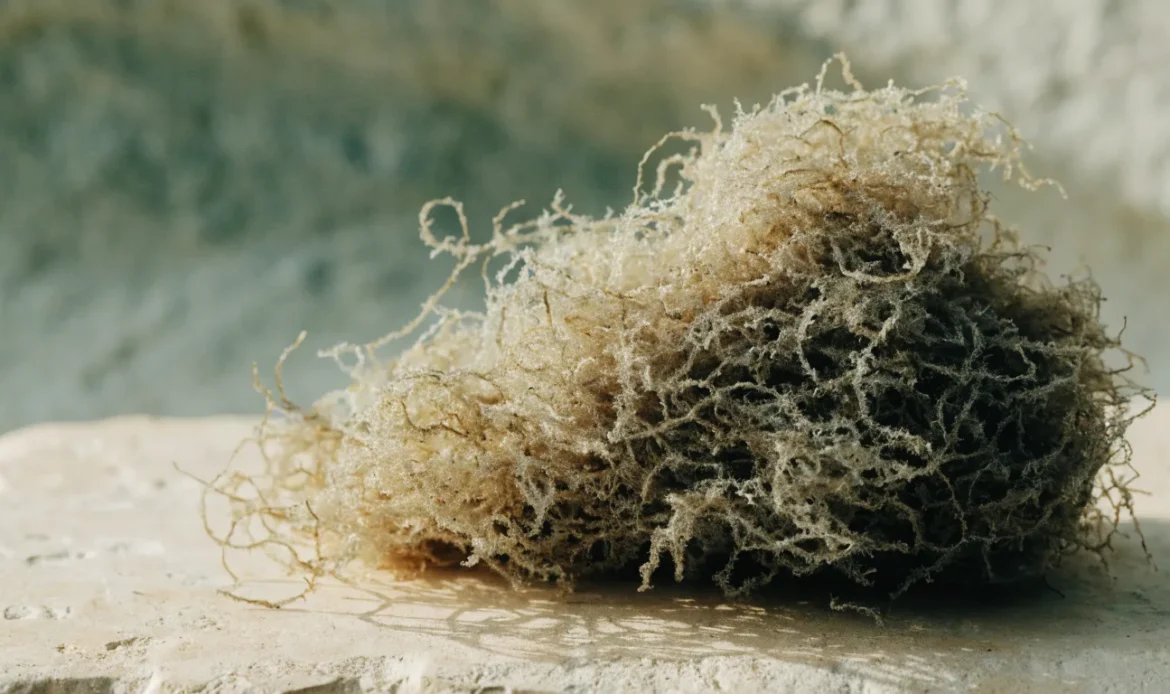
Short answer: Gold sea moss is a name used for several golden- or light-colored varieties of the red algae commonly called sea moss. Color alone does not prove origin, species, or quality. To judge a product, check species identification, harvest details, handling steps, and test records. Use a sourcing checklist and clear questions before buying.
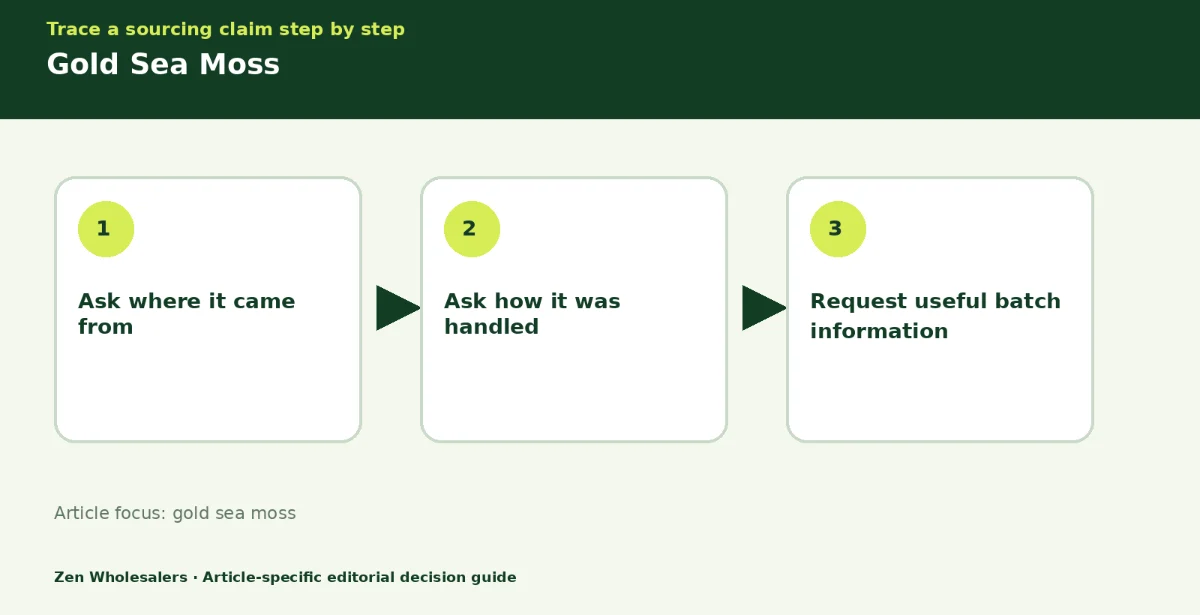
Why this matters
Gold sea moss is offered in many forms: dried, raw, and as gel. Buyers often want to know where it came from, how it was handled, and what tests show. This guide explains how to evaluate those claims. It also points to what sellers can and cannot prove with common documents.
What this page covers
- What “gold sea moss” can mean.
- How to check origin and species.
- Handling, processing, and common product forms.
- Tests and documents to ask for.
- A practical checklist and a short decision guide.
- FAQs and next steps.
H2: What people mean by “gold sea moss”
“Gold sea moss” is a market name. It usually refers to seaweed that looks golden, straw-colored, or light brown when dried. Several species of red algae (Rhodophyta) and different drying or handling methods can produce a golden appearance.
Important points
- Color is not a reliable species ID. It can change with drying, sun exposure, or the algae’s life stage.
- Origin (country or region) and species are separate facts. One does not prove the other.
- Sellers may use “gold” to describe color, a harvest area, or a product line. Ask what they mean.
H2: Species and scientific names — what to ask
Why species matters
Different species can have different textures, tastes, and traditional uses. They can also vary in the kinds and amounts of minerals they contain. Knowing the scientific name helps buyers compare products and find reliable information.
What to request from a seller
- The scientific name of the seaweed (genus and species).
- A description of how the species was confirmed (expert ID, photographic records, or genetic testing).
- Photographs of the algae in water and after harvest.
What this can and cannot prove
- A scientific name listed on a product label shows intent. It does not prove the seller identified the seaweed correctly unless they also provide evidence.
- Genetic testing provides stronger proof than a label claim, but not every seller will have it. Ask if tests exist and what methods were used.
H2: Origin and provenance — practical checks
Origin claims can mean several things:
- Where the algae grew (harvest location).
- Where it was processed.
- Where the final product was packaged.
Questions to ask sellers
- Where was the seaweed harvested? Give coordinates or the nearest town if possible.
- Who collected it (a licensed harvester, a farm, or a cooperative)?
- Where was it rinsed, dried, and packaged? Provide facility names and addresses.
- Can they show chain-of-custody notes, harvest logs, or bills of lading?
How to read answers
- Precise harvest coordinates or GPS records are stronger evidence than a general region name.
- Harvest logs with date and harvester name help trace a batch.
- If a seller cannot or will not share basic provenance, treat origin claims with caution.
H2: Wild-harvested vs farmed — differences and what to verify
Common terms
- Wild-harvested: Collected from natural reefs or shores.
- Farmed (cultivated): Grown on ropes or other structures in controlled areas.
What to verify for wild harvest
- Harvest permits or records of licensed harvesters.
- Details on how the seaweed was harvested and handled to reduce contamination.
What to verify for farmed seaweed
- Farm location and farming method (longline, rope, raft).
- Harvest dates and how the farm controls fouling or nearby pollution sources.
What neither label proves alone
- “Wild” does not guarantee lower contaminants. The water quality matters.
- “Farmed” does not guarantee clean water or better processing. Both wild and farmed seaweeds can be tested to show their contents.
H2: Handling and processing — what affects final product
Key steps that affect quality
- Rinsing: Removes sand, salt, and some organics.
- Drying: Sun-drying, shade-drying, or mechanical drying affect color and texture.
- Storage: Exposure to heat or moisture during storage can change color and shelf life.
- Gel-making: For sea moss gel, water ratio, blending time, and straining change texture and clarity.
Questions to ask about handling
- How soon after harvest was the seaweed rinsed and dried?
- Which drying method was used? Photos help.
- Where and how was the product stored before sale?
- For gels: what is the water source and what preservatives, if any, are used?
H2: Testing and documents to request
Why testing matters
Seaweeds can contain minerals, including iodine, and can absorb metals or other contaminants from their environment. Testing gives measurable data. It does not retroactively prove a product’s safety unless the tests match the exact batch you buy.
Useful documents and tests to request
- Batch or lot number that matches any test reports.
- Heavy metals testing (lead, cadmium, mercury) for the batch.
- Microbiological testing for pathogens if the product is sold as ready-to-eat or as a gel.
- Iodine analysis if you are concerned about mineral intake. Public health sources note that iodine in seaweed can vary widely and can be significant for some users [1][2][3][5].
- Third-party lab reports are stronger than in-house tests. Ask who ran the test and for the report’s scope.
How to interpret test results
- A test report tied to your batch is the best evidence. If the report covers a different harvest or lot, it does not prove results for the lot you buy.
- Labs should be identified on the report. Independent accredited labs add credibility.
- Look for testing dates, units, and detection limits. If you are unsure, ask the lab or a third party to help interpret them.
Regulatory and labeling notes
- Rules for dietary supplements and foods vary by country. Products marketed as supplements may be treated differently under law than foods. For context on regulatory attention to sea moss in supplements, see a public discussion on supplement oversight [4].
H2: Iodine and mineral variability — what experts say
What the literature shows
- Seaweed species and the waters they grow in influence mineral levels, including iodine [1].
- Iodine levels can be high enough to matter to some users; experts warn that iodine intake from seaweeds is variable and can be large in some cases [2][5].
- Surveys show wide variability of iodine in seaweed products and related foods [3].
Practical takeaway
If you need to manage iodine intake, ask for iodine test results for the exact batch and consult a health professional. Tests are the only reliable way to know how much iodine is in a specific product.
H2: How to evaluate marketing claims
Red flags and helpful signs
- Red flag: Vague claims like “premium” or “rare” without details.
- Red flag: No lot numbers, no harvest dates, and no photos of the raw material.
- Helpful sign: Batch-specific lab reports, harvest logs, and clear photos of algae in water.
- Helpful sign: A clear description of processing steps and facility addresses.
How to ask sellers politely
Use short direct questions. Example:
- “Can you share the species name and how it was identified?”
- “Do you have a lab report for the batch number?”
- “Where was this batch harvested and processed?”
A transparent seller will offer answers or tell you how to get them.
H2: Practical checklist — questions to ask before buying gold sea moss
| Question to ask | Why it matters | Acceptable answer or next step |
|---|---|---|
| What is the scientific name (genus & species)? | Species affects identity and chemical content. | A specific name (not just “sea moss”) and method of ID. |
| Where and when was this batch harvested? | Harvest location and date affect provenance and traceability. | Harvest coordinates or specific area and date; harvest log. |
| Was this wild-harvested or farmed? | Farming and wild harvest have different risks and controls. | Clear statement plus details (farm method or harvester license). |
| Can you show photos of the algae in the water and after harvest? | Photos help verify appearance and handling. | Clear photos linked to the batch are helpful. |
| Do you have batch-specific lab tests (heavy metals, iodine, microbiology)? | Tests measure contents and hazards. | A lab report with batch number and lab name. |
| Where was it rinsed, dried, and packaged? | Processing steps can introduce contamination. | Facility name and location, or photos of processing. |
| Are there lot numbers, harvest logs, or chain-of-custody records? | These show traceability. | Yes — documents tied to the batch you will buy. |
| How should I store the product and how long will it keep? | Proper storage preserves quality. | Clear instructions, not broad guesses. |
| If I buy gel, what water source and additives were used? | Gels can add microbial risk and dilute the seaweed. | Water source, any additives, and processing steps. |
H2: Decision guide — three buyer scenarios
If you are buying for personal use
- Look for clear labeling, batch testing, and basic handling info. Ask for iodine testing if you have dietary concerns. If answers are limited, choose a different seller.
If you are buying for resale or manufacturing
- Insist on lot-specific lab reports, chain-of-custody, supplier agreements, and the right to audit or visit the source. Consider an initial small trial order with full testing.
If you are buying wholesale for large orders
- Require supply continuity details: how often batches are available, how many harvests per season, and contingency plans. Ask for minimum testing frequency and contract terms that allow for batch verification.
H2: Storage and simple preparation (safe handling basics)
Storage for dried seaweed
- Keep dried seaweed in a cool, dry place. Avoid direct sunlight and high humidity. Airtight containers slow moisture uptake.
Storage for gel
- Sea moss gel is perishable. Follow the seller’s storage instructions. If uncertain, ask how long the specific gel batch is expected to remain acceptable.
Simple preparation tips
- Rinse dried pieces in cool water to remove sand and debris before soaking or cooking.
- If using sea moss in a blended gel, use clean water and clean equipment. For ready-to-eat gels, prefer products with batch testing and clear handling steps.
H2: How to compare sellers — a short scoring idea
Use three categories: traceability, testing, and handling. Score 0–2 in each (0 = none, 1 = partial, 2 = full). Add the scores:
- 6: Strong transparency — good candidate.
- 3–5: Some transparency — ask follow-up questions.
- 0–2: Low transparency — consider other suppliers.
H2: Where to learn more and next steps
If you want more background on seaweeds in food and nutrition, see public resources that discuss variability in composition and safety [1][2][3][5]. If you plan to buy from a farm or supplier and want to visit or audit, prepare your questions in advance and request documents ahead of time.
You can learn about how a farm operates and what to look for on an actual farm page: visit our farm overview for details and photos of processes and handling at /our-farm/. If you want product options or batch details, explore /shop/ or contact us to request more information at /contact/. For business buyers, see our wholesale page at /wholesale/ or learn about sea moss basics at /learn/.
(Internal links:
- Our farm: /our-farm/
- Learn more: /learn/
- Shop: /shop/
- Wholesale: /wholesale/
- Contact: /contact/ )
Continue reading
Frequently asked questions
What should I check first?
Start with the product or ingredient label, the source information, and whether the seller can answer clear questions.
Is this a replacement for professional advice?
No. Use this article as general education. Ask a qualified professional for personal medical, legal, or food-safety guidance.
Where can I learn more?
Use the Zen Wholesalers Learning Library to compare related guides and choose a useful next question.
References
- [1] Harvard T.H. Chan School of Public Health, “Seaweed.” https://nutritionsource.hsph.harvard.edu/seaweed/
- [2] Smyth PPA. “Iodine, Seaweed, and the Thyroid.” European Thyroid Journal, 2021. https://pmc.ncbi.nlm.nih.gov/articles/PMC8077470/
- [3] Food Standards Australia New Zealand, “Survey of iodine levels in seaweed and seaweed containing products,” updated 2025. https://www.foodstandards.gov.au/science-data/monitoring-safety/surveyofiodinelevels
- [4] Operation Supplement Safety, “Sea Moss in Dietary Supplements.” https://www.opss.org/article/sea-moss-dietary-supplements
- [5] Blikra MJ et al. “Consequences of acute and long-term excessive iodine intake: A literature review focusing on seaweed as a potential dietary iodine source.” 2024. https://doi.org/10.1111/1541-4337.70037