
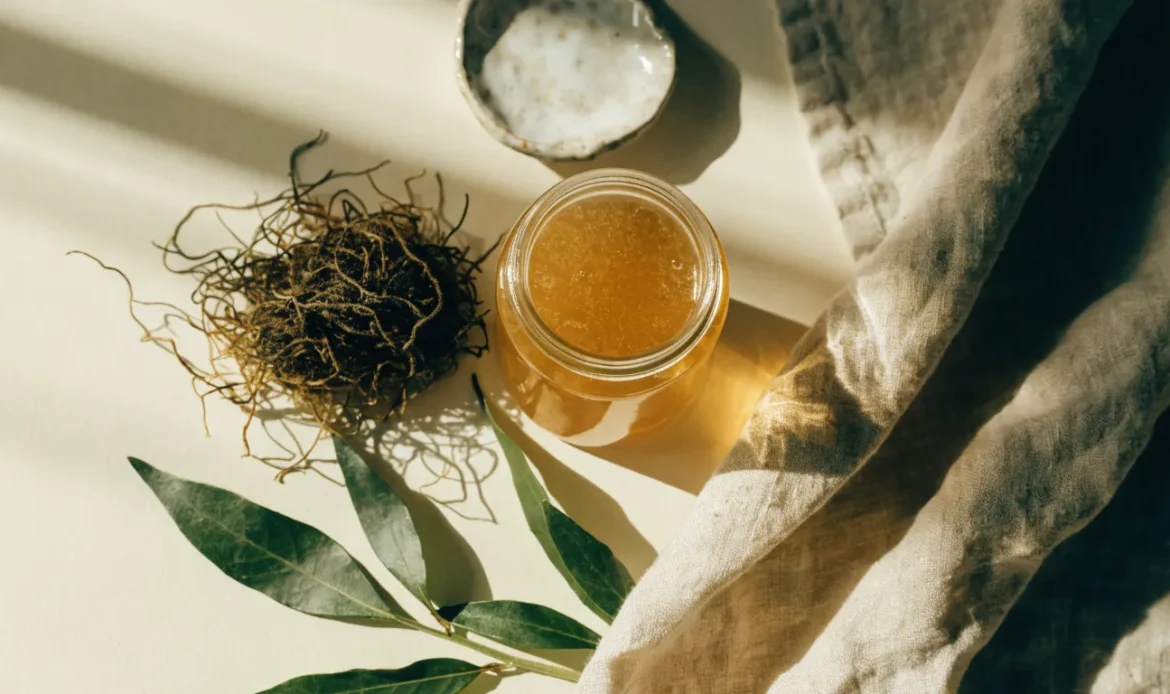
Short answer: A “sea moss plant” is a common name for several types of marine algae people harvest, dry, or process into foods and supplements. It is used for texture and nutrition. The exact species, how it was grown, and how it was processed affect its taste, texture, and safety. You can check a few facts before buying or using it to make a better choice.
Why this matters: sea moss products vary a lot. Some are sold raw, some dried, some as gel, powder, or capsules. Safety questions—especially about iodine—are important. Read on to learn what to check, how to compare formats, and what questions to ask a supplier.
What “sea moss” or “sea moss plant” means
- “Sea moss” is a market name. It groups different marine algae that look similar or are used in similar ways.
- People harvest sea moss from rocks, farms, or beaches. They may sun-dry it, oven-dry it, make a gel, grind it to powder, or put it in capsules.
- Uses include cooking, thickening, and adding to foods or drinks. The product type changes how you store and use it.
Note: Scientific names and exact species differ across regions. When you need that detail, ask the seller for the species name or a photo of the fresh plant.
How sea moss grows and where it comes from
Sea moss grows in the ocean. Some grows wild on rocks in intertidal zones. Some is farmed on ropes or frames in shallow water. Farming methods, water quality, and local species affect the final product.
What you can check:
- Is the sea moss wild-harvested or farmed?
- Where was it harvested (region or coast)?
- Does the supplier give harvest dates and processing details?
What you cannot prove from a label alone:
- Exact water quality unless the seller provides test results.
- Presence or level of specific minerals without lab tests.
If water quality or contaminants are a concern, ask the supplier for lab reports or certificates of analysis.
Common product formats and how to choose between them
Here are common sea moss formats and what they mean for use and purchasing.
- Raw/whole: Dried or sun-dried strands or clumps. Needs cleaning before use. Good if you want to prepare gel or cook.
- Gel: Sea moss soaked, blended, and strained into a thick liquid. Ready to mix into recipes. Shorter shelf life; often refrigerated.
- Powder: Dried and ground. Easy to add to smoothies or capsules. Check for fillers.
- Capsules or tablets: Powdered sea moss in pill form. Convenient, but harder to measure by eye.
- Wholesale bulk: Larger quantities for food businesses, makers, or retail.
How to choose:
- For cooking and thickening: raw or gel may be best.
- For convenience: powder or capsules are easier to dose.
- For reselling or product making: ask about batch testing, traceability, and packaging options.
Safety notes — iodine and contaminants
Seaweeds can contain iodine and other minerals. The amount of iodine varies by species, location, and processing. High iodine intake can affect the thyroid for some people. Scientific reviews show that seaweeds are a potential source of large iodine exposures in diets, and both short-term and long-term excessive iodine intake may have effects on thyroid function [2][5].
What to check about iodine and safety:
- Does the seller disclose iodine testing or a certificate of analysis (COA)?
- If you or customers have thyroid issues, talk with a healthcare professional before regular high intake of seaweed products.
- National surveys find iodine levels vary widely across seaweed products and types [3].
- Some public bodies and experts advise caution or recommend testing for iodine in seaweed products used as food or supplements [4].
Other safety points:
- Contamination risk (heavy metals, microbes) depends on source and processing. Ask for lab tests if you plan frequent consumption or resell.
- Processing and drying reduce microbial loads but do not remove minerals like iodine.
We cannot tell from a typical label whether a batch has safe iodine or contaminants. Only lab testing can show that.
Sources to consult: public health pages on seaweed and dietary iodine, and supplement-safety organizations [1][2][3][4][5].
How processing changes sea moss
Processing affects taste, texture, and shelf life.
- Drying (sun or oven) removes water and helps preservation. Dried sea moss can be rehydrated.
- Gel-making involves soaking and blending. Gel is easy to use but spoils faster.
- Powdering concentrates everything into a finer form and may mix better in recipes.
- Encapsulation places powdered sea moss in pills. This adds convenience but hides the content visually.
What to ask a seller:
- How was it dried or processed?
- Are there any additives, preservatives, or fillers?
- Does the product require refrigeration?
If labels are unclear, request processing details in writing.
Labels, claims, and testing: what to expect and what to ask
Labels can say a lot — if sellers provide truthful, verifiable information. But labels can also be vague. Here are specific questions to ask.
- Species identification: What species is this product? Can I see a Latin name?
- Harvest data: Where and when was it harvested?
- Processing: How was it dried or processed?
- Testing: Are there lab test results for iodine, heavy metals, or microbiology?
- Additives: Are there any added ingredients or fillers?
- Storage and shelf life: How should I store it? How long does it last?
If the seller can provide a recent certificate of analysis (COA) for the batch you will receive, that answers many questions about iodine and contaminants.
Practical decision guide: Choose the right sea moss for your needs
Use this checklist to decide which product fits your use. Tick the box that matters most for you.
| Question | What to look for | Why it matters |
|---|---|---|
| Purpose | Raw/dried for cooking; gel for drinks/recipes; powder/capsules for convenience | Different formats change prep and shelf life |
| Traceability | Seller provides harvest location, date, and species | Helps judge source and ask for testing |
| Testing | COA for iodine and contaminants available | Only tests show mineral or contaminant levels |
| Additives | Ingredient list with no hidden fillers | Pure product is easier to dose and label |
| Storage needs | Clear storage instructions and best-by date | Prevent spoilage and food-safety issues |
| Quantity | Small batch to try or bulk for business | Bulk needs more verification and storage planning |
| Price transparency | Clear price per weight and shipping terms | Avoid surprises, especially for wholesale |
| Return / contact policy | Clear contact info and return/exchange terms | Helpful if product quality differs from expectation |
Decision steps:
- Identify your primary goal (personal use, food service, or resale).
- Decide on format (raw, gel, powder, capsule, wholesale).
- Ask the supplier the checklist questions above.
- If you will consume regularly, request iodine testing. If reselling, keep test records.
This table helps you make a practical choice without relying on vague claims.
Format comparison: Pros and cons
- Raw/dried
- Pros: Good for traditional recipes; longer shelf life when dry.
- Cons: Requires cleaning and soaking; variable texture.
- Gel
- Pros: Ready to use; blends easily.
- Cons: Shorter shelf life; may contain added water or stabilizers.
- Powder
- Pros: Easy to dose and mix; shelf-stable if dry.
- Cons: Watch for fillers; processing can vary.
- Capsules
- Pros: Convenient dosing; portable.
- Cons: Harder to verify content per serving without testing.
When comparing offers, prefer sellers who provide clear processing details and test results when possible.
Buying wholesale or for retail
If you plan to buy sea moss in bulk for a shop or product line, take extra steps.
Checklist for wholesale sourcing:
- Ask for batch-specific COAs for iodine and heavy metals.
- Get sample batches first. Test them independently if your business requires that.
- Confirm storage, packaging, and shelf-life expectations.
- Ask about lead times and availability.
- Check return and damage policies for bulk orders.
Wholesale buyers should also review local food safety rules and labeling laws that apply to seaweed products.
Storage and basic preparation
Basic storage tips:
- Keep dried sea moss in a cool, dry place in a sealed container.
- Keep gel refrigerated and follow any best-by guidance.
- Avoid moisture for powdered products to limit clumping and spoilage.
Simple preparation for gels:
- Rinse dried sea moss to remove sand and salt.
- Soak in clean water until softened (time varies by product).
- Blend with fresh water and strain to desired consistency.
- Store gel in a sealed container in the refrigerator.
Exact soaking times and water amounts vary by product. Follow seller instructions.
What testing can and cannot tell you
Lab tests can measure iodine levels, heavy metals, and microbes. A COA is useful. But remember:
- Tests are for a specific batch or sample. Results do not automatically apply to every batch from a seller.
- Lack of a COA does not prove the product is unsafe; it means less verifiable information.
- Even with tests, long-term health effects depend on how much and how often someone consumes the product.
If you or customers will use sea moss often, insist on up-to-date testing.
Where to learn more and next steps
If you are ready to shop, look for sellers who share details and COAs. If you want to learn how to cook or make gel, choose raw or dried formats and follow recipes from reputable food-safety sources.
Useful starting pages on this site:
- Browse products: Shop
- Wholesale information: Wholesale
- Learn about sea moss and uses: Learn
- Contact us for questions: Contact
- Return to the home page: Home
Conclusion
A “sea moss plant” is a practical name for several kinds of marine algae used as food, thickener, or supplement. The key decisions are about format, source, and testing. Look for sellers who can answer simple questions: which species, where and when it was harvested, how it was processed, and whether batch testing exists for iodine and contaminants. If you will use sea moss often or sell it, ask for certificates of analysis and consider independent testing. If you are unsure about iodine or other mineral intakes, check with a healthcare provider.
If you want to explore options or buy, start by comparing formats on our Shop (/shop/) page, review our learning resources at Learn (/learn/), or contact us directly at Contact (/contact/). For bulk orders, see our Wholesale (/wholesale/) information or return to Home (/) for more.
Frequently asked questions
Is “sea moss plant” the same as seaweed?
Sea moss is a type of seaweed. The name refers to several marine algae used in foods and supplements. Different species are called sea moss in different places. For details about seaweed broadly, see public health resources [1].
Should I worry about iodine in sea moss?
Iodine levels in seaweed can vary widely. Some seaweeds are high in iodine. Excessive iodine can affect the thyroid in some people. If you will use seaweed regularly, consider asking for iodine test results or talk with a healthcare professional [2][5].
How can I tell if a product is safe?
Ask the seller for a recent certificate of analysis (COA) that shows testing for iodine, heavy metals, or microbes. Also check processing methods and storage instructions. Tests are the best way to verify safety for a batch [3][4].
Is gel safer than dried sea moss?
Neither form is inherently safer. Gel is more perishable and needs refrigeration. Dried sea moss can last longer but still requires cleaning. Safety depends on source, processing, and testing.
Can I resell sea moss products I buy wholesale?
Yes, but you should confirm supplier traceability and obtain COAs if needed. You must also follow local food-safety and labeling laws for retail products.
How often should I test batches if I sell sea moss?
Testing frequency depends on your risk tolerance, customer use patterns, and local regulations. Many businesses test each production batch or at reasonable intervals. Independent lab advice can help set a testing schedule.
References
- Harvard T.H. Chan School of Public Health, “Seaweed.” https://nutritionsource.hsph.harvard.edu/seaweed/
- Smyth PPA. “Iodine, Seaweed, and the Thyroid.” European Thyroid Journal, 2021. https://pmc.ncbi.nlm.nih.gov/articles/PMC8077470/
- Food Standards Australia New Zealand, “Survey of iodine levels in seaweed and seaweed containing products,” updated 2025. https://www.foodstandards.gov.au/science-data/monitoring-safety/surveyofiodinelevels
- Operation Supplement Safety, “Sea Moss in Dietary Supplements.” https://www.opss.org/article/sea-moss-dietary-supplements
- Blikra MJ et al. “Consequences of acute and long-term excessive iodine intake: A literature review focusing on seaweed as a potential dietary iodine source.” 2024. https://doi.org/10.1111/1541-4337.70037