
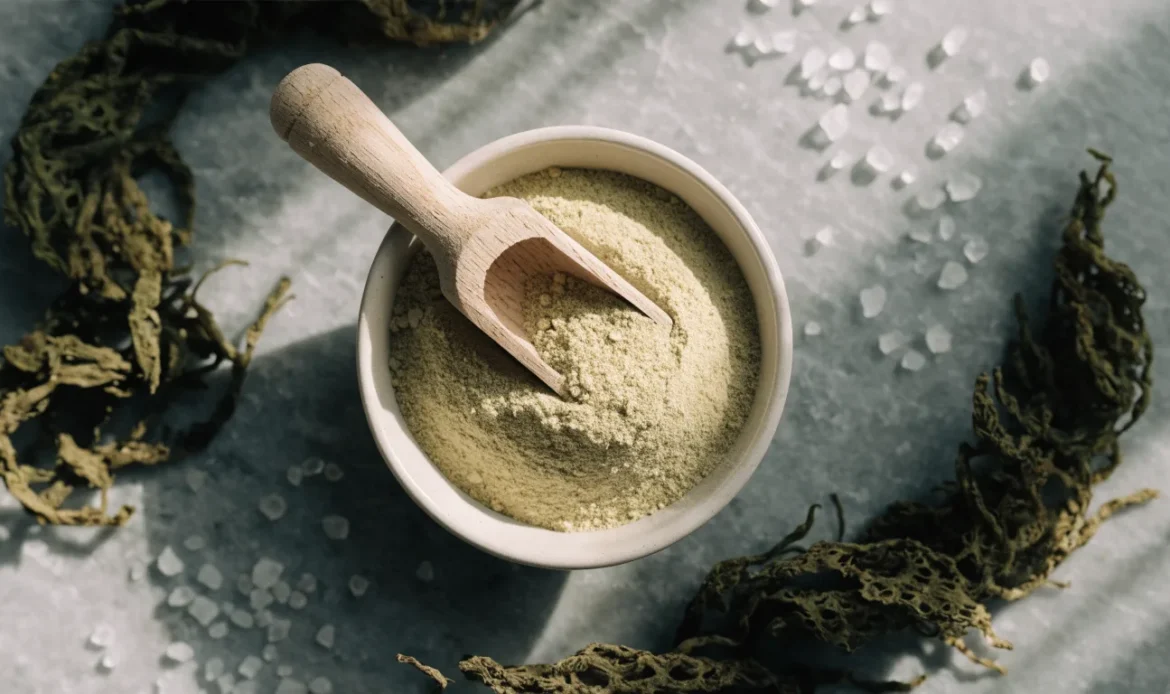
Short answer first: Powdered sea moss is dried, ground seaweed sold as a fine powder. It is a shelf-stable form of seaweed you can add to foods, drinks, or use to make gel. It is convenient, but nutrient levels (especially iodine) and purity vary by source, so check labels and test results before buying.
Why this matters: powdered sea moss is useful for cooking and mixing. But seaweeds can contain high iodine and other variable components. You can check some facts on a package. Other facts you cannot confirm from a label alone. Below is a clear guide to what powdered sea moss is, how it is made, what you can check, what you should ask a seller, and a short decision guide to pick the right format.
What is powdered sea moss?
Powdered sea moss is simply seaweed that has been dried and finely milled into a powder. Sellers may use the common name “sea moss” for several types of red algae. Powder form is different from fresh seaweed, raw whole dried seaweed, sea moss gel (reconstituted), or capsules. Powdered sea moss is often used as an ingredient because it mixes more easily than strips of dried seaweed.
Key facts you can rely on:
- It is a dried, ground product. That means it is not raw in the sense of the fresh plant, but it may be minimally processed.
- Powder form is meant to be convenient for mixing into foods, drinks, or making a gel.
Limits of what the product label can prove:
- A label cannot show the exact amounts of elements like iodine, unless there is a lab result for that batch.
- A product statement about origin or “wild-harvested” is a seller claim unless backed by traceable sourcing documentation.
How powdered sea moss is commonly made
Typical steps used by reputable suppliers:
- Harvest: seaweed is harvested from coastal waters.
- Rinse and clean: visible sand, shell pieces, and debris are washed away.
- Dry: the seaweed is dried by sun, air, or low-temperature dryers.
- Mill: dried seaweed is ground into a powder.
- Package: powder is sealed in bags or jars.
Note: each step may change the final product. Drying method affects texture and shelf stability. Milling fineness affects how it mixes. Washing affects surface contaminants. None of these steps can guarantee specific mineral levels without testing.
Why powdered sea moss is chosen
Common practical reasons people pick powdered form:
- Convenience: easy to store and mix.
- Longer shelf life than fresh seaweed or gel.
- Easier to measure for recipes.
- Suits powdered formulations and dry blending.
Tradeoffs:
- Nutrient content can vary from batch to batch.
- Powdered sea moss may need rehydration for some uses.
- You cannot assume exact iodine content without lab data.
What to check on a powdered sea moss package
You can verify some things before purchase. Use this practical checklist first. If a seller cannot answer these points, consider another source.
Practical buying checklist
- Species or common name listed: Does the label say what kind of seaweed it is?
- Harvest date or lot number: Is there a batch or lot number you can reference?
- Country or region of harvest: Where does the seller state it came from?
- Processing method: Was it sun-dried, air-dried, or oven-dried?
- Ingredient list: Is the product pure seaweed or mixed with other ingredients?
- Allergen statements: Does the label include allergen warnings?
- Storage instructions: Does the packaging list how to store and shelf life?
- Third-party test or Certificate of Analysis (COA): Is there a COA available for the lot?
- If yes, which analytes are tested (iodine, heavy metals, microbes)?
- Is the COA recent and tied to the lot number?
- Packaging tamper-evident and sealed: Is the package sealed and labeled?
- Seller contact info: Is there a way to contact the company with questions?
What a COA will and won’t tell you
- A COA confirms the results for the sample tested. It does not guarantee every future or past lot will have the same numbers.
- Check the COA date and lot number. If these match the product, it gives stronger assurance for that batch.
- Look for the lab name and a signature or accreditation. Accredited labs follow recognized methods.
Where to ask for more information
- Contact the seller and request a COA tied to the lot number.
- Ask what laboratory methods were used for iodine and heavy-metal testing.
- If the seller cannot or will not provide a COA, consider that a red flag.
Cautions about iodine and variability
- Iodine levels in seaweed are well-known to vary widely by species, season, and location. This means one batch can be far different from another [1][2][5].
- High iodine intake can affect the thyroid. If you have a thyroid condition, consult a licensed healthcare professional before changing your intake [2][5].
- Regulatory surveys have found wide variation in iodine content across seaweed products, which has led to guidance for testing and labeling in several regions [3][5].
Sources that discuss iodine and seaweed:
- Harvard T.H. Chan School of Public Health explains that different seaweeds vary in nutrient content and that iodine can be high in some species [1].
- Reviews and studies show that excessive iodine intake from seaweed is a documented risk and that testing is important [2][5].
- Government surveys report variability in iodine across commercial seaweed products and suggest testing and monitoring [3].
Powdered sea moss vs other formats
This table-style decision guide helps compare powdered sea moss with other common formats. Use it to pick the form that fits your use and risk tolerance.
Format comparison guide
- Powdered sea moss
- Strengths: shelf-stable, easy to blend, convenient for recipes and formulations.
- Practical uses: smoothies, baking, powdered blends, making gel from powder.
- Checks to make: species, COA, lot number, storage.
- Dried whole (strips or chips)
- Strengths: less processed, easy to inspect visually, good for cooking.
- Practical uses: soups, rehydration, culinary use.
- Checks to make: same as powder — species, drying method, COA.
- Sea moss gel (reconstituted)
- Strengths: ready-to-use texture, easy to mix into foods and drinks.
- Practical uses: spreads, recipes that require viscous texture.
- Checks to make: shelf life, refrigeration needs, preservatives added, COA.
- Capsules or tablets
- Strengths: measured doses, easy for supplements.
- Practical uses: supplement form when dose control is desired.
- Checks to make: label claims, list of ingredients, third-party testing, serving size.
Notes on choice:
- Choose powder if you need long storage and flexible use.
- Choose whole dried seaweed if you want to see the product and do culinary rehydration.
- Choose gel if you want immediate texture without rehydration.
- Choose capsules only if you have clear label and testing for iodine and contaminants.
How to use powdered sea moss safely
Simple, practical steps:
- Read the label and COA first.
- Store the powder in a cool, dry place per the package directions.
- If you plan to use it often, buy smaller batches or ask about lot rotation.
- If you are at risk from high iodine (thyroid issues, pregnancy), check lab data and talk with a healthcare professional before regular use.
- If making gel from powder, use clean tools and follow food-safety steps to avoid contamination.
Basic rehydration idea (practical, non-medical)
- Mix powder with clean, cold water. Stir or whisk until the powder swells and forms a gel-like texture.
- Let it sit per the recipe or package instructions for full rehydration.
- Store made gel in the refrigerator and follow label storage guidance.
Note: exact ratios vary by product. Use the supplier’s directions.
Food safety and contamination
- Seaweed can carry microbes or environmental contaminants if not handled properly. A COA that includes microbial tests helps show if the tested lot passed the lab checks.
- Heavy metals and other marine contaminants can be present in sea products depending on location. Tests for common heavy metals are part of a typical safety screen.
- Remember: a COA shows results for the tested sample. It is not a blanket guarantee for all future production.
Questions to ask before buying powdered sea moss
Use these questions when you contact a seller or read product pages:
- What species of seaweed is this? Scientific name or common name?
- Do you have a Certificate of Analysis for the lot? What exactly was tested (iodine, arsenic, lead, cadmium, mercury, microbes)?
- Where and when was this harvested?
- How was it dried and milled?
- Is the product pure seaweed or blended with other ingredients?
- What lot number and best-by date are on the package?
- Are there storage instructions and an expected shelf life?
What answers are useful
- A clear lot number and a recent COA that lists iodine and heavy metals is useful.
- A named testing lab and method is better than vague statements.
- If a seller cannot provide testing or details, that increases uncertainty.
Practical decision checklist
This short checklist helps you decide whether to buy a given powdered sea moss product. Give each item a yes or no. If you have more than two “no” answers, pause and ask the seller more questions.
Decision checklist
- Yes/No: Is the species or common name listed clearly on the label?
- Yes/No: Is there a lot number or harvest date on the package?
- Yes/No: Can the seller provide a COA tied to that lot?
- Yes/No: Does the COA include iodine and heavy-metal testing?
- Yes/No: Are storage instructions and a best-by date given?
- Yes/No: Is there a clear ingredient list (no hidden fillers)?
- Yes/No: Does the seller publish contact info and return policy?
- Yes/No: Do you have no known medical reason (e.g., thyroid condition) to avoid potential iodine intake? (If unsure, consult a professional.)
If you answered “No” to more than two, ask for more data before buying.
What sellers can and cannot prove
What a seller can prove:
- The product was tested and here are the results for that sample (with a COA).
- The product contains only the ingredients listed on the label.
- The product was packaged with a labeled lot number and date.
What a seller cannot prove with a single test:
- That every future or past package has identical iodine or contaminant levels.
- That long-term health effects will or will not occur from use.
- That a product is free of all environmental contaminants in every situation.
This distinction matters. Testing improves transparency. But variability in natural products means testing must be continuous and tied to specific lots to be fully informative.
When to consult a professional
Talk to a licensed healthcare professional if:
- You have thyroid disease, are pregnant or breastfeeding, or have a condition that could be affected by iodine intake.
- You plan to use powdered sea moss as a regular part of a diet and have concerns about nutrient intake.
Do not rely on seller claims for medical advice. Sellers can provide product information and test results, but medical guidance should come from a healthcare professional.
Next steps and useful links
If you want to learn more about seaweed and safety, start here:
- Learn more about what powdered sea moss is and other formats on our learning hub: /learn/
- Browse all product formats and shop options: /shop/
- If you are a business buyer, see bulk and wholesale options: /wholesale/
- Contact us with specific product questions or requests for COAs: /contact/
- Return to the home page for general info: /
Conclusion
Powdered sea moss is a convenient, shelf-stable form of seaweed. It is useful for mixing, cooking, or making gel. But important features like iodine content and contaminant levels can vary by species, location, and batch. Ask for a COA tied to the lot, check the label for species and harvest details, and consult a healthcare professional if you have thyroid concerns. Use the checklist above to evaluate products. With clear questions and the right documentation, you can make an informed choice about powdered sea moss.
Continue reading
Frequently asked questions
Is powdered sea moss the same as sea moss gel?
No. Powdered sea moss is a dried, milled product. Sea moss gel is a rehydrated, spreadable form made from fresh or reconstituted sea moss. They are different formats and behave differently in recipes.
Does powdered sea moss contain iodine?
Seaweeds are known to contain iodine, but the amount varies widely by species, season, and location. A Certificate of Analysis (COA) for the specific lot is the best way to know iodine levels for that batch [1][2][5].
How can I tell if powdered sea moss is safe?
Ask for a COA tied to the lot that lists tests for iodine and common contaminants like heavy metals and microbes. Confirm the lot number on the package matches the COA. Also check storage instructions, harvest info, and seller contact details [3][4].
Can I make gel from powdered sea moss?
Yes. Many people rehydrate powder by mixing it with water until it thickens to a gel-like texture. Follow the supplier’s directions for ratios and food-safety guidance.
Are there special risks for people with thyroid problems?
Because seaweeds can contain high levels of iodine, they can affect thyroid function in some people. If you have thyroid disease or are unsure, consult a licensed healthcare professional before regularly using products that may contain iodine [2][5].
What does a COA typically include?
A COA usually lists the lab name, sample ID or lot number, test date, and results for specific analytes (e.g., iodine, arsenic, lead). Look for the COA to be tied to the lot on your package. If a COA lacks clear linkage to a lot, its value is limited.
References
- Harvard T.H. Chan School of Public Health, “Seaweed.” https://nutritionsource.hsph.harvard.edu/seaweed/
- Smyth PPA. “Iodine, Seaweed, and the Thyroid.” European Thyroid Journal, 2021. https://pmc.ncbi.nlm.nih.gov/articles/PMC8077470/
- Food Standards Australia New Zealand, “Survey of iodine levels in seaweed and seaweed containing products,” updated 2025. https://www.foodstandards.gov.au/science-data/monitoring-safety/surveyofiodinelevels
- Operation Supplement Safety, “Sea Moss in Dietary Supplements.” https://www.opss.org/article/sea-moss-dietary-supplements
- Blikra MJ et al. “Consequences of acute and long-term excessive iodine intake: A literature review focusing on seaweed as a potential dietary iodine source.” 2024. https://doi.org/10.1111/1541-4337.70037