
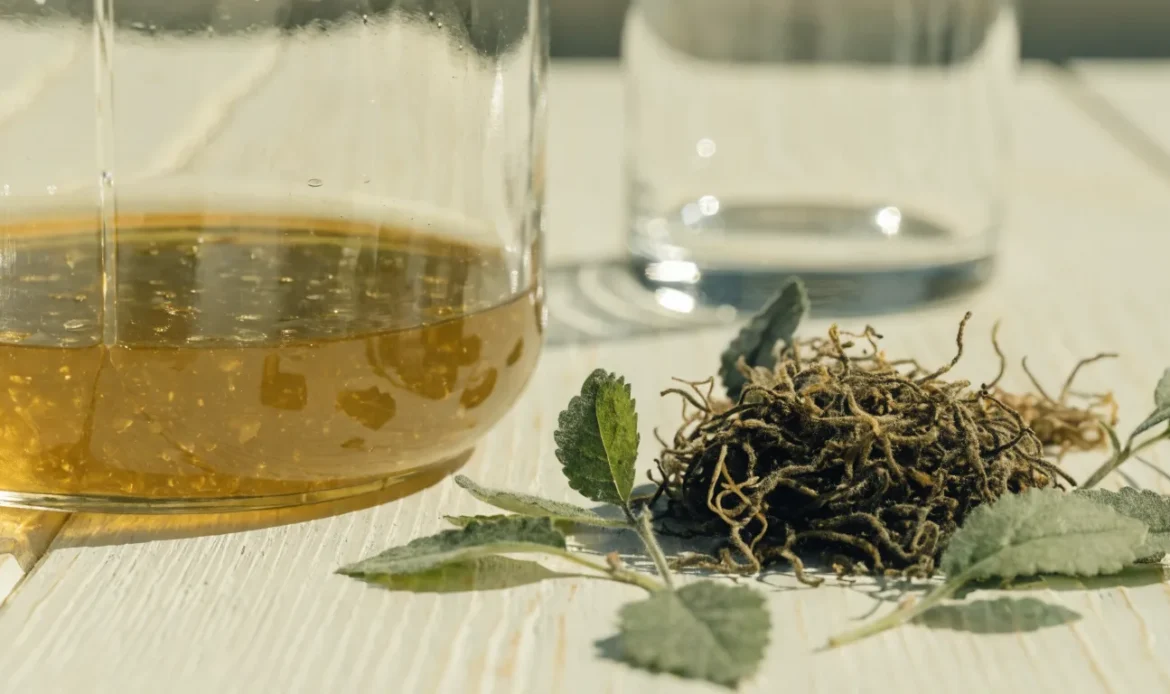
Short answer: Elderberry sea moss is a product that pairs sea moss with elderberry in a single format. It usually combines prepared sea moss (gel, powder, or dried) with elderberry extract, syrup, or flavor. People choose it for taste or convenience. This guide explains the formats, what to check on labels, safety points, and how to decide which product fits your needs.
What is in the name?
- “Sea moss” is a common name for several edible seaweeds used in food and supplements. Seaweed can be sold raw, dried, as gel, or as a powder. See a general overview of seaweed nutrition and use for context [1].
- “Elderberry” usually refers to preparations made from berries of Sambucus species. In products, elderberry may appear as juice, syrup, extract, or powder.
- “Elderberry sea moss” means the two are combined. The mix can be made by adding elderberry syrup to sea moss gel. Or a manufacturer may blend sea moss powder with elderberry extract. Each product is different.
Common formats of elderberry sea moss
Products vary a lot. Here are the main formats you will meet.
- Sea moss gel with elderberry
- Sea moss is soaked, blended with water, and made into a gel. Elderberry juice, syrup, or extract is mixed into the gel for color and flavor.
- Gel is often sold refrigerated or frozen.
- Powdered sea moss with elderberry
- Sea moss is dried and ground. Elderberry powder or extract is mixed in.
- Powders can be shelf-stable if processed and packaged correctly.
- Capsules or softgels containing sea moss and elderberry
- Manufacturer packs a measured dose into a capsule. Ingredients may include sea moss powder plus an elderberry extract.
- Dried sea moss plus elderberry syrup or concentrate
- Some kits sell raw dried sea moss alongside an elderberry syrup to mix at home.
- Ready-to-drink blends
- Drinks that combine sea moss extract or gel with elderberry syrup and other ingredients.
Each format changes how you store, dose, and use the product. A gel is often used in smoothies and recipes. A powder goes into shakes or baking. Capsules are for measured dosing.
How elderberry sea moss is made (typical steps)
Manufacturers and home makers use similar basic steps. Exact steps depend on format.
- For gel:
- Rinse raw or rehydrated sea moss to remove sand and debris.
- Soak it in water until soft.
- Blend with fresh water until smooth.
- Strain if desired, then add elderberry syrup, juice, or extract.
- Package and keep cool.
- For powder blends:
- Dry sea moss completely.
- Grind into powder.
- Mix with elderberry powder or a stabilized extract.
- Package in jars or capsules.
- For capsules:
- Use a measured ratio of powders or extracts.
- Fill capsules under sanitary conditions.
- Label and package.
What you cannot know from a name:
- The exact ratio of sea moss to elderberry.
- Whether the elderberry is whole-berry, concentrate, or a low-strength flavoring.
- Whether any added sugars, preservatives, or stabilizers are present.
Ask the seller for ingredient details if these points matter to you.
What you can check on labels and what labels cannot prove
What labels can show:
- A list of ingredients (mandatory in many markets).
- Suggested serving size, storage instructions, and use directions.
- Allergen statements and major additives.
- Whether the product is raw, dried, or blended.
What labels cannot prove without testing:
- Exact amounts of specific minerals (like iodine) or phytochemicals.
- Absence of contaminants such as heavy metals or microbes.
- True source or harvest area of the seaweed unless verified by a certificate.
- Consistent potency across batches.
When a label lists a third-party lab test or Certificate of Analysis (COA), it can help. But you should read the COA yourself or ask for a copy. If no COA is available, labels alone do not verify lab test results.
Safety points to consider
Seaweed products can vary in their levels of natural minerals. Iodine is a key example. High iodine levels can affect thyroid function in some people. Scientific reviews and agencies advise caution about iodine from seaweed and seaweed products [2][3][5].
- If you have thyroid disease, are pregnant, or take thyroid medication, ask a clinician before using seaweed products. A clinician can advise based on your medical history and lab tests.
- Check whether the product lists iodine content or provides a COA. If it does, review that data with a clinician if you have a health concern.
- Sea moss and elderberry products can contain added sugar, alcohol extracts, or other ingredients. Check ingredient lists if you watch sugar, sodium, or alcohol intake.
- Supplements and blended foods can be made under different standards. Operation Supplement Safety cautions that formulations vary and that consumers should look for tested, reputable products [4].
- For the general population, small amounts used in recipes are not the same as concentrated supplement doses. But variability is wide, so check labels and ask questions.
Practical decision guide: Which format fits you?
The table below helps you pick a format. It lists common goals, format fit, and key checks to make.
| Goal or use | Best formats | What to check before buying |
|---|---|---|
| Add to smoothies or recipes | Gel or powder | Freshness, refrigeration rules (gel), ingredient list |
| Easy measured dose | Capsules | Serving size, capsule count, full ingredient list |
| Long shelf life or travel | Powder or capsules | Packaging seals, moisture control, storage advice |
| Strong elderberry flavor | Gel with real elderberry or syrup | Source of elderberry (juice, syrup, extract), added sugar |
| DIY control of ingredients | Dried sea moss + separate elderberry syrup | Drying method, rehydration steps, syrup ingredients |
| Avoid added sugar | Powder or plain gel without syrup | Ingredient list, added sugars on label |
Checklist (quick buy guide)
- Read the full ingredient list.
- Note whether the product is refrigerated or shelf-stable.
- Check for added sugars, alcohol, or flavorings.
- Ask for a COA or lab report for iodine and contaminants if you have health concerns.
- Confirm storage and shelf-life instructions.
- Ask whether elderberry is whole fruit, extract, or flavor.
- Ask about third-party manufacturing or safety audits if that matters.
How to use elderberry sea moss (basic ideas)
- Smoothies: Scoop gel or powder into a blender with fruit and liquid.
- Stir-in: Add a spoonful of gel to warm cereal or sauces after cooking.
- Baking: Use powdered blends in baked goods. Follow a recipe that accounts for moisture changes.
- Capsules: Take as directed on the package.
- Homemade mixes: If you buy dried sea moss and elderberry syrup, follow rehydration instructions for the moss, then blend with syrup to taste.
Do not heat elderberry syrup or extracts strongly unless the product instructions allow it. High heat may change taste or stability of some ingredients.
Questions to ask a seller or manufacturer
- What exactly is in the product? (Ask for a full ingredient list.)
- Where and how was the sea moss sourced and processed? (Vague answers are common; ask for specifics.)
- Do you have a Certificate of Analysis (COA) or third-party lab report for iodine, heavy metals, or microbes?
- Is the elderberry whole-berry, concentrate, or an extract? What is the ratio or concentration?
- Is sugar added? How much per serving?
- How should the product be stored? What is the shelf life after opening?
- Do you follow Good Manufacturing Practices (GMP) or other quality standards?
If a seller can provide a recent COA, that gives you data to review. If not, consider whether you want to buy that product.
What buyers often misunderstand
- “Natural” does not equal “consistent.” Natural products vary by batch.
- A label listing “sea moss” does not tell you the mineral content.
- Flavor color from elderberry can mask the base product. Taste or color alone do not prove potency.
- “Made with elderberry” does not mean a strong elderberry concentration. Ask for amounts.
Suggested next steps
- If you want more background about seaweed as food, see the Harvard Seaweed overview for general context [1].
- If you are concerned about iodine or thyroid issues, read professional reviews on iodine and seaweed [2][5] and public monitoring data [3].
- If you want safety notes about sea moss supplements, read the Operation Supplement Safety overview [4].
- If you want to browse product formats or buy for personal or business use, visit our shop or wholesale pages linked below.
Useful next links:
- Home: /
- Learn more: /learn/
- Shop elderberry sea moss products: /shop/
- Wholesale inquiries: /wholesale/
- Contact us with questions: /contact/
Conclusion
Elderberry sea moss is a broad category of products that pair sea moss with elderberry in many formats. The main choices are gel, powder, capsules, dried kits, or ready-to-drink blends. Labels tell you some things: ingredients, storage, and use instructions. Labels cannot substitute for lab tests if you need data on iodine or contaminants. Ask sellers for ingredient details and COAs when needed. Match the format to how you plan to use the product, and consult a clinician if you have thyroid issues or other health concerns. If you want more background on seaweed or product safety, follow the links and sources below.
Continue reading
Frequently asked questions
Is elderberry sea moss the same as sea moss flavored with elderberry?
Often yes. Many products are sea moss blended with elderberry syrup or extract. “Elderberry sea moss” can mean either a flavored gel or a true blended supplement. Read the ingredient list to know which you have.
Can I make elderberry sea moss at home?
Yes. A common home method is to soak and blend sea moss into a gel and add elderberry syrup or extract to taste. Follow safe food-handling steps. Keep refrigerated and use within recommended days for fresh gels.
Are there safety concerns with sea moss and iodine?
Seaweeds can be rich in iodine. High iodine intake can affect the thyroid in some people. If you have thyroid issues or take thyroid medicine, ask a clinician before using seaweed products and consider asking the seller for iodine test data [2][5].
What should I ask about elderberry in the product?
Ask whether the elderberry is whole fruit, concentrate, or extract. Ask about added sugars and how much elderberry is present per serving. A product labeled “made with elderberry” may still have small amounts.
Should I look for a Certificate of Analysis (COA)?
If you want lab verification of mineral levels or contaminants, ask for a COA. A COA can show test results for iodine, heavy metals, or microbial safety. If no COA is available, the label alone cannot confirm those measurements [4].
How long does elderberry sea moss last?
Shelf life depends on format. Gel is usually perishable and needs refrigeration. Powders and capsules can last longer if sealed and kept dry. Always follow the product’s storage and use-by instructions.
References
- Harvard T.H. Chan School of Public Health, “Seaweed.” https://nutritionsource.hsph.harvard.edu/seaweed/
- Smyth PPA. “Iodine, Seaweed, and the Thyroid.” European Thyroid Journal, 2021. https://pmc.ncbi.nlm.nih.gov/articles/PMC8077470/
- Food Standards Australia New Zealand, “Survey of iodine levels in seaweed and seaweed containing products,” updated 2025. https://www.foodstandards.gov.au/science-data/monitoring-safety/surveyofiodinelevels
- Operation Supplement Safety, “Sea Moss in Dietary Supplements.” https://www.opss.org/article/sea-moss-dietary-supplements
- Blikra MJ et al. “Consequences of acute and long-term excessive iodine intake: A literature review focusing on seaweed as a potential dietary iodine source.” 2024. https://doi.org/10.1111/1541-4337.70037