
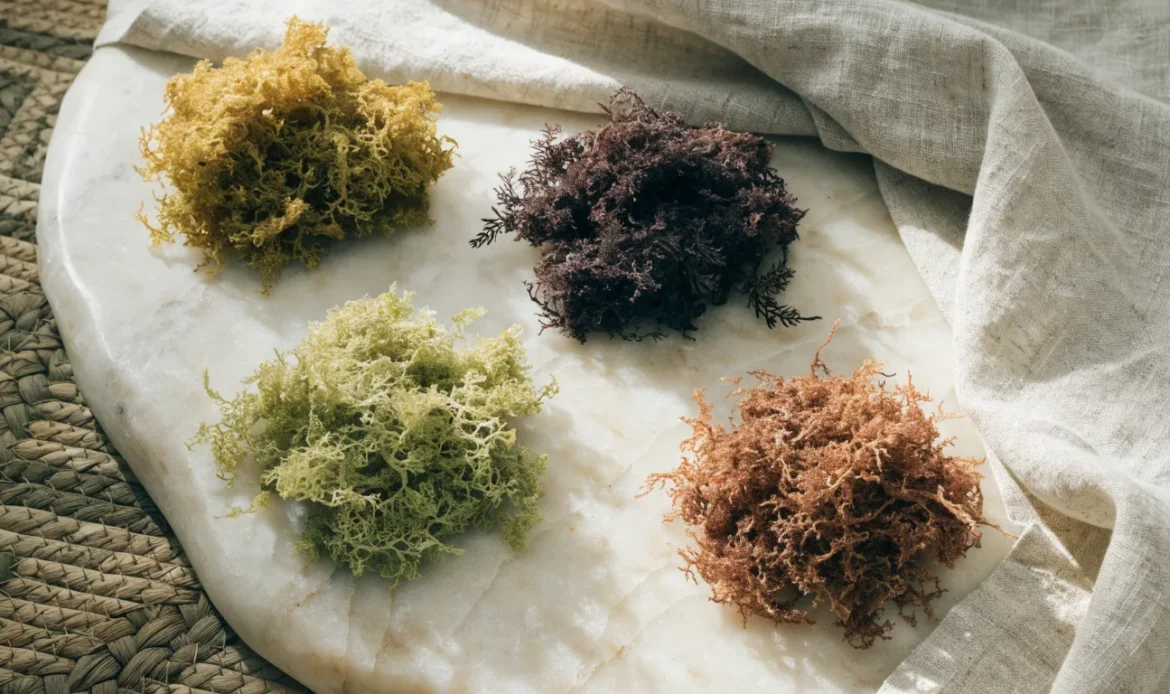
Short answer first: Dried sea moss is seaweed that has been cleaned and dried so it keeps longer. People buy it as loose pieces, powder, or flakes. Its nutrients and iodine levels vary a lot. Check testing and seller transparency before you buy.
What dried sea moss is
Dried sea moss is simply seaweed that has been removed from the water, cleaned, and dried. Drying makes the seaweed lighter, shelf-stable, and easier to ship. Dried sea moss can come as whole pieces, broken chips, thin flakes, or ground powder.
Two points to know:
- Seaweeds are a wide group of plants from the ocean. Different seaweeds can look similar but have different textures and contents. Nutrient levels vary by species, season, and where they grew [1].
- Dried sea moss is a storage and format choice. It usually needs rinsing and rehydrating before most culinary uses.
(For general context on seaweed and nutrient variation, see References [1].)
Common dried sea moss formats and how they differ
Here are the formats you will commonly see and what to expect from each.
- Raw dried pieces
- What it is: Whole or broken stems and fronds that were dried after harvest.
- How people use it: Soaked then blended into a gel; added to soups after rehydration.
- Pros: Simple, closest to the original plant. Often the least processed.
- Cons: Needs time to rehydrate and clean.
- Dried flakes or chips
- What it is: Pieces cut or broken into smaller bits.
- How people use it: Easier to measure than large pieces. May still need rinsing and soaking.
- Pros: Faster rehydration than large chunks.
- Cons: May include smaller debris to remove.
- Powder (ground dried sea moss)
- What it is: Dried sea moss that has been ground into a fine or coarse powder.
- How people use it: Stirred into drinks or recipes, or put into capsules.
- Pros: Convenient and quick to use.
- Cons: Powder is hygroscopic (attracts moisture) and may clump if stored poorly. You lose the visual cue of whole plant quality.
- Gel (made from rehydrated dried sea moss)
- What it is: Rehydrated and blended dried sea moss that forms a thick gel.
- How people use it: As a thickener in smoothies, soups, or topical products.
- Pros: Ready to use, no soaking each time.
- Cons: Gel is perishable and needs refrigeration or freezing.
- Extracts and capsules
- What it is: Concentrated or encapsulated forms made from dried seaweed or its extracts.
- How people use it: For convenience and measured dosing.
- Pros: Easy to store and use.
- Cons: You are more reliant on the maker’s testing and labeling.
No format is universally best. The right choice depends on how you want to use the sea moss and how much prep you are willing to do.
How dried sea moss is made (short overview)
Producers usually follow a few steps: harvest, clean, and dry. Drying may happen by sun, shade, or mechanical dehydrators. Drying method affects texture and color, but not necessarily safety or nutrient content. What matters for safety and transparency is how well the product is cleaned and tested for contaminants. The drying step preserves the product for storage and shipping.
What you should check when buying dried sea moss
Below is a practical decision checklist. It lists what to look for, why it matters, and what the information can and cannot prove.
| What to check | Why it matters | What the claim or label can and cannot prove |
|---|---|---|
| Species or common name listed | Different species have different textures and levels of minerals | Proves what the seller says about the product. It does not guarantee consistent nutrient levels across batches. |
| Harvest or sourcing information (region, wild/farmed) | Helps you judge seasonality and likely environmental conditions | Shows seller transparency. It cannot prove absolute absence of local contamination without testing. |
| Batch testing or Certificate of Analysis (COA) for heavy metals, microbes, or iodine | Testing helps confirm the safety of that batch | A COA proves the tested sample met specific limits at test time. It does not guarantee future batches or test for substances not listed on the COA. |
| Dry appearance and smell | Visual and smell checks catch obvious spoilage or contamination | Fresh-looking and neutral smell are good signs. They cannot prove invisible contaminants or exact nutrient levels. |
| Seller policies (returns, contact info, clear labeling) | Good customer support shows reliability | Policies show business practices. They do not equal product safety testing. |
| Processing details (how dried, additives, grinding) | Tells you if additives or steps might affect use | If additives are listed, it proves they are in the product. If not listed, absence is not proof of purity unless tested. |
Use the checklist to compare sellers side by side. If a seller provides lab results, read what was tested and when the test occurred. If no testing is available, ask questions before buying.
(For background on testing and supplement oversight concerns, see Reference [4]. For variation in iodine across seaweeds, see References [2], [3], and [5].)
Safety notes: iodine and contaminants
- Iodine levels in seaweeds can vary widely. Some seaweeds are naturally high in iodine and may exceed typical daily needs if consumed frequently. This variability makes it hard to estimate how much iodine you get from a given serving of dried sea moss [2][3][5].
- Excessive iodine intake can affect thyroid function in some people. If you have thyroid disease, are pregnant, or are taking thyroid medication, talk with a healthcare provider before you add seaweed products to your diet [2][5].
- Contaminants such as heavy metals or microbes can be a concern for any wild-harvested marine product. Look for batch testing that includes heavy metals and microbial limits. Testing reduces uncertainty for a specific batch but does not eliminate all risk [4].
You cannot tell iodine content or contamination by color, taste, or smell alone. Only proper testing can measure those components. If product testing is not available, consider smaller trial purchases or choose a seller who publishes lab results.
How to prepare dried sea moss (step-by-step guide)
Preparation can vary by product. Below is a general method for raw dried pieces and flakes.
- Inspect the pieces
- Spread the dried sea moss on a clean tray. Look for large shells, sand, or obvious dirt. Remove these pieces.
- Rinse
- Rinse the sea moss under cool running water to remove surface salt and debris.
- Soak and rehydrate
- Place rinsed sea moss in a clean bowl and cover with filtered or bottled water. Let it soak until it softens and expands. Soaking times vary by piece size and dryness. Smaller pieces rehydrate faster than thick chunks.
- Change the soaking water if it looks cloudy or contains debris.
- Final rinse
- After soaking, rinse again to remove any remaining grit.
- Make gel (if desired)
- Put the rehydrated sea moss and fresh water into a blender. Blend until smooth. The result should be a soft gel-like paste.
- Store gel in a sealed container in the refrigerator or freezer.
- Use
- Add the gel to smoothies, soups, stews, or recipes as a thickener. You can also cook rehydrated pieces directly in recipes.
Notes:
- Use clean utensils and containers. Sea moss gel is perishable once rehydrated.
- If you are unsure about the product, start with a small amount when trying it the first time.
Simple gel recipe (practical example)
- Rinse and soak cleaned dried sea moss until soft.
- Drain and rinse the soaked moss.
- Place moss in a blender with enough clean water to cover roughly. Blend until smooth.
- Transfer to a sealed container. Refrigerate or freeze.
Adjust the water amount to get thicker or thinner gel. Thicker gel uses less water. Keep in mind gel is perishable and needs cold storage.
Storage tips for dried sea moss and gel
- Dried sea moss: Store in an airtight container in a cool, dry place away from direct sunlight. Avoid humid or damp areas.
- Powder: Keep in a dry sealed container. Moisture makes powder clump and speeds spoilage.
- Made gel: Gel should be refrigerated or frozen. Treat gel like a perishable prepared food.
No storage label can prove indefinite safety. If the product smells off, has visible mold, or looks unusually slimy after storage, discard it.
A decision guide: Which dried sea moss format is right for you?
Use this short decision guide to pick a format.
- You want to make your own gel and control the texture:
- Choose: Raw dried pieces or flakes.
- Why: Easier to rehydrate and blend yourself.
- You want convenience and fast use:
- Choose: Powder or pre-made gel.
- Why: Powder mixes quickly; gel is ready to add to recipes.
- You plan to travel or store for long without refrigeration:
- Choose: Dried pieces or powder.
- Why: These formats are shelf-stable until rehydrated.
- You want a precise, capsule-style option:
- Choose: Capsules or extracts from a reputable maker with testing.
- Why: Easier to dose, but verify testing and labeling.
- You want the least processed option:
- Choose: Whole dried pieces from a transparent seller.
- Why: Less processing makes it easier to inspect and prepare.
What sellers’ labels and tests can and cannot tell you
- Label facts (species, region, ingredients) tell you what the seller claims. They do not prove the absence of contaminants or exact nutrient levels.
- A Certificate of Analysis (COA) usually lists which tests were done for a specific batch. A COA proves only that that sample was tested on a given date and met the limits for the tests listed.
- No label or single lab test can guarantee future batches or cover every possible contaminant. Regular testing and supplier transparency reduce risk but do not eliminate it.
(For more on supplement testing and limitations, see Reference [4]. For iodine variability and its implications, see References [2], [3], and [5].)
How to read a lab report or COA (quick tips)
- Check the date and the batch number. The report should match the product batch.
- Look for tests for heavy metals (lead, cadmium, mercury), microbes, and, if relevant, iodine.
- Note the testing lab name. Reputable third-party labs are preferred.
- Review which tests were not done. Absence of a test does not mean absence of the contaminant.
If the seller can’t provide a COA, ask what quality checks they perform and why the information is not published.
Uses for dried sea moss (culinary and non-culinary)
- Culinary:
- Make gel for smoothies and sauces.
- Rehydrate and cook pieces in soups and stews.
- Grind to powder for baking or dry mixes.
- Non-culinary:
- Some people use sea moss gel in skincare recipes as a thickener. If you apply sea moss topically, patch-test first and avoid if you have allergies.
Do not assume a particular use will give you certain health effects. The presence of seaweed in a recipe does not guarantee a specific nutritional or medical outcome.
Next steps and useful links
If you want to learn more about sea moss and related topics, here are some helpful places to go next:
- Home: learn more about our company and values at Home.
- Learn more guides: detailed educational content at Learn.
- Shop formats and sizes: check available dried sea moss options at Shop.
- Wholesale resources for bulk buyers: information for large orders at Wholesale.
- Contact us with questions: reach out at Contact.
Conclusion
Dried sea moss is a practical, shelf-stable form of seaweed. It comes in pieces, flakes, powder, and can be rehydrated into gel. Nutrient and iodine levels vary, so buyer checks and batch testing matter. Use the checklist above when comparing sellers. If you have a thyroid condition or other health concerns, consult a healthcare professional before adding seaweed products to your routine. Start small, check labels and tests, and choose the format that fits your cooking and storage needs.
Frequently asked questions
How long does dried sea moss last?
Dried sea moss lasts longer than fresh seaweed when kept dry and sealed. Exact time varies by drying method and storage conditions. Inspect for off smells, mold, or insects before using.
How much does dried sea moss need to soak?
Soak times vary with piece size and dryness. Small flakes soften sooner than thick chunks. Soak until the pieces are soft and flexible. Change soak water if it becomes cloudy.
Is dried sea moss the same as Irish moss?
“Sea moss” and “Irish moss” are common names that can refer to different species of seaweed. Labels should list a species or common name. Species differ in texture and content.
Can I tell how much iodine is in dried sea moss by looking at it?
No. Iodine concentration cannot be determined by sight, taste, or smell. Iodine varies by species and environment. If iodine is a concern, choose products with batch testing or consult a healthcare provider [2][3][5].
Are there safety tests I should look for?
Look for lab results that test for heavy metals and microbes. If you need information about iodine content, look for that specific test. A COA should match the product batch and show testing dates [4].
Can I use dried sea moss topically?
Some people use sea moss gel in skincare recipes. If you try it, do a small patch test first and stop if you notice irritation or an allergic reaction.
References
- Harvard T.H. Chan School of Public Health, “Seaweed.” https://nutritionsource.hsph.harvard.edu/seaweed/
- Smyth PPA. “Iodine, Seaweed, and the Thyroid.” European Thyroid Journal, 2021. https://pmc.ncbi.nlm.nih.gov/articles/PMC8077470/
- Food Standards Australia New Zealand, “Survey of iodine levels in seaweed and seaweed containing products,” updated 2025. https://www.foodstandards.gov.au/science-data/monitoring-safety/surveyofiodinelevels
- Operation Supplement Safety, “Sea Moss in Dietary Supplements.” https://www.opss.org/article/sea-moss-dietary-supplements
- Blikra MJ et al. “Consequences of acute and long-term excessive iodine intake: A literature review focusing on seaweed as a potential dietary iodine source.” 2024. https://doi.org/10.1111/1541-4337.70037