
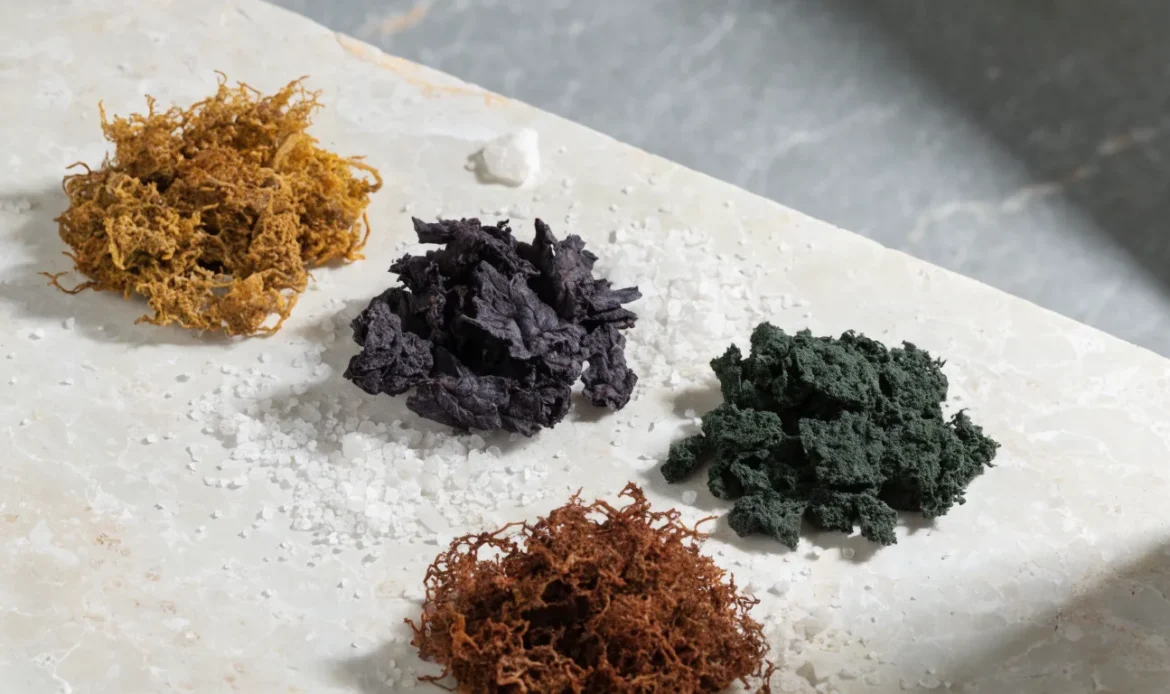
Short answer first: Sea moss can look like long, thin strands or tangled clumps when fresh. When dried it shrinks and becomes brittle. It can also appear as a clear gel, a pale powder, flakes, or in capsules. Color and texture change with species, drying, and processing.
This guide explains common looks and formats. It lists what you can check by looking and touching. It also says what you cannot tell without testing. At the end is a clear checklist and a decision guide to help you pick the right form.
Quick visual overview
- Fresh/raw: long, branch-like strands or frilly plates. Colors range from green to yellow, gold, brown, red, or purple tones. Strands can be thin like string or thicker and more leaf-like.
- Dried: shriveled pieces, clumps, or brittle strands. Colors often deepen or become more muted after drying.
- Gel: translucent or pale-colored. Jelly-like texture. Often sold in jars or tubs.
- Powder: fine to coarse powder. Color varies from off-white to light tan or greenish.
- Capsules/tablets: small, sealed pill forms with powder inside.
- Flakes or pieces: diced or shredded, used in blends or cooking.
Colors and exact shapes vary a lot. Lighting, wetness, and drying method all change how it looks.
How sea moss looks in different formats
Fresh (wet) sea moss
Fresh sea moss looks alive. It has a wet sheen. Strands may look smooth and slightly slippery. Branches or fronds can be flat or tubular. Some kinds are more delicate. Others are thicker. Fresh pieces may still have tiny bits of sea growth or sand attached.
What to check:
- Color: uniform or patchy.
- Texture: firm but flexible, not slimy or rotten-smelling.
- Smell: briny or seawater-like is normal; strong rotten odors are not.
Limits: You cannot tell the levels of iodine, heavy metals, or microbes by sight.
Dried sea moss
Dried sea moss shrinks. It becomes firm or brittle. Dried colors can be darker or paler than fresh. Dried pieces often curl. Some look like small twigs or dried leaves. Drying concentrates the appearance but masks some subtle color tones.
What to check:
- Cleanliness: visible sand or shell fragments should be minimal.
- Color consistency: large odd stains or mold spots are a red flag.
- Feel: dry, not damp unless deliberately packed wet.
Limits: Dried appearance does not show lab testing or processing details.
Sea moss gel
Sea moss gel is made by soaking and blending. It looks jelly-like. Color ranges from clear to pale off-white, sometimes with a green or brown tint depending on the starting moss. Gel can be soft and spreadable or thick and spoonable.
What to check:
- Texture: smooth and even without visible mold.
- Smell: mild sea scent, not sour or rotten.
- Separation: slight liquid separation can happen; strong separation or bubbles may mean spoilage.
Limits: Gel appearance can’t prove purity or precise composition.
Sea moss powder, flakes, and capsules
Powders are dry and free-flowing. Flakes look like small shredded pieces. Capsules hide the powder inside. Colors vary by source and processing—light tan, cream, or greenish.
What to check:
- Clumping: heavy clumps can mean moisture or poor storage.
- Powder smell: a clean, ocean-like scent is normal; strong off-odors are a warning.
- Capsule integrity: look for damaged seals.
Limits: Powder color and clumpiness do not prove nutritional or contaminant data.
What you can check visually or with simple hands-on tests
You can learn a lot by looking closely and touching. Here are practical checks and what they can tell you.
- Color uniformity: uneven dark patches or fuzzy white spots may be mold or sun damage. But some natural color variation is normal.
- Smell: a fresh ocean smell is fine. Sour, rotten, or strongly chemical smells are a warning sign.
- Texture: feel for excessive sliminess or a sticky film. For dried moss, excessive dampness suggests poor storage.
- Cleanliness: bits of sand or shell are expected in raw sea harvests. Large amounts of grit, foreign objects, or plastic fragments are a problem.
- Packaging: look for clear labels, harvest or packing dates, and batch numbers. These do not guarantee safety but show supplier transparency.
- Moisture: jars of gel should not show visible mold. Dried moss should be dry and brittle. Powders should flow freely.
What visual checks cannot prove:
- Chemical content (like iodine level), heavy metals, or microbes require lab tests.
- Claims about origin or harvest methods need supplier documentation.
- Nutrient levels can vary widely and can’t be measured by sight.
For safety and dietary concerns, respected sources note that seaweeds can carry variable iodine and other compounds. If you need data on iodine or contaminants, ask the supplier for lab results or consult testing authorities [1][2][3][5].
A practical decision checklist
Use this quick checklist when you inspect sea moss in a store or photos from a supplier. Mark each item Yes/No and follow the suggested next step.
| Check | Why it matters | If yes | If no |
|---|---|---|---|
| Color looks consistent for the form | Sudden dark spots or fuzzy areas may signal spoilage | Good visual sign | Ask for another batch or a clear photo |
| Smell is mild / ocean-like | Harsh sour or chemical smells suggest spoilage or contamination | Acceptable | Avoid purchase |
| No visible mold in jar or on dried pieces | Mold can indicate poor storage | Acceptable | Reject or ask for replacement |
| Minimal sand or shell bits (fresh/raw) | Excess grit affects use and hints at poor cleaning | OK after rinsing | Request cleaned product |
| Powder flows freely (powder/flake) | Clumping suggests moisture exposure | Good | Ask about storage; avoid if damp |
| Gel texture is smooth, no fuzzy spots | Smooth gel lasts; fuzz indicates spoilage | OK | Discard |
| Packaging shows date or batch code | Indicates traceability and supplier transparency | Positive | Ask the seller for more info |
| Supplier provides lab or testing info on request | Verifies iodine, contaminants, and safety claims | Strong positive | Consider asking for test details before buying |
Use the checklist to compare samples. If a seller will not show a batch code or answer basic questions, treat that as a risk indicator.
Which form should you choose? A practical decision guide
Short uses and visual cues. This helps you match appearance and format to your needs.
- Fresh/raw strands: Choose if you want to see texture and rinse before use. Look for flexible, unbroken strands and a fresh sea smell. Good for culinary use where texture matters.
- Dried pieces: Choose for storage and longer shelf life. Look for uniform drying and no damp spots. Good for rehydrating and making gels.
- Gel: Choose for convenience. Look for smooth, fresh gel in sealed containers. Good for direct use in smoothies or topical application (if using as an ingredient).
- Powder or flakes: Choose for blending into mixes or supplements. Look for free-flowing, low-clump powder.
- Capsules/tablets: Choose for ease of dosing. Check capsule integrity and labeling.
Next question to ask yourself: Do you need documentation about testing or source? If yes, buy from sellers who provide lab results or respond to test requests.
How appearance changes when you prepare sea moss
Simple steps like rinsing and soaking change how sea moss looks.
- Rinsing removes surface grit and shifts color slightly. Rinse until the water runs clear or mostly clear.
- Soaking rehydrates dried moss. It softens and often expands. Soaking time depends on type; aim until the texture is soft and flexible.
- Blending into gel turns strands into a uniform jelly. Color usually becomes lighter or more translucent after blending.
- Cooking or boiling will change color and soften fibers further.
Always inspect the moss after each step. If a strong off-odor appears during soaking or the moss disintegrates unusually, stop and do not use it.
Common look-alikes and things to watch for
You may find other seaweeds or items that look like sea moss.
- Other seaweeds: Many seaweeds have similar frilly shapes. Names and uses differ. Visual similarity alone does not identify species.
- Drift material and debris: Pieces of seagrass, algae, or man-made items can look similar when tangled.
- Plastic fragments: Small plastic can stick to seaweed and look like foreign bits. Check closely.
- White/blue fuzzy growth: Often mold or salt bloom. Mold shows fuzzy filaments. Salt bloom appears as powdery crystals and looks different from mold.
If you see unusual items or materials, ask the seller and inspect more closely before buying or using.
Buying tips and questions to ask a supplier
When buying from a store or an online seller, ask plain questions. Here are useful ones:
- Can you show recent photos of the actual batch?
- Do you provide a harvest or packing date?
- Are there batch codes or lot numbers on packaging?
- Can you share lab testing results for contaminants or iodine on request?
- How was it dried or processed? (air-dried, sun-dried, machine-dried)
- How should I store this product?
These questions help you judge transparency. Answers that are vague or evasive are a sign to be cautious.
Conclusion
Sea moss can look many ways. It can be fresh strands, dried clumps, a soft gel, fine powder, flakes, or capsules. You can learn a lot by looking closely. Check color, smell, texture, and packaging details. But remember: sight and touch cannot prove chemical contents or safety. Ask sellers for batch information or lab tests when that matters to you.
If you want to learn more about seaweed basics, visit our learning center: Learn (/learn/). To see product formats, visit our store: Shop (/shop/). If you need large quantities, check our bulk options: Wholesale (/wholesale/). For questions, reach out here: Contact (/contact/). Return to Home (/) anytime.
Frequently asked questions
What color is sea moss supposed to be?
Sea moss color varies. It can be green, gold, brown, red, or purple. Color depends on type, where it grew, and how it was dried or processed. Color alone does not tell you about safety or composition.
Is a strong fishy smell normal?
A mild ocean or sea smell is normal. A strong rotten or sour smell is a warning sign. If the smell is unpleasant or chemical-like, avoid using it.
Can I tell if sea moss is contaminated by looking?
No. Visual checks help spot mold, foreign objects, or poor storage. But they cannot reveal iodine levels, heavy metals, or microbes. Lab tests are needed for those.
Will soaking change the color?
Yes. Soaking typically lightens or evens out color and makes dried pieces plump and soft. Some pigments may leach into the water during soaking.
How can I tell real sea moss from other seaweed?
Visual shape and texture give clues, but many seaweeds look similar. Ask the seller for the common name, photos, and any documentation. If you need species-level certainty, lab or expert identification is required.
What should I do if I see mold?
If you find fuzzy, discolored spots on gel or dried pieces, do not use them. Mold can indicate poor storage. Contact the seller or return the product.
References
- Harvard T.H. Chan School of Public Health, “Seaweed.” https://nutritionsource.hsph.harvard.edu/seaweed/
- Smyth PPA. “Iodine, Seaweed, and the Thyroid.” European Thyroid Journal, 2021. https://pmc.ncbi.nlm.nih.gov/articles/PMC8077470/
- Food Standards Australia New Zealand, “Survey of iodine levels in seaweed and seaweed containing products,” updated 2025. https://www.foodstandards.gov.au/science-data/monitoring-safety/surveyofiodinelevels
- Operation Supplement Safety, “Sea Moss in Dietary Supplements.” https://www.opss.org/article/sea-moss-dietary-supplements
- Blikra MJ et al. “Consequences of acute and long-term excessive iodine intake: A literature review focusing on seaweed as a potential dietary iodine source.” 2024. https://doi.org/10.1111/1541-4337.70037