
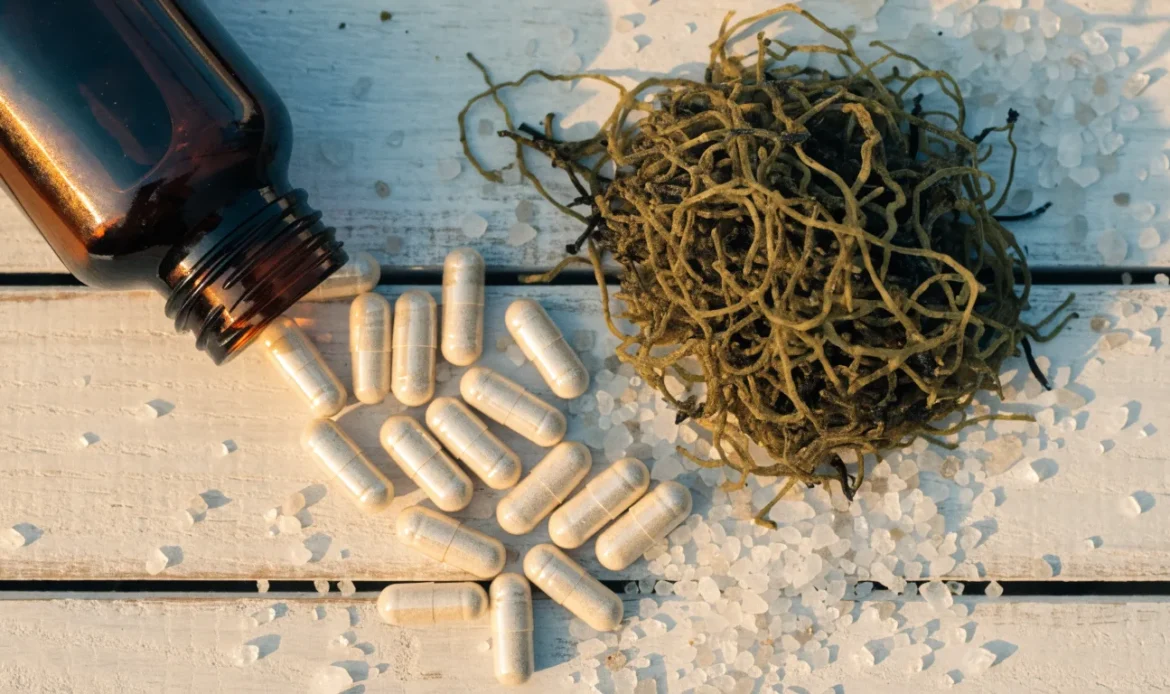
Short answer first: this product name usually means a capsule supplement that combines sea moss and moringa, and that the bottle contains 90 capsules. It is a capsule format, not a gel, powder, or whole dried seaweed. Use labels and seller details to learn exact ingredients, serving size, capsule type, and any testing claims.
This article explains what that product name tells you. It also explains what it does not prove. You will get a clear way to compare capsule options and decide what to check before you buy from a sea moss shop.
What the name tells you
- “Alkaline Herb Shop” is a brand or store name style. It does not tell you how the ingredients were sourced or processed.
- “Sea Moss & Moringa” names two ingredients. It does not tell you the exact amounts of each unless the label lists them.
- “Supplement 90 Capsules” tells you the product is a dietary supplement sold in capsule form and that the container has 90 capsules.
What this name does not prove:
- It does not prove quality, purity, lab testing, or a specific origin for the sea moss or moringa.
- It does not prove that the product contains a clinically effective amount of any nutrient.
- It does not prove a product is free from contaminants or that it is safe for every person.
What you can check right away:
- Look for a Supplement Facts panel on the label.
- Look for a list of ingredients and serving size.
- Look for manufacturer or distributor contact details and a lot number or expiration date.
What you should ask the seller:
- Is there a Certificate of Analysis (COA) for each lot?
- Does the label list iodine or other mineral levels?
- Is the capsule vegetarian or gelatin?
- Where were the sea moss and moringa sourced and processed?
If the seller can answer these questions clearly, you can make a more informed choice. If not, you have a reason to look for more documentation or choose a different product.
Capsule format: what to expect
Capsules are one common way to sell sea moss and moringa. Here are practical points about capsules.
- Capsules aim to be convenient. They are easy to carry and dose.
- Capsules hide taste and texture. Some people prefer them for this reason.
- Capsule content can be powdered sea moss, moringa leaf powder, blends, or extracts.
- Capsule size and suggested dosage matter. A label should show how many capsules equal one serving.
- The shelf life of a capsule product depends on how it is processed and stored. A label or seller should state a best-by date.
What capsule labels should show:
- Supplement Facts panel with serving size.
- Amount of each listed ingredient per serving.
- Other ingredients like capsule material, fillers, or binders.
- Allergen statements if present.
What capsule labels often do not show:
- Exact levels of minerals like iodine unless the manufacturer tests and lists them.
- Heavy metals or microbial test results unless the company provides COAs or test summaries.
Safety notes: iodine and seaweed variability
Seaweed, including forms sold as sea moss, can contain iodine. Iodine levels in seaweed can vary a lot depending on species and where it was harvested. This variability means that the iodine content in supplements can also vary. For general context, reputable sources explain that seaweeds are a known source of iodine and that levels are inconsistent across products [1], [2].
Some papers and food-safety surveys have found wide differences in iodine content in seaweed products. Because of this, it helps to know whether the product has been tested for iodine and whether test results are available [3], [5].
Organizations that track supplement safety advise caution with sea moss supplements because seaweed-sourced minerals can be variable and sometimes high [4]. Ask the seller for lab reports if you want specific mineral levels for a lot.
How to read the label: a buyer’s checklist
When you see a product like “Alkaline Herb Shop Sea Moss & Moringa Supplement 90 Capsules,” use this checklist to read the label carefully:
Decision guide table — How capsule format compares to other sea moss formats
| Format | How it is sold | Typical pros | Typical cons | What to ask or check |
|---|---|---|---|---|
| Capsules (e.g., 90 capsules) | Bottle with capsules, labeled serving size | Convenient, no taste, portable | Ingredient amounts may be low per capsule; mineral content not always listed | Check Supplement Facts, capsule material, COA, serving size |
| Dried whole sea moss | Dried raw seaweed | Minimal processing, can make gel or cook | Needs prep; variable mineral load | Ask about species, harvest area, drying method, COA |
| Powder | Ground dried sea moss or moringa | Easy to mix; can measure dose | May contain fillers; variable solubility | Check ingredient list, purity, lab tests |
| Gel (prepared by seller) | Ready-to-use gel | Familiar format for traditional use | Short shelf life; may need refrigeration | Check preparation method, storage instructions |
| Tincture | Liquid extract in alcohol or glycerin | Concentrated extract, small dose | Different extraction profiles; alcohol content | Check solvent used, extract ratio, preservative info |
Use this table to match format to how you plan to use the product. The right format depends on your needs for convenience, dosage control, and documentation.
What you can verify and what you cannot
What you can verify:
- Label information: serving size, ingredient list, other ingredients, lot numbers.
- Seller contact details and return policy.
- Presence of any third-party testing statements or COAs if provided.
- Basic packaging information such as count (90 capsules).
What you cannot prove from the name alone:
- Actual iodine level or mineral concentrations.
- Absence or presence of contaminants such as heavy metals or microbes without lab tests.
- Specific sourcing claims (country, harvest method) unless the seller documents them.
- That the product will have a particular effect for any person.
If you need precise mineral or contaminant data, request a COA that matches the lot number on your bottle. If none is available, consider choosing a product or vendor that provides such testing.
Questions to ask any sea moss shop or seller
A short list of questions you can use when you contact a seller. Keep answers in writing when possible.
- Can you provide a Certificate of Analysis (COA) for the batch I would receive?
- Does the label list iodine or mineral content per serving?
- Where were the sea moss and moringa sourced and processed?
- What capsule material is used? (vegetarian/gelatin)
- Are there any fillers, binders, or anti-caking agents?
- Is there a recommended storage method and a best-by date?
- What is your return or satisfaction policy?
These questions help you move from marketing language to verifiable facts.
Practical buying decision guide
If you want a structured way to decide, use this simple decision guide. Score each item 0 (no), 1 (partial), 2 (yes). Add the scores.
- Does the label show a clear Supplement Facts panel? (0/1/2)
- Does the product show full ingredient details and capsule material? (0/1/2)
- Does the seller provide a COA or lab test on request? (0/1/2)
- Is the serving size and suggested daily dose clear? (0/1/2)
- Does the seller list a lot number and best-by date? (0/1/2)
Total score interpretation:
- 8–10: Product documentation looks strong. Still confirm COA if mineral testing is important.
- 4–7: Some useful info is present. You may want COA or more details before buying.
- 0–3: Limited documentation. Consider asking questions or choosing a different supplier.
This short guide helps you prioritize what matters when buying a capsule product from a sea moss shop.
Storage, handling, and use notes
- Store capsules in a cool, dry place away from direct sunlight unless the label says otherwise.
- Follow the suggested serving size on the label. Do not assume “more is better.”
- Keep supplements out of reach of children.
- If a product smells off, discolors, or the capsule integrity is poor, do not use it and contact the seller.
These are general best practices. They are not medical advice.
How capsules compare to making your own sea moss gel or buying dried moss
Capsules are a processed form. Making your own gel from dried sea moss means you control the starting material and the water used. Dried sea moss allows you to rinse and look at the product before use. Capsules can be more convenient but give you less visibility into the raw material. Decide based on your priorities:
- If you want hands-on control and inspection, choose dried sea moss.
- If you want convenience and no taste, capsules may be better.
- If you want to mix into recipes or smoothies, powders and gels may work best.
What credible testing looks like
A credible lab report or COA should include:
- The lab name and contact information.
- The lot or batch number it applies to.
- Tests performed and results (e.g., heavy metals, microbial, iodine content).
- Date of testing.
A COA from an accredited third-party lab gives more confidence than a self-declared test. If a seller provides testing, check that the COA matches the lot you will receive.
When to consult more sources
If you have a thyroid condition or take medication, talk with a healthcare professional before changing iodine intake. Seaweed-based products can have variable iodine. Reliable sources explain that iodine levels vary and can affect thyroid function if intake is high or changes rapidly [1], [2], [5]. Operation Supplement Safety also offers consumer guidance on sea moss in supplements [4].
If you are buying for resale or wholesale, ask about bulk lot documentation, minimum order sizes, and shipping conditions. See our wholesale page for general guidance on how vendors may handle bulk orders: Wholesale inquiries (/wholesale/).
Suggested next steps on the site
- Browse product forms at our store: Shop supplements.
- Learn about sea moss basics and safety: Learn about sea moss.
- Contact us for vendor or product questions: Contact Zen Wholesalers.
- Return to the home page for broader resources: Home.
These links will help you find product listings, learning resources, and contact options.
Final checks before you buy
- Read the label closely.
- Ask for a COA if you need mineral or contaminant testing.
- Confirm capsule type and any fillers.
- Keep documentation and lot numbers for any future questions.
Choosing a supplement means balancing convenience, documentation, and transparency. A 90-capsule bottle can be convenient. But the right choice depends on the label details and what testing the seller provides.
Conclusion
“Alkaline Herb Shop Sea Moss & Moringa Supplement 90 Capsules” describes a capsule product combining sea moss and moringa sold in a 90-capsule bottle. The name tells you format and count, but not sourcing or test results. Use the label, a COA when available, and the questions in this article to learn more. If you want more background before buying, read product pages on our store, check learning articles, or contact the seller directly.
Useful links: Shop supplements (/shop/), Learn about sea moss (/learn/), Wholesale inquiries (/wholesale/), Contact Zen Wholesalers (/contact/), Home (/).
Frequently asked questions
Does the name tell me how much sea moss is in each capsule?
No. The name alone does not show amounts. Check the Supplement Facts panel to see how much of each ingredient is listed per serving.
Are capsules always safer than fresh gel?
Not always. Capsules are convenient but can hide the raw material. Safety depends on sourcing and testing, not just format.
Should I worry about iodine in a sea moss capsule?
Seaweed can contain iodine and its levels vary. If iodine is a concern, ask the seller for test results or a COA showing iodine content. Sources explain variability in seaweed iodine levels [1], [2], [3], [5].
What does a COA show?
A Certificate of Analysis should show tests run, results, a lab name, and a lot number. It can list heavy metals, microbial counts, and sometimes mineral levels like iodine.
Can I return a supplement if I do not like it?
Return policies vary by seller. Check the seller’s return and refund policy before buying.
References
- Harvard T.H. Chan School of Public Health, “Seaweed.” https://nutritionsource.hsph.harvard.edu/seaweed/
- Smyth PPA. “Iodine, Seaweed, and the Thyroid.” European Thyroid Journal, 2021. https://pmc.ncbi.nlm.nih.gov/articles/PMC8077470/
- Food Standards Australia New Zealand, “Survey of iodine levels in seaweed and seaweed containing products,” updated 2025. https://www.foodstandards.gov.au/science-data/monitoring-safety/surveyofiodinelevels
- Operation Supplement Safety, “Sea Moss in Dietary Supplements.” https://www.opss.org/article/sea-moss-dietary-supplements
- Blikra MJ et al. “Consequences of acute and long-term excessive iodine intake: A literature review focusing on seaweed as a potential dietary iodine source.” 2024. https://doi.org/10.1111/1541-4337.70037