
Short answer first: “Caribbean natural sea moss” is a trade name for seaweed harvested or farmed in Caribbean waters. Buyers should check species, harvest method, handling, lab testing, and traceability. No single color or island proves quality. Ask for clear documents and recent test results to make a safer, smarter buy.
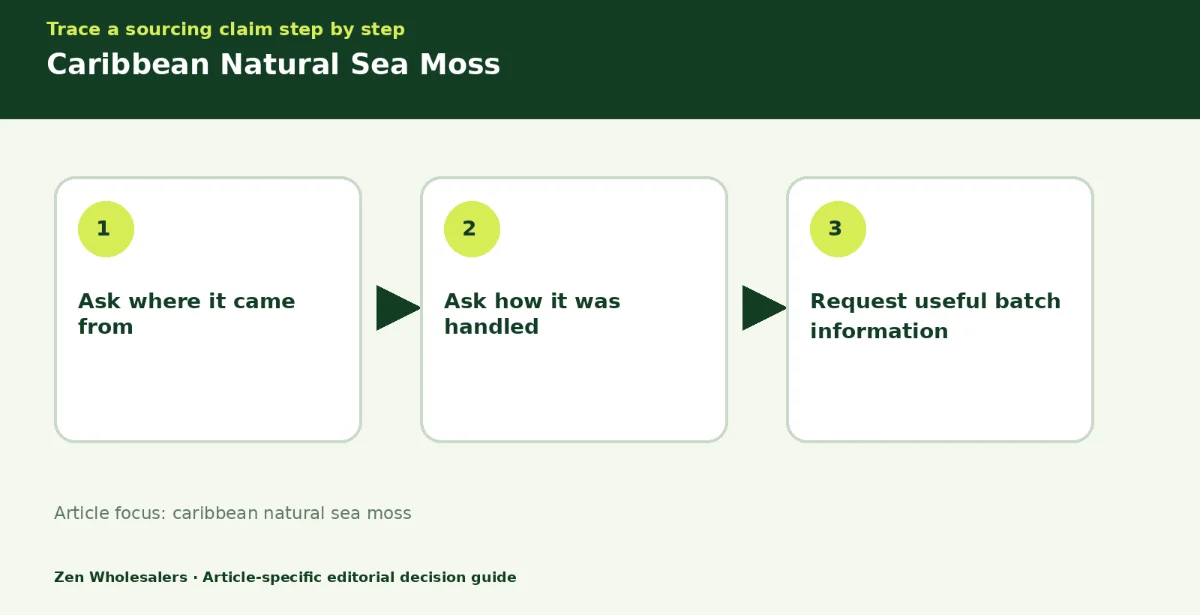
What people mean by “Caribbean natural sea moss”
“Sea moss” is a common name. It can mean several types of red algae used as food, gelling agents, or supplements. In the Caribbean, sellers may use local red algae species under the name sea moss. Names on a package do not always tell the whole story.
Why this matters:
- Species and local growing conditions affect texture and how the seaweed is processed.
- Origin can affect regulations and testing needs.
- The word “natural” does not replace proof of handling or testing.
We cannot tell you which island or color is best. Instead, this guide explains what you can check, what documentation helps, and what questions give useful answers.
How to evaluate origin and provenance
Below are steps you can take when a supplier calls their product “Caribbean natural sea moss.”
Ask for clear harvest details
Ask the supplier to describe:
- The harvest site (island, bay, or general area).
- Harvest date or season.
- Whether harvest was wild or farmed.
What to watch for:
- A named bay or island is useful. But a place name alone cannot prove the product was actually harvested there.
- Photographs, harvest logs, or GPS data are stronger evidence than a label alone.
Check harvest method: wild vs. farmed
Both methods are common.
- Wild-harvested: Taken from natural beds. Wild harvest can vary by season and site.
- Farmed: Grown on ropes or plots. Farming can allow more control over planting and harvest time.
Neither method is uniformly better. Each can have good or poor handling. Ask which method they use and why.
Handling and processing steps to confirm
After harvest, sea moss often goes through several steps. These steps matter for product quality and safety.
Ask about:
- Rinsing/washing steps and the water used.
- Sorting to remove debris and non-target seaweed.
- Drying method (sun, shade, mechanical).
- Storage before and after packing.
- Packaging type and sealing.
Good answers will include how many rinses, whether they dry to a stable moisture level, and how they avoid cross-contamination. These answers help you judge whether the product was handled hygienically.
Species identification
“Sea moss” may include more than one red algae species. Species can affect texture and how the product is used.
What you can ask:
- The species name(s) the supplier uses in their product.
- Whether species were identified by a specialist or a lab.
A supplier may not always have a species report. If species identity matters for your use, ask for lab identification or photographs of fresh seaweed before processing.
Lab testing and documentation
Testing gives you objective data. Common tests include:
- Microbial contamination checks.
- Heavy metals screening.
- Iodine levels.
Why iodine testing matters:
Seaweed can contain high levels of iodine. High iodine intake can affect the thyroid in some people, so labs and guidance bodies note iodine variability in seaweed [1][2][5]. Because iodine levels vary by species and site, a test helps you understand product content. National surveys show wide variation in seaweed iodine levels and recommend monitoring [3].
What to request:
- Recent lab reports (date-stamped).
- Which lab performed the tests and whether it is accredited.
- Batch-linked results (so results match the product you will receive).
Lab results do not prove origin. They show safety markers for the tested batch.
Chain of custody and traceability
Traceability helps connect a final product back to harvest events.
Look for:
- Batch numbers tied to harvest dates.
- Harvest records showing weights and dates.
- Photos or videos from harvest.
- Supplier audit reports or supplier declarations.
Traceability reduces risk. It also helps if you need to run a trace or recall.
What you can realistically check — and what you can’t prove
What you can check:
- Labels and declared origin.
- Harvest dates and general location.
- Batch numbers and linked lab tests.
- Processing steps (rinsing, drying, storage).
- Recent lab reports for safety markers.
What you cannot fully prove from a label alone:
- Exact GPS coordinates for every harvest.
- That all product in a batch came from a single harvest site unless you see chain-of-custody records.
- Long-term environmental history of the harvest site.
- Future consistency from a new shipment without new tests.
Be skeptical of claims that are not supported by documents. Documents and lab tests are what you can verify.
Decision guide: questions, proof, and red flags
| Question to ask | Why it matters | What proof to request | Red flags |
|---|---|---|---|
| Where exactly was it harvested? | Helps trace environmental risks | Harvest location (island/bay), harvest date | Vague answers like “Caribbean” without specifics |
| Wild or farmed? | Affects variability and control | Description of method, photos, farm records | No clear answer or inconsistent claims |
| What species is it? | Species affect texture and content | Species name, photos, ID report | Species name missing or very general terms only |
| Any lab tests? | Tests show safety markers | Recent lab reports with batch number, lab name | No lab results, or old reports not linked to batch |
| How was it processed? | Affects contamination risk | Steps for rinsing, drying, storage | No handling description, or claims like “sun-dried only” without details |
| Does it have traceability? | Helps trace back problems | Batch numbers, harvest logs, chain-of-custody | No batch coding or paperwork |
| Can I get a sample for my testing? | Allows independent check | Small sample, or samples from different batches | Refusal to provide samples |
Use this table as a checklist when you speak with a supplier. If several red flags appear, ask for stronger documentation or consider another supplier.
Practical steps when you receive a shipment
When a shipment arrives, do a practical check before accepting or using it.
- Inspect the outer packaging for damage and correct labeling.
- Check the lot or batch number and compare to documents you were given.
- Note the smell. A clean ocean smell is expected for seaweed. Strong off-odors can indicate spoilage or contamination.
- Check appearance. Color and texture will vary by species and processing. Look for foreign debris.
- If product is dried, ensure it feels dry and not damp. Damp dried product can grow mold.
- If fresh or refrigerated, check packing temperature and signs of proper cold chain handling.
- Record a sample photo and keep a small amount separate for testing if needed.
If you plan to repackage or use the sea moss in foods or supplements, follow hygienic handling and consider asking for a current Certificate of Analysis for the batch.
Testing to consider and when to ask for it
Consider asking for these tests for food, ingredient, or bulk purchases:
- Microbiological testing (e.g., total plate counts, yeast and mold).
- Heavy metals (e.g., lead, cadmium, mercury). These tests are standard for many foods and ingredients.
- Iodine content. Iodine can be high in some seaweeds; labs and food safety authorities recommend monitoring seaweed iodine levels [1][2][3][5].
- Pesticides or agricultural residues if farmed near agricultural runoff.
- Species identification, when species matters for use or labeling.
Ask if tests are current and batch-linked. Tests from years ago are less useful.
Operation Supplement Safety discusses sea moss in the context of supplements and highlights the importance of testing and quality control [4].
Handling and storage tips (buyer perspective)
- Store dried sea moss in a cool, dry place in sealed containers.
- Label incoming stock with batch number, receipt date, and supplier.
- If product is fresh or refrigerated, follow cold chain practices immediately.
- If you will rehydrate or rinse product, use potable water and clean containers.
- Keep samples for at least one sample-size period in case you need lab testing later.
Do not rely on color alone to judge safety. Color varies by species and handling.
Questions to ask suppliers — short list you can copy
- Where exactly was this batch harvested? (Please include harvest date.)
- Was this wild harvest or farmed? Please describe.
- Which species are included under this product name?
- Can you provide the batch lab report(s) for microbes, heavy metals, and iodine?
- Which lab ran these tests and when?
- What processing steps did this batch go through after harvest?
- Do you have batch photos, harvest logs, or GPS data?
- Can you provide a small sample for our own testing?
Pricing, volume, and contract notes
Price often reflects harvest method, processing, testing, and logistics. When you negotiate:
- Confirm that test results and traceability will be supplied with each contracted batch.
- Build quality checks into contracts (e.g., right to reject on safety test failures).
- Consider trial purchases with testing before large orders.
Do not rely on a single shipment to judge long-term consistency. Require batch-linked documentation for ongoing supply.
Where to learn more
For background on seaweed and food safety, see resources from public health and food safety authorities. Seaweed contains variable natural compounds, and authorities recommend testing and monitoring when using seaweed as a food or ingredient [1][2][3][5]. For product and sourcing information specific to our operation, visit our farm page or learn hub:
- Our farm: /our-farm/
- Learn more about seaweed and sourcing: /learn/
- Browse product options: /shop/
- Wholesale inquiries: /wholesale/
- Contact us for sourcing questions: /contact/
- Home: /
Conclusion
“Caribbean natural sea moss” is a broad term. The best way to buy with confidence is to ask clear questions and request batch-linked proof. Check harvest details, processing steps, species information, and recent lab reports. Keep records for every shipment. If something is unclear, ask for a sample or independent testing. For more about our farm operations, sourcing approach, or to place an order, see /our-farm/, visit our product pages at /shop/, or contact us at /contact/. If you need bulk supplies, explore /wholesale/. Learn more background in our learning hub at /learn/ and return to our home page at /.
Continue reading
Frequently asked questions
Does “Caribbean natural sea moss” mean it is safe to eat?
Not automatically. “Natural” or origin labels do not replace lab testing or good handling. Ask for batch-linked lab reports and processing steps.
Can I tell origin by color?
No. Color varies by species and processing. Color alone is not proof of origin or safety.
Is iodine a concern with sea moss?
Seaweed can have high and variable iodine levels. If iodine content matters to you or your customers, ask for tested iodine levels for the batch [1][2][3][5].
Can I rely on a supplier’s lab report?
You can use it as evidence, but check the date, batch linkage, and lab accreditation. Prefer recent, batch-linked reports from accredited labs.
Should I test incoming shipments myself?
If you handle many batches or sell to consumers, testing some incoming shipments is a good risk control. At minimum, get the supplier’s recent batch reports and keep samples for possible testing.
How do I know if a supplier is farmed or wild-harvested?
Ask directly. Request photos, farm records, or harvest logs. Farming records and ropes or stake photos can support farmed claims; harvest logs and boat records help support wild harvest claims.
References
- Harvard T.H. Chan School of Public Health, “Seaweed.” https://nutritionsource.hsph.harvard.edu/seaweed/
- Smyth PPA. “Iodine, Seaweed, and the Thyroid.” European Thyroid Journal, 2021. https://pmc.ncbi.nlm.nih.gov/articles/PMC8077470/
- Food Standards Australia New Zealand, “Survey of iodine levels in seaweed and seaweed containing products,” updated 2025. https://www.foodstandards.gov.au/science-data/monitoring-safety/surveyofiodinelevels
- Operation Supplement Safety, “Sea Moss in Dietary Supplements.” https://www.opss.org/article/sea-moss-dietary-supplements
- Blikra MJ et al. “Consequences of acute and long-term excessive iodine intake: A literature review focusing on seaweed as a potential dietary iodine source.” 2024. https://doi.org/10.1111/1541-4337.70037