
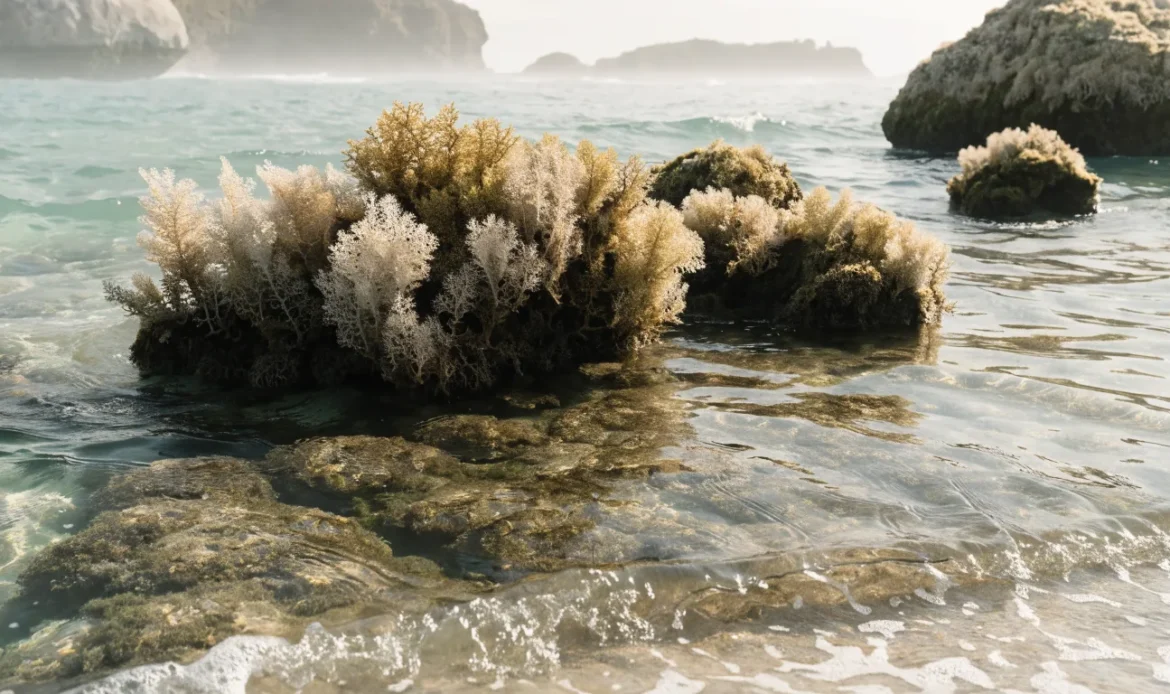
Short answer: Wildcraft sea moss is sea moss that is gathered from natural shore or reef areas rather than grown in aquaculture. It can offer natural variation in color and texture. That variation also means buyers need to check certain safety and sourcing details before buying or using it.
This guide explains what wildcraft sea moss is. It compares wild-harvested and farmed forms. It lists safety checks you can make. It gives a decision checklist to help you pick a product and format. Use this to choose with more confidence, whether you plan to buy one jar or order wholesale.
What “wildcraft” means
Wildcraft (or wild-harvest) describes how the sea moss was collected. Wildcraft sea moss is:
- Gathered from the natural shoreline, rocks, or reefs.
- Collected by hand, by small boats, or with simple gear.
- Not planted, fenced, or actively farmed in a controlled bed.
Wildcraft does not describe processing. After harvest, wildcraft sea moss may be washed, sun-dried, air-dried, frozen, or turned into gels, powders, or capsules. The term only tells you where the plant grew, not how it was cleaned or tested.
What wildcraft does not prove
- It does not prove the product was tested for contaminants.
- It does not prove better or safer nutrition.
- It does not prove a product is local or sustainably harvested, unless the seller clearly states those facts and documents them.
How wildcraft differs from farmed sea moss
Here are the main differences to expect between wild-harvested and farmed (cultivated) sea moss.
- Growing control:
- Wildcraft: Grows in natural conditions. Weather, tides, and nearby plants influence growth.
- Farmed: Grown in controlled or semi-controlled beds. Farmers can manage spacing, seed stock, and sometimes water flow.
- Consistency:
- Wildcraft: Natural variation in size, color, and texture is common.
- Farmed: Often more uniform from batch to batch.
- Environmental sources:
- Wildcraft: May grow near natural runoff, boats, or coastal streams. This can add local influences.
- Farmed: Location choice and farm practices can reduce exposure to some local sources of contamination, but not always.
- Harvest impact:
- Wildcraft: Can be low-impact when done carefully. But unregulated harvest can harm habitats if it removes too much biomass.
- Farmed: Can relieve pressure on wild beds if managed responsibly. Farming itself has environmental trade-offs.
None of these points prove a single wildcraft or farmed product is inherently safer or better. You must judge each product on its own labeling, testing, and seller transparency.
What to check for safety and quality
Wild sea plants live in open water. That means their composition can vary. Some things you can check, and some things you cannot prove from a label.
What you can check before you buy
- Seller transparency. Look for clear harvest locations, harvest dates, and species name.
- Processing steps. Find out how the product was cleaned, dried, or processed.
- Testing. Ask if the product has lab tests for heavy metals, bacteria, and iodine levels.
- Handling and packaging. Check if the sea moss is kept dry, sealed, and stored away from heat.
- Visual cues. For whole dried moss, look for clean color, minimal sand, and no strong off smells.
What labeling or photos alone cannot prove
- That the product is free of contaminants unless a current lab report is provided.
- That “wild” means “sustainably harvested.” You need details or third-party verification.
- Exact mineral or iodine amounts. Sea moss mineral content varies by patch and season.
Why iodine is a special case
Seaweeds, including sea moss, can be a source of iodine. This means iodine levels can be high or variable. High iodine intake can affect the thyroid in some people. Because levels vary widely by species and harvest site, a product claim about iodine content should be backed by testing. For background on seaweed and iodine, see expert sources [1][2][5].
Regulatory and safety notes
- Surveys and reviews show iodine levels in seaweed products can vary widely. That is why testing matters for safety and labeling [3][5].
- Consumer and supplement safety groups advise careful sourcing and testing for sea moss products sold as supplements [4].
How wildcraft sea moss is commonly processed and sold
After harvest, sellers commonly follow one or more of these processing routes. Each route affects how you can use the product and what checks make sense.
- Raw dried sea moss
- Cut, rinsed, and sun-dried or air-dried.
- Sold whole or in pieces.
- Good for those who want to rehydrate or make their own gel.
- Check for visible sand, shell bits, and discoloration. Ask about final rinse steps and drying method.
- Cleaned wet or frozen sea moss
- Rinsed and stored wet or frozen.
- Often easier to turn into gel.
- Ask how long it was kept wet and at what temperature. Wet storage can encourage microbial growth if not kept cold.
- Pre-made gel
- Sea moss soaked and blended with water.
- Ready to use in foods and drinks.
- Check for added ingredients and for refrigeration or shelf-life claims.
- Powder or capsules
- Dried sea moss ground into powder or put into capsules.
- Convenient, but more processing steps occur.
- Ask for test reports for heavy metals and iodine, and for ingredient lists and batch numbers.
- Blended or mixed products
- Sea moss mixed with other herbs or foods.
- Read the label for full ingredient lists and any processing aids.
For any format, testing and clear labeling remain important. Processing can reduce some risks like visible grit, but it does not by itself prove the absence of heavy metals or high iodine.
Practical decision checklist — Should you buy wildcraft sea moss?
Use this checklist before you buy. Mark each item yes/no. If you have several “no” answers, ask the seller more questions or choose a different product.
Decision checklist (useful checks before buying wildcraft sea moss)
- Does the listing or seller name the harvest location or region? (Yes / No)
- Is the species identified (scientific or common name)? (Yes / No)
- Is there a harvest or pack date on the package? (Yes / No)
- Does the seller provide recent lab tests for heavy metals, microbes, or iodine? (Yes / No)
- Does the product include clear cleaning and drying steps? (Yes / No)
- Are storage and shelf-life directions listed and reasonable? (Yes / No)
- Are photos clear and do they show whole product or packaging? (Yes / No)
- Are return, refund, or contact policies visible? (Yes / No)
- Is the seller reachable by phone or email for questions? (Yes / No)
- If buying for bulk/wholesale: Does the seller offer batch testing and traceability labels? (Yes / No)
How to use the checklist
- Aim for most items to be Yes.
- If lab tests are missing, request them before bulk purchases.
- If you plan to consume regularly, prioritize verified iodine testing.
Format comparison table — which form fits your needs?
| Format | Ease of use | Storage | Visible risk checks | Best for |
|---|---|---|---|---|
| Raw dried | Medium (soak before use) | Long if kept dry | Can see debris and color | DIY gel makers, cooks |
| Wet or frozen | Easy (ready to blend) | Shorter; needs cold storage | Harder to inspect until thawed | Gel makers who refrigerate |
| Pre-made gel | Very easy | Short; usually refrigerated | Check label for added ingredients | Smoothie users, recipes |
| Powder / capsules | Very easy | Long if sealed | Hard to inspect visually | Capsules, measured doses |
| Blends (mixed) | Easy | Depends on additives | Check all ingredients | Those wanting ready blends |
Notes:
- “Visible risk checks” means you can visually check for sand, shells, or odd smells. Ground forms hide these.
- Always ask for lab tests when buying powders, capsules, or wholesale lots.
Questions to ask a seller of wildcraft sea moss
Short calls or messages that are worth your time:
- What exact species is this sea moss?
- Where and when was it harvested?
- How was it cleaned and dried?
- Do you have recent test reports for iodine and heavy metals? Can I see batch numbers?
- How should I store this product and how long does it keep?
- If buying wholesale: Can you provide a COA (certificate of analysis) per batch?
- Do you have photos of a representative harvested batch?
Good sellers will answer these plainly. If answers are vague, treat the product as higher risk.
How to inspect wildcraft sea moss when it arrives
For whole or dried sea moss:
- Look at color and texture. Natural color variation is normal.
- Smell it carefully. A sea smell is normal. Strong foul or rotten odors are not.
- Check for sand and shell bits. Some grit is normal; heavy grit is not.
- Note packaging condition. Damaged seals can mean contamination.
For gels, powders, or capsules:
- Check the lot number, seal, and expiration.
- Read the full ingredient list.
- If the gel has off-color or an odd smell, do not use it.
If you suspect a problem, contact the seller right away and keep photos and packaging.
What wildcraft sea moss can and cannot prove about nutrition and safety
What it can show:
- The likely species and general appearance.
- Whether the product was seldom handled or has visible debris.
- Whether the seller is transparent about sourcing and testing.
What it cannot show without a lab report:
- Exact iodine levels.
- Presence or exact levels of heavy metals or persistent organic pollutants.
- Microbial contamination in wet or improperly stored products.
If you plan to consume sea moss often, or recommend it to others, ask for lab reports. This is more important for ground powders, capsules, and wholesale purchases.
Useful next steps and links
If you want to learn more about seaweed basics, testing, or to shop:
- Read our learning hub: Why people choose different sea moss formats. Learn more
- Browse product formats and ready-to-ship options in our store. Shop formats
- If you plan to buy in bulk, see our wholesale information. Wholesale inquiries
- Have specific questions? Reach out to us directly. Contact Zen Wholesalers
- Return to the homepage for quick links and new updates. Home
Conclusion
Wildcraft sea moss is sea moss gathered from natural coastal areas. It can be a good choice for people who prefer naturally harvested products. But wildcraft alone does not guarantee safety, consistency, or sustainability. Do these things before you buy: check species and harvest info, ask for lab testing for iodine and metals, inspect packaging and storage instructions, and ask sellers straightforward questions. Use the decision checklist in this guide when buying, especially for powders and wholesale. Clear labeling and testing are the best available ways to reduce uncertainty.
Frequently asked questions
Is wildcraft sea moss safer than farmed sea moss?
Not automatically. Wildcraft means it was wild-harvested. Safety depends on where it grew, how it was handled, and whether it was tested. Look for testing and clear seller information.
Can I tell safety from color or smell alone?
No. Color and smell give clues. But they cannot show levels of iodine or heavy metals. Lab tests are needed for those.
Should I ask for lab tests before buying wholesale?
Yes. For wholesale, batch testing and a certificate of analysis help you reduce risk and show traceability.
Do all wildcraft sea moss products contain the same minerals?
No. Mineral content varies by species, season, and location. That is why precise nutrient claims should be supported by testing.
Is it safe to make sea moss gel at home from wild dried moss?
You can make gel at home if you start with clean, properly dried sea moss and follow good food safety. Rinse well, soak in clean water, and store the gel refrigerated. If you are unsure about the source or storage, ask for tests first.
How can I find the harvest location on a product label?
Look for region names or coordinates. If a label only says “wild-harvested” without a region, ask the seller directly for more details.
References
- [1] Harvard T.H. Chan School of Public Health, “Seaweed.” https://nutritionsource.hsph.harvard.edu/seaweed/
- [2] Smyth PPA. “Iodine, Seaweed, and the Thyroid.” European Thyroid Journal, 2021. https://pmc.ncbi.nlm.nih.gov/articles/PMC8077470/
- [3] Food Standards Australia New Zealand, “Survey of iodine levels in seaweed and seaweed containing products,” updated 2025. https://www.foodstandards.gov.au/science-data/monitoring-safety/surveyofiodinelevels
- [4] Operation Supplement Safety, “Sea Moss in Dietary Supplements.” https://www.opss.org/article/sea-moss-dietary-supplements
- [5] Blikra MJ et al. “Consequences of acute and long-term excessive iodine intake: A literature review focusing on seaweed as a potential dietary iodine source.” 2024. https://doi.org/10.1111/1541-4337.70037