
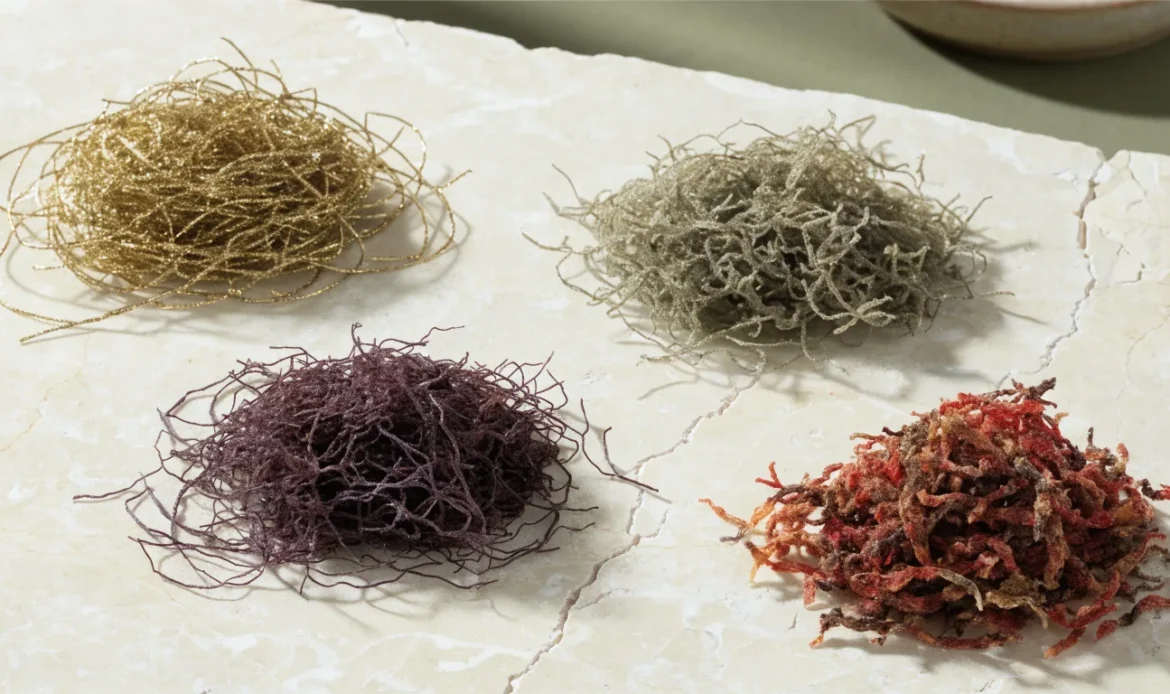
Short answer: Dry sea moss is seaweed that has been dried for storage and sale. It is sold as whole pieces, chopped flakes, or powder. You rehydrate whole or chopped dry sea moss to make a gel or cook it in recipes. Many people choose dry sea moss for longer shelf life, lower shipping cost, and control over how it is prepared. Before you buy, check the seller’s processing and testing information and ask about iodine and contaminants because nutrient and contaminant levels can vary.
What is dry sea moss?
Dry sea moss is simply seaweed that has been dried after harvest. Vendors sell it in different formats:
- Whole pieces: branches or sheets that look like dried seaweed.
- Chopped or shredded: small pieces that are easier to rehydrate.
- Powder: dried seaweed ground into a fine form for mixing.
- Flakes or granules: a middle ground between pieces and powder.
Drying removes most of the water. This makes the product lighter and easier to ship. It also slows spoilage, so the product can stay usable until you open it. Dry sea moss is an ingredient. You can rehydrate it, blend it into gels, cook with it, or grind it into your own powder.
Be clear: “dry sea moss” does not guarantee anything about species, harvest method, or testing. Those are separate pieces of information you should check with the seller.
Common dry formats and when to use them
H3: Whole dried sea moss
- Looks like branches or sheets.
- Good if you want to control cleaning and how you make a gel.
- Often needs the longest soak time.
- Best if you plan to make larger batches at home.
H3: Chopped or shredded dry sea moss
- Pieces are smaller and faster to rehydrate.
- Easier to measure for recipes.
- A good middle option between whole and powder.
H3: Powdered dry sea moss
- Fine and mixable without rehydrating first.
- Convenient for smoothies or dry blends.
- Powder can come from different processing methods. Ask whether heat was used.
H3: Flakes and granules
- Easier to portion than whole pieces.
- Rehydrate faster than whole pieces.
- Can be sprinkled or soaked.
Each format fits different needs. Whole pieces give you the most control. Powders give the most convenience. Pick the format that matches how you will use it.
How to rehydrate and use dry sea moss
Below are simple steps to clean and rehydrate whole or chopped dry sea moss. These steps are general. Follow any specific instructions from your seller.
- Inspect the dry sea moss.
- Look for odd colors, foreign bits, or strong odors.
- Small sand or shell bits can be normal. Remove large debris.
- Rinse.
- Rinse the sea moss under cool running water to wash away surface salt and grit.
- Soak.
- Place the sea moss in clean water and let it soak for several hours or overnight. The water should cover the sea moss.
- During soak, change the water if it becomes very cloudy.
- Final rinse and check.
- After soaking, rinse again. If you still see debris, pick it out.
- Blend to make gel (optional).
- Place the rehydrated sea moss and fresh water in a blender. Puree until smooth.
- Refrigerate the blended product if you will use it soon. If you want to freeze portions, use freezer-safe containers.
- Use in cooking.
- You can add rehydrated or blended sea moss to soups, sauces, smoothies, or baked goods.
- Powdered sea moss can be mixed directly into dry or wet recipes depending on the recipe.
These steps help you prepare dry sea moss safely and get the texture you want.
Safety notes: what to check and what labels don’t prove
Seaweed can vary widely in nutrient content and in levels of iodine and other elements. It can also carry contaminants depending on where it was harvested and how it was processed. Here are things to check and limits of what labeling can tell you.
What to check on the label or ask the seller:
- Species or common name of the seaweed.
- Form sold (whole, chopped, powder).
- Harvest method or region (if provided).
- Processing method (sun-dried, low-heat dried, ground).
- Any third-party lab test results for heavy metals, microbes, or iodine.
- Handling, storage, and recommended preparation steps.
What labels and claims cannot fully prove:
- A label that lists a country or harvest region does not guarantee all batches come from that place.
- “Natural” or “wild-harvested” does not assure safety testing or low contaminants.
- The absence of an iodine value on a label does not mean iodine is low. Seaweed iodine content varies by species and location [1,2,5].
- A “clean” appearance does not prove absence of microbes or heavy metals.
Evidence and reason: Seaweed can be a rich source of iodine and other minerals. Iodine levels in seaweed vary a lot, and some seaweed types can be high in iodine [1,2,5]. Food regulators have found wide variation in iodine across products in surveys [3]. That means testing matters if you need to know iodine or heavy metal levels.
If you rely on sea moss for dietary reasons, ask for current lab reports. If a seller cannot or will not provide test data, you should decide if you are comfortable buying without it.
Sources that discuss these risks include nutrition and thyroid research and food-standards surveys [1–3,5]. Consumer safety groups also discuss supplement labeling and the lack or presence of testing for some sea-moss products [4].
How sellers test and what results mean
Many reputable sellers use third-party laboratories to test for:
- Heavy metals (like arsenic, lead, cadmium).
- Microbial contamination (like bacteria counts).
- Iodine content.
If a seller provides a certificate of analysis (COA):
- Check the date. Testing should be recent or tied to a specific batch number.
- Check which laboratory did the testing.
- Look at the analytes tested. A test for microbiology does not cover heavy metals and vice versa.
- If iodine is measured, note the units and batch details. Iodine can be high but varies a lot, so the value is informative only for the tested batch.
If a seller provides no COA, you can ask:
- Do you test each batch or occasional batches?
- Which lab do you use?
- Can you share a COA for the batch I would receive?
A seller’s willingness to share test data is an important sign. It does not guarantee safety, but it shows transparency.
Buying guide: who should buy dry sea moss and who may choose another format
Dry sea moss is a good choice if you:
- Want to store product for longer without refrigeration.
- Want to control how sea moss is cleaned and prepared.
- Buy in bulk or want lower shipping weight.
- Use sea moss for cooking, gel making, or to make your own powder.
Choose ready-made gel or capsules if you:
- Prefer convenience and predictable texture.
- Do not want to handle cleaning and rehydrating.
- Need a measured dose and prefer pre-made servings (but check testing and labeling carefully).
Powder can be right if you:
- Want to add a dry ingredient to smoothies or mixes.
- Prefer not to rehydrate before use.
Remember: convenience formats can hide processing details. Powder or gel forms should list processing methods and ideally have testing information.
Practical decision checklist
Use this checklist when you consider a dry sea moss product. Check each item or ask the seller to confirm.
- [ ] Product form chosen: whole / chopped / flakes / powder
- [ ] Species or common name provided
- [ ] Batch information or lot number available
- [ ] Third-party test results (COA) available for heavy metals and microbes
- [ ] Iodine testing provided or seller willing to explain iodine levels
- [ ] Processing method listed (sun-dried, low-heat, ground)
- [ ] Clear storage and handling instructions on label
- [ ] Return policy or customer support available
- [ ] Seller can answer how product was cleaned after harvest
Decision guide (quick match)
- If you want lowest shipping weight + long storage: consider dry format.
- If you want fastest use and no prep: consider gel or a tested powdered product.
- If you need to control iodine exposure: ask for specific iodine COAs.
- If buying for a store or large orders: ask about batch testing and traceability.
Format comparison table
| Use case | Dry whole/chopped | Powder | Pre-made gel |
|---|---|---|---|
| Best for control over cleaning | ✔️ | ✔️ (less control) | ✖️ |
| Best for convenience | ✖️ | ✔️ | ✔️ |
| Best for lighter shipping | ✔️ | ✔️ | ✖️ |
| Easiest to test batch-by-batch | ✔️ (if COA provided) | ✔️ | ✔️ |
| Quick to add to smoothies | ✖️ (needs prep) | ✔️ | ✔️ |
| Good for wholesale buyers | ✔️ | ✔️ | ✖️ |
(Use this table to match the product form to your needs. It does not replace asking the seller for testing and batch info.)
How to store dry sea moss
- Keep it dry. Moisture can encourage mold.
- Store in a cool, dark place in a sealed container.
- Avoid open moisture and high heat.
- Clearly label the container with the purchase date and any batch number.
If you rehydrate and make a gel:
- Keep the gel refrigerated or frozen as your recipe or seller suggests.
- Use standard food-safety practices: if it smells off or shows visible mold, discard.
Questions to ask sellers (script)
- Which species is this sea moss?
- Can you provide a COA for heavy metals and microbes for the batch I would receive?
- Has iodine been tested for this batch? May I see the results?
- How was the sea moss dried and processed?
- What is your harvest traceability (batch, date, location)?
- What are your storage and handling recommendations?
A seller who answers these clearly provides better information. That does not guarantee quality, but it reduces uncertainty.
Where to go next
If you want to learn more about seaweed and safety science, our learning guides explain testing and preparation steps in more detail. If you are ready to buy, check our current product pages and wholesale options.
- Learn more on our main Learn hub: Learn
- See our retail offerings: Shop
- For bulk orders and wholesale info: Wholesale
- Contact us with questions: Contact
- Back to home: Home
Conclusion
Dry sea moss is a shelf-stable form of seaweed sold as whole pieces, chopped pieces, flakes, or powder. It gives you control over cleaning and prep. It is a sensible choice for cooks, makers, and bulk buyers. But seaweed varies a lot in iodine and mineral content. Labels alone cannot prove the levels of iodine or contaminants in a batch. Ask sellers for batch-specific test results and processing details. Use the checklist above to make a safer, clearer buying choice.
Frequently asked questions
Is dry sea moss the same as seaweed you find at the beach?
Not exactly. Dry sea moss is harvested, cleaned, and dried. Beach seaweed can include sand, shells, and mixed species. Dry sea moss sold for food should be cleaned and processed. Ask the seller about cleaning and processing steps.
Does dry sea moss contain iodine?
Seaweed can contain iodine, and levels vary widely by species and location [1,2,5]. Some types are low; others can be high. If you need to know iodine amounts, request a lab test for the specific batch.
Can I eat dry sea moss directly?
You can eat small amounts after rinsing, but dry pieces are usually tough. Most people rehydrate or blend dry sea moss before using it in food or drinks.
How do I know if a seller tests for heavy metals or microbes?
Ask for a COA (certificate of analysis) tied to a batch number. The COA should list the lab and the analytes tested. If a seller cannot provide test results, you should consider how comfortable you are buying without them.
Is powdered sea moss more processed than dry pieces?
Powdering often involves extra processing, like grinding or heating. That can change texture and convenience. Ask the seller how the powder was made if processing matters to you.
What if I buy in bulk for a business?
For wholesale purchases, request batch traceability and recent COAs. Confirm return policy and storage guidance. Ask how the product will be packaged to stay dry during shipping.
References
- Harvard T.H. Chan School of Public Health, “Seaweed.” https://nutritionsource.hsph.harvard.edu/seaweed/
- Smyth PPA. “Iodine, Seaweed, and the Thyroid.” European Thyroid Journal, 2021. https://pmc.ncbi.nlm.nih.gov/articles/PMC8077470/
- Food Standards Australia New Zealand, “Survey of iodine levels in seaweed and seaweed containing products,” updated 2025. https://www.foodstandards.gov.au/science-data/monitoring-safety/surveyofiodinelevels
- Operation Supplement Safety, “Sea Moss in Dietary Supplements.” https://www.opss.org/article/sea-moss-dietary-supplements
- Blikra MJ et al. “Consequences of acute and long-term excessive iodine intake: A literature review focusing on seaweed as a potential dietary iodine source.” 2024. https://doi.org/10.1111/1541-4337.70037