
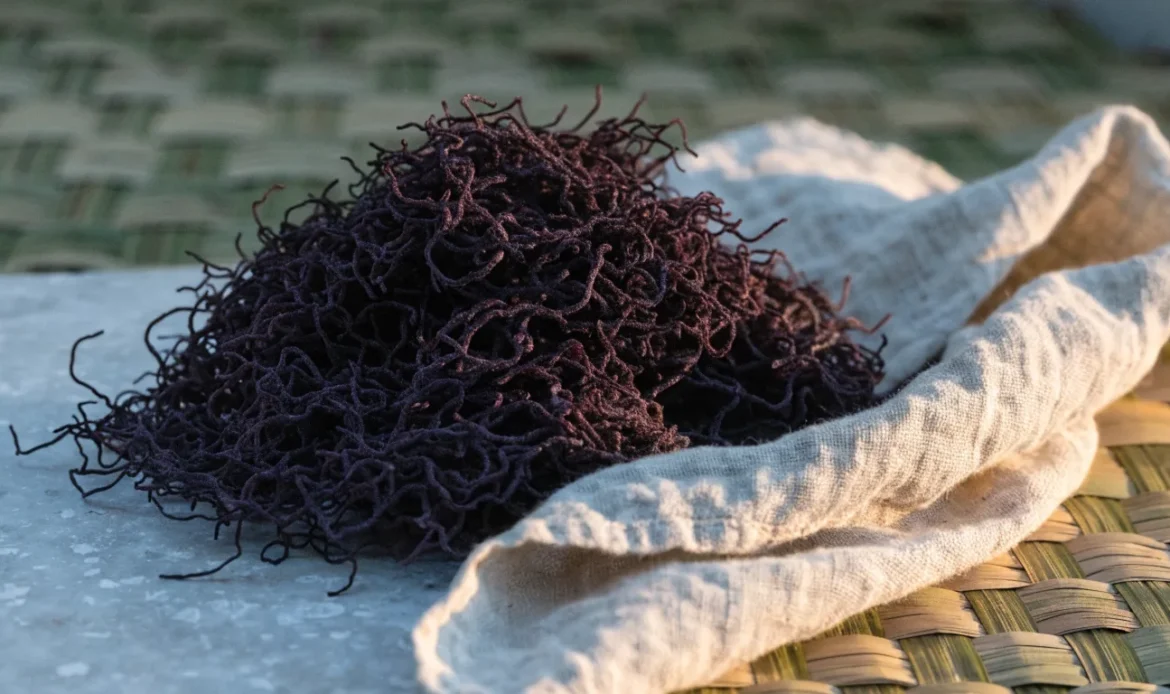
Short answer
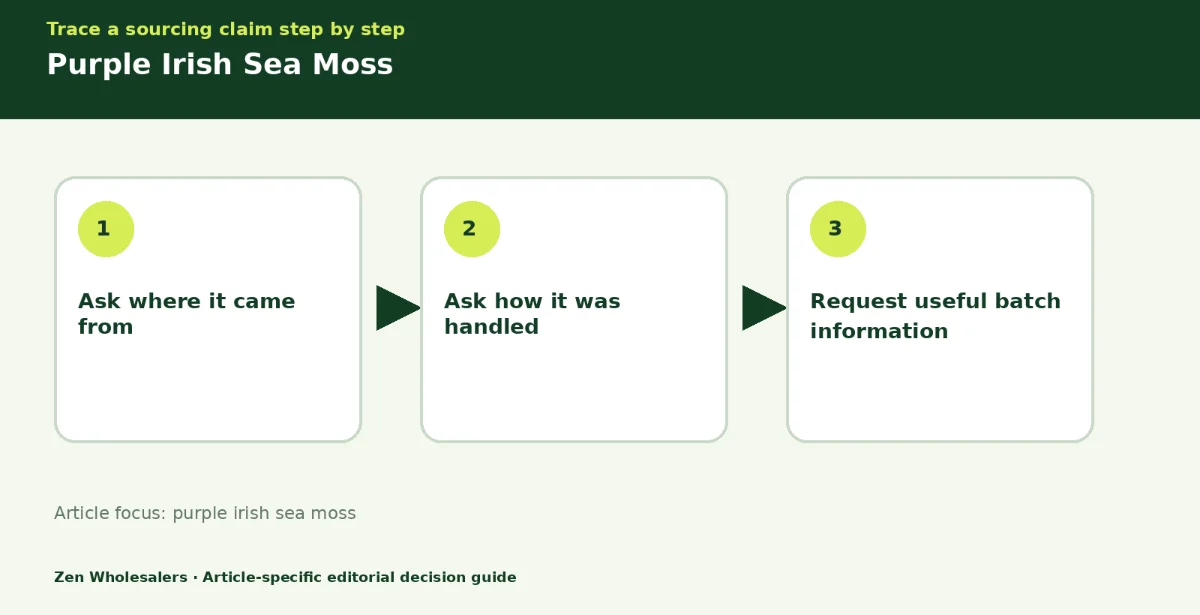
Purple Irish sea moss is a market name for certain purple-tinted seaweed sold for food and supply. It is not one fixed species or source. Suppliers may sell different species, harvest sites, and handling methods under the same name. To buy responsibly, ask clear questions about species, harvest location, processing, and lab testing. This article tells you what to check and what the answers can — and cannot — prove.
Why this matters
Color and name can tell you something. They do not prove safety, purity, or exact origin. Seaweeds from different places, species, or seasons can look similar. Records, tests, and clear supplier answers are the only reliable proof.
What “purple Irish sea moss” usually refers to
- The phrase combines three ideas: “purple” (a visual color cue), “Irish” (a traditional name linked to “Irish moss”), and “sea moss” (a market term for edible seaweed).
- In commerce, sellers may use that label for a range of red or purple-tinted algae. The exact species and origin can vary by seller and batch.
- Because the name is not a formal scientific label, always ask for the scientific name (Latin name) if species identity matters to you.
H2 What you can reasonably expect to learn from a supplier
You can ask for and expect clear answers to some questions. These answers help you decide, but they do not prove everything.
Ask for:
- The scientific name of the product (for example, a Latin binomial). This is the most reliable way to know species identity.
- The harvest location and date, or the general harvest region. Records should include at least the country or region and a harvest window.
- Whether the material is wild-harvested or farmed.
- The processing steps: rinsing, drying method (sun, air, oven, freeze-dry), and when processing happened after harvest.
- Any third-party testing or certificates of analysis (COA) for contaminants, heavy metals, and iodine.
- Photos of the product — both close-up and whole-batch views.
- Handling and storage conditions before shipping.
- A sample or small trial lot before you place a larger order.
What those answers can prove
- A Latin name confirms a species claim if the supplier provides one and it matches third-party identification.
- A harvest log and photos support origin claims but do not guarantee they are false or altered. Independent verification (like third-party audits or DNA testing) gives stronger proof.
- A COA shows what tests were run and the results for that test batch only. It does not guarantee future batches will match unless ongoing testing is in place.
H2 Why testing matters: iodine, metals, and microbes
Seaweed can vary widely in mineral content and in environmental residues. This is why testing is important when you source sea moss.
Iodine and safety
- Seaweeds can contain high levels of iodine. The amount varies by species, location, and season. High iodine intakes can affect thyroid function in some people. For an overview of seaweed and nutrition, see Harvard’s seaweed guide [1].
- Reviews and reports highlight that iodine content in seaweed is variable and that excess intake is a concern in some cases [2][5]. Food safety agencies recommend monitoring iodine in seaweed products [3].
- A supplier COA for iodine gives information for that batch. If iodine is a concern for you or your customers, request regular testing and clear labeling.
Heavy metals and other contaminants
- Seaweed can accumulate metals and other compounds from the water. Testing for lead, cadmium, arsenic, and mercury is common in commercial supply chains.
- Ask for a third-party lab test for heavy metals and for microbial contaminants when the seaweed is intended for food use.
Regulatory and supplement context
- Sea moss sold as a food or ingredient should meet local food safety rules. If a supplier markets products as dietary supplements, check for labeling and testing appropriate to supplement regulations. Operation Supplement Safety provides a background on sea moss in supplement products [4].
H2 How to verify species and origin
No single step proves everything. Use several checks together.
1) Ask for the scientific name
- Sellers should be able to tell you a Latin name. If they cannot, treat the claim as uncertain.
2) Request documentation
- Harvest logs or catch records showing date, region, and harvester details help. Processing records help too.
3) Check for photos and batch IDs
- Batch photos that match the product you receive make substitution less likely.
4) Consider lab tools
- DNA barcoding can identify species but is not a routine buyer check for all orders. It is a useful option if species identity is critical.
5) Third-party audits and traceability
- Independent audits or traceability systems (traceable batch numbers, chain-of-custody records) give stronger assurance.
H2 Harvest and handling: what affects the product you receive
Short summary: Where and how seaweed is taken and dried will affect appearance, shelf stability, and possible contamination risks.
Harvest method
- Wild-harvest: picks from natural beds. Wild material can vary by season and weather.
- Farmed: grown on ropes or other structures. Farming makes supply more consistent but practices differ widely.
Processing and drying
- Washing and rinsing remove salt, sand, and surface organisms.
- Drying method and speed affect moisture content and how the product looks. Faster drying reduces time for microbes to grow; slower drying at low temperatures may preserve pigments but takes longer.
- Packing and storage after drying affect shelf condition. Ask how the product is stored and shipped.
H2 Wholesale vs retail buying: practical differences
If you want larger volumes for resale or manufacturing, here are key extra checks.
- Samples: Always ask for a sample and test it. A small test order helps you evaluate color, smell, rehydration, and any lab results.
- Consistency: Ask how the supplier manages seasonal variation and how they guarantee consistent batches.
- Lead times: Ask about harvest windows and lead times for large orders.
- Packaging: Request packaging specs, lot codes, and storage instructions.
- Returns and acceptance: Agree on acceptance tests, holdback samples, and rejection criteria before placing a PO.
H2 Red flags and positive signals from suppliers
Red flags
- No Latin name or inconsistent species claims.
- No testing or refusal to provide COAs for recent batches.
- vagueness on harvest location, dates, or processing steps.
- No photos or batch IDs.
- Pressure to buy without samples or testing.
Positive signals
- Clear Latin names and batch records.
- Recent third-party COAs for iodine, heavy metals, and microbes.
- Willingness to provide samples and support a trial order.
- Work history with food buyers or documented traceability.
H2 Practical checklist: decision guide for buying purple Irish sea moss
Use this checklist when talking to a supplier. Mark each item as Must Have, Nice to Have, or Red Flag.
| Item | Must Have / Nice to Have / Red Flag |
|---|---|
| Scientific name (Latin) | Must Have |
| Harvest region and date (at least country/region) | Must Have |
| Wild-harvest or farmed | Must Have |
| Processing steps and drying method | Must Have |
| Batch photos and batch ID | Must Have |
| Recent third-party COA for heavy metals | Must Have |
| Recent third-party COA for iodine | Must Have if selling as food or supplement |
| Microbial test results (for food use) | Must Have |
| Traceability or chain-of-custody documentation | Nice to Have |
| Third-party audit or certification | Nice to Have |
| DNA barcoding or species ID from lab | Nice to Have if species critical |
| No documentation or refusal to share tests | Red Flag |
| No sample or refusal to allow trial order | Red Flag |
How to use the checklist
- For food use, treat testing for heavy metals, microbes, and iodine as Must Have.
- For non-food uses, adjust priorities based on your risk tolerance and local rules.
- If several Must Haves are missing, consider other suppliers or a test order with strict acceptance terms.
H2 Sample questions to ask a supplier (copy-paste friendly)
- What is the scientific name (Latin) of the product?
- Where and when was this batch harvested? Can you share the harvest log or a harvest region?
- Is this material wild-harvested or farmed?
- How was the seaweed processed and dried? When did drying occur relative to harvest?
- Can you provide a batch photo and batch ID?
- Do you have third-party lab tests (COA) for heavy metals, iodine, and microbes for this batch?
- What storage conditions do you recommend? How was it stored before shipping?
- Can I order a sample? What is your trial order policy?
- Do you have traceability or chain-of-custody documentation?
- What are your lead times for wholesale orders?
H2 What color means — and what it does not
Color may reflect species, growth stage, or processing. It is useful as a first check but never as proof of origin or safety.
- Purple tints can come from pigments in the algae or from environmental factors.
- Dried and rehydrated color can change after processing.
- Color alone does not show iodine content, contaminants, or whether the product matches a named origin.
H2 Packaging, labeling, and shipping notes
- Labels should include product name, batch ID, net weight, harvest date (or range), country or region of harvest, and supplier contact.
- For wholesale, packaging options and barrier properties (to control moisture) can affect shelf condition. Ask suppliers for packaging specs.
- Check local import rules for food products. Some markets require specific documentation or testing on arrival.
Frequently asked questions
What should I check first?
Start with the product or ingredient label, the source information, and whether the seller can answer clear questions.
Is this a replacement for professional advice?
No. Use this article as general education. Ask a qualified professional for personal medical, legal, or food-safety guidance.
Where can I learn more?
Use the Zen Wholesalers Learning Library to compare related guides and choose a useful next question.
References
- Harvard T.H. Chan School of Public Health, “Seaweed.” https://nutritionsource.hsph.harvard.edu/seaweed/
- Smyth PPA. “Iodine, Seaweed, and the Thyroid.” European Thyroid Journal, 2021. https://pmc.ncbi.nlm.nih.gov/articles/PMC8077470/
- Food Standards Australia New Zealand, “Survey of iodine levels in seaweed and seaweed containing products,” updated 2025. https://www.foodstandards.gov.au/science-data/monitoring-safety/surveyofiodinelevels
- Operation Supplement Safety, “Sea Moss in Dietary Supplements.” https://www.opss.org/article/sea-moss-dietary-supplements
- Blikra MJ et al. “Consequences of acute and long-term excessive iodine intake: A literature review focusing on seaweed as a potential dietary iodine source.” 2024. https://doi.org/10.1111/1541-4337.70037