

Short answer: No — not always. “Irish moss” usually refers to a specific red seaweed species called Chondrus crispus. “Sea moss” is a broader, commercial name. Sellers use “sea moss” for many kinds of red algae from different regions. That creates confusion. Read on to learn how the names differ, what you can check as a buyer, and which next questions to ask suppliers.
Why this matters
- Names affect which seaweed you get.
- Species, where it was harvested, and how it was processed can change texture, color, and how people use it.
- Labels do not always tell the full story. You can ask for clear info before you buy.
How to use this article
- If you want to source seaweed, read the sourcing checklist and decision guide.
- If you just want to learn the difference, read the short biology and naming sections.
- If you want to buy, check the sourcing questions and links at the end.
What people mean by “Irish moss” and “sea moss”
- Irish moss: A common name for the red algae species Chondrus crispus. This seaweed has a long history of use in some North Atlantic coastal areas. It is one species among many called “moss” in English.
- Sea moss: A broad, market-friendly term. Sellers use it for many red seaweeds. These can include Chondrus crispus, but also other species such as types of Gracilaria, Eucheuma, and related red algae. In many markets, “sea moss” refers to whatever red seaweed was harvested and processed for food or supplements.
Why sellers use both names
- “Irish moss” names a particular species.
- “Sea moss” sounds familiar and covers many products.
- In commerce, names often mix science, tradition, and marketing. That can hide species and origin details.
The biology in simple terms
- Algae are plants or plant-like organisms that live in water.
- “Red algae” is a group that includes Chondrus crispus and many other species.
- Different species look and behave differently when dried, soaked, or made into gels.
- Species differences matter for texture and use, but they do not guarantee specific nutrient or safety profiles without testing.
We do not know all nutrient or contaminant details just from a name. Testing is the only way to prove iodine levels, heavy metals, or microbial safety [1][2][5].
Sourcing and origin: what you should expect to find on a label
A clear label or supplier page should tell you:
- The species name (scientific name is best).
- The harvest or collection area (general region).
- Whether the product was hand-harvested or farmed.
- How it was processed (air-dried, sun-dried, boiled, frozen, powdered, etc.).
- Storage instructions and a best-by date or lot number.
- Any lab testing or certifications available.
What labels cannot prove without documents
- Clean water at harvest time.
- Exact contaminant levels.
- Wild vs. farmed method details beyond what the supplier states.
- The species identity unless verified by a lab test or traceable documentation.
If you need proof of safety or composition, ask for test results or a certificate of analysis (COA). Without those, labels are only a starting point.
Why testing matters: iodine and contaminants
What science says in broad terms
- Seaweeds often contain iodine. Amounts vary a lot by species, place, and season [1][2][5]. Iodine can be high in some seaweeds.
- Seaweed can also take up heavy metals and other contaminants from water. Levels vary by location and species. Testing shows whether levels fall within safe limits set by local regulators [3][5].
- Public health and food agencies have advised care with seaweed used as food or supplements. It is reasonable to expect lab testing for products sold as food or supplements [4].
What this means for buyers
- Do not rely on the species name alone to know iodine or contaminant content.
- Ask for lab reports if you are concerned about iodine, heavy metals, or microbes.
- Reputable sellers can share third-party test results or COAs for batches.
Sources you can cite when asking a supplier for testing:
- Research and guidance show variability in iodine and contaminants and recommend testing for seaweed products [1][2][3][5].
- Guidance for dietary supplements highlights the need for product verification and accurate labeling [4].
How to verify what you are buying: a practical checklist
Use this checklist when sourcing or buying sea moss or Irish moss. Ask the seller to answer each item. A supplier who can answer most items is more transparent.
Decision Checklist: What to ask and look for
- Species ID: Is the scientific name listed (for example, Chondrus crispus)?
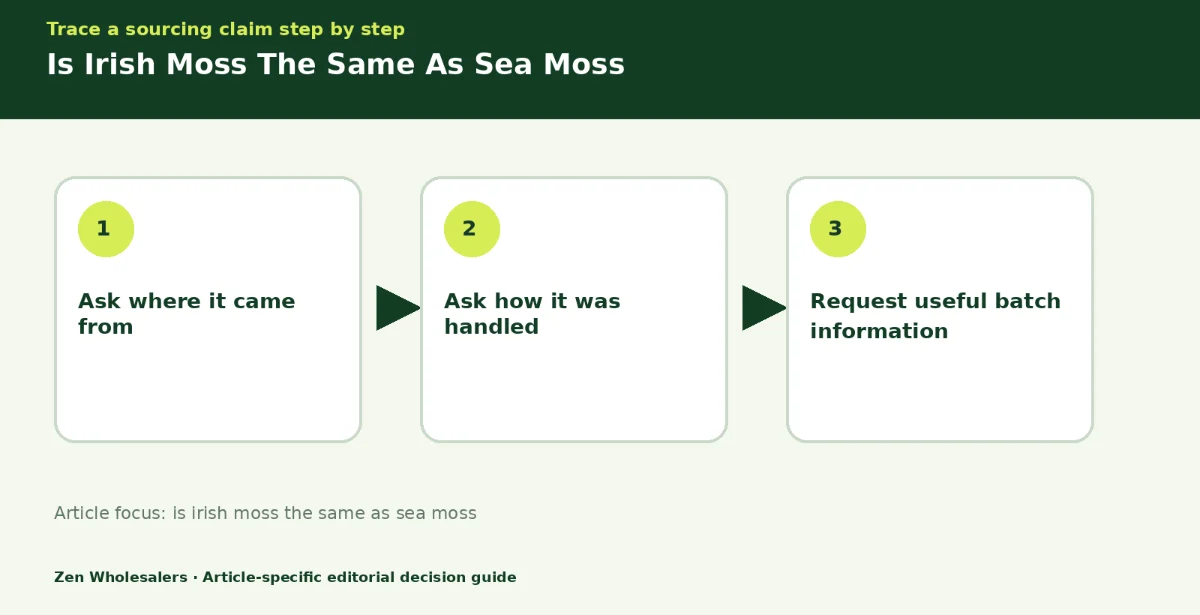
- Harvest region: Where was it collected? Ask for the general region or sea area.
- Wild or farmed: Was it wild-harvested or cultivated? How was it harvested?
- Processing: How was it dried or processed? Any heat or chemical steps?
- Lot number and harvest date: Can they provide batch info and dates?
- Lab testing: Can they provide a COA or third-party lab report? Ask specifically for tests for iodine, heavy metals, and microbes.
- Storage and handling: How was it stored after harvest? How long was the shelf time?
- Certifications: Do they have any food-safety or organic certifications? (Ask which certifier.)
- Return policy: Can you return or sample a small batch before a large purchase?
- Samples for wholesale: Do they provide samples for testing before you buy larger amounts?
- References: Can they supply references from other buyers or public traceability info?
Tips for interpreting answers
- A named species is better than a vague name.
- A COA from an accredited lab is stronger than an internal test report.
- If a seller refuses to share basic batch or testing info, proceed with caution.
A simple comparison table for common buyer questions
| Question | Irish moss (Chondrus crispus) | “Sea moss” (market term) |
|---|---|---|
| Is the name a single species? | Usually yes. Chondrus crispus is one species. | No. “Sea moss” can be many species. |
| Does the name predict iodine or contaminants? | Not by itself. Testing is needed. | No. Species and origin both affect composition. |
| Is appearance consistent? | Tends to have characteristic textures and colors when fresh. | Appearance varies widely by species and region. |
| What should buyers check? | Species name, batch info, testing. | Species ID, harvest info, testing, and processing details. |
This table shows what to check. It does not prove safety or nutrition.
Practical steps for sourcing: small buyer to wholesale
If you are a small buyer
- Start with a small purchase. Test the product yourself or ask for lab results.
- Ask the seller for usage instructions and storage tips.
- Check the return policy.
If you are a wholesale buyer or retailer
- Ask for a COA for each lot. Prefer third-party lab testing.
- Request a sample lot before committing to a large order. Send the sample to your own lab if your buyers need proof.
- Ask for traceability documents: lot numbers, harvest dates, and handling steps.
- Request product handling and storage guidance for retail sale (shelf life, display).
What a careful supplier should be able to provide
- Species name and harvest region.
- Batch-level COA showing tests for iodine, heavy metals, and microbes.
- Processing and storage details.
- A clear return and replacement policy for defective batches.
Preparation and use basics (safety-minded)
Simple, safe handling steps
- Clean workspace and clean hands when handling dried seaweed.
- Follow supplier instructions for soaking, rinsing, and preparing. Many sellers include preparation notes.
- Store dried seaweed in a cool, dry place in sealed packaging.
- If a product is sold as a gel, follow refrigeration and expiry instructions.
- If you have thyroid issues or iodine sensitivity, consult a healthcare professional before consuming seaweed products. This article is not medical advice.
Why rinsing and soaking matter
- Soaking and rinsing remove sand, salt, and loose debris. They do not remove dissolved iodine or metals. For that, lab testing is the only proof.
Which product type to pick: a short decision guide
Think about your goal. This short guide helps you choose a format or product type based on common needs. It does not recommend a specific brand.
- Want to cook with seaweed: Choose dried whole seaweed with a clear species name and processing instructions. Dried whole forms are easy to measure and rinse.
- Want convenience and portion control: Look for powdered or encapsulated products that include a COA. Check the ingredient list for fillers.
- Looking for wholesale: Request samples and COAs for each lot. Ask about minimum order quantities and storage.
- Need low-iodine options: Ask the supplier whether they have species or lots with known lower iodine, and ask for lab results before buying.
Always ask for test results if iodine or heavy metals are a concern.
Questions to ask a supplier right away (script)
Use this short script in emails or chats:
- What is the scientific name of the seaweed in this product?
- Where was it harvested (general region)?
- Was it farmed or wild-harvested? How was it processed?
- Can you share the batch COA with tests for iodine and heavy metals? Which lab ran the tests?
- Do you provide samples for testing before wholesale orders?
These direct questions cut through vague marketing terms.
Useful next steps and links
- Learn more about seaweed basics and safety on our learning pages: Learn.
- Browse available product formats and small-quantity options: Shop.
- If you are sourcing for resale or need wholesale pricing, contact our team: Wholesale or Contact.
- Return to the home page for company info and support: [/].
These links can help you move from learning to buying or sourcing.
Conclusion
“Is Irish moss the same as sea moss?” The short answer: not always. Irish moss is typically one species. Sea moss is a general market name that covers many species of red algae. Names alone do not prove anything about iodine, contaminants, or exact origin. For reliable sourcing, ask for the scientific name, batch details, and third-party lab testing. Use a checklist and request samples if you plan to buy larger amounts. If you need help getting supplier documents or have questions about testing, contact the seller and ask for clear, dated documentation.
Frequently asked questions
Is Irish moss and sea moss the same product?
Not always. “Irish moss” usually names one species, Chondrus crispus. “Sea moss” is a broad term sellers use for many red algae. You need a species name and sourcing info to know which seaweed you have.
Can I tell the species by color or shape?
Sometimes you can guess, but color and shape change with drying and processing. The only reliable proof is species ID by supplier documentation or lab verification.
Does the label “Irish moss” mean it was harvested in Ireland?
No. The name refers to a species, not necessarily a harvest location. If the harvest location matters to you, ask the seller for harvest region or batch details.
How can I check iodine or heavy metal levels?
Ask the supplier for a current COA from an accredited lab. COAs list measured levels for iodine and common contaminants. If none is available, you cannot know levels from the label alone [1][2][3][5].
Are there regulations for seaweed sold as food or supplements?
Many countries have rules for food safety and dietary supplements. Suppliers of supplements may follow additional industry guidance. For safety, request product testing and documentation [4].
What if the seller refuses to share batch testing or harvest details?
That is a red flag. Consider buying from a supplier who provides transparent batch info and lab reports. For wholesale, insist on COAs and samples before a large purchase.
References
- Harvard T.H. Chan School of Public Health, “Seaweed.” https://nutritionsource.hsph.harvard.edu/seaweed/
- Smyth PPA. “Iodine, Seaweed, and the Thyroid.” European Thyroid Journal, 2021. https://pmc.ncbi.nlm.nih.gov/articles/PMC8077470/
- Food Standards Australia New Zealand, “Survey of iodine levels in seaweed and seaweed containing products,” updated 2025. https://www.foodstandards.gov.au/science-data/monitoring-safety/surveyofiodinelevels
- Operation Supplement Safety, “Sea Moss in Dietary Supplements.” https://www.opss.org/article/sea-moss-dietary-supplements
- Blikra MJ et al. “Consequences of acute and long-term excessive iodine intake: A literature review focusing on seaweed as a potential dietary iodine source.” 2024. https://doi.org/10.1111/1541-4337.70037