
Short answer
You can purchase sea moss from several places: online retailers, specialty Caribbean or health-food stores, local markets, and wholesalers. Each place sells different forms (raw dried, gels, powders, or capsules). What matters most is verifying the seller’s information, asking about testing and harvest practices, and choosing the format that fits how you plan to use it.
Why this guide
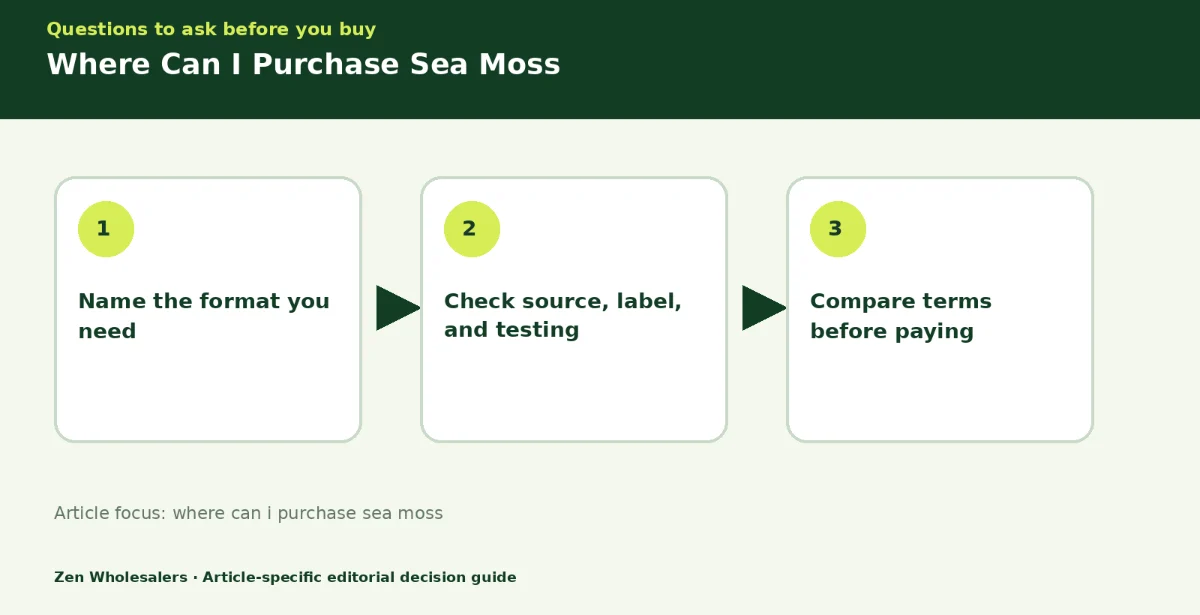
This article answers “where can I purchase sea moss” right away, then helps you decide. You will get a practical checklist, clear questions to ask sellers, and a decision table to narrow your options. The goal is a useful buying plan whether you shop locally or online.
Where you can purchase sea moss: main options
Below are the common places people buy sea moss. Each option notes strengths and what to check before you buy.
Online retailers and direct brand shops
What they sell: Many sellers online offer raw dried sea moss, prepared gels, powders, and capsules.
Why people buy here:
- Large selection of forms and pack sizes.
- Easy to compare product pages and labels.
What to check:
- Seller contact details and return policy.
- Clear ingredient list and storage directions.
- Batch or lot numbers and any available lab reports.
- Photos that show packaging and product texture.
Notes: Online shopping is convenient. But online listings vary in the detail they provide. If a product page has little information, ask the seller for specifics before buying.
Local health-food stores and co-ops
What they sell: Packaged sea moss products, often gels, powders, or capsules.
Why people buy here:
- You can view the product in person.
- Staff can sometimes answer basic questions.
What to check:
- Freshness and packaging integrity.
- Ingredient list and any preservative or additives.
- Whether the store can share the supplier information or a certificate of analysis (COA).
Notes: Shops vary in how much sourcing information they keep. Ask the manager where the store sources its sea moss.
Caribbean grocery stores and ethnic markets
What they sell: Raw dried sea moss, sometimes homemade gels or prepared mixes.
Why people buy here:
- These stores may stock regional varieties.
- Staff may have experience preparing sea moss.
What to check:
- Packaging and date of preparation (if gel).
- Whether the store can detail the product’s origin and handling.
- Clear labeling of any additives.
Notes: Small markets can be a good source for traditional preparations. Still ask for specifics on harvest or handling if that matters to you.
Farmers markets, craft fairs, and local vendors
What they sell: Small-batch or home-prepared gels, dried sea moss, and sometimes tutorials on preparation.
Why people buy here:
- Direct contact with sellers.
- Chance to ask questions face-to-face.
What to check:
- Clean preparation methods and safe packaging.
- Business contact information and a written ingredient list.
- Whether the vendor follows basic food-safety practices.
Notes: Local sellers can be helpful, but take extra care with perishable products like fresh gel. Request a written list of ingredients and how the product was stored.
Wholesalers and bulk suppliers
What they sell: Large quantities for retail, food use, or manufacturing.
Why people buy here:
- Lower unit cost for large orders.
- Options to buy by the kilo or pallet.
What to check:
- Minimum order quantities and lead times.
- Certificates of analysis or accessible testing.
- Packaging, shelf storage, and shipping method.
Notes: If you plan to buy in bulk, use a supplier who can give consistent documentation about batches and testing. See our wholesale page for more information about working with suppliers: /wholesale/
Foraging or local harvest (with caution)
What they sell: Wild-harvest sea moss is sometimes available from people who harvest locally.
Why people buy here:
- Directly sourced product.
What to check:
- Harvester’s training and local regulations.
- Water quality where the sea moss was harvested.
- Documentation of safe handling and drying.
Notes: Foraging and buying directly from harvesters carry risks because seawater can contain heavy metals, microplastics, or high iodine levels depending on the site. If you are not confident in the harvester’s practices and testing, consider a commercial supplier who shares testing data.
Social media sellers and community marketplaces
What they sell: Home-made gels, dried sea moss, and powders sold via platforms like Facebook or marketplaces.
Why people buy here:
- Often lower prices and local delivery options.
What to check:
- Reviews or references from other buyers.
- Clear ingredient lists and business contact info.
- Willingness to provide a COA or testing information.
Notes: Use caution if the seller cannot provide clear contact details or product information.
Forms of sea moss you might purchase
Different forms matter for storage, shelf life, and how you plan to use the product.
- Raw dried sea moss: Dried pieces or strands. You usually soak and rinse before making gel or using in recipes. Check for visible debris and smell.
- Sea moss gel: Pre-made, ready to use. Gel is perishable; check production date and storage instructions.
- Powder: Dried sea moss ground to powder. Easier to add to smoothies or recipes.
- Capsules and pills: Processed forms for convenience. Look at the ingredient list and capsule material.
- Extracts or tinctures: Concentrated forms. Check solvent or carrier information on the label.
None of these forms is inherently superior for every use. The best one depends on how you plan to use the product and how you will store it.
How to choose the right seller: a practical decision checklist
Use this checklist when you are ready to buy. It lists the most useful checks to perform before purchase.
- Seller identity
- Is there a business name, address, and phone number?
- Is there a clear returns policy or customer service contact?
- Product labeling
- Is there an ingredient list and net weight?
- Are storage and preparation instructions included?
- Origin and harvest
- Does the seller state where the sea moss was harvested or farmed?
- Is the harvest method (wild vs. farmed) listed?
- Safety and testing
- Can the seller provide a certificate of analysis (COA) or third-party lab test?
- Do tests include heavy metals, microbial contamination, and iodine levels?
- Packaging and handling
- Is product sealed with lot or batch number?
- For gels, is cold-chain handling documented?
- Seller claims
- Avoid sellers who make medical or guaranteed health claims.
- Look for clear, factual descriptions instead of promises.
- Reviews and references
- Are there independent customer reviews or third-party references?
- Can the seller provide references for wholesale purchases?
- Price and value
- Compare similar product forms and package sizes.
- Consider shipping and handling when comparing cost.
Use this checklist as a conversation guide when contacting a seller.
Decision table: where to purchase sea moss based on your needs
| Where to buy | Best for | What to check immediately | Quick questions to ask the seller |
|---|---|---|---|
| Online retailers / brand shops | Convenience and variety | Shipping method, batch number, ingredients | “Can you provide a COA or batch test for this product?” |
| Local health-food store | In-person inspection, convenience | Packaging date, ingredient label | “Who is the product supplier?” |
| Caribbean grocery | Regional varieties, traditional forms | Packaging and storage, ingredient list | “When was this prepared or packaged?” |
| Farmers markets / local vendors | Small batches, direct contact | Clean handling, written ingredient list | “How do you store this product and for how long?” |
| Wholesaler | Large quantity orders | Lead times, COAs, storage | “Do you offer COAs and what are your minimum orders?” |
| Social media sellers | Local pickup, possible lower cost | Seller reviews, clear contact info | “Do you have customer references and product details?” |
This table helps match your buying scenario to the likely place to purchase. It highlights the most useful checks in each context.
Questions to ask sellers (short list)
- Where was this sea moss harvested or farmed?
- Can you provide a certificate of analysis or lab test results for this batch?
- What is the exact ingredient list and any preservatives used?
- How should I store this product and how long will it keep?
- Do you have a batch or lot number for traceability?
- What is your return or refund policy?
Asking these questions will reveal which sellers are prepared to share useful information and which are not.
What testing and safety information matters?
Seaweed can concentrate iodine and other minerals from seawater. Iodine content and other elements vary by species and location. Because levels vary, buyer testing is relevant. Sources recommend awareness of iodine intake and testing of seaweed products rather than assuming consistent levels [1][2][5].
Certificates of analysis (COAs) or third-party lab test results can show whether a product was tested for heavy metals, microbial contamination, and iodine. If a seller cannot provide test documentation and the product will be consumed regularly, this is a valid reason to choose another source.
Operation Supplement Safety and other industry groups discuss sea moss in the context of dietary supplement safety and encourage documentation and careful sourcing [4]. National food-safety agencies have done surveys of iodine and related compounds in seaweed products, showing that levels and risks depend on product and origin [3].
Important note: A lab report helps, but a single test does not guarantee safety for all future batches. Look for sellers who document regular testing and batch traceability.
How to search “purchase sea moss near me” effectively
- Use local search phrases: “purchase sea moss near me,” “sea moss gel near me,” or “dried sea moss near me.”
- Check store pages and Google Business listings for contact details and photos.
- Read reviews on independent platforms. Look for specifics, not just star ratings.
- Search community groups and local Facebook Marketplace listings. Ask sellers for product photos and ingredient lists.
- Call ahead. Ask the seller the checklist questions to confirm basic details before you visit.
- For wholesale needs, search for “sea moss wholesale” and request supplier references and COAs.
If you find a store or seller with minimal information, ask for written details or lab reports before buying.
Red flags: when to avoid a seller
- No contact information or a business address.
- No ingredient list or batch information.
- Vague origin statements like “from the islands” without more detail.
- Claims that sound like medical cures or guaranteed health outcomes.
- Sellers unwilling to answer questions about storage or testing.
These issues suggest the seller may not have adequate traceability or quality control.
Storage and handling basics (general guidance)
- For dried sea moss: Store in a cool, dry place in a sealed container.
- For prepared gel: Keep refrigerated and follow the seller’s storage directions. Ask about the preparation date.
- For powders and capsules: Store away from heat and moisture, in sealed packaging.
These are general steps. Follow any specific instructions on the product label.
Suggested next steps (links to useful pages)
- Learn more about seaweed basics and safety: /learn/
- Browse product types and formats on our shopping page: /shop/
- If you need bulk quantities or want to discuss wholesale: /wholesale/
- Have questions for our team? Reach out: /contact/
- Return to our homepage for general info: /
Conclusion
Where you can purchase sea moss depends on your needs: convenience, quantity, product form, and how much documentation you want. Online shops, local specialty stores, and wholesalers all sell sea moss. The most useful next step is to decide the format you want and then use the checklist and questions in this guide when you contact sellers. Request lab reports when you plan to consume sea moss regularly. If you want a place to start exploring products and formats, visit our shop or learn pages: /shop/ and /learn/. For bulk or supplier questions, see /wholesale/ or contact us: /contact/.
Continue reading
Frequently asked questions
Can I buy sea moss in regular grocery stores?
Some grocery stores carry sea moss or seaweed products, but availability varies. Specialty or ethnic markets and health-food stores are more likely to stock sea moss products.
Should I ask sellers for lab tests?
Yes. For products meant to be eaten regularly, asking for a certificate of analysis (COA) or third-party test results is a reasonable step. Tests that include heavy metals, microbial checks, and iodine content are most relevant.
Is wild-harvest sea moss safe to buy?
Wild-harvest sea moss can be safe, but safety depends on the harvest location and handling. Ask harvesters about water quality, drying methods, and testing. If these details are not available, choose a supplier with documented testing.
What form of sea moss is best to buy first?
Choose the form that fits how you plan to use it. Dried sea moss is flexible for making preparations. Ready-made gel is convenient but perishable. Powders and capsules are simple to store. There is no single “best” form for every person.
How can I find a reliable wholesale supplier?
Look for wholesalers who provide COAs, batch traceability, and clear shipping and packaging policies. Ask for references and sample paperwork before placing a large order.
Can product reviews be trusted when buying sea moss online?
Reviews can help but use them alongside other checks. Look for detailed reviews that describe product form, packaging, and seller responsiveness. Reviews alone do not replace documentation like COAs.
References
- [1] Harvard T.H. Chan School of Public Health, “Seaweed.” https://nutritionsource.hsph.harvard.edu/seaweed/
- [2] Smyth PPA. “Iodine, Seaweed, and the Thyroid.” European Thyroid Journal, 2021. https://pmc.ncbi.nlm.nih.gov/articles/PMC8077470/
- [3] Food Standards Australia New Zealand, “Survey of iodine levels in seaweed and seaweed containing products,” updated 2025. https://www.foodstandards.gov.au/science-data/monitoring-safety/surveyofiodinelevels
- [4] Operation Supplement Safety, “Sea Moss in Dietary Supplements.” https://www.opss.org/article/sea-moss-dietary-supplements
- [5] Blikra MJ et al. “Consequences of acute and long-term excessive iodine intake: A literature review focusing on seaweed as a potential dietary iodine source.” 2024. https://doi.org/10.1111/1541-4337.70037