
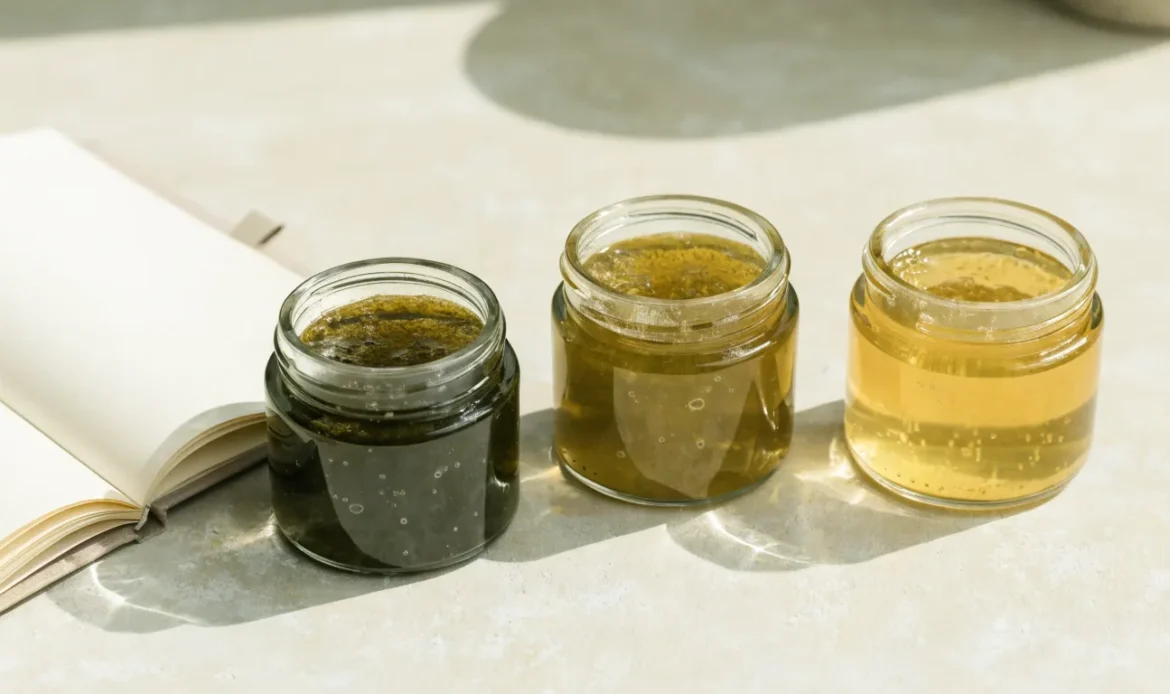
Short answer: “Sea moss advanced” usually describes sea moss products that come in specific formats or with added processing steps. It does not have a single industry definition. To choose one, check the format, testing, labeling, and how the seller describes sourcing and processing.
This guide explains what “advanced” can mean. It lists formats and trade-offs. It shows what you can verify and what you cannot. You will get a simple decision checklist to pick the right product for your needs.
What people mean by “sea moss advanced”
“Sea moss advanced” is a marketing phrase. Sellers use it in several ways. Common meanings include:
- A processed product like a powdered extract, concentrated gel, or capsule.
- A blended product that mixes sea moss with other sea plants or herbs.
- A product that highlights extra testing, filtration, or a specific drying method.
There is no single legal or scientific standard for “advanced.” That makes it important to ask clear questions before you buy.
Real, checkable differences in sea moss products
Here are the differences you can check yourself. These are factual features. They matter for storage, use, and safety.
- Format: raw whole, dried, gel, powder, tincture, or capsule. Each format changes how you store and use the sea moss.
- Processing steps: sun-dried, oven-dried, freeze-dried, powdered, or water-extracted. The label or seller can tell you which.
- Added ingredients: some products add herbs, flavoring, or stabilizers. Look at the ingredient list.
- Testing information: third-party lab reports or Certificates of Analysis (COA) can show iodine, heavy metals, and microbial tests.
- Packaging and shelf instructions: this tells you how long a product may last after opening and whether refrigeration is needed.
- Label transparency: a clear label lists batch numbers, harvest window, and contact details.
These items are verifiable from the label, seller, or test reports. They help you compare products that use the phrase “advanced.”
What you cannot prove from a marketing term
“Advanced” does not prove safety or quality by itself. Here are limits to be clear about:
- The word “advanced” does not guarantee third-party testing.
- It does not prove low levels of iodine or contaminants.
- It does not mean the product is more nutritious.
- It does not guarantee consistent composition across batches.
To move from marketing to fact, ask for a COA or batch test. If the seller cannot provide test data, the marketing term remains unverified.
Why testing matters: iodine and contaminants
Seaweeds can contain iodine and environmental traces. Iodine levels vary widely by species, location, and processing. This variation can affect how much iodine is in a serving [2][5]. Recent surveys show iodine in seaweed products can be high or low depending on many factors [3]. For supplements and food, testing helps you understand actual iodine content.
Testing also looks for heavy metals, microbial contamination, and other unwanted substances. Industry groups and safety organizations recommend testing and clear labeling for seaweed products [4].
Formats explained: pros and cons
Below are common formats you will see in “advanced” products. Use these notes to pick what fits your needs.
- Raw/dried sea moss (whole)
- Pros: Simple ingredient list. Minimal processing. Good for rehydration and home use.
- Cons: Needs cleaning and soaking. Texture varies. Harder to standardize serving.
- Sea moss gel (prepared)
- Pros: Ready to blend into foods. Easier to use for cooking.
- Cons: Perishable. Shelf life depends on preservation steps and refrigeration. Watch for added ingredients.
- Powders and extracts
- Pros: Concentrated, shelf-stable, easy to dose.
- Cons: May be subject to extraction methods that change composition. Check for fillers or carriers.
- Capsules and tablets
- Pros: Convenient dosing. Shelf-stable.
- Cons: Limited transparency on what the capsule contains beyond the label. May hide blends.
- Blends (sea moss with botanicals or minerals)
- Pros: Designed for specific tastes or uses.
- Cons: Each added ingredient adds a new safety and sourcing question. Check interactions and added ingredient testing.
How processing changes the product
Processing can change color, taste, texture, and concentration. For example, drying method may affect how the product rehydrates. Water-extraction may concentrate some soluble components. Powdering may use carriers like maltodextrin. Ask the seller:
- What processing steps were used?
- Are any carriers or solvents used?
- Are there steps to control iodine or contaminants?
If a seller provides clear answers and test results, you can make a reasoned choice.
Practical decision checklist: choosing a sea moss advanced product
Use this checklist to compare products. Check every item before buying.
| Checkpoint | Why it matters | What to ask or look for |
|---|---|---|
| Format | Determines use and storage | Is it raw, gel, powder, or capsule? |
| Ingredient list | Shows additives | Any preservatives, flavorings, or carriers? |
| Source info | Helps trace variability | Does the label or seller give harvest region or species? |
| Batch number | Helps trace tests | Is a batch or lot number printed on the package? |
| Certificate of Analysis (COA) | Verifies tests | Can the seller provide a third-party lab COA? |
| Iodine test reported | Important nutrient and risk | Does the COA include iodine levels? |
| Heavy metals test | Safety check | Does the COA show heavy metal results? |
| Microbial testing | Food safety | Are microbial counts or safety tests shown? |
| Processing details | Affects composition | How was the product dried or extracted? |
| Storage instructions | Keeps product stable | Refrigerate after opening? Shelf life? |
| Serving size & instructions | Prevents overuse | Clear serving guidance on label? |
| Company contact | For questions | Is there a clear customer contact? |
If a product misses several of these items, treat the claim “advanced” cautiously.
Comparing common use-cases and recommended formats
Think about how you plan to use sea moss. Here are common goals and practical format suggestions. These are neutral suggestions. They do not promise health effects.
- Cooking and smoothies
- Suggested formats: gel or powder that blends well.
- What to check: refrigeration for gels; solubility and no fillers for powders.
- Travel-friendly or pills
- Suggested formats: capsules or tablets.
- What to check: ingredient list, capsule materials, and batch tests.
- DIY craft or rehydration
- Suggested formats: raw/dried whole sea moss.
- What to check: cleanliness, soaking instructions, and visible debris.
- Product development or wholesale
- Suggested formats: powders with COAs, ingredient specs.
- What to check: bulk testing, supply continuity, and wholesale terms.
How to read a Certificate of Analysis (COA)
A COA gives test results for a specific batch. If a seller offers one, look for:
- Batch or lot number that matches the product label.
- Test date and laboratory name.
- Tests for iodine, heavy metals (lead, mercury, arsenic), and microbes.
- Units used for reporting (ppm, mg/kg). If you are unsure, ask the seller to explain.
A COA helps convert “advanced” from a marketing term into a verifiable fact.
Questions to ask a seller before buying
Ask short, specific questions. Below are examples you can adapt.
- What species of sea moss is this?
- Where and when was it harvested?
- What drying or extraction methods were used?
- Can you provide a COA for the batch I will receive?
- Does the product contain added ingredients?
- What are the storage and shelf-life instructions?
- If buying wholesale: what are lead times and batch consistency assurances?
Sellers that answer clearly and provide COAs make decision-making easier.
Safety notes and precautions
Be cautious with dosing and cumulative iodine intake. Iodine content can vary by species and region [2][3][5]. If you have thyroid issues or take iodine-containing medicines, ask a qualified health professional before adding seaweed products to your regimen.
Products sold as supplements or foods follow different rules in different countries. In general, look for transparent testing and clear labeling. Industry safety groups have published guidance on sea moss and supplements [4].
Practical storage and handling tips
- Check label for storage instructions. Some gels need refrigeration. Dried products usually store at room temperature in a dry place.
- Keep batch number and purchase receipt. They help with any quality questions.
- If you notice odd smell, color, or texture, stop using the product and contact the seller.
Decision guide: buy, ask for tests, or walk away
Use this short guide to decide.
- Buy if:
- The product has a clear label and ingredient list.
- A matching COA is available for the batch.
- Storage and serving instructions are clear.
- Ask for tests if:
- The product claims “advanced” but no COA is provided.
- You need low or known iodine content.
- You sell or serve the product to others and need safety documentation.
- Walk away if:
- The seller refuses to provide batch testing or basic sourcing details.
- The label lacks ingredient information or contact details.
- The product shows signs of poor handling (mold, off-odors, damaged packaging).
Pricing and wholesale notes
Price alone does not indicate safety or quality. If you plan to buy large volumes:
- Ask for COAs for multiple batches.
- Confirm supply continuity and harvest windows.
- Verify packing methods and shelf life.
- Ask about volume discounts and return policies.
If a seller avoids these basic questions, treat the offer as high risk.
Useful next steps and links
If you want to learn more or shop:
- Start at our home page: Home
- Explore more educational guides: Learn and Learn (advanced topics and basics)
- Browse available formats: Shop
- For business purchases: Wholesale
- Need help or a COA request? Contact the team: Contact
These links help you move from reading to comparing products or asking sellers the right questions.
Conclusion
“Sea moss advanced” can mean many things. It can refer to format, processing, or added features. The word alone does not prove quality or safety. You can make a better choice by checking the format, ingredient list, processing method, and, most importantly, batch testing and COAs. Ask short, specific questions. Keep records of batch numbers and tests. If a seller provides clear answers, you can make a fact-based decision. If they cannot, treat the “advanced” label with caution.
Frequently asked questions
Does “sea moss advanced” mean it is safer?
Not automatically. “Advanced” is a marketing term. Ask for test results and check the label. A COA is a reliable way to confirm safety tests.
Should I worry about iodine in sea moss?
Iodine levels can vary. Testing shows some seaweed products have high iodine and others low [2][3][5]. If iodine is a concern, ask for a documented iodine test for the batch.
Can I trust capsule or powder forms more than gels?
Each format has pros and cons. Capsules and powders are often more shelf-stable. Gels are ready to use but may need refrigeration. Trust depends on label transparency and testing, not the format alone.
What tests should I expect on a reliable COA?
At minimum, look for tests that report iodine, heavy metals, and microbial safety. The COA should list the batch number and testing lab.
Are there standard regulations for calling a seaweed product “advanced”?
No single international standard defines “advanced.” Rules vary by country. The term is marketing, so verify claims with tests and documentation.
Where can I get more practical guides about sea moss?
Start with clear educational pages and buying guides. See our general learning hub for basic sea moss information and our shop pages for product formats. Visit Learn (/learn/) for more guides.
References
- Harvard T.H. Chan School of Public Health, “Seaweed.” https://nutritionsource.hsph.harvard.edu/seaweed/
- Smyth PPA. “Iodine, Seaweed, and the Thyroid.” European Thyroid Journal, 2021. https://pmc.ncbi.nlm.nih.gov/articles/PMC8077470/
- Food Standards Australia New Zealand, “Survey of iodine levels in seaweed and seaweed containing products,” updated 2025. https://www.foodstandards.gov.au/science-data/monitoring-safety/surveyofiodinelevels
- Operation Supplement Safety, “Sea Moss in Dietary Supplements.” https://www.opss.org/article/sea-moss-dietary-supplements
- Blikra MJ et al. “Consequences of acute and long-term excessive iodine intake: A literature review focusing on seaweed as a potential dietary iodine source.” 2024. https://doi.org/10.1111/1541-4337.70037