
Short answer: I cannot confirm a specific “True Sea Moss” recall from the public sources I can use. If you think a sea moss product you own is unsafe, stop using it and follow the check-and-report steps below. This article shows how to look for a recall, what to inspect on a product, and how to decide whether to keep, return, or replace it.
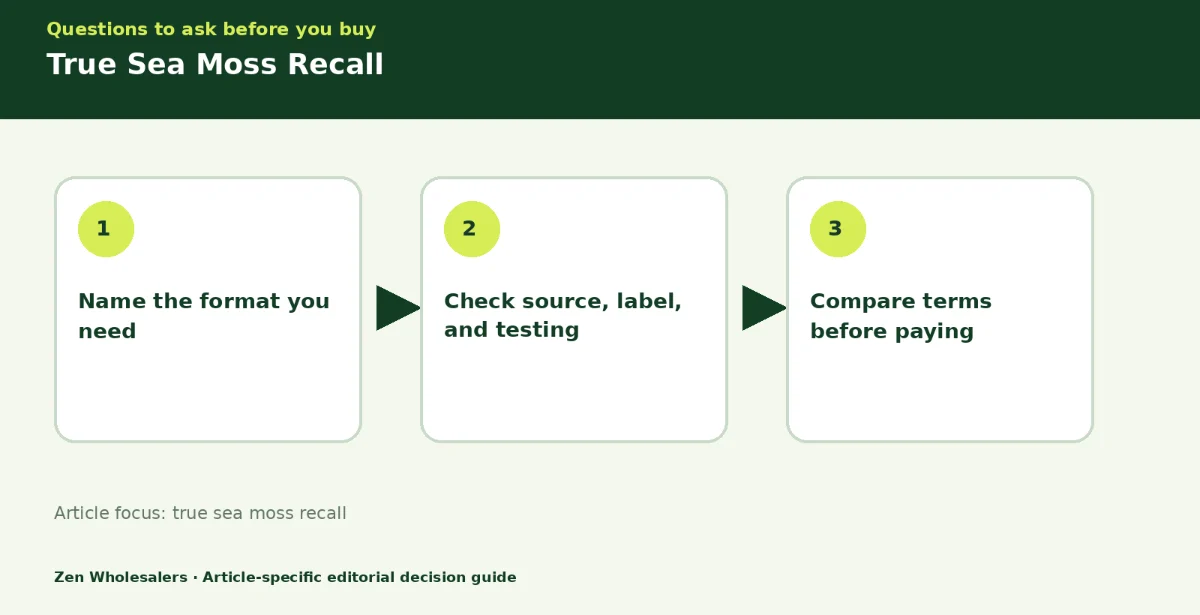
What people mean by “True Sea Moss recall”
People search this phrase for a few reasons:
- They heard about a brand name or product batch being pulled from shelves.
- They worry about safety problems in seaweed products, like high iodine or contaminants.
- They found odd smell, color, or packaging and want to know if that means a recall.
A product recall is an official action by a company or a government agency. If you want to know about a specific lot or brand, use the steps below to confirm. Public sources sometimes lag, so checking the seller and the official recall lists can help.
How to check whether a sea moss product is recalled
Follow these steps in order. Keep short notes and photos as you go.
- Save the product details
- Keep the product, label, and packaging.
- Note brand name, lot or batch number, expiration or best-by date, UPC/barcode, and any stickers.
- Look for a public recall notice
- Search official recall pages for your country. In the U.S. this is the place to check for supplement and food recalls. (If you are outside the U.S., check your national food safety authority.)
- Search the brand’s official website and social media for statements.
- Contact the seller
- Ask the retailer where you bought it if they received any recall notices.
- If you bought online, check your order history and the seller’s product page for updates.
- Contact the manufacturer
- Use the contact info on the label. Ask for verification: is my lot number included in any recall or hold?
- Report the problem
- If you suspect a real safety problem and cannot find clear recall info, report it to your local food safety authority. Keep photos, lot numbers, and purchase receipts.
If you find an official recall, follow the recall instructions. These may ask you to return the product, destroy it, or await further instructions.
Why seaweed and sea moss products can be flagged or recalled
Seaweed products can vary a lot in what they contain. A few common reasons authorities or companies flag seaweed and sea moss items are:
- Variable iodine levels. Some seaweeds contain a lot of iodine. High iodine intake can affect the thyroid for some people. Reviews and monitoring studies note large iodine differences across samples and products [2] [3] [5].
- Labeling or ingredient errors. A product might be misbranded, or its label might not match what is inside. This can trigger recalls.
- Contaminants or hygiene issues. Like other foods and supplements, seaweed products can be tested for microbes, heavy metals, or other contaminants. Testing is the only reliable way to know results.
- Manufacturing or packaging problems. If a processing facility finds contamination, they may recall products from certain lots.
These are reasons an authority or maker might issue a recall. That does not mean every sea moss product is unsafe. It means checking and records matter.
References that discuss these concerns include public health reviews and monitoring of seaweed iodine levels and supplement safety [1] [2] [3] [4] [5].
What to inspect on your sea moss product right now — checklist
Use this checklist before you throw anything away or decide to keep using it. Photograph each item. Keep the photos safe.
- Product identity
- Item on label: brand and product name.
- Lot or batch number present? (Yes / No)
- Expiration, harvest date, or best-by date present? (Yes / No)
- Packaging and seals
- Is the factory seal intact? (Yes / No)
- Any tears, holes, or water damage? (Yes / No)
- Label claims
- Does the label state “tested,” “third-party tested,” or list certificates? (Yes / No)
- Are contact details (address, phone, website) present? (Yes / No)
- Appearance and smell
- Color looks normal for that product type? (Yes / No)
- Off or rotten smell? (Yes / No)
- Purchase details
- Where and when bought (store or online)?
- Save receipt or order confirmation.
- If you see anything that looks wrong
- Stop using the product.
- Keep the product and packaging.
- Take clear photos of label, lot number, and damage.
- Contact the seller and manufacturer right away.
Decision guide (short):
- No lot number or no manufacturer contact info AND you suspect a problem: avoid use and report to your food safety authority.
- Product included in an official recall: follow recall instructions exactly.
- Product not in a recall but claimed “third-party tested”: ask for the test report or lab name before resuming use.
Table: Quick “what to look for” and “what to do” summary
| What to look for | Why it matters | What to do |
|---|---|---|
| Lot/batch number on label | Identifies a specific production run | Photograph it. Ask seller/manufacturer if that lot is affected. |
| Broken seal, wet package, mold | Possible spoilage or contamination | Stop using. Save package. Contact seller. |
| Iodine or test claims on label | Seaweed can vary in iodine content | Ask for test data or third-party certificate. If unsure, seeking health advice is wise. |
| Missing contact details | Harder to get answers or refunds | Contact the retailer and local regulator to report concerns. |
| Official recall notice found online | Shows a formal action | Follow the recall steps exactly. |
What recalls cannot prove
A recall or safety advisory tells you there is a problem with a batch, label, or process. It cannot prove:
- That all products of a brand are unsafe.
- That a product makes someone sick in every case.
- The exact chemical or biological cause unless test reports are released.
- Long-term risks without proper testing and follow-up studies.
Recalls are a signal to stop use and seek information. They do not always mean a product is dangerous for everyone in every situation.
If a sea moss product may have high iodine — what to know
Some seaweed species and seaweed products contain much more iodine than others. High iodine intake can affect thyroid function in sensitive people. Reviews and surveys point to this variability and the need to know how much iodine is in a product before using it regularly [2] [3] [5].
What you can do:
- If the product label lists iodine, compare that value to your usual iodine intake. If it does not list iodine, ask the seller or maker for lab data.
- If you have thyroid disease, or use thyroid medicine, ask your healthcare provider before using products that may add iodine.
- Do not rely on unverified claims on a label. Ask for third-party testing results.
These are precautionary steps, not health advice. For medical guidance, consult a qualified clinician.
How manufacturers and retailers can make recalls easier to find
When a recall happens, look for these transparent signs:
- Public recall notice on the maker’s website and on official regulatory recall pages.
- Clear instructions on whether to return, destroy, or quarantine the product.
- Affected lot numbers listed.
If you are shopping, prefer brands and sellers that provide:
- Clear lot and date labeling.
- Contact info on every package.
- Third-party testing or lab certificates on request.
Even with good labeling, testing is the only way to confirm safety for specific contaminants or iodine levels [4].
Buying decision guide: Should you buy sea moss now?
Use this short decision tree.
- Do you need sea moss today?
- If no: wait until you find a product with clear lot labeling and available test documentation.
- If yes: pick a product with clear labeling, a listed lot number, and contact information.
- Do you have a medical condition (e.g., thyroid disease)?
- If yes: consult your healthcare provider before adding seaweed products.
- Seller and product checks before purchase:
- Does the product list lot number and harvest/pack date?
- Can the seller share third-party lab reports for iodine and contaminants?
- Does the seller have readable contact information and a returns policy?
- After purchase:
- Record lot number and keep packaging.
- Store according to label instructions.
- Monitor for official recall notices for the brand and lot.
This guide helps balance immediate need with safety.
Practical actions for sellers, buyers, and wholesalers
If you sell or wholesale sea moss:
- Keep lot records and shipping records for traceability.
- Provide clear label information and contact details.
- Be ready to share test results for iodine and contaminants if buyers request them.
If you buy or use sea moss:
- Keep purchase proof and packaging.
- Ask for reports if you plan regular use.
- Report any safety concerns to the seller and the proper authority.
If you are a wholesaler or retailer and a customer reports a problem, collect the lot number, photos, and purchase info. Contact your supplier and the manufacturer. Follow your local rules for product holds and recalls.
Internal links that may help:
- Learn more about our sea moss resources: Learn
- See our current products and buying options: Shop
- Interested in stocking sea moss? Learn about our wholesale program: Wholesale
- Have questions or concerns? Contact us: Contact
- Return to the site home page: Home
Conclusion
If you searched “true sea moss recall” because you worry about a product, start with the product details. Save packaging, record lot numbers, and contact the seller and maker. Check official recall lists and ask for test data if you are concerned about iodine or contaminants. Keep records and photos. If a recall is announced, follow the recall instructions closely.
We want you to make a safe, informed choice. For more on sea moss products, testing, and buying guidance, visit our learning hub: Learn (/learn/). To browse current products, see Shop (/shop/). If you need wholesale info, go to Wholesale (/wholesale/). For direct help, Contact (/contact/) us.
Frequently asked questions
Are sea moss recalls common?
Recalls for seaweed products are not everyday events, but they do happen for reasons like labeling errors, packaging problems, or test results for iodine or contaminants. The frequency depends on supply chains and testing programs. Regular checking and traceability help you act quickly.
How can I tell if a product lot is recalled?
Look for official public notices from the manufacturer or your national food safety authority and check the brand’s website. Save photos, lot numbers, and receipts. If you cannot find clear info, contact the seller or manufacturer directly.
What should I do if there is no lot number on the package?
If you suspect a problem, stop using the product. Contact the retailer and report the issue to your food safety authority. Keep the package, photos, and receipts. Lack of lot numbers makes tracebacks harder.
Can iodine in sea moss make me sick?
Some seaweed products can contain high iodine. For people with thyroid conditions or those on related medications, changes in iodine intake can be important. If you have a medical condition, talk to a clinician before using products that may add iodine to your diet [2] [5].
Should I throw away a product if I suspect it’s unsafe?
Follow recall instructions. If an official recall asks you to return or destroy the item, follow those steps. If you simply suspect spoilage (bad smell, mold, broken seal), stop using it and follow seller guidance. Photograph and preserve packaging until you get instructions.
Can sellers refuse to accept returns during a recall?
Official recall instructions usually tell you what to do. If no official steps are given, contact the seller and the manufacturer. Retail return policies vary, but public recall procedures override normal sale rules when a formal recall is issued.
References
- [1] Harvard T.H. Chan School of Public Health, “Seaweed.” https://nutritionsource.hsph.harvard.edu/seaweed/
- [2] Smyth PPA. “Iodine, Seaweed, and the Thyroid.” European Thyroid Journal, 2021. https://pmc.ncbi.nlm.nih.gov/articles/PMC8077470/
- [3] Food Standards Australia New Zealand, “Survey of iodine levels in seaweed and seaweed containing products,” updated 2025. https://www.foodstandards.gov.au/science-data/monitoring-safety/surveyofiodinelevels
- [4] Operation Supplement Safety, “Sea Moss in Dietary Supplements.” https://www.opss.org/article/sea-moss-dietary-supplements
- [5] Blikra MJ et al. “Consequences of acute and long-term excessive iodine intake: A literature review focusing on seaweed as a potential dietary iodine source.” 2024. https://doi.org/10.1111/1541-4337.70037