
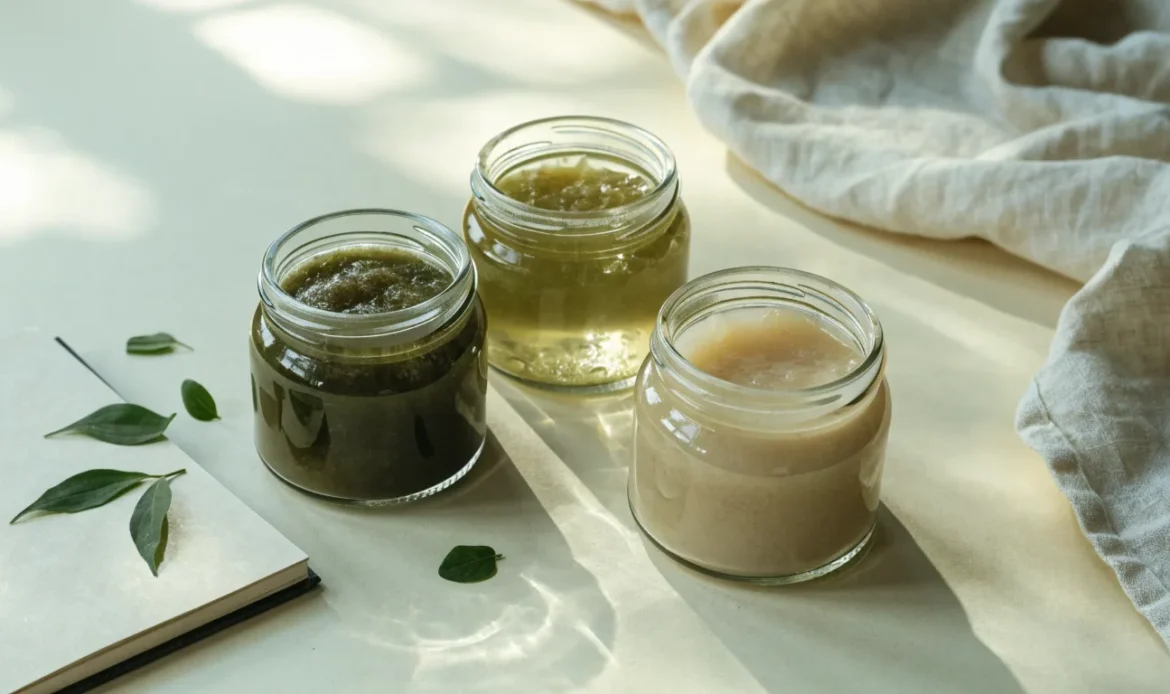
Short answer: Yes — you can find true sea moss near you, but you should check a few facts before you buy. Ask for the species name, the harvest location or farm, a recent lab report (COA), and clear storage and processing details. Those answers help you judge quality. They do not prove safety on their own. Read on for a step-by-step buying checklist and a simple decision guide.
What people mean by “true sea moss”
“Sea moss” is a common name. It often refers to several kinds of red seaweed that people use in food and supplements. Sellers may call different species “sea moss.” That means the same name can mean different plants.
Seaweed types can differ in texture and how you use them. They also differ in how they are harvested and processed. These differences matter for cooking, storage, and testing. For general information about seaweed and the need to treat seaweed as food, see a basic overview from Harvard T.H. Chan School of Public Health [1].
Important point: a name alone does not guarantee safety or quality. Species name, harvest info, and test results give useful clues. They do not prove a product is free from contaminants or safe for every use.
Where to look for “true sea moss” near you
Try these places in your local area. Each has pros and cons.
- Caribbean grocery stores and markets. These often stock sea moss for traditional dishes.
- Health food stores and co-ops. They may sell dried, powdered, or jarred sea moss products.
- Farmers markets or local food fairs. Small harvesters sometimes sell direct.
- Ethnic or specialty food shops. Look in shops serving Caribbean, West African, or Latin American communities.
- Local fish markets or seafood suppliers. Some sell fresh or dried seaweed.
- Online marketplaces with local pickup options. You can arrange to inspect the product in person.
- Local seaweed farmers or harvesters. If your area has seaweed growers, they can be a source.
Wherever you buy, expect to ask questions. Local sellers may be more open to sharing harvest dates, processing steps, or lab reports. But remember: verbal claims are not the same as lab evidence.
How to check if a nearby product is likely “true sea moss”
Use the checklist below before you buy. This list helps you gather facts. It does not replace a lab test.
Practical Buyer Checklist — What to check before you buy sea moss near you:
- Species name: Ask for the scientific or common species name.
- Harvest date: When was it collected?
- Harvest location: Where was it collected? (region or bay)
- Wild or farmed: Was it wild-harvested or grown on a farm?
- Processing steps: How was it cleaned and dried? Were chemicals used?
- Storage: How has it been stored? (cool, dry, sealed)
- Packaging date and shelf-life: Is there a pack or best-by date?
- Certificate of Analysis (COA): Ask for a recent third-party lab report.
- Tests shown: Does the COA list heavy metals, microbiology, and iodine?
- Seller transparency: Can the seller provide contact to the harvester or grower?
- Smell and look: For fresh or dried product, check for odd odors, visible mold, or grit.
- Price context: Is the price unusually low? If so, ask why.
- Intended use: Is it for food, topical use, or a supplement? Labeling should match use.
A short note on COAs: A Certificate of Analysis is a lab report. It shows test results for a batch. A COA helps check heavy metals, iodine, and microbes. COAs should show a test date and match the batch you are buying. COAs do not guarantee long-term safety. They are one helpful document among others [4].
Quick table: sea moss forms and what to expect
| Form | What it is | What to check | Best for |
|---|---|---|---|
| Raw / wet | Recently harvested and rinsed | Harvest date, smell, storage | Traditional recipes, fresh gels |
| Dried whole | Cleaned and air- or low-heat dried | Dryness, absence of mold, COA | Long storage, DIY gels, cooking |
| Powdered or flakes | Dried, milled product | Processing method, additives | Smooth mixing, supplements |
| Gel | Rehydrated or blended product | Ingredients list, refrigeration needs | Ready-to-use in smoothies |
| Capsules or pills | Dried powder in a pill form | Labeling, supplement facts, COA | Easy dosing, no prep |
This table helps you decide which form fits your needs. It does not list safety guarantees. Always check the checklist items above before buying.
What to ask a seller, and why the answers matter
Ask these questions in person, by phone, or by email. Plain answers help you assess risk.
- What species is this?
- Why ask: Different species are used for food. Knowing the species helps you search for specific handling and testing guidelines.
- Where was it harvested or farmed?
- Why ask: Water quality and coastal land use affect contamination risk. Location alone does not prove safety. But it is important context.
- When was it harvested?
- Why ask: Freshness matters for texture and microbial risk.
- Is it wild-harvested or farmed?
- Why ask: Farming methods and wild harvest methods differ in control and traceability.
- How was it cleaned and dried?
- Why ask: Cleaning and drying affect shelf life and the chance of grit or microbes.
- Can I see a COA for this batch?
- Why ask: A COA is the best document to confirm lab testing. Look for tests for heavy metals and iodine and for microbial counts when relevant [4].
- How should I store it?
- Why ask: Proper storage preserves quality and safety.
- Is there an ingredient list (for processed products)?
- Why ask: Some products add other herbs, gels, or preservatives.
If a seller refuses to answer or gives vague answers, treat that as a red flag.
What the available information can and cannot prove
Be clear about limits.
What you can learn from seller answers and labels:
- Species, processing, and dates give context.
- COAs report lab results for a tested batch.
- Storage instructions tell you how to keep the product.
What those facts cannot prove by themselves:
- A species name or harvest location does not prove the product is safe today.
- A COA only covers the batch and tests listed. It cannot account for post-test handling.
- A label or seller claim does not replace laboratory evidence.
For example, iodine levels in seaweed vary a lot by species and location. That variability means testing is needed if iodine intake is a concern [2][3][5]. These sources note that iodine can be high in some seaweed. That is why COAs that report iodine are useful.
Red flags when buying sea moss locally
Look out for:
- No species name or vague phrases like “seaweed blend.”
- No test reports or refusal to share a COA when asked.
- Strange smell, visible mold, or fine dirt that won’t rinse off.
- Packaged product with no processing or best-by date.
- Sellers who claim health cures or guaranteed clinical results. (Avoid health promises.)
- Unusually low price without an explanation.
If you see red flags, walk away. Better to get a different batch or seller.
Simple decision guide: Should you buy this sea moss now?
Use this short guide when you inspect a product.
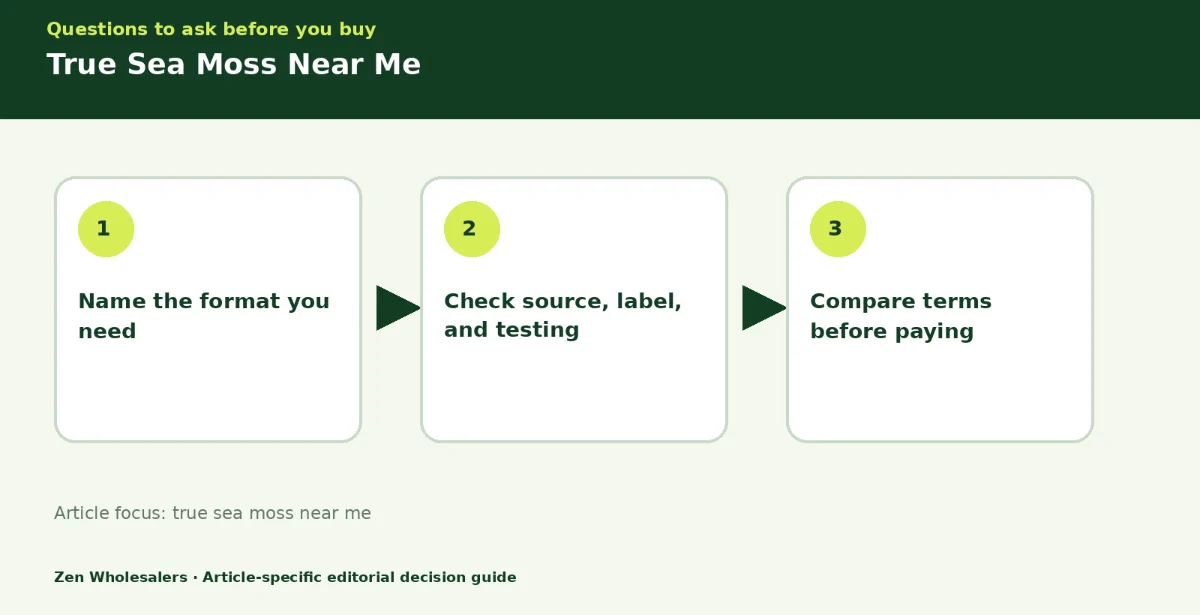
- Step 1: Seller names the species?
- If no → Pause and ask more. If still no, do not buy.
- Step 2: Seller provides harvest date and location?
- If no → Ask for reasons. If vague, consider another seller.
- Step 3: Seller provides a COA matching the batch?
- If yes → Check tests shown (heavy metals, iodine, microbes). If key tests are missing, ask for more info.
- If no → Decide whether you accept unknown test status. For food use, prefer products with COAs.
- Step 4: Product looks and smells normal and is stored well?
- If yes → Proceed if you are comfortable.
- If no → Do not buy.
- Step 5: Does the product match your intended use (food, topical, supplement)?
- If yes → Buy only if all other checks pass.
- If no → Find a product suited to your use.
This guide won’t reduce all risk. It helps you make a fact-based choice.
Buying wholesale or for resale
If you need larger quantities, add these steps:
- Ask about batch traceability for the volumes you want.
- Request a COA for the batch you will receive. Make sure the COA dates match the shipment.
- Ask about minimum order quantities, packaging options, and re-test policies.
- Get storage and handling instructions for bulk material.
- Ask for references from other buyers if possible.
Wholesale purchases increase your responsibility. You may need to share test information with customers or regulators. A COA and clear traceability are more important at scale.
How to prepare and use sea moss safely at home
Simple safe steps when you have sea moss:
- Rinse dried sea moss well to remove sand and grit.
- Soak and inspect for off-smells or slimy patches.
- If making gel, blend with fresh water and store in the fridge for short periods.
- Follow refrigeration or freezing instructions for gels and prepared products.
- Follow label directions for supplements and do not exceed suggested amounts.
If you have thyroid concerns or take iodine-sensitive medication, consult a healthcare provider before adding sea moss to your diet. Sources note that iodine in seaweed can be high and variable, so careful use is important [2][5].
What to read next
If you want more detail, see our guides:
- Read basics about sea moss and use on our Learn page: Learn.
- Browse products and forms in our shop: Shop.
- If you need bulk options, visit our wholesale page: Wholesale.
- Contact us with product or sourcing questions: Contact.
- Back to the homepage: Home.
Conclusion
Finding “true sea moss near me” is possible. The key is asking clear questions and checking facts. Ask for the species name, harvest information, and a Certificate of Analysis that matches the batch. Inspect the product for smell and look. Know what a COA can and cannot prove. These steps help you make a safer, more informed choice. If you need more help, visit our learning pages or contact us directly.
Frequently asked questions
What does “true sea moss” mean?
It usually means a red seaweed used for food. Different sellers use the name for different species. Ask the seller for the species name to be sure.
Can I tell sea moss is safe by smell or look alone?
No. Smell and appearance help spot obvious problems. But they do not prove the product is free from contaminants. A lab test (COA) gives more reliable information.
Should I avoid sea moss if I have thyroid issues?
Seaweed can contain iodine, which affects the thyroid in some people. If you have thyroid conditions or take related medicine, talk to your doctor. For general information on iodine and seaweed, see relevant literature [2][5].
Is farmed sea moss safer than wild-harvested?
Farming may allow more control over water and processing. Wild harvest has different risks. Safety depends on how the product was handled and tested. Ask for details and a COA.
What tests should a COA include?
Useful tests often cover heavy metals and iodine. Microbial tests are also helpful for fresh or prepared products. The needed tests depend on the product form and local rules. A COA should show a test date and match the batch you are buying [4].
Where can I find a lab-tested product nearby?
Ask local sellers—natural food stores, ethnic markets, and harvesters. Request a COA. If a seller does not provide one, consider buying a different product.
References
- [1] Harvard T.H. Chan School of Public Health, “Seaweed.” https://nutritionsource.hsph.harvard.edu/seaweed/
- [2] Smyth PPA. “Iodine, Seaweed, and the Thyroid.” European Thyroid Journal, 2021. https://pmc.ncbi.nlm.nih.gov/articles/PMC8077470/
- [3] Food Standards Australia New Zealand, “Survey of iodine levels in seaweed and seaweed containing products,” updated 2025. https://www.foodstandards.gov.au/science-data/monitoring-safety/surveyofiodinelevels
- [4] Operation Supplement Safety, “Sea Moss in Dietary Supplements.” https://www.opss.org/article/sea-moss-dietary-supplements
- [5] Blikra MJ et al. “Consequences of acute and long-term excessive iodine intake: A literature review focusing on seaweed as a potential dietary iodine source.” 2024. https://doi.org/10.1111/1541-4337.70037