
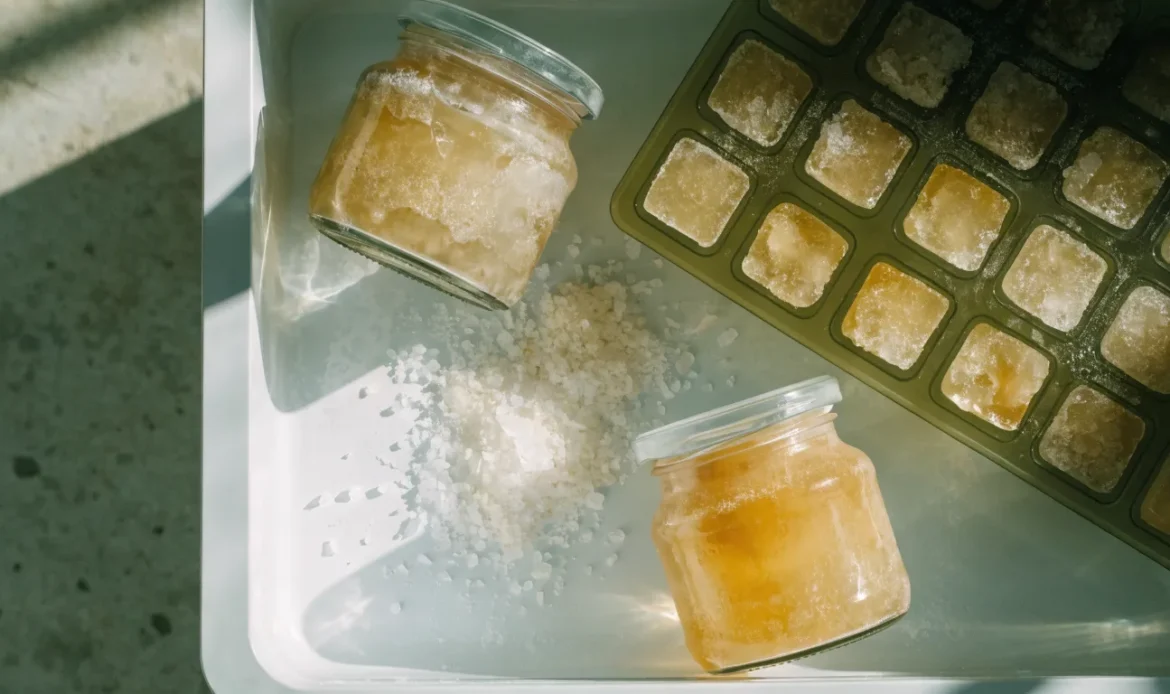
Short answer: How long sea moss lasts in the freezer depends on three things: the form (dry, raw whole, or gel), how clean and dry it was before freezing, and how well you package it. Freezing keeps sea moss safe for a long time, but quality (texture, taste, color) drops over time. Use the checklist below and the step-by-step instructions to get the best results.
Why the answer can’t be one exact number
Sea moss is a type of seaweed. Its makeup can vary a lot. That means water content, minerals like iodine, and texture change by batch and by source [1][2][3][5]. Freezing slows spoilage. But it does not stop chemical changes or loss of quality. Also, how you wash, prepare, and pack sea moss before freezing changes how long it keeps good eating or mixing quality.
We can offer cautious, practical guidance. But no freezer time rule fits every product or situation.
What affects how long sea moss will stay good in the freezer
- Form of the product:
- Dry sea moss (dried whole or chips) has low water content. It resists spoilage better than wet forms.
- Raw soaked sea moss holds water and is softer. It freezes differently.
- Sea moss gel has high water content and is more vulnerable to texture change.
- Cleanliness and handling:
- Proper rinsing and removing debris helps. If marine grit or organic material remains, it can speed quality loss.
- Packaging:
- Airtight, vacuum, or well-wrapped containers cut freezer burn and slow moisture loss.
- Freezer temperature and stability:
- A steady freezer at standard frozen temperatures will preserve quality better than a freezer that cycles or opens often.
- Additives or mix-ins:
- If the gel has citrus, milk, sweeteners, or other ingredients, those change how it freezes and thaws.
- Mineral content:
- Seaweed can contain high or variable levels of iodine and other minerals. Freezing does not remove these [1][2]. That matters for dosing but not for freezer life.
Note: Some sea moss is sold as a supplement form. If you use sea moss as a supplement, check label guidance and regulatory notes [4].
Practical quality guidelines (not a safety guarantee)
Below is a conservative quality guide. These are common-sense ranges to help you plan. They are not absolute rules. If the product had poor handling, it may fail sooner. If it was handled perfectly, quality may last longer.
| Sea moss form | Typical freezer quality guideline | Why this range |
|---|---|---|
| Dried (whole or chips) | Months to a year or more (quality may change) | Low moisture resists spoilage; watch for freezer odors and moisture entry. |
| Raw soaked (cleaned, drained) | A few months for best texture | Water expands when frozen; texture softens after thawing. |
| Sea moss gel (homemade) | 1–6 months for best texture and flavor (conservative) | Gel contains much water; texture and color change over time. |
Label these ranges as “quality guidance.” They help you avoid unpleasant texture or flavor. They don’t prove safety. If you see off smells, odd colors, or mold after thawing, discard.
Step-by-step: How to freeze sea moss the right way
Follow these steps to freeze sea moss with better results.
- Clean and inspect.
- Rinse well under cool water. Remove sand, shells, and visible debris.
- Cut away any dark or slimy patches.
- Prepare the form you will freeze.
- For dried: make sure it is fully dry before freezing. Moisture will form ice crystals.
- For raw soaked: drain well. Pat dry with paper towels to reduce surface water.
- For gel: blend and cool the gel fully before packaging.
- Choose packaging.
- Use airtight containers or freezer bags. Squeeze out air from bags before sealing.
- For gel, consider small portions so you only thaw what you need.
- For long storage, vacuum sealing reduces freezer burn.
- Label and date.
- Write the date you froze it and the form (raw, gel, dried).
- Freeze flat.
- Lay flat in the freezer so gel or raw pieces freeze evenly and stack easily.
- Maintain a stable freezer.
- Keep the freezer door closed as much as possible. Rapid temperature swings harm quality.
Thawing and using frozen sea moss
- Thaw in the refrigerator for best texture. Slow thawing keeps gel smoother.
- For gel: if it separates or looks watery after thawing, stir or gently re-blend. Texture may not fully recover.
- For raw soaked pieces: cook or blend as your recipe requires after thawing.
- For dried sea moss: you usually rehydrate before use. Freezing should not block this process.
Food-safety note: If thawed at room temperature for long periods, bacteria can grow. Thaw in the fridge or use from frozen in cooked recipes when possible.
Signs your frozen sea moss is past usable quality
Stop using and discard if you see any of the following after thawing:
- Mold (fuzzy growth of any color).
- Strong, unpleasant, or sour odor.
- Vivid color changes beyond normal (for example, bright or dark stains not present before freezing).
- Excessive freezer burn with off odors or very dry, brittle texture.
When in doubt, throw it out. It is the safest option.
Practical checklist: freeze-prep decision guide
Use this short checklist before you freeze sea moss.
- Is it clean and free of debris? Yes / No
- Is it dry enough for the form you plan to freeze? Yes / No
- Did you remove extra water for soaked forms? Yes / No
- Is it packed airtight or vacuum-sealed? Yes / No
- Did you label with date and form? Yes / No
- Will you freeze in small portions for one-time thawing? Yes / No
If you answered “No” to any of the first four items, fix that before freezing.
Quick recipe tips for frozen sea moss gel
- Freeze in ice cube trays for single-serve portions. Pop cubes into a freezer bag.
- Use frozen gel directly in smoothies or hot drinks (blend from frozen).
- For recipes needing smooth texture, re-blend after thawing.
What you can check but cannot prove from visual or smell checks
- You can check color, smell, and texture. These give strong clues about spoilage.
- You cannot tell by sight or smell whether mineral content (like iodine) changed. Freezing does not remove minerals [1][2].
- You cannot judge microbial counts or contamination without lab tests. If handling was poor, risk may exist even if it looks okay.
- If a label claims certain lab results, do not assume those results apply after home handling or freezing.
If you need certainty about safety or minerals, ask the supplier for lab reports or consult a lab. For supplement concerns, refer to advisories on commercial products [4].
Next questions to ask before you freeze
- What form do I plan to use most (gel, raw, dried)? Freeze in portions that match typical use.
- Was the sea moss inspected and cleaned properly before freezing?
- Does the product label include handling or storage instructions?
- Do you need lab information about minerals or contaminants? If so, request it from the supplier.
If you buy sea moss from a vendor, ask about their harvesting and drying practices. If you need large quantities for business, consider checking our wholesale options for consistent supply: [/wholesale/].
Conclusion
Freezing is a useful way to keep sea moss on hand. The main points to remember:
- Form, handling, and packaging matter more than a single “time” rule.
- Use airtight packaging, date everything, and portion gel to match use.
- Check thawed sea moss for mold, smell, or odd color. When in doubt, discard.
- Freezing does not remove minerals like iodine; that remains part of the product [1][2][5].
If you want more on storage best practices, see our storage guide [/learn/storage/]. To explore products we offer, visit [/shop/]. For general learning, check [/learn/]. Need help with a bulk order or product questions? Contact us at [/contact/] or visit our homepage [/].
Continue reading
Frequently asked questions
Can I freeze sea moss gel in glass jars?
Yes, if the jars are freezer-safe. Leave headspace for expansion. Tight lids help prevent freezer odors. If unsure, freeze in plastic or silicone containers.
Does freezing reduce iodine or other minerals?
Freezing preserves minerals. It does not remove iodine or significantly change total mineral content [1][2][5]. If you monitor iodine intake, freezing does not lower that content.
Is frozen sea moss safe to eat after several months?
Freezing slows spoilage, but you must judge safety after thawing by checking smell, mold, and color. If handling was poor before freezing, safety could be compromised. When in doubt, discard.
Can I refreeze thawed sea moss gel?
Refreezing may harm texture. For safety, refreeze only if it was thawed in the refrigerator and shows no signs of spoilage. Quality will likely degrade.
How should I store dried sea moss in the freezer?
Ensure it is fully dry and in an airtight container. Dried sea moss resists spoilage better due to low moisture. Keep away from strong-smelling foods.
Do store-bought sea moss supplements freeze the same way as fresh or homemade?
Commercial supplements may have different formulations. Follow the product label or supplier guidance. If label lacks instruction, contact the supplier or use airtight storage and date labeling.
References
- [1] Harvard T.H. Chan School of Public Health, “Seaweed.” https://nutritionsource.hsph.harvard.edu/seaweed/
- [2] Smyth PPA. “Iodine, Seaweed, and the Thyroid.” European Thyroid Journal, 2021. https://pmc.ncbi.nlm.nih.gov/articles/PMC8077470/
- [3] Food Standards Australia New Zealand, “Survey of iodine levels in seaweed and seaweed containing products,” updated 2025. https://www.foodstandards.gov.au/science-data/monitoring-safety/surveyofiodinelevels
- [4] Operation Supplement Safety, “Sea Moss in Dietary Supplements.” https://www.opss.org/article/sea-moss-dietary-supplements
- [5] Blikra MJ et al. “Consequences of acute and long-term excessive iodine intake: A literature review focusing on seaweed as a potential dietary iodine source.” 2024. https://doi.org/10.1111/1541-4337.70037