

Short answer: Sea moss contains iodine and other minerals that the thyroid uses. That makes it a food people consider for thyroid support. But evidence from medical studies is limited. Sea moss may help some people through its iodine. It can also supply too much iodine for others. Read the facts, the limits, and a clear safety checklist to help you decide what to do next.
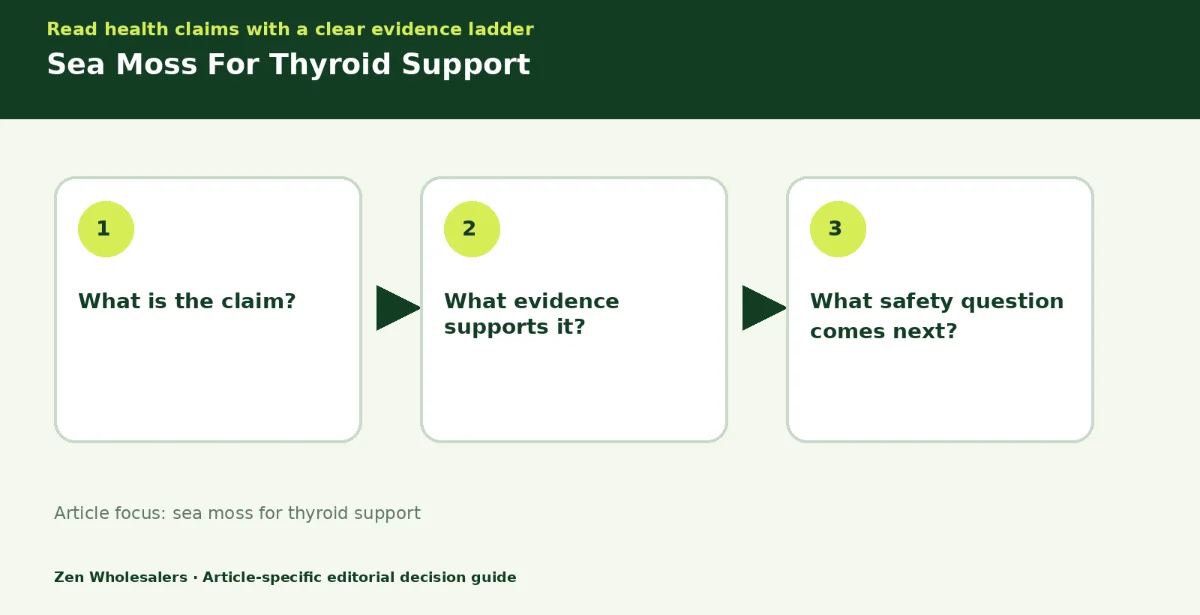
How this article is organized
- What sea moss is and what it contains
- How the thyroid uses iodine
- What research and food data say now
- Traditional use and why that matters
- Limits of current evidence
- Safety and when to ask a clinician
- A simple decision checklist you can use today
- FAQs, suggested visual, and sources
What is sea moss (and why people talk about it)
Sea moss is a type of red seaweed. People use it as food. It is eaten fresh, dried, or made into gels and supplements. Sea moss is one of many seaweeds that can carry iodine and other minerals. This makes it a food of interest for people thinking about thyroid health. [1]
What sea moss contains that matters to the thyroid
The thyroid gland needs iodine to make thyroid hormones. Seaweeds, including sea moss, can be a rich source of iodine. The exact amount of iodine in sea moss depends on the species, where it grew, and how it was processed. Some seaweed samples have low iodine; others have very high iodine. This wide range matters because both too little and too much iodine can affect the thyroid. [1][2]
Other nutrients in sea moss may include potassium, calcium, and small amounts of other minerals. These components matter for general nutrition but have limited direct proof linking them to thyroid hormone production. [1]
How the thyroid uses iodine — a short explanation
The thyroid uses iodine to make two main hormones: T4 (thyroxine) and T3 (triiodothyronine). The body gets iodine from food. If iodine is very low, the thyroid can’t make enough hormone. If iodine is very high, it can also disrupt normal thyroid function in some people. This balance is why any strong source of iodine should be used carefully. [2]
What the research says right now
- Food composition and surveys show that many seaweeds are high in iodine. This makes them a plausible dietary source of iodine. [1]
- There are reports and reviews that warn of thyroid problems after eating very high-iodine seaweeds or concentrated seaweed products. These reports include both short-term and long-term effects from high iodine intake. [5]
- Direct clinical trials testing sea moss specifically for thyroid disease are very limited or lacking. That means we do not have strong clinical proof that sea moss improves hypothyroidism or other thyroid conditions in people. It is more accurate to say sea moss provides nutrients the thyroid needs, and that some case reports and observational data raise safety concerns about high iodine exposure. [2][5]
In short: we have good data that seaweed can deliver iodine. We do not have strong clinical trials proving that sea moss treats thyroid disease. We do have reviews and case reports that high iodine from seaweed can cause problems for some people. [1][2][5]
Traditional use and food culture
People in coastal cultures have used seaweeds for food and medicine for centuries. Traditional use shows seaweed is a common part of diets in many places. That cultural context supports seaweed as a food source of iodine and minerals. Traditional use is valuable information. But tradition is not the same as clinical proof. Use tradition as context, not as final proof of medical benefit.
Clear limitations and uncertainty
- Limited clinical trials: There are few controlled studies testing sea moss for thyroid function. That means we cannot prove benefit or harm in a general way.
- Variability: Iodine levels in sea moss vary a lot. The same type of product can have different iodine concentrations from batch to batch. That makes it hard to predict how much iodine a person will consume. [1]
- Individual response: Some people tolerate extra iodine fine. Others — including those with autoimmune thyroid disease, prior thyroid surgery, or certain sensitivities — can react to changes in iodine intake. [2][5]
- Supplements: Sea moss sold as a supplement may have different processing, added ingredients, or labeling issues. Supplements are not always tested the same way foods are. That increases uncertainty about what is actually in the bottle. [4]
Because of these limits, the safest path is to treat sea moss as a nutrient-rich food that may affect iodine intake, rather than as a proven thyroid therapy.
Safety and when to ask a clinician
Do not use this article as medical advice for your own treatment. Below are safety points to help you decide when to stop and when to ask a clinician.
- Ask a clinician if you have a thyroid condition. If you have hypothyroidism, hyperthyroidism, autoimmune thyroid disease (like Hashimoto’s or Graves’), recent thyroid surgery, or take thyroid medication, talk to a clinician before adding sea moss regularly. Your thyroid status changes how your body responds to iodine. [2]
- Ask if you are pregnant, breastfeeding, or planning pregnancy. Pregnancy changes iodine needs and thyroid demands. A clinician can advise safe food choices and testing.
- Stop and check if you notice new symptoms after eating seaweed or a sea moss product. New fatigue, heart palpitations, unexplained weight change, tremor, or neck swelling should prompt medical review. Studies show that sudden large iodine exposures from seaweed can sometimes trigger thyroid problems. [5]
- Be cautious with concentrated products and high-dose supplements. Supplements or extracts can contain far more iodine than food servings. Labeling may be unclear. Many safety organizations advise caution with seaweed-based supplements for this reason. [4]
If you are unsure, a reasonable next step is a clinical check that can include a review of current thyroid tests (TSH, T4, T3, and antibodies) and a discussion of diet. A clinician can help you estimate total iodine intake from all sources.
Practical decision checklist: Should you try sea moss for thyroid support?
Use this short checklist to decide whether to try sea moss, adjust how you use it, or avoid it.
| Step | If YES — do this | If NO — do this |
|---|---|---|
| 1. Do you have a diagnosed thyroid condition or take thyroid meds? | Talk to your clinician before using sea moss. Do not change meds without medical advice. | You may proceed with general food caution below. |
| 2. Are you pregnant or breastfeeding? | Ask your clinician before regular use. | Continue to next step. |
| 3. Will you use a concentrated product or supplement (gel, capsule, tincture)? | Avoid until you have clinician approval and an idea of iodine content. | Fresh or culinary dried sea moss in small amounts is lower risk for many people. |
| 4. Can you get a lab test if needed? | If yes, plan baseline thyroid labs (TSH ± free T4/T3) before regular use. | If no, be more cautious with frequency and amount. |
| 5. Do you notice symptoms after trying sea moss once? | Stop use and consult a clinician for evaluation. | If no symptoms, continue cautiously and re-evaluate after weeks. |
This checklist is a guide. It does not replace medical advice.
How to check a product or food for iodine concerns
- Read labels. Some products list iodine. If iodine is not listed, ask the seller for lab results or a certificate of analysis.
- Prefer whole-food preparations (culinary sea moss) over concentrated extracts if you want to limit iodine spikes. Whole food is still variable, but extracts can concentrate iodine. [4]
- Buy from sellers who test their products and publish results. If lab data are not available, treat iodine content as unknown.
- Start small. Try a small amount once and watch for symptoms before using regularly. If you have a thyroid condition, check with a clinician before trying anything new. [4][5]
Evidence-strength ladder (plain words)
- Food composition data: Strong evidence that seaweeds can contain iodine. [1]
- Case reports and observational data: Moderate evidence that high iodine from seaweed can cause thyroid problems in some people. [5]
- Clinical trials of sea moss for treating thyroid disease: Very limited or absent. This is the main gap. [2]
This ladder shows we know the composition and risks better than we know clinical benefit.
Practical tips if you decide to use sea moss as food
- Treat it like any iodine-containing food. Balance it with other iodine sources in your diet.
- Avoid daily high amounts unless a clinician says it is safe.
- If you buy supplements, choose brands that publish third-party test results. Ask about iodine content. [4]
- Keep a food diary for a few weeks when you start. Note any changes in energy, weight, heart rate, or mood. Share this with your clinician if needed.
Conclusion — clear next steps
Sea moss is a food source of iodine and other minerals. That makes it relevant to thyroid health. But the science does not prove sea moss as a treatment for thyroid disease. There is stronger evidence that seaweed can deliver large amounts of iodine — and that too much iodine can harm some people. If you have a thyroid condition, take a cautious path: check with a clinician, consider baseline tests, and prefer products with transparent testing. If you are healthy and want to try culinary sea moss, use it in small, occasional amounts while watching for changes. For more general reading on seaweed nutrition and benefits, see our Learn pages and shop if you decide to try culinary products.
Helpful links:
- Learn more about benefits of seaweed and sea moss: /learn/benefits/
- Read general guides and education: /learn/
- Browse our culinary and wholesale options: /shop/ and /wholesale/
- Contact us with product questions and lab data requests: /contact/
- Back to home: /
Continue reading
Frequently asked questions
Will sea moss cure hypothyroidism?
No. There is no strong clinical proof that sea moss cures hypothyroidism. Sea moss is a food that may provide iodine. Iodine is one part of thyroid health, but disease causes and treatments are varied. Clinical care should come from a clinician. [2]
Is sea moss the same as other seaweed?
Sea moss is one type of seaweed. Different seaweeds have different iodine levels. The term “sea moss” can mean several species. That adds to variability in iodine content. [1]
Can too much sea moss cause thyroid problems?
Yes. Very high iodine intake from seaweed has been linked to thyroid dysfunction in some reports. People with certain thyroid conditions or sensitivities can be affected. If you are concerned, consult a clinician. [5]
Are sea moss supplements safe?
Supplements can vary. Some may concentrate iodine or contain unclear amounts. Choose products with transparent testing and talk to a clinician first, especially if you have thyroid issues. [4]
How can I know how much iodine is in a sea moss product?
The best way is to get lab results or a certificate of analysis from the seller. If the seller cannot provide testing data, treat iodine content as unknown and use caution. [4]
References
- [1] Harvard T.H. Chan School of Public Health, “Seaweed.” https://nutritionsource.hsph.harvard.edu/seaweed/
- [2] Smyth PPA. “Iodine, Seaweed, and the Thyroid.” European Thyroid Journal, 2021. https://pmc.ncbi.nlm.nih.gov/articles/PMC8077470/
- [4] Operation Supplement Safety, “Sea Moss in Dietary Supplements.” https://www.opss.org/article/sea-moss-dietary-supplements
- [5] Blikra MJ et al. “Consequences of acute and long-term excessive iodine intake: A literature review focusing on seaweed as a potential dietary iodine source.” 2024. https://doi.org/10.1111/1541-4337.70037