
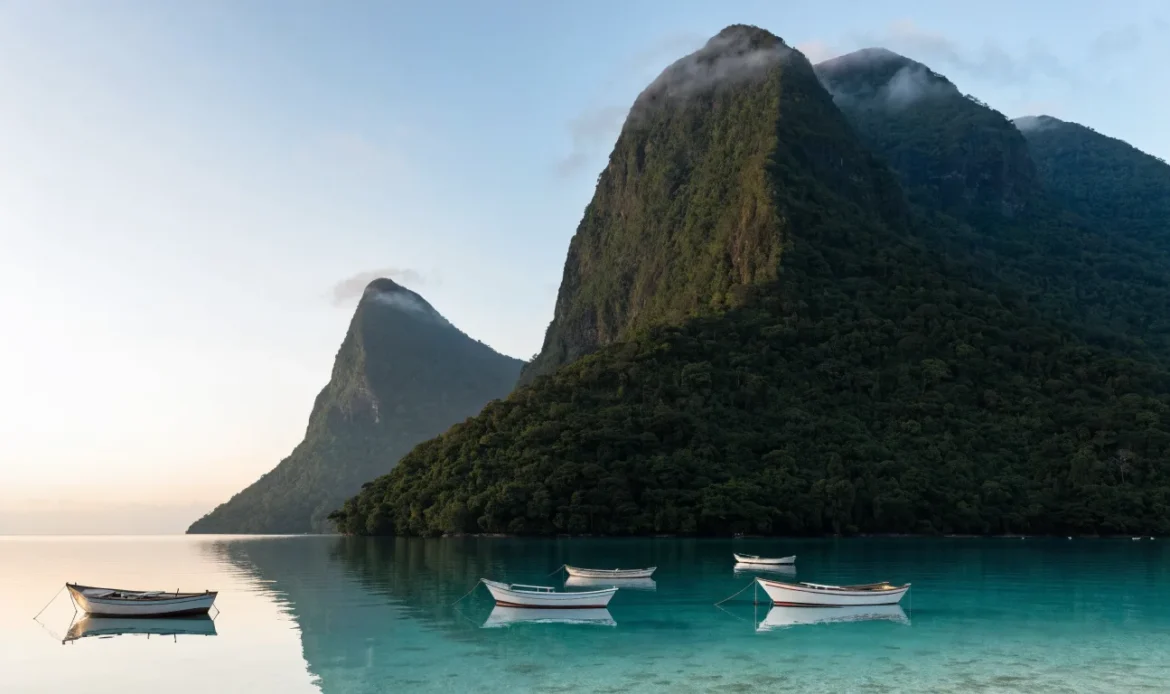
Saint Lucia appears on a great many sea moss labels, including from sellers who have never sourced anything there. The island has become shorthand for Caribbean authenticity in the way that Irish became shorthand for the species. Both words are now doing marketing work as often as descriptive work.
So: what Saint Lucian sea moss actually is, and what changes commercially when you buy at the origin.
What grows there
Eucheuma cottonii, also classified as Kappaphycus alvarezii — the thick, heavily branched warm-water species that makes up most of world supply. Not Chondrus crispus, the flat cold-water Atlantic species that the name Irish moss properly describes.
This matters when the same listing says both. “Wildcrafted Irish moss from Saint Lucia” names a North Atlantic species and a tropical island in one sentence. The species question in trade terms covers what to do about it.
It grows in gold, purple, green and mixed. The colours are pigment variation within the same species rather than different plants; what the colours actually mean goes through how they differ in the finished gel.
Why the west coast specifically
Saint Lucia’s two coasts are not equivalent. The Atlantic side is rough, exposed and swell-driven. The Caribbean side is calmer and deeper close inshore, which matters for three practical reasons:
- Lines survive. Growing lines in open water need conditions that do not destroy them every few weeks.
- Cutting is possible more days of the year. Harvest by hand from small boats requires water you can work in.
- Drying happens near the water. Shorter transit between cutting and drying means less time damp, which is the main driver of both spoilage and smell.
This is also why the season is real. Growth rates change through the year, storms interrupt cutting, and some months simply yield less. A supplier promising identical volume every month is not describing this coast.
What buying at the origin changes
Traceability you can substantiate
If your own label says Saint Lucia, you may eventually have to prove it. Buying from the island means the coast is a fact you can name rather than a claim inherited from an invoice. That matters more than it used to: origin claims on food packaging attract attention precisely because they are so often decorative.
Grades kept unblended
A consolidator serving many buyers blends lots to hold a standard. That is a service, not a fault — but it means gold is gold on average. If you need a single variety kept separate, that request has to reach the person doing the grading, which usually means buying closer to the source. Direct versus through a distributor covers the trade-off properly.
Season visibility
Buying at origin means you hear about a poor month before it becomes your stockout. Buying three links downstream means you hear about it when the price moves.
What it costs you
Honestly: speed and convenience. Stock on the water is weeks, not days. Small orders carry disproportionate freight. And if you import into the United States, the Foreign Supplier Verification Program puts hazard analysis, supplier evaluation, periodic verification and record-keeping on you as the importer rather than on a domestic distributor.
Buying at origin buys traceability and control. It costs speed, working capital and compliance overhead. Below a certain volume that trade is not worth making.
The paperwork, in plain terms
Importing dried sea moss into the US involves a short, specific list:
- HS/HTS 1212.21 — seaweeds and other algae, dried, fit for human consumption. The adjacent 1212.29 covers seaweed not fit for human consumption; the wrong code on an invoice creates problems at entry.
- FDA Food Facility Registration for the exporting facility, before first export, which requires a DUNS number.
- Prior Notice under 21 CFR Part 1 Subpart I before every shipment arrives at a US port.
- FSVP — yours, as importer.
None of it is exotic, and a supplier who has exported before will have the registration in place. A supplier who has not heard of Prior Notice is telling you how many US shipments they have actually made. More vetting questions.
What Saint Lucian origin does not tell you
Worth being direct, because the island is used as a proxy for quality it cannot guarantee:
- It does not tell you it grew in open water. Pools and tanks exist everywhere. Verify the growing method separately.
- It does not tell you it is clean. Two-phase cleaning is a process choice, not a geography. Rinse a sample and look for sand.
- It does not tell you the iodine or heavy metal load. Those come from a lot-matched Certificate of Analysis, and they vary between harvests from the same coast.
- It does not tell you it was dried properly. Under-dried moss packed warm is the single most common cause of a shipment arriving sour.
Origin narrows the field. Testing and inspection decide it.
Questions worth asking a Saint Lucian supplier
- Which coast, and is it line-grown in open water or gathered from natural substrate?
- How does the season run, and which months are short?
- Is the moss two-phase cleaned, and what does that remove?
- Sun-dried or machine-dried, and what moisture does it go into the bag at?
- Can I have a lot-matched COA with heavy metals and iodine?
- Are you the exporter of record, and is the facility FDA-registered?
Where we fit
We harvest on lines in open water off the west coast, cut by hand, sun-dry, and two-phase clean. We sell direct by the pound in gold, purple, green and mixed full-spectrum, on a quoted price rather than a list price.
That suits a buyer who wants the coast named and the variety kept unblended. It suits a buyer who needs 20 lb in their warehouse on Thursday considerably less, and we would rather say so.