
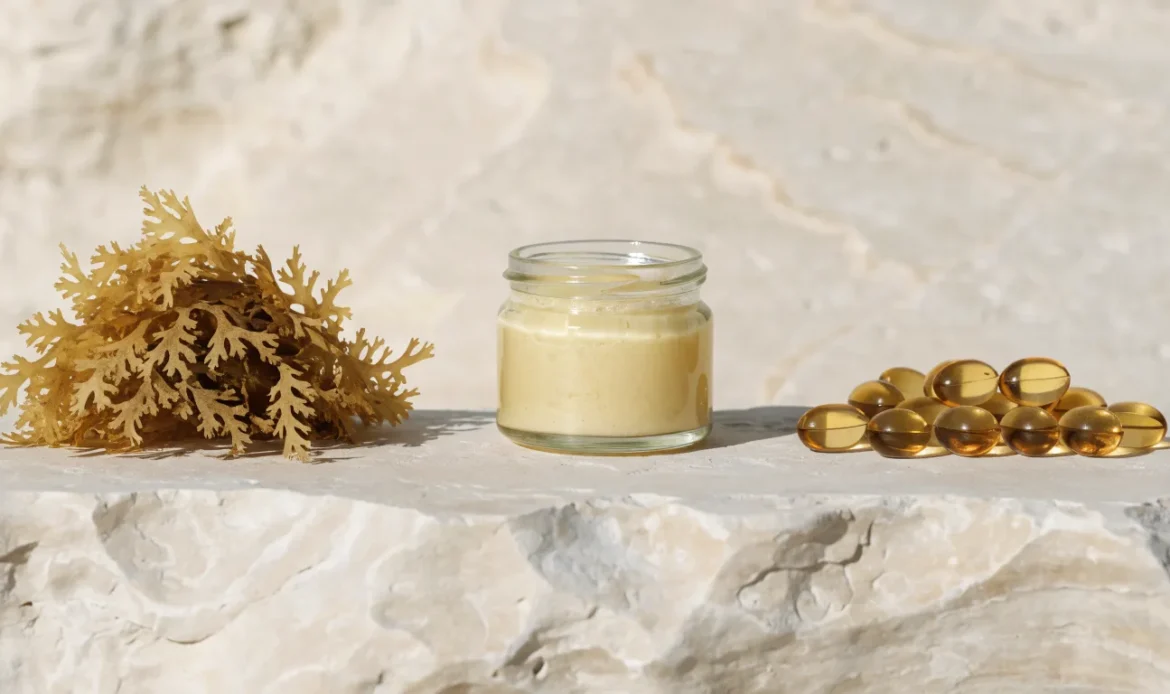
The sea moss supplement market is unusually easy to enter. The raw material is cheap, the processing is simple, and the claims mostly come pre-written from an existing folklore. The result is a shelf full of products that look identical and are not.
This is what actually separates them, in the order the questions matter.
1. Does it state the species?
There are two species in play. Eucheuma cottonii is the warm-water Caribbean and Indo-Pacific seaweed that makes up most of the market — thick, branched, gold or purple. Chondrus crispus is the cold-water Atlantic species that the name Irish moss properly refers to — flat and fan-shaped.
A label that names neither is telling you the seller either does not know or would rather you did not. A label saying “wildcrafted Irish moss from Saint Lucia” is worse, because those two claims contradict each other. The species comparison in full.
2. Does it state an origin you can picture?
“Ocean harvested” is not an origin. A country, a coast, ideally a named region is. Origin matters for two reasons: heavy metal load depends on water quality, and iodine content varies by species and location.
It also matters for a claim you will see everywhere — wildcrafted. Genuinely wildcrafted sea moss grows in open ocean. A lot of product described that way is grown in tanks or shallow pools, sometimes fed with salt and nutrients. The difference and how to spot it.
3. Does it state the iodine content?
This is the single most useful number on a sea moss label, and it is missing from the overwhelming majority of them.
Iodine is the reason to respect the dose. The adult Tolerable Upper Intake Level is 1,100 micrograms a day. A 2020 risk assessment analysing 30 red seaweed samples found Chondrus crispus averaging around 3.86 mg/kg dry weight, with a standard deviation of ±1.49 mg/kg — roughly 3 to 7 micrograms per gram of dried moss.
Read that standard deviation again. It is nearly 40% of the mean. That variation is why a brand that tests each lot and prints the number is offering something materially different from one that does not, even if the seaweed came off the same beach.
A sea moss product without a stated iodine content is asking you to dose a nutrient with a narrow safe range by guesswork.
4. Is there third-party heavy metal testing?
Seaweed absorbs what is in the water around it — arsenic, cadmium, lead, mercury. Research published in 2025 in the Journal of Agriculture and Food Research found seaweed consumption can lead to heavy metal accumulation with consequences including kidney dysfunction and neurological effects.
This is not a reason to avoid sea moss. It is a reason to buy from someone who tests. Ask for a certificate of analysis — per lot, dated, from an independent laboratory. A serious supplier has one ready. Note that a COA for one lot two years ago is not the same as ongoing testing.
5. What else is in it?
The most common addition is bladderwrack and burdock root, sold as the classic trio. That combination comes from Dr Sebi’s teaching rather than from trial evidence, and it has a practical consequence: bladderwrack is a brown seaweed and carries considerably more iodine than red sea moss. The blend is a meaningfully higher iodine dose, and almost none of them tell you by how much.
Also worth checking:
- Proprietary blends. If sea moss is one of sixteen ingredients in an undisclosed ratio, you cannot know what you are taking. There is usually very little of the headline ingredient.
- Added sugar in gels. Fruit purees are pleasant and they are sugar. A mango sea moss gel is partly a dessert.
- Fillers in capsules. Rice flour and magnesium stearate are ordinary manufacturing aids, but they should be declared.
- Preservatives in shelf-stable gel. Legitimate, but it means the product is not the raw fresh gel the photograph implies.
6. Does the marketing make claims the evidence cannot carry?
This is a proxy for everything else. A brand willing to print “92 of the 102 minerals your body needs” has told you it does not check its claims — the figure has no analytical basis and the body does not require 102 minerals. The full trace.
Same for detox claims, which have no mechanism and are close to backwards for a plant that accumulates metals. Same for cure-all framing. There are no large, well-designed human trials of sea moss for meaningful health outcomes; the entire human evidence base is two small trials of Chondrus crispus, each under 60 people and under 12 weeks, reporting modest effects on fasting glucose, stool frequency and antioxidant capacity.
A brand that describes those results accurately is more likely to have been careful with the things you cannot check. Every major claim graded.
Choosing a format
Match the format to what you actually want:
- Gel — best for soluble fibre and culinary use, which is where most of the evidence sits. Three to four weeks refrigerated. Full guide.
- Powder — same fibre as gel, two-year shelf life, you control the dose, usually cheapest per gram. The most underrated option.
- Capsules — best for consistency, travel and iodine specifically. Weak on fibre, since two capsules hold only 1 to 2 grams of dried seaweed. Capsules versus gel.
If iodine is genuinely the goal, a potassium iodide supplement gives you an exact dose for a fraction of the price. Sea moss makes sense when you want the fibre and the food, not when you want one isolated nutrient.
A short buying checklist
- Species named — Eucheuma cottonii or Chondrus crispus.
- Origin named — a country and coast, not “ocean harvested”.
- Iodine content stated per serving.
- Third-party heavy metal testing, per lot, available on request.
- No undisclosed proprietary blend.
- No 92-minerals claim, no detox claim, no cure-all framing.
Six checks. Most products on the market fail at least three of them, which makes the shortlist considerably shorter than the shelf suggests.