
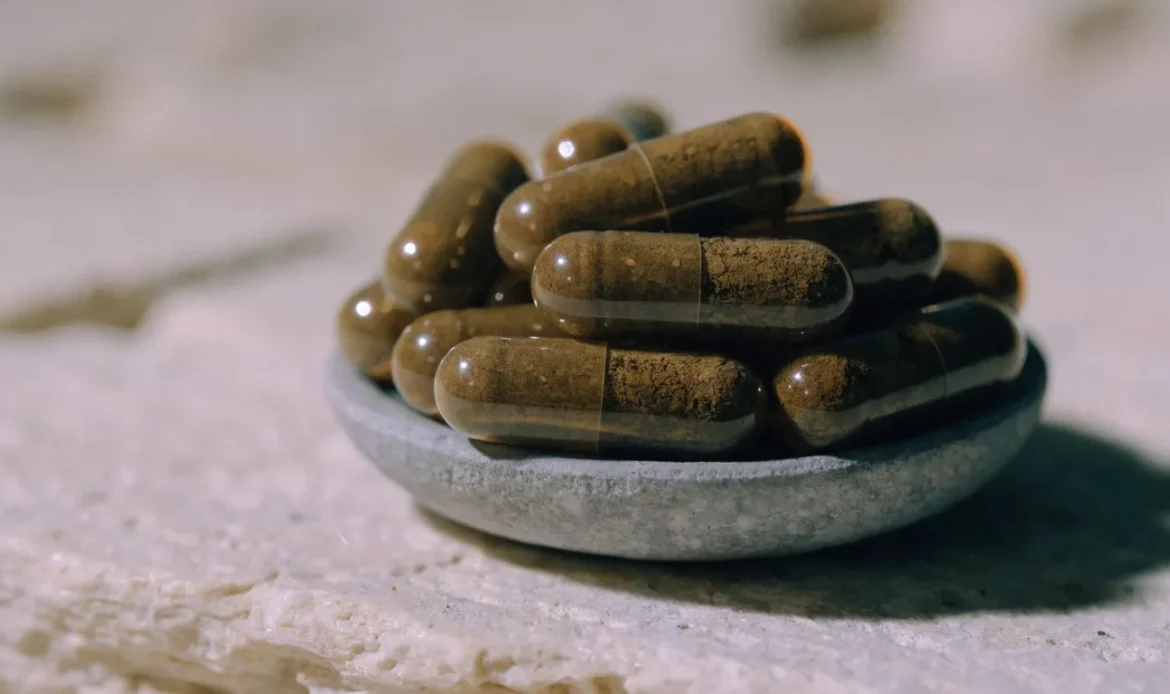
Sea moss pills solve two genuine problems with gel: gel has to be refrigerated and eaten within a month, and some people simply do not want seaweed in their smoothie. Capsules travel, keep for two years and taste of nothing.
What they cost you is less obvious, and it goes to the heart of what sea moss is actually good for.
What is inside a sea moss capsule
Dried sea moss, milled to powder, packed into a vegetable or gelatin shell. Some products use a concentrated extract instead; many blend in bladderwrack and burdock root, which is a Dr Sebi-derived combination rather than an evidence-based one. We look at that trio separately.
A typical capsule holds 500 mg to 1,200 mg of sea moss powder. Two capsules a day is a common label instruction, so roughly 1 to 2.4 grams of dried seaweed.
The trade-off: you lose the fibre
This is the part worth understanding, because it inverts the usual convenience argument.
The best-supported benefits of sea moss are the fibre ones. One of the two small human trials of Chondrus crispus reported improved stool frequency; the other found modest reductions in fasting glucose, most plausibly through soluble fibre slowing carbohydrate absorption. Both effects depend on getting a meaningful quantity of soluble fibre into your gut.
Two capsules deliver perhaps 1 to 2 grams of dried seaweed. Two tablespoons of gel deliver considerably more hydrated seaweed by volume. For fibre purposes, capsules are a fraction of the dose.
Capsules deliver the iodine efficiently and the fibre barely at all. Since the fibre is where most of the evidence sits, that is the wrong half to keep.
What capsules do deliver well is iodine, which is dense and survives milling intact. If your reason for taking sea moss is iodine, capsules are a sensible format — arguably a better one, because the dose per capsule is more consistent than a scoop of homemade gel.
Dose consistency cuts both ways
A capsule gives you the same amount every time, which matters because iodine has a narrow safe range. Published analysis of Chondrus crispus found roughly 3 to 7 micrograms of iodine per gram of dried seaweed, averaging around 3.86 mg/kg (±1.49) across 30 samples. The adult Tolerable Upper Intake Level is 1,100 micrograms a day.
Run the arithmetic on a typical two-capsule dose and you are well inside the limit. But note the standard deviation — batch variation is substantial, and a capsule label almost never states iodine content at all. You are trusting that the manufacturer tested, and most do not publish it.
- Look for a stated iodine content per serving. Its absence is the most common gap on a sea moss label.
- Look for third-party testing for heavy metals. Seaweed accumulates arsenic, cadmium, lead and mercury from its environment.
- Check the species and origin. “Wildcrafted Irish moss from the Caribbean” is two claims that contradict each other.
- Be wary of proprietary blends. If sea moss is one of sixteen ingredients in an undisclosed ratio, you do not know what you are taking.
Capsules versus gel versus powder
Capsules
Best for: travel, consistency, people who dislike the texture, iodine specifically. Shelf life around two years. Weakest for fibre. Most expensive per gram of actual seaweed.
Gel
Best for: fibre, culinary use, value. Three to four weeks refrigerated, three months frozen. Dose varies by how you make or scoop it. Full guide to sea moss gel.
Powder
The middle option, and underrated. Same fibre as gel, same shelf life as capsules, and you control the dose. Stirs into smoothies and baking; will not set a gel unless you hydrate it properly. Usually the cheapest per gram.
The best way to take sea moss compares all three against what you are actually trying to achieve.
Are sea moss pills effective?
Effective at what is the question the marketing avoids.
For iodine intake: yes, and more reliably than gel. For soluble fibre and the regularity and glucose effects that come with it: only weakly, because the dose is small. For the broader claims — immunity, energy, detox, weight loss, hair growth — no format is supported, because the claims themselves are not supported in humans. We go through those one by one.
There are no large, well-designed human trials of sea moss supplementation for meaningful health outcomes in any format. Two small trials of the whole seaweed is the entirety of the human evidence base. A capsule cannot outperform the evidence for the material inside it.
A reasonable way to decide
- If you want fibre and the digestive benefits, take gel or powder. Capsules are the wrong tool.
- If you want iodine, capsules are fine — but a standard potassium iodide supplement gives you a known dose for far less money.
- If you want convenience and will not keep up with gel, capsules you actually take beat gel that spoils in the fridge.
- Whatever you choose, buy tested product. Iodine and heavy metals, per lot, with a certificate you can read.
And if a label promises 92 minerals, treat that as information about the manufacturer rather than the product. The claim has no analytical basis.