
Short answer: Wild harvested sea moss means the seaweed was taken from natural shore or ocean areas rather than grown on a farm. To shop smart, ask for the species name, harvest date and place, how it was handled after harvest, and any lab or permit documents. Those items help you judge quality and risk. They do not prove everything, but they do give useful clues.
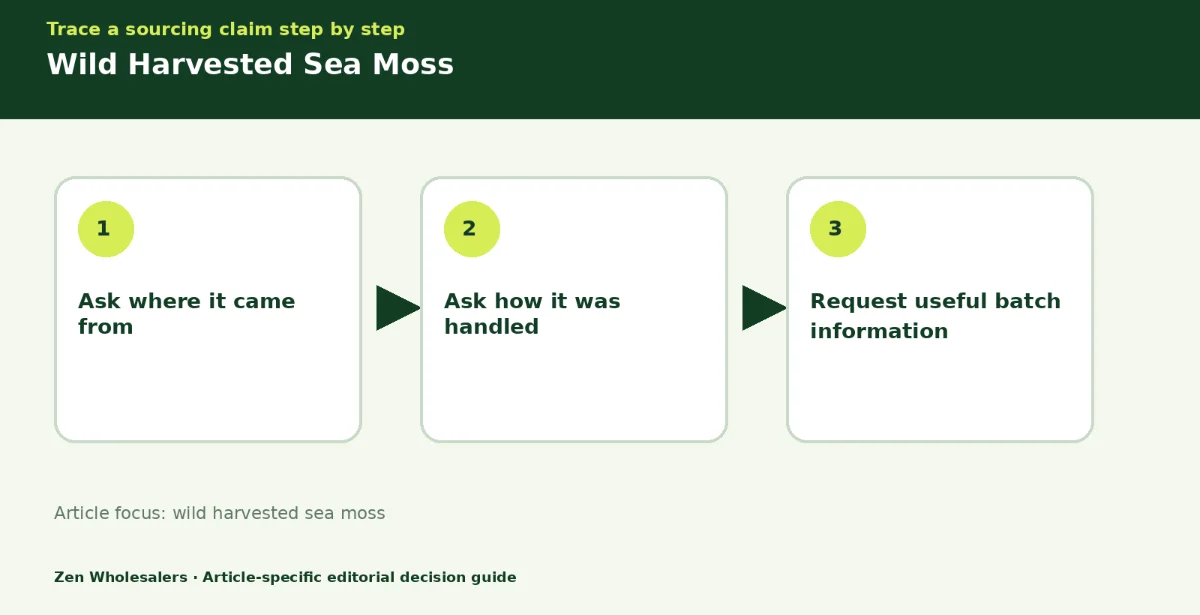
Why this matters: wild sea moss is variable. It can look different from batch to batch. It may have more or less natural debris. It may come from places with different water conditions. Knowing what to check helps you choose a product that fits your needs and comfort level.
This guide tells you what to ask, what documents to expect, how to read those documents, and what they can and cannot prove. It also gives a one-page decision checklist you can print and use when you buy. If you want to learn about how we source at our farm, visit /our-farm/ for our local approach.
How “wild harvested” is used and what it can mean
“Wild harvested” or “wildcrafted” simply means the sea moss was collected from a natural setting. That can be on rocks at low tide, on reefs, or by divers. It does not automatically mean the product is safer, purer, or more potent. It only says where the seaweed started.
What wild harvest does tell you:
- The sea moss was not grown on a rope or sea farm.
- The product may show more natural variety in color, texture, and size.
- Harvest dates and locations can be more important for safety and traceability.
What wild harvest does not prove:
- That the water was clean or polluted.
- That the product meets any specific safety standard.
- That the species is correctly identified.
To reduce risk, buyers should ask for clear information about species, location, handling, and tests. Later sections explain how to check each of those things.
Key things to verify about origin and species
- Species name
- Ask for the scientific name (for example, Chondrus crispus or Gracilaria spp.). Common names vary by place.
- Why it matters: different species look alike but can behave differently in processing. Species names help match your expectations for texture and use.
- What a vendor can show: photos, a species ID from a trained harvester or botanist, or a lab report using microscopy or DNA tests. These items help but need context. Photos alone can be misleading.
- Harvest location
- Ask for the place where the sea moss was collected. A general region is common. Some suppliers can provide GPS coordinates, a harbor, or the nearest town.
- Why it matters: location gives clues about local water quality, tides, and nearby industries. It also helps with traceability.
- What a vendor can show: landing logs, harvest reports, or a written origin statement. These help trace a batch but do not prove the entire area is free from contamination.
- Harvest date and batch number
- Ask when the sea moss was taken.
- Why it matters: fresh wild sea moss may be processed sooner and handled differently than older batches.
- What a vendor can show: batch IDs, harvest dates on labels, or processing logs. These provide traceable links between harvest and sale.
- Method of harvest
- Ask whether the moss was hand-picked by divers, gathered during low tide, or collected by mechanical means.
- Why it matters: hand-harvested moss may have less damage and fewer contaminants. Mechanical harvest can pull up more sediment or other species.
- What a vendor can show: a description of the harvest practice and photos or short videos from the field.
- Handling after harvest
- Ask how sea moss was cleaned, stored, and transported.
- Key handling steps: rinsing in clean water, sorting, drying or refrigeration, and packaging.
- What a vendor can show: handling SOPs (standard operating procedures), photos, or a processing timeline. Labels that say “sun-dried” or “air-dried” should come with more detail on how the product was treated.
- Permits and local rules
- Wild harvesting often needs permits or must follow local quotas.
- Ask whether harvesters follow local rules and can show permits or community agreements.
- What a vendor can show: copies or references to permits, or a statement about following local management plans.
Handling, processing, and storage: what to check
After harvest, how sea moss is handled matters for safety and quality.
- Rinsing and cleaning: Good handling includes rinsing to remove sand, shells, and small organisms. Ask what water was used and how many rinses were done.
- Drying or refrigeration: Sea moss is either dried for storage or kept chilled to be sold fresh. Ask for the drying method and temperature controls. Drying time and conditions affect texture and shelf stability.
- Storage time: How long was the product stored before sale? Ask for the date it left the processing site.
- Cross-contamination controls: If the same facility handles other seafood or products, ask how cross-contact is avoided.
- Packaging and labeling: Look for batch numbers, harvest date, and a place of origin on the label. These items help if you need to follow up.
What these documents can show and cannot prove:
- A processing log can show what steps were taken and when. It cannot, by itself, prove absence of contaminants.
- Test results (see next section) can detect some contaminants for a batch. They cannot guarantee future batches are the same unless testing is routine.
Tests and documentation to request
No single document proves a product is completely safe. But a set of documents gives a clearer picture.
Useful documents to request:
- Species identification: a written ID with the scientific name. Photos or a lab ID add support.
- Harvest records: date, general place, and batch number.
- Handling records: cleaning, drying, cold storage notes.
- Permits or harvest agreements: a copy or a reference to local rules.
- Lab test reports: look for tests on heavy metals, microbial counts, and iodine if available. Ask for the lab name, test date, and batch number the test covers.
- Certificates of analysis (CoA): some suppliers provide CoAs from third-party labs. These are helpful when they match a batch number.
What a test can and cannot show:
- Lab tests can measure levels of certain chemicals or microbes in a sample. They show results for that sample and that time.
- Tests do not prove ongoing safety unless testing is repeated across batches.
- Labs have methods that differ. Ask which method was used and whether the result applies to your batch.
Regulatory note: consumer guidance on seaweed and supplements highlights that seaweed can be a source of iodine and other elements. If you use sea moss in a supplement or food, check local rules and consider sharing test results with buyers [1][2][4][5].
Safety signals and red flags
Ask these questions. If the answer is uncertain, pause before you buy.
Red flags:
- No species name or only a vague common name.
- No harvest date or batch number.
- No details on cleaning or storage.
- The supplier cannot show any lab tests or third-party checks after request.
- Claims that the sea moss is “pure” or “detoxifying” without supporting test data.
- No permit or local compliance information where required.
Positive signals:
- Clear species ID with scientific name.
- Batch labels and harvest dates.
- Third-party lab test reports that match the batch.
- Transparent photos or videos of harvest and processing.
- Willingness to answer follow-up questions and to provide documents.
Decision guide: How to choose wild harvested sea moss (printable checklist)
Use this checklist when you contact a supplier or inspect a product. Mark Yes, No, or Ask for each item.
- Species and ID
- Scientific name given? Yes / No / Ask
- Photos or lab ID available? Yes / No / Ask
- Origin and harvest
- Region or general harvest site provided? Yes / No / Ask
- Harvest date provided? Yes / No / Ask
- Batch number provided? Yes / No / Ask
- Harvest method described (hand, dive, rake)? Yes / No / Ask
- Handling and storage
- Cleaning steps explained? Yes / No / Ask
- Drying or chilling method described? Yes / No / Ask
- Storage time and conditions provided? Yes / No / Ask
- Document checks
- Permits or local compliance info available? Yes / No / Ask
- Third-party lab tests for heavy metals available? Yes / No / Ask
- Tests for microbial contamination available? Yes / No / Ask
- Iodine levels or screening available? Yes / No / Ask
- Certificate of Analysis tied to batch? Yes / No / Ask
- Transparency and traceability
- Supplier gives contact info to follow up? Yes / No / Ask
- Photos or video of harvest/processing available? Yes / No / Ask
How to use the results:
- If many items are Yes: you have better traceability and can feel more confident asking follow-up questions.
- If many items are No or Ask: ask the supplier for more detail. Consider a different source if transparency is low.
- If tests are provided: check whether the test matches the batch and ask which lab performed it.
How to read a lab report (simple points)
If a supplier gives a lab report, look for:
- The lab name and contact info. Reputable third-party labs list these details.
- The sample ID and batch number. This ties the test to the product.
- Test date. This shows when the sample was tested.
- Analytes tested. Common items: heavy metals (lead, mercury), microbial counts, and sometimes iodine. The list should match your concerns.
- Units and methods. Units tell you how results are measured. The method section tells you how the test was done.
- Signature or stamp. Many labs include a sign-off.
What lab reports cannot do:
- A single test cannot guarantee all future batches are the same.
- A lab report does not replace good harvest and handling practices.
- Different labs or methods can give different results. Ask for clarity if unsure.
Wild harvested vs farmed: what changes for the buyer?
Wild harvested sea moss:
- Pros: natural variety; may be collected where you prefer; may suit some traditional uses.
- Cons: more batch-to-batch variation; less control over water conditions; traceability can be harder.
Farmed sea moss:
- Pros: growing conditions are controlled; harvests may be more consistent; farms often have routine testing.
- Cons: farming methods vary and can have their own risks.
Neither option is automatically better. Your choice should depend on the supplier’s transparency, the documentation they can provide, and your own comfort level with variability. If you want to learn more about farming methods, visit /learn/ for general background on aquaculture.
Questions to ask a supplier in one minute
- What species is this? (Scientific name.)
- When and where was it harvested? (Batch number and harvest date.)
- How was it cleaned and stored after harvest?
- Do you have any lab test results for this batch?
- Can I see photos or video of the harvest and processing?
- Do you follow local harvest rules or have permits?
If the supplier is hesitant to answer, ask why. Transparency is a good sign.
When to ask for a third-party test
Consider asking for a third-party lab test when:
- You plan to use the sea moss in a product you will sell.
- You have specific health concerns (for example, if you must limit iodine).
- The supplier cannot provide clear handling details or harvest dates.
- You want confirmation for a high-volume purchase.
A third-party lab test is not always needed for small personal purchases. It is more common for wholesale or commercial buyers. If you need lab help, some labs offer single-batch testing.
Practical buying steps for small buyers
- Read the label carefully. Look for species, origin, and batch info.
- Use the one-minute questions above when you contact the seller.
- Ask for photos of the product and the harvest area if you can.
- If the product will be consumed by people with health conditions, discuss iodine and other risks with a healthcare provider. Seaweed can contain iodine [2][5]; tests can clarify levels.
- Keep the packaging and batch info for your records.
Practical buying steps for wholesale buyers
- Require a supplier to provide batch-linked test results for heavy metals and microbes.
- Ask for clear species ID and harvest documentation.
- Visit the harvest area or arrange a video call of the harvest and processing if possible.
- Include traceability steps in your purchase contract (batch numbers, test results).
- Require notification procedures if test results change or a recall is needed.
- Consider routine spot testing at an independent lab.
If you want to learn about our wholesale options, visit /wholesale/ or contact us at /contact/.
Conclusion
Wild harvested sea moss is a real option for buyers. It offers natural variety and a link to the ocean. But it also brings more variability and a need for careful checks. Before you buy, ask for the species name, harvest date and place, handling details, and batch-linked lab tests if possible. Use the checklist in this article when you talk with suppliers. These steps will help you make a clearer choice.
If you want to read about how we manage our sourcing or learn about our products, visit /our-farm/, explore product basics at /learn/, or browse items at /shop/. For wholesale inquiries, see /wholesale/ or reach out via /contact/. For general site home, go to /.
Continue reading
Frequently asked questions
Does “wild harvested” mean the sea moss is safer than farmed?
Not always. “Wild harvested” only says it came from a natural area. Safety depends on water quality, handling, and testing. Ask for harvest details and test reports.
What is the most important document to ask for?
For many buyers, a batch-linked lab report and a clear species ID are most useful. Harvest records and handling notes add context.
Can I rely on photos to prove origin?
Photos help, but they can be staged or not show the full picture. Use photos along with harvest records, batch numbers, and tests.
Should I worry about iodine in sea moss?
Seaweed, including sea moss, can be a source of iodine. If you have thyroid issues or are on iodine-restricted diets, talk to a healthcare provider. Lab tests can show iodine for a batch, but testing is not always provided [2][5].
What if a supplier refuses to share lab reports?
Ask why the report is not available. If a supplier refuses to be transparent, consider a different source. Transparency is important for traceability.
Where can I learn more about seaweed and safety?
Good starting points are public health and food safety sites. For general information on seaweed and nutrition, see Harvard’s Seaweed information [1]. For regulatory and supplement context, see Operation Supplement Safety [4].
References
- Harvard T.H. Chan School of Public Health, “Seaweed.” https://nutritionsource.hsph.harvard.edu/seaweed/
- Smyth PPA. “Iodine, Seaweed, and the Thyroid.” European Thyroid Journal, 2021. https://pmc.ncbi.nlm.nih.gov/articles/PMC8077470/
- Food Standards Australia New Zealand, “Survey of iodine levels in seaweed and seaweed containing products,” updated 2025. https://www.foodstandards.gov.au/science-data/monitoring-safety/surveyofiodinelevels
- Operation Supplement Safety, “Sea Moss in Dietary Supplements.” https://www.opss.org/article/sea-moss-dietary-supplements
- Blikra MJ et al. “Consequences of acute and long-term excessive iodine intake: A literature review focusing on seaweed as a potential dietary iodine source.” 2024. https://doi.org/10.1111/1541-4337.70037