
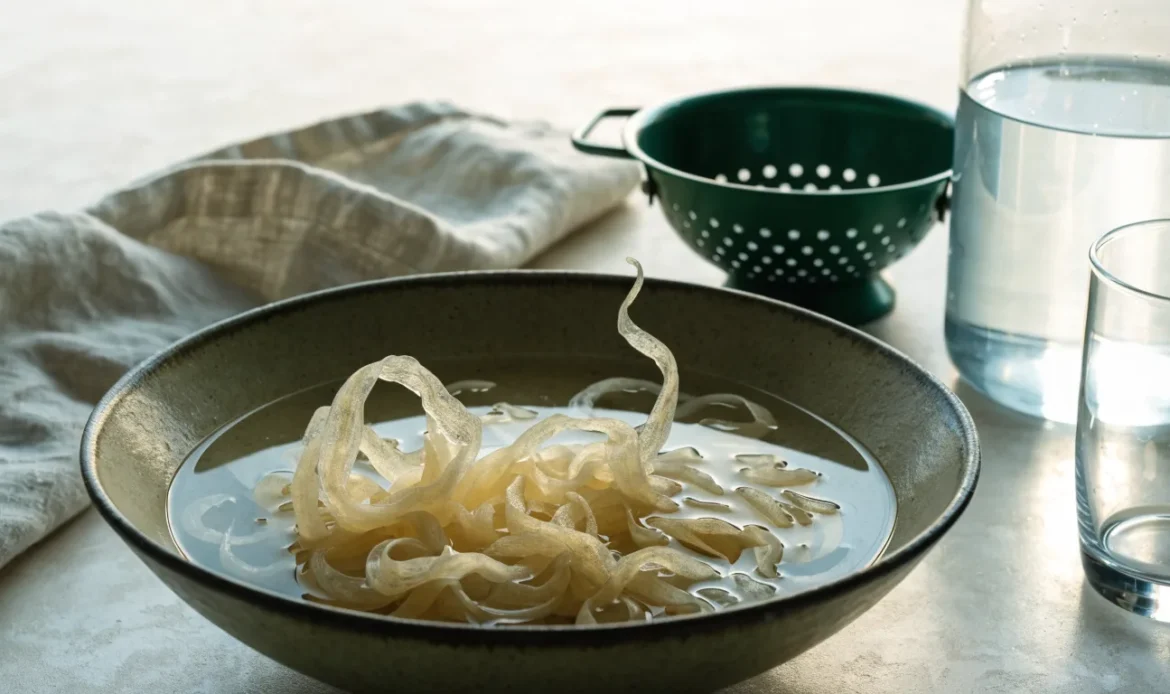
Short answer: Soaking sea moss means putting dried sea moss into clean water to rehydrate it, remove salt and debris, and soften it for blending or cooking. You rinse first, soak until the pieces are soft and expanded, change the water if needed, then use or store the rehydrated moss.
This short answer helps you decide what to do next. Below you will find clear steps, what to check, how long people commonly soak sea moss, what the limits of our knowledge are, and a practical decision checklist to choose a soak method for your plans.
What “soaking sea moss” means
Soaking sea moss is a simple kitchen step. It turns dried sea moss back into a soft, flexible form. Dried sea moss is hard, salty, and compact. Soaked sea moss is soft and can be cut, blended, or cooked. People commonly soak sea moss before making a gel, adding it to smoothies, or using it in recipes.
Soaking is not a food test. It does not prove safety by itself. Soaking helps clean the product, but it cannot remove all contaminants, heavy metals, or too much iodine. Those risks come from where and how the sea moss was harvested and processed. You can ask sellers for lab reports or sourcing details, but soaking alone does not replace testing.
Why you soak sea moss
- To rehydrate and soften the dried pieces.
- To loosen sand, grit, and small bits of debris.
- To reduce surface salt and old ocean smell.
- To make it easy to blend into a gel or add to recipes.
- To inspect the moss for color, odd smell, or visible issues before use.
Soaking is a preparation step. It makes sea moss usable. It also gives you a chance to check the product and decide if you trust it.
What soaking can and can’t do
What soaking can do:
- Make the sea moss soft and easier to chop or blend.
- Remove loose sand and floating bits.
- Reduce some surface salt and debris.
What soaking can’t do:
- Prove the product is free of heavy metals, bacteria, or chemical contaminants.
- Remove naturally high iodine from some seaweeds.
- Replace proper lab testing or supplier transparency.
If you are concerned about contaminants or iodine, ask the seller for third-party lab test results. That is the only reliable way to check levels of iodine, heavy metals, or microbes in a product.
(For more on seaweed as a dietary source of iodine and related cautions, see sources in References [1], [2], [3], and [5].)
How long to soak sea moss (common practice and why it varies)
Soak time varies with:
- Whether the moss is fully dried, partly dried, or fresh.
- The thickness and size of pieces.
- The water temperature.
- Whether you plan to make a gel or cook it.
Common practice ranges:
- Short soak (4–6 hours): Used when pieces are thin, or if you plan to cook them right away.
- Typical soak (8–24 hours): Often used for most dried sea moss to fully rehydrate and expand.
- Long soak (24+ hours): Sometimes used for very dense pieces or to make a softer, silkier gel. If soaking this long, check the water and smell every few hours and refrigerate after a long soak.
Note: These are common ranges people use in kitchens. They are not a safety guarantee. Use your senses and good judgment. If the moss smells bad, looks discolored in an unusual way, or has visible mold, discard it.
Step-by-step: How to soak sea moss
- Start with clean hands and a clean bowl or jar.
- Inspect the dried sea moss pieces. Remove any large bits of shell, plant matter, or foreign items.
- Rinse briefly under cool, running potable water to loosen surface salt and grit.
- Place the sea moss in a clean bowl or jar.
- Cover with filtered or tap water that is safe to drink. Use enough water so the moss can expand freely.
- Let it sit at room temperature or in the fridge depending on how long you plan to soak.
- Check and change the water if it becomes cloudy or very salty. If you see sand or small particles, rinse gently and refresh the water.
- When the moss is soft, plump, and flexible, drain and lightly rinse again.
- Use immediately to blend into a gel, cook into a dish, or store in the fridge for short-term use.
Keep the tool and container clean. Use potable (drinkable) water. If you will soak for longer than about a day, refrigeration is commonly used to slow bacterial growth.
Tips on water and additives
- Use clean, drinkable water. Filtered water is a good choice for taste.
- Some people add a splash of lime, lemon, or apple cider vinegar to the soak water to help remove odors and loosen barnacles. This can help smell but is optional.
- Avoid using hot water for initial soaking. Hot water can make texture changes too fast and may impact flavor.
- Do not use bleach or strong chemicals to clean food-grade sea moss.
If you have questions about sanitation, consult a food safety resource.
How to tell when sea moss is ready
- Texture: The pieces are soft and bend without snapping.
- Size: The sea moss has expanded and looks plump.
- Color: Color may deepen slightly, but large dark stains or odd colors may be a warning.
- Smell: A mild ocean smell is normal. A sour, rotten, or sharp off-odor is a sign to discard.
- Debris: After draining, little to no sand or floating particles should remain.
If any sign is off, do not use the sea moss. A mild sea smell is normal; strong bad smells or visible mold are not.
Common mistakes and how to avoid them
- Mistake: Using unclean water or dirty containers.
- Fix: Wash hands and use clean bowls, jars, and utensils.
- Mistake: Soaking too briefly and then trying to blend.
- Fix: Wait until the moss is soft. Tiny hard bits can damage blenders.
- Mistake: Leaving sea moss at warm room temperature too long.
- Fix: Refrigerate if soaking more than a day.
- Mistake: Ignoring smell or visible signs.
- Fix: Inspect and discard anything that smells bad or has mold.
- Mistake: Assuming soaking removes all impurities.
- Fix: Ask for test results or buy from a seller who provides lab reports.
Recipes and next steps after soaking
- Gel: Blend soaked sea moss with fresh water until smooth. Gel sets in the fridge and can be used as a thickener.
- Blends: Add soaked sea moss directly into smoothies. Blend well for a smooth texture.
- Cooking: Add soaked sea moss into soups, stews, or desserts where it will break down with heat.
- Drying again: You can re-dry soaked sea moss if you need to store it longer, but this is less common at home.
Which step you take depends on your plan. If you want gel, aim for a silky blend with little water. If you want to cook, leave it slightly chunkier if that suits your recipe.
Decision checklist: Should you soak and how?
Use this checklist to pick a soak method that fits your needs.
- What form did you buy?
- If dried strips or clumps: Soak.
- If already gelled or powdered: No soaking needed.
- What will you make?
- Gel for later use: Soak 8–24 hours, blend into a smooth gel.
- Smoothies or cold blends: Soak until soft (4–24 hours), then blend.
- Hot recipes (soup, stew): Soak to soften; cooking will further break it down.
- How much time do you have?
- Quick option (same day): Rinse, then soak at least 4–6 hours (check texture).
- Overnight option: Soak 8–24 hours at room temp or in the fridge.
- How to handle water?
- Use potable water. Change water if it gets cloudy or very salty.
- How will you store after soaking?
- Use immediately, or make gel and store in the fridge for short-term use.
- Safety checks:
- Does it smell normal? (Mild ocean scent = okay.)
- Any visible mold or unusual color? (If yes, discard.)
- Seller provided lab tests or clear supply info? (If not, ask.)
This checklist helps you match a soak method to your plan and time. It also helps you check safety and trust.
Practical table: Soak length guide by plan (common ranges)
| Plan | Typical soak time (common practice) | Notes |
|---|---|---|
| Quick blend or small pieces | 4–6 hours | Use thin pieces; check texture before blending |
| Overnight gel or general use | 8–24 hours | Common for most dried sea moss; yields soft pieces |
| Very dense pieces or softer gel | 24+ hours (monitor) | Refrigerate if over 24 hours; change water if needed |
| If already gel or powder | 0 hours | No soaking needed; use directly |
These are common practice ranges used in kitchens. They are not safety guarantees. Soak until the texture works for your plan.
What to check from the seller before you buy
Before buying dried sea moss online or in person, ask the seller:
- Where was the sea moss harvested? (Region and general description.)
- How was it cleaned and processed? (Sun-dried, washed, hand-cleaned?)
- Are there third-party lab test results for contaminants, microbes, or iodine levels?
- How should it be stored and used?
A seller who can share clear answers or lab reports gives you better information to judge product safety. If a seller cannot provide basic sourcing or testing details, consider another source.
What we know about iodine and seaweed (what to check)
Seaweed can be a high source of iodine. Iodine affects thyroid function in sensitive people. If you have thyroid concerns or take iodine-sensitive medication, ask a health professional about seaweed in your diet. Soaking does not remove iodine to safe or reliable levels. For more detail on iodine and seaweed, see References [1], [2], [3], and [5].
Storage after soaking
- Short term: Keep in the fridge and use within a few days. Exact safe time depends on handling and local food safety guidelines.
- Longer term: Blend into a gel and store in sealed containers in the fridge. Some people freeze gel portions for longer storage.
- Follow food safety best practices: keep cold, use clean containers, and discard if off-smelling.
If in doubt, throw it out. Food safety should come first.
When not to use soaked sea moss
- If it smells sour, rotten, or otherwise off.
- If you see visible mold or strange discoloration.
- If you have reason to suspect contamination from an unreliable source and no test results.
- If you must avoid iodine and the product has uncertain iodine levels.
Soaking and rinsing are helpful, but they do not make an unsafe product safe.
Links to other useful guides and pages
- Learn more about sea moss basics at our Learn hub: /learn/.
- Browse product formats if you want ready-made gel or dried options: Shop.
- Learn about bulk options and wholesale programs: Wholesale.
- Have questions or need help before buying? Contact our team: Contact.
- Return to our main site homepage: Home.
If you want more detail on how to turn soaked moss into gel or recipes, a detailed how-to is in our Learn (/learn/) section.
Final notes and sensible next questions
Soaking sea moss is a simple and useful kitchen step. It makes dried moss soft and usable. It helps with cleaning, but it does not guarantee safety from contaminants or high iodine. The next useful question is: “Does my seller provide third-party lab tests for contaminants and iodine?” If they do, review them or ask for clarification. If not, consider buying from a seller who shares test results or speaks clearly about sourcing.
If you want hands-on help choosing a form (dried, gel, powder) for your needs, use the decision checklist above and visit our product pages or wholesale program to learn format differences: Shop (/shop/) and Wholesale (/wholesale/). For more background on seaweed safety and iodine, see References below.
Conclusion
Soaking sea moss rehydrates, softens, and helps clean the product. Use clean water, inspect the moss during the soak, and follow the checklist to pick a soak length that fits your recipe and timeline. Remember that soaking is not a substitute for testing or clear supplier information. Ask sellers for lab results if you have safety or dietary concerns. For next steps, consult our learn pages or product listings to choose the best form for your needs: Home (/), /learn/ (/learn/), /shop/ (/shop/), /wholesale/ (/wholesale/), /contact/ (/contact/).
Frequently asked questions
Do I need to soak sea moss before blending?
Yes. Dried sea moss is hard. Soaking softens it so blenders can break it down smoothly. If you try to blend dry moss, you can harm the blender and get a gritty texture.
Can I soak sea moss in the fridge?
Yes. If you plan to soak for more than about a day, many people refrigerate the bowl or jar to slow bacterial growth. Check the product for smell and clarity of the water as you soak.
Will soaking remove iodine?
Soaking can reduce surface salt and some materials, but it does not reliably remove iodine inside the seaweed. If you need to manage iodine intake, ask the seller for lab tests or speak with a health professional. See References [2] and [5].
How do I clean gritty bits from sea moss?
Rinse under cool running water, then soak. Change the water if it becomes sandy. Inspect by hand and pick out shell bits before blending.
Can I soak powdered sea moss?
Powdered sea moss is typically meant to be mixed directly. It usually does not need soaking. Check product instructions.
How long can I keep soaked sea moss in the fridge?
Safe fridge storage depends on many factors including cleanliness, initial quality, and temperature. Use it within a few days or convert to gel and keep in sealed jars. If it smells off or shows mold, discard it.
References
- Harvard T.H. Chan School of Public Health, “Seaweed.” https://nutritionsource.hsph.harvard.edu/seaweed/
- Smyth PPA. “Iodine, Seaweed, and the Thyroid.” European Thyroid Journal, 2021. https://pmc.ncbi.nlm.nih.gov/articles/PMC8077470/
- Food Standards Australia New Zealand, “Survey of iodine levels in seaweed and seaweed containing products,” updated 2025. https://www.foodstandards.gov.au/science-data/monitoring-safety/surveyofiodinelevels
- Operation Supplement Safety, “Sea Moss in Dietary Supplements.” https://www.opss.org/article/sea-moss-dietary-supplements
- Blikra MJ et al. “Consequences of acute and long-term excessive iodine intake: A literature review focusing on seaweed as a potential dietary iodine source.” 2024. https://doi.org/10.1111/1541-4337.70037