
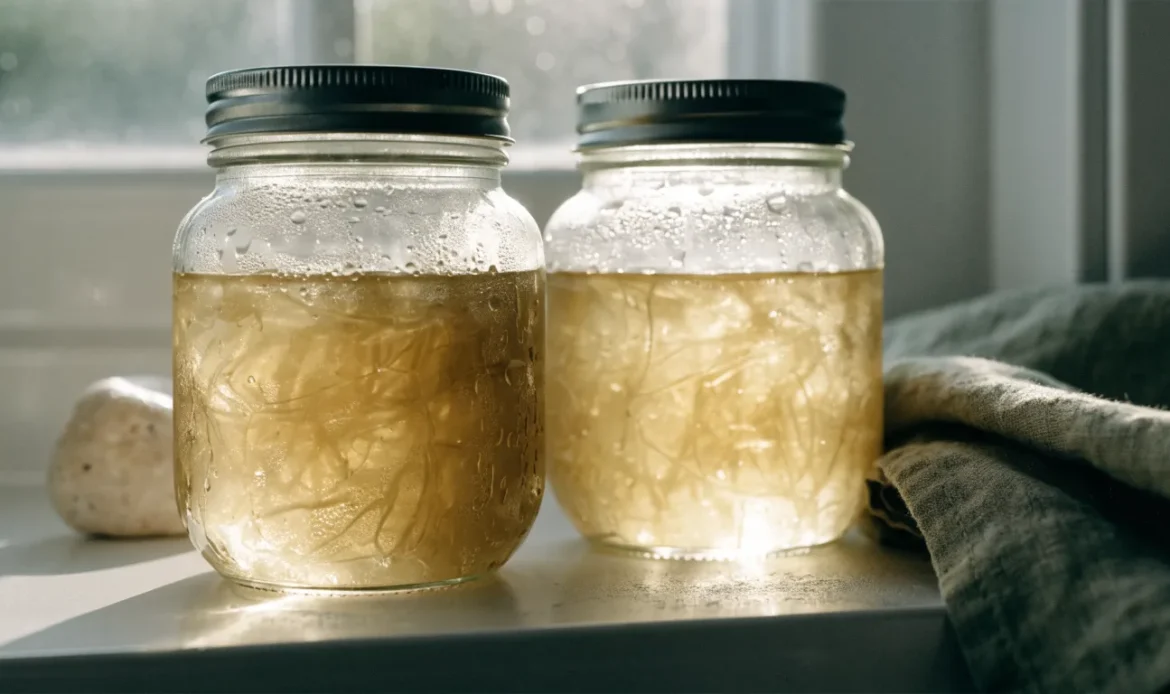
Short answer first: it depends on the form you have. Dry, sealed sea moss can usually stay in a cool, dry place. Wet, rehydrated, or gel forms should be kept cold to slow spoilage. Read on for simple checks, step-by-step storage actions, a decision checklist, and clear next steps.
Which forms of sea moss are common?
Sea moss is sold in several formats. Each needs different care.
- Dried sea moss: The water has been removed. It is brittle or slightly flexible. It looks and feels dry.
- Fresh (wet) sea moss: This is raw sea moss that still has moisture. It is soft and feels damp.
- Rehydrated or soaked sea moss: Sea moss that has been soaked in water to soften it.
- Sea moss gel: Blended sea moss mixed with water to make a spoonable gel.
- Powdered sea moss: Sea moss ground to a fine powder and sold in jars or bags.
- Capsules or supplements: Powder or extract enclosed in capsules or bottles.
Knowing which format you have is the first step in choosing storage.
Why storage depends on moisture and temperature
Two things control how fast foods and ingredients spoil: moisture and temperature.
- Moisture gives microbes a place to grow. Wet products spoil faster.
- Cold slows microbial growth and chemical changes. That is why refrigerators slow spoilage.
So the simple rule: if sea moss has significant moisture (wet, soaked, or gel), keep it cold. If it is dry and sealed, keeping it dry is usually the main concern.
How to tell what you actually bought
If the packaging is unclear, use a quick check:
- Touch it. Is it wet or sticky? Then it is perishable.
- Is it powder or dry flakes? It may be safe at room temperature if kept dry.
- Is it a gel or in a jar? Treat it as perishable.
If you bought fresh sea moss that still feels damp, plan to refrigerate it.
What refrigeration does—and what it does not do
Refrigeration slows down the processes that cause spoilage. It reduces how fast bacteria and mold grow. It helps keep texture and smell more stable.
Refrigeration does not sterilize or make food forever safe. It delays spoilage. You still must inspect the sea moss before use. If a product looks, smells, or feels wrong, do not use it.
Practical storage steps for each format
Here are clear steps you can follow for each format. Use the ones that match your product.
Dried sea moss
- Keep it in its original sealed package while unopened.
- After opening, place it in a dry, airtight container or resealable bag.
- Store in a cool, dark pantry or cabinet away from steam or heat sources.
- If it gets damp in storage, dry it again if possible, or discard.
Fresh (wet) sea moss
- Keep it cold from the time you get it home.
- Store in a clean, airtight container in the refrigerator.
- Use promptly, or prepare gel or freeze portions for longer storage.
Rehydrated or soaked sea moss
- Once soaked, treat it like any wet food: refrigerate in a sealed container.
- Use it soon after soaking or freeze portions if you need more time.
Sea moss gel
- Use clean jars and utensils when making and storing gel.
- Cool the gel before sealing if you made it warm.
- Keep sealed jars in the refrigerator and label them with the date.
- If you plan to keep gel a long time, freeze portions in ice cube trays.
Powdered sea moss
- Store in a dry, airtight jar away from light and heat.
- Keep a dry scoop or spoon in the container to avoid introducing moisture.
Capsules and supplements
- Follow the product label instructions.
- Keep seals intact until use. Store in a dry place unless the label says otherwise.
Best practices for refrigerating sea moss gel
Follow these steps to reduce the risk of spoilage:
- Use clean jars and lids. Wash them with hot, soapy water and dry well.
- Cool any warm gel before putting the lid on.
- Leave a small headspace in the jar for expansion if freezing.
- Seal jars tightly to limit air exposure.
- Label each jar with the date you made or opened it.
- Place jars in the main body of the fridge, not the door, where temperature is steadier.
- Use clean spoons each time you scoop gel—don’t double-dip.
If you or your buyer plans to store for longer than a few days, use the freezer. Freeze in small portions so you only thaw what you need.
Freezing and thawing: tips that reduce waste
Freezing is useful for many wet forms. Follow these tips:
- Portion the gel into small amounts before freezing. Ice cube trays are handy.
- Wrap or seal frozen portions to avoid freezer burn.
- Thaw only what you will use. Thawed gel can be stirred or re-blended to improve texture.
- Do not refreeze gel after it has been thawed and used.
Expect some texture change after freezing. That is normal, but always check smell and look before using.
How to check sea moss before use
Always inspect sea moss before you eat or use it. Use three checks:
- Smell: A briny, ocean-like scent is normal. A sour, rotten, or strong off-odor is not normal.
- Look: Check for unexpected colors, fuzzy growth, or dark spots. Mold can appear as fuzzy patches.
- Texture: Wet forms should feel consistent for their format. Sliminess beyond a normal slippery feel, or curdled textures, are warning signs.
If you see mold, discard the product. Do not try to cut off mold and use the rest. If the product smells strongly off or tastes wrong, throw it out.
A practical decision checklist (table)
Use this decision guide when you bring sea moss home or before you store it. The table below gives clear actions.
| Step | What to look for | Action to take now | Next storage step |
|---|---|---|---|
| 1. Identify format | Dry, wet, gel, powder, or capsule | Match to row below | Follow the specific storage plan |
| 2. Package condition | Sealed and intact vs open or damaged | If damaged, inspect product; if it’s damp or smells off, discard | Transfer to clean, airtight container if keeping |
| 3. Dry pieces or powder | Feels dry, no clumps or damp spots | Store in dry, airtight container in pantry | Avoid heat; check monthly for moisture |
| 4. Fresh/wet pieces | Feels damp or sticky | Refrigerate immediately in clean container | Label with date and use soon |
| 5. Soaked/reconstituted | Soft and wet after soaking | Refrigerate in sealed jar; use promptly | Freeze portions if not using within a few days |
| 6. Gel (opened or home-made) | Smooth or slightly separated but no mold | Keep refrigerated; label jar with date | For longer storage, freeze in small portions |
| 7. Gel that smells sour or shows mold | Any mold or bad odors present | Discard immediately | Clean storage area and containers |
| 8. Powdered or capsules | No moisture, seal intact | Keep dry; do not refrigerate unless label says so | Keep in cool, dry place away from sunlight |
| 9. Thawed gel | Texture changed after thawing | Inspect smell and look; stir or re-blend if okay | Use promptly; do not refreeze used portions |
| 10. Unsure about safety | Any doubt about condition | Discard to be safe | Ask seller for guidance or product info |
This checklist focuses on safe, simple steps you can do at home. It avoids promises about exact shelf life, because many variables affect storage.
Common storage mistakes and how to avoid them
People often make the same storage errors. These are easy to avoid.
- Mistake: Leaving gel or soaked sea moss at room temperature for long periods. Fix: Keep them in the refrigerator and store in small containers if you open jars often.
- Mistake: Using dirty utensils to scoop gel. Fix: Always use clean spoons or a clean spatula.
- Mistake: Storing jars in the fridge door. Fix: Put jars on a main shelf where temperature is steadier.
- Mistake: Relying on smell alone. Fix: Check look and texture too.
- Mistake: Refreezing thawed gel. Fix: Portion before freezing to avoid repeated thawing.
These small steps reduce waste and lower the chance of spoilage.
What sellers and labels can tell you — and what they cannot
A product label can help. Look for these things:
- Format name (dried, gel, powder).
- Storage instructions from the maker.
- Date of packing or best-use guidance.
- Any contact information for questions.
What labels cannot always tell you:
- Exact iodine content unless the product has lab testing data.
- Precise shelf life under every home condition.
- How the product was handled before you bought it.
If you have special concerns, ask the seller for product testing or extra storage guidance. If the seller provides lab data or shelf-life testing, that information is useful for your decision. If no information is available, rely on the checks and steps in this guide.
Safety note on iodine and supplement context
Seaweed products, including sea moss, can contain varying amounts of iodine. Iodine levels depend on seaweed type and where it was harvested. Some seaweed products can have high iodine. If you have thyroid conditions or are on iodine-sensitive medication, check product information and speak with a health professional. Surveys and reviews show that iodine levels vary widely across seaweed products [2][3][5]. For general nutritional information about seaweed, see public resources [1]. For guidance on sea moss in supplements, consult official supplement safety resources [4].
This article does not replace medical advice. If you have health questions, ask a qualified professional.
When refrigeration may not be enough
Refrigeration helps but cannot fix poor hygiene or contamination. Refrigerators slow microbial growth but do not kill bacteria or mold. If sea moss was handled with dirty tools, left at warm temperatures for too long before refrigeration, or stored in a contaminated container, it may still be unsafe. If you suspect poor handling or see signs of spoilage, do not use the product.
Troubleshooting: common scenarios and what to do
Scenario: You opened a jar of gel you bought and it smells a bit sour.
- What to do: Do not taste more. Check for visible mold. If you see mold or the smell is strong and not like normal ocean scent, discard the jar.
Scenario: Your dried sea moss got humid and clumped.
- What to do: If it dried again without visible mold, you could dry it fully and store it in a dry jar. If there is any doubt or mold is present, discard it.
Scenario: You froze gel and after thawing it looks thinner.
- What to do: Stir or re-blend the gel. Check smell and look. Use promptly if it seems fine.
Scenario: You bought a product with no storage instructions.
- What to do: Identify the format by touch. If wet or gel, refrigerate. If dry or powdered, keep dry in a sealed container.
Useful next steps
- Learn more about sea moss basics and formats: Learn about sea moss basics.
- Compare product formats and how to use them: Learn how products differ.
- Browse products and formats we sell: Shop sea moss products.
- Need larger quantities for a business? See our wholesale options: Wholesale information.
- Have specific product or order questions? Contact our team: Contact us.
- Return to the home page for more: Zen Wholesalers
Conclusion
Does sea moss need to be refrigerated? The short, clear rule is this: refrigerate anything that has moisture—fresh, soaked, or gelled sea moss. Keep dry formats sealed and dry. Always inspect smell, look, and texture before using. Label jars, use clean utensils, and portion before freezing to make life easier. If you are unsure about safety or product details, ask the seller for information or consult a professional. When in doubt, discard the product.
Frequently asked questions
Does all sea moss need refrigeration?
No. Dry sea moss and sealed powdered products usually do not need refrigeration if they stay dry. Wet forms—fresh, soaked, or gel—should be refrigerated. Always check the label and follow the format checks in this guide.
How can I tell if my sea moss gel is spoiled?
Look for visible mold, strong sour or rotten smells, and slimy textures that are not normal for the gel. If any of those appear, discard the product.
Can I freeze sea moss gel and still use it in recipes?
Yes. Freezing is a common way to extend storage. Freeze in small portions. Thaw in the refrigerator and stir or re-blend if texture changed. Always check smell and look before using.
If I dry sea moss at home, does it need refrigeration?
If it is fully dry and stored in a clean, airtight container, refrigeration is usually not needed. Keep it away from heat, light, and moisture. If it becomes damp, treat it as a perishable product.
Do powdered sea moss and capsules need to be refrigerated?
Most powdered sea moss and capsules do not require refrigeration if kept dry and the packaging is intact. Follow the product label instructions if they differ.
Is smell always a reliable test?
Smell is a helpful test but not perfect. Combine smell with visual checks and texture checks. If anything looks or smells off, do not use it.
References
- [1] Harvard T.H. Chan School of Public Health, “Seaweed.” https://nutritionsource.hsph.harvard.edu/seaweed/
- [2] Smyth PPA. “Iodine, Seaweed, and the Thyroid.” European Thyroid Journal, 2021. https://pmc.ncbi.nlm.nih.gov/articles/PMC8077470/
- [3] Food Standards Australia New Zealand, “Survey of iodine levels in seaweed and seaweed containing products,” updated 2025. https://www.foodstandards.gov.au/science-data/monitoring-safety/surveyofiodinelevels
- [4] Operation Supplement Safety, “Sea Moss in Dietary Supplements.” https://www.opss.org/article/sea-moss-dietary-supplements
- [5] Blikra MJ et al. “Consequences of acute and long-term excessive iodine intake: A literature review focusing on seaweed as a potential dietary iodine source.” 2024. https://doi.org/10.1111/1541-4337.70037