
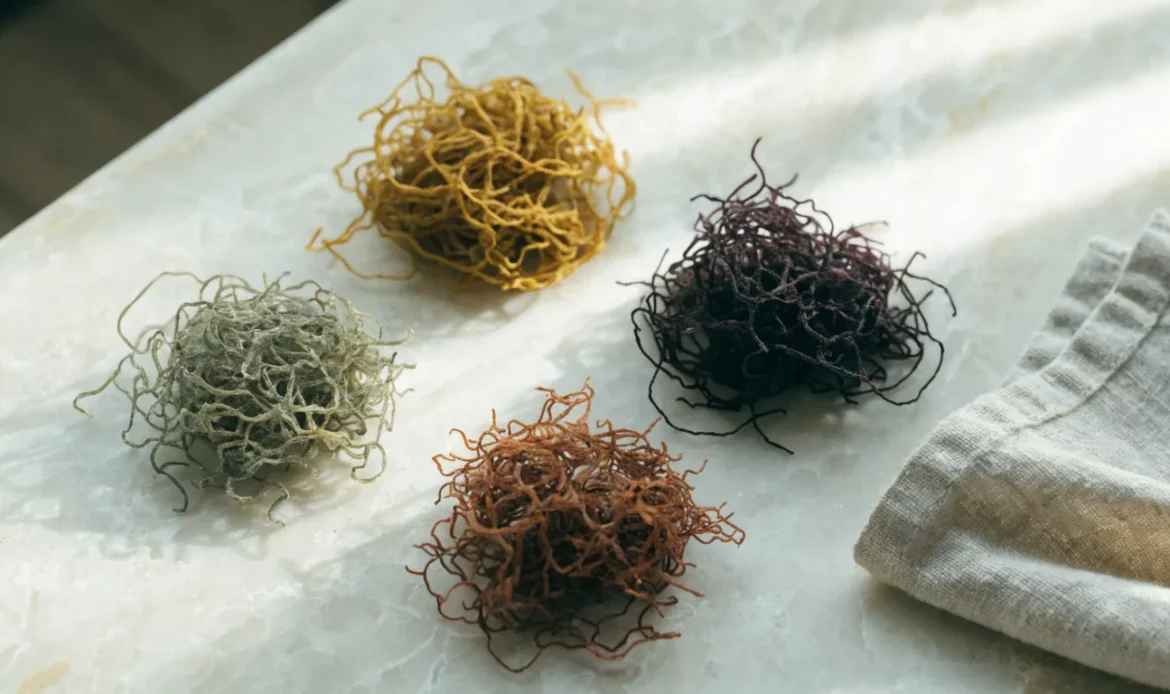
Short answer first: Sea moss comes in many colors — green, red, gold, purple, brown, and sometimes nearly black. Color comes from the seaweed species, where and how it grew, and how it was handled after harvest. Color alone does not prove a product’s safety, nutrient makeup, or quality. Use color as one clue, not the only test.
What determines seamoss color?
Sea moss color comes from natural pigments in the algae and from the environment it grew in. Key points, in plain terms:
- Different kinds of seaweed make different pigments. Chlorophyll makes green. Other pigments make red, purple, yellow, or brown tones.
- Light level and depth matter. Seaweed that grows deeper gets less sunlight. That can change which pigments are used and how the plant looks.
- Water temperature, salt, and nutrients in the water also affect pigment and overall color.
- What happens after harvest changes color. Drying, sun-bleaching, heat, freezing, or blending can change or fade colors.
These factors work together. A single color can come from several causes. A single cause can show different colors in different places.
(For general context on seaweed variety and nutrients, see an overview on seaweed from a public health source.) [1]
Common seamoss colors and what they often mean
Below are common colors you will see labeled or shown in photos. These short notes explain typical causes. Remember: color suggests something, but it does not prove details about nutrients, safety, or origin.
Gold or yellow seamoss
- Often shows more yellow or pale tones.
- This can come from drying in sun or from species with more carotenoid pigments.
- Gold color does not guarantee freshness. It may reflect processing or sun exposure.
Purple seamoss
- Purple tones come from pigments such as phycobiliproteins in some red algae.
- Purple may appear when certain species are harvested in specific seasons or when they are briefly sun-dried.
- Purple does not by itself mean higher or lower levels of any mineral.
Red seamoss
- Red shades typically come from red algae species. These species naturally contain red pigments.
- Red does not tell you the level of iodine, heavy metals, or other compounds.
Green seamoss
- Green comes from chlorophyll. It is common in seaweed that grows near the surface where sunlight is strong.
- Fresh, quickly dried, or minimally processed seaweed often keeps a greener color.
Brown seamoss
- Brown tones are common in many seaweeds. This color can come from pigments like fucoxanthin.
- Brown can also come from oxidation after harvest or long drying times.
Very dark or black-looking seamoss
- Very dark colors can be natural in some types or can result from age, heavy oxidation, or deposits on the plant.
- Dark color may also come from surface encrustations or sand that was not fully cleaned.
What seamoss color cannot prove
This is important. Color alone cannot tell you:
- Exact species or scientific name. Similar colors may cross species.
- Exact nutrient levels, such as how much iodine is present. Iodine content varies widely by species and location and by processing methods (so color is not a reliable marker) [2][3][5].
- Whether the product has unsafe levels of heavy metals or contaminants. These require testing.
- Whether the sea moss is fresh, unless color changes are extreme and paired with other signs (smell, texture, packaging dates).
If a seller claims that a color guarantees a specific mineral level or detox effect, treat that claim with caution. Color is only one visible trait.
How processing and storage change seamoss color
After harvest, handling affects what you see:
- Sun drying can bleach or fade colors. It can make greens turn yellowish.
- Heat and oven drying can darken or brown some pigments.
- Freeze-drying often preserves color better than sun drying, but not always.
- Soaking and boiling can leach pigments into the water. The sea moss may change color during soaking or cooking.
- Grinding or blending into powder or gel will mix pigments and often give a brownish or neutral color.
Pro tip: If a product’s photos look bright and consistent across many listings or seasons, ask the seller how the product was processed and whether the photo shows fresh or processed material.
Practical decision checklist: how to use color during buying
Use this short checklist when color matters to you. Tick each box as you go. Color is one piece of your decision process.
- Visual check
- Does the color match the seller’s labeling and photos?
- Are there signs of uneven discoloration (dark spots, mold-like patches)?
- Smell and texture (if you can inspect in person)
- Is there an off or sour odor? If yes, avoid.
- Is texture slimy or crumbly in ways that seem wrong for the claimed form?
- Sourcing and documentation
- Does the seller list the species or at least a clear common name?
- Does the seller provide harvest date or season?
- Processing details
- How was it dried (sun-dried, oven-dried, freeze-dried)?
- Was it treated with additives, or is it just seaweed?
- Safety and testing
- Are lab test results provided on iodine, heavy metals, or microbiology?
- If not, can the seller supply a recent certificate of analysis?
- Packaging and labeling
- Is packaging sealed and labeled with net weight, batch code, and contact info?
- Are storage instructions listed?
- Intended use
- Is the color suitable for your use? (Some colors blend into smoothies; others are more visible in gels.)
- Price and transparency
- Is the price shown clearly? Ask questions if pricing or origin is vague.
- If buying wholesale or for resale: Request a sample before bulk purchase.
Use the checklist as a practical tool. Don’t expect color alone to answer safety or nutrient questions.
Choosing color by use
Some buyers pick a color for how it looks in a final recipe or product. Here are simple tips.
- Smoothies and shakes: Neutral or brownish gels and powders blend in. Bright green or purple can tint a drink.
- Jams and gummies: Color can be a selling point. Red/purple gels give a natural tint.
- Skincare or topical products: Color may affect product appearance. If the final product needs to be light, choose a paler or bleached option, but confirm processing and additives.
- Raw culinary use: For dishes where seaweed visibility is desired, choose the color that matches the recipe.
Remember: color can change during cooking or soaking. Test small batches before wide use.
Safety notes related to seamoss color and composition
Sea moss can hold important minerals and compounds that vary with species and place of harvest. Two points to keep in mind:
- Iodine varies widely. Some seaweeds are high in iodine. Too much iodine can affect the thyroid in some people. You cannot tell iodine level by color. If iodine matters to you, look for lab testing or authoritative guidance about iodine in seaweed products [2][3][5].
- Product safety depends on testing and handling. Color alone does not show whether the product has been tested for heavy metals, arsenic, or microbiological contamination. Ask sellers for certificates of analysis or third-party lab testing when safety is a concern [4].
If a product is sold as a dietary supplement, check labeling claims and any available lab data. Regulatory bodies and researchers have reviewed variability and risks with seaweed-derived products; be cautious and ask for evidence rather than inferring safety from color alone [4][5].
How to check a product listing or label for trustworthy details
When you read an online listing or product label, look for these items beyond color:
- Clear product name and species (for example: a genus or common name). If the listing only uses a color name with no species, ask for details.
- Harvest or production date, or at least season.
- Processing method: sun-dried, oven-dried, freeze-dried, gel made from raw seaweed.
- Any lab testing documents or a link to a certificate of analysis.
- Contact information and a clear returns policy.
- If sold as a dietary supplement: ingredient list, serving size guidance, and a clear statement about whether the product has been tested for heavy metals or iodine.
If these items are missing, request them before you buy large quantities or plan to use the product in a commercial product line.
Simple cleaning and preparation tips that affect color
If you buy raw or dried sea moss, simple steps will help you see the true color and reduce surprises:
- Rinse: Rinse under cold water to remove sand, shells, or surface dust. Rinsing may also slightly change color.
- Soak: Soak in clean water. Note that soaking will often soften and sometimes change color.
- Inspect after soaking: Look for slimy patches that do not wash away, strong off smells, or disintegration. These could indicate spoilage.
- Store: Keep dried sea moss in a cool, dry place. Keep gels or prepared products refrigerated as the seller recommends.
These are handling tips. They do not replace lab testing for contaminants.
Decision guide table: color, likely handling, and quick buyer action
| Visible color | Likely natural cause | Quick buyer action |
|---|---|---|
| Bright green | Fresh surface chlorophyll, shallow growth, minimal sun bleaching | Ask about drying method; test small batch in recipes |
| Pale yellow / gold | Sun-bleaching or carotenoid dominance | Check processing and freshness; inspect texture and smell |
| Red / reddish-purple | Red algae pigments or certain species | Ask seller for species name and harvest season |
| Deep purple | Pigments intensified by season or certain red algae | Confirm whether color is natural or from added colorants |
| Brown / tan | Brown algae pigments, oxidation, or long drying | Ask about age and storage; request lab tests if concerned |
| Very dark / near black | Natural pigment, age, or contamination | Inspect closely; avoid if odd smell or texture present |
Use this table as a quick field guide. It is a practical, not scientific, aid.
What you should ask the seller about seamoss color
If color matters, ask these clear questions:
- What species is this product?
- Where and when was it harvested?
- How was it dried or processed?
- Do you have a recent lab report for iodine and heavy metals?
- Is any coloring or additive used?
- Can I get a small sample before buying a large amount?
Good sellers will answer plainly. If answers are vague, consider a different source.
Next steps and related guides
If you want to learn more about seaweed basics, visit our learning hub: /learn/. If you are ready to check product options, see our shop: /shop/. For wholesale inquiries or samples, see /wholesale/ or contact us directly at /contact/. You may also return to the homepage for an overview: /.
If you are buying for food or retail, ask for samples and lab reports. If you are using sea moss in a product, test color stability across your process.
Conclusion
Seamoss color tells part of the story. It can point to species, growth conditions, and how the product was handled. But color alone cannot prove nutrient content, safety, or freshness. Use color as a visual clue. Then ask clear questions about species, harvest, processing, and lab testing. When in doubt, request a sample or lab reports before you buy in bulk.
Continue reading
Frequently asked questions
What color is sea moss?
Sea moss can be green, red, purple, gold, brown, or dark. The color depends on species, light and water where it grew, and how it was dried or processed.
Is purple sea moss better than green?
Color does not prove better or worse. Purple and green simply reflect different pigments and conditions. Nutrient levels and safety cannot be determined by color alone.
Can color tell me if seamoss is safe?
No. Color gives clues but cannot confirm safety. Lab testing is needed to check iodine, heavy metals, or microbes.
Why does my sea moss change color when I soak it?
Soaking can leach pigments into the water and soften the seaweed. Heat or agitation can also change pigment appearance. This is normal for many seaweed types.
If a seller labels seamoss by color, is that enough information?
Color labeling is helpful but incomplete. Ask for species, harvest info, processing method, and any lab results before making a decision.
Should I avoid dark-colored seamoss?
Not automatically. Dark color can be natural for some species or can mean age or oxidation. Check smell, texture, and ask the seller for details and test results.
References
- Harvard T.H. Chan School of Public Health, “Seaweed.” https://nutritionsource.hsph.harvard.edu/seaweed/
- Smyth PPA. “Iodine, Seaweed, and the Thyroid.” European Thyroid Journal, 2021. https://pmc.ncbi.nlm.nih.gov/articles/PMC8077470/
- Food Standards Australia New Zealand, “Survey of iodine levels in seaweed and seaweed containing products,” updated 2025. https://www.foodstandards.gov.au/science-data/monitoring-safety/surveyofiodinelevels
- Operation Supplement Safety, “Sea Moss in Dietary Supplements.” https://www.opss.org/article/sea-moss-dietary-supplements
- Blikra MJ et al. “Consequences of acute and long-term excessive iodine intake: A literature review focusing on seaweed as a potential dietary iodine source.” 2024. https://doi.org/10.1111/1541-4337.70037