
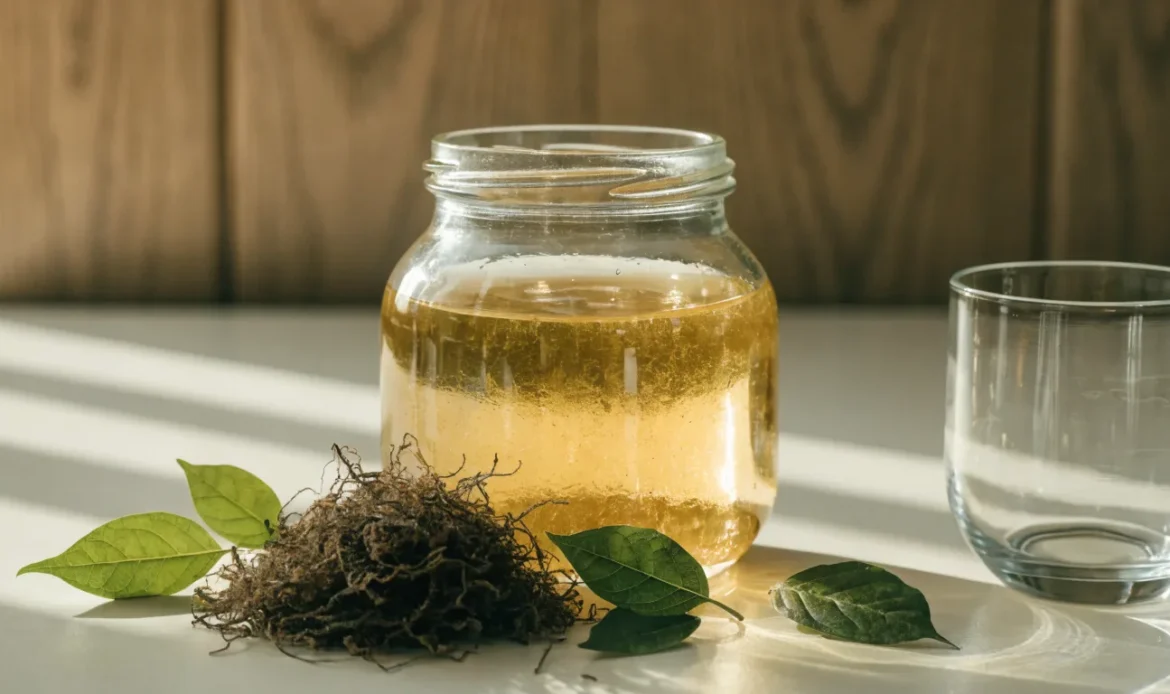
Short answer: Sea moss black seed oil is a blend that combines dried or powdered sea moss (a seaweed) with black seed oil. The mix is sold as an oil, tincture, capsule, or combined with other botanicals like ashwagandha and ginger. People choose these blends for convenience, flavor, or to carry ingredients in one product. You can evaluate and compare formats by checking labels, test results, and how the maker processes seaweed and oil.
What is “sea moss black seed oil”?
Sea moss black seed oil names a product that mixes two main parts:
- Sea moss: a type of edible seaweed. It is sold fresh, dried, powdered, or made into gels. Seaweed contains many compounds and can hold minerals from seawater [1].
- Black seed oil: oil pressed from Nigella sativa seeds. It is an oil used in cooking and as a supplement.
Companies make blends by infusing oil with powdered sea moss, mixing gels with oil bases, or offering capsules that contain both extracts and oils. Sellers sometimes add other botanicals like ashwagandha or ginger to change taste or scent, or to target a certain audience. These add-ins are common in herbal blends but do not guarantee any specific effect.
Quick format overview
Many blends come in one of these forms:
- Liquid oil or infusion: oil with sea moss particles or extract.
- Tincture or oil-based drops: a small bottle for oral drops or topical use.
- Capsules or softgels: for people who want a measured dose without taste.
- Gel blends: sea moss gel with added oil for spooning into food or drinks.
Each form changes the way you use the product, how long it keeps, and how it mixes with foods or skin.
Ingredients you may see listed
Common ingredients in these blends include:
- Sea moss (Chondrus crispus, Gracilaria, or other species). Labels may say “seaweed” without naming species.
- Black seed oil (Nigella sativa).
- Carrier oils such as olive oil, coconut oil, or MCT oil.
- Added herbs: ashwagandha, ginger, turmeric, cinnamon, or flavor extracts.
- Preservatives or emulsifiers in prepared gels or capsules.
Ask for a full ingredient list if you have allergies. Also ask for the seaweed species and whether it was rinsed and tested.
Why people combine sea moss and black seed oil
Both sea moss and black seed oil appear in traditional diets and herbal practices. Blending them:
- Lets makers combine two ingredient lists into one product.
- Can make sea moss easier to take if taste is a concern.
- Allows sellers to offer a single supplement for people who want both.
This is about convenience and preference. There is no single, agreed definition of a “sea moss black seed oil” product. Always read the label.
Safety and testing — what to check
Seaweed and seaweed-based products can concentrate minerals and trace elements from seawater. Iodine is a key example. Seaweed can be a valuable dietary source of iodine, but it can also supply more iodine than a person needs in a single serving. Excess iodine can affect thyroid function in some people [2][5]. Different seaweed species and harvest locations vary a lot in iodine content [3].
What you can and should check before buying:
- Ask whether the product was tested for iodine and heavy metals. Testing should be for arsenic, lead, cadmium, and iodine at minimum.
- Look for third-party lab reports (Certificates of Analysis, COAs). A COA shows which tests were run and the results.
- If you take thyroid medicine or have a thyroid condition, check with a healthcare provider before using seaweed products. Medical supervision is important when you change iodine intake [2].
- For supplements, check general safety advisories. Organizations that review supplement risks note limited oversight and advise caution with sea moss supplements [4].
Do not assume a product is safe because it is “natural.” Natural materials can vary in composition.
Common claims and how to read them
Marketing may list many traditional uses for each ingredient. That is common. But words like “supports,” “promotes,” or “helps with” are not the same as medical proof. Watch for:
- Vague claims without test data or COAs.
- Statements that promise disease cures or guaranteed medical results. Avoid any product text that claims to prevent or cure diseases. Those claims are not allowed for dietary supplements and are not supported by clear, universal evidence.
If a maker cites studies, ask which species, dose, and preparation the study used. Seaweed species and processing change the chemical profile.
How sea moss, ashwagandha, and ginger may be presented together
Some products mix sea moss with black seed oil and add herbs such as ashwagandha or ginger. This is a formulation choice. Each added herb comes with its own questions:
- Ashwagandha is an herb used in some traditional systems. If present, label the source and extract strength.
- Ginger is a common spice and is often added for flavor.
Check interactions and contraindications for each herb. For example, people taking specific medications or with certain health conditions should consult their clinician about ashwagandha or other herbs.
How to choose a format: advantages and limits
Below is a simple table that compares common ways sea moss black seed oil is packaged.
| Format | Pros | Cons | Good if you want… |
|---|---|---|---|
| Liquid oil or infusion | Easy to add to food. Often lower processing. | Can separate or spoil without proper preservation. Label clarity may vary. | Flexibility in mixing into food or on skin |
| Capsules / softgels | Simple doses. No taste. | Harder to test batch contents. May hide raw material quality. | Convenience and travel |
| Gel blend | Familiar sea moss texture. Easy for smoothies. | Shorter shelf life. Can contain stabilizers. | Adding to foods or smoothies |
| Tincture / drops | Concentrated. Small volumes used. | Strong taste. May use alcohol or other solvents. | Minimal-quantity dosing and portability |
This table helps you match format to your routine. It does not rate safety or quality. Always ask for COAs or lab tests.
Practical decision checklist — should you buy this product?
Use this checklist to screen any sea moss black seed oil product before buying. Tick boxes you can confirm.
- Product label lists full ingredients and seaweed species.
- Seller provides a recent Certificate of Analysis for heavy metals and iodine.
- The COA is from a recognized lab and matches the product batch or lot number.
- Packaging includes storage and shelf-life guidance.
- The product lists a manufacturer or distributor contact.
- Add-ins (ashwagandha, ginger) are listed with source and amount.
- The product avoids absolute health claims (no cure/prevent wording).
- You do not have a thyroid condition or you have confirmed use with your clinician.
- You do not have allergies to seeds, seaweed, or added botanicals.
- Return policy and customer support are clear.
If several boxes are unchecked, pause and ask the seller questions. If the seller cannot answer, it is safer to choose another product.
How to read a Certificate of Analysis (COA) quickly
If a seller provides a COA, scan for:
- The product lot or batch number that matches the bottle.
- Tests listed for heavy metals (lead, arsenic, cadmium), and for iodine.
- Microbial tests for contamination if the product is a gel or water-based.
- Date of testing and lab accreditation.
A COA helps but does not guarantee full safety. It documents the tests run on the sample tested.
Questions to ask a seller
Short list you can use when contacting a maker:
- Which seaweed species is in this product?
- Was the seaweed tested for iodine and heavy metals? Can I see the COA?
- What is the carrier oil?
- Are ashwagandha or ginger added? What form and amount?
- Where is the product manufactured and bottled?
- What is the shelf life and recommended storage?
Answers will show how transparent the maker is.
Storage and shelf life basics
Storage depends on the format:
- Oils usually keep best in cool, dark places.
- Gels may need refrigeration and a shorter use window.
- Capsules store like other dried supplements; follow label directions.
Do not assume long shelf life without a date. If stored incorrectly, oils can go rancid and gels can grow microbes.
Where to use sea moss black seed oil (food vs topical)
Some products are clearly for food use and list serving suggestions. Others are made for topical use on skin or hair. Do not swap uses without confirmation. An oil meant for skin may not be safe to ingest and vice versa. Labels should state intended use.
How ashwagandha and ginger change the decision
Ashwagandha and ginger are common add-ins. They can:
- Change taste and aroma.
- Add herb-specific safety considerations. For example, certain medications may interact with ashwagandha.
- Affect the final shelf life and required preservation steps.
If you are sensitive to herbs or take medications, discuss these ingredients with a clinician.
Suggested uses (non-medical)
You can use a sea moss black seed oil product in simple ways:
- Stir a small amount into a cool smoothie or blended drink if the label says edible.
- Add a spoon of gel to cooking where heat won’t break down ingredients if label allows.
- Apply a topical oil to hair or skin only if the product is labeled for topical use.
- Take capsules according to the label if the product lists recommended use.
Always follow the product label and your clinician’s advice.
Labelling red flags
Watch for:
- No ingredient list or vague terms like “herbal complex” without detail.
- No contact info or opaque company location.
- Promises that a product “cures” or “prevents” health conditions.
- No tests or unwillingness to share COAs.
These are common signs a seller may not be transparent.
Cost considerations
Price can vary widely based on format, brand, and testing. High price does not automatically mean better safety. Ask what you get for the price: test reports, sourcing transparency, and manufacturing practices matter more than marketing.
Links to the next guides and shopping
- Learn more about seaweed basics: Seaweed guide
- Browse our product formats and shop options: Shop products
- Interested in bulk or reselling? See wholesale info: Wholesale inquiry
- Want to contact us with questions? Contact our team
- Back to Home
Conclusion
Sea moss black seed oil describes a family of blended products. They vary by format, ingredient amounts, and safety testing. You can make a safer choice by checking labels, asking for COAs, and confirming intended use (oral or topical). If you have thyroid issues or take certain medicines, get clinical advice before you try seaweed-based products. Use the checklist and format table in this guide to compare options. For more on seaweed basics, testing, and buying tips, visit our learning pages and contact us with specific product questions.
Frequently asked questions
Is sea moss black seed oil the same as plain sea moss?
No. Sea moss black seed oil blends seaweed with black seed oil and sometimes other herbs. Plain sea moss is raw, dried, powdered, or gelled seaweed without added oils or herbs.
Can I use the oil on my skin and eat it too?
Not necessarily. Check the label. Some products are made for food use. Others are made only for topical use. Never ingest a product labeled for external use.
Should I worry about iodine?
Seaweed can contain a lot of iodine. That is a known concern. If you have thyroid issues or take thyroid medication, talk to a clinician before using seaweed products. Ask the seller for iodine testing results [2][3][5].
What is a Certificate of Analysis (COA) and why does it matter?
A COA is a lab report. It shows which tests were done on a sample and the results. For seaweed products, look for tests for heavy metals and iodine. A COA gives facts about what was measured in that batch.
Are all black seed oils the same?
No. Black seed oil quality can vary by the seed source, pressing method, and processing. Labels should state the oil type. If a product mixes black seed oil with other carrier oils, that should be listed.
Can the added herbs like ashwagandha or ginger change safety?
Yes. Each herb has its own profile. Ashwagandha and ginger are common additions. They can interact with medications or affect people differently. If you have a medical condition or take medications, consult a clinician.
References
- Harvard T.H. Chan School of Public Health, “Seaweed.” https://nutritionsource.hsph.harvard.edu/seaweed/
- Smyth PPA. “Iodine, Seaweed, and the Thyroid.” European Thyroid Journal, 2021. https://pmc.ncbi.nlm.nih.gov/articles/PMC8077470/
- Food Standards Australia New Zealand, “Survey of iodine levels in seaweed and seaweed containing products,” updated 2025. https://www.foodstandards.gov.au/science-data/monitoring-safety/surveyofiodinelevels
- Operation Supplement Safety, “Sea Moss in Dietary Supplements.” https://www.opss.org/article/sea-moss-dietary-supplements
- Blikra MJ et al. “Consequences of acute and long-term excessive iodine intake: A literature review focusing on seaweed as a potential dietary iodine source.” 2024. https://doi.org/10.1111/1541-4337.70037