
Short answer: You can buy graviola (soursop) leaves in fresh, dried, cut, or powdered forms. Decide which form fits your use, check the seller’s sourcing and handling practices, and follow safe storage and preparation steps. Read on for a clear buying checklist, a decision table, and practical tips.
Why this guide
- It tells you what to check when buying graviola leaves.
- It explains the common forms and uses in food and culture.
- It flags safety, handling, and the limits of seller information.
- It helps you pick the right product for cooking or making an herbal infusion.
What graviola leaves are
- Common names: graviola, soursop leaves.
- Botanical name: Annona muricata.
- People in the Caribbean, Latin America, and parts of Africa often use the fruit and leaves in cooking and local traditions.
- Leaves are usually used dried or fresh for teas, rinses, or mild flavoring. This guide focuses on buying leaves, not the fruit.
H2: Common forms and how people use them
H3: Fresh leaves
- Appearance: glossy green, soft when fresh.
- Uses: fresh infusions, light cooking, wrapping foods.
- Storage: keep cool and use quickly. Fresh leaves do not last long at room temperature.
H3: Dried whole leaves
- Appearance: intact leaves, may be brittle and darker.
- Uses: steeped for teas, made into sachets, used for long-term storage.
- Storage: keep in airtight containers away from sunlight and moisture.
H3: Cut or crumbled leaves
- Appearance: pieces of leaf, convenient for tea bags or jars.
- Uses: easier to measure than whole leaves; faster to infuse.
- Note: look for uniform cuts and few stems.
H3: Powdered leaves
- Appearance: fine or coarse powder.
- Uses: added to smoothies, capsules, or mixed into foods where a powdered form is needed.
- Caution: powder exposes more surface area. It can absorb moisture and degrade faster.
H2: How to identify real graviola leaves
Key ID points
- Shape: typically oval to oblong leaves with smooth edges.
- Color: fresh leaves are bright to deep green. Dried leaves are green-brown.
- Smell: leaves have a mild, plant-like scent when crushed. They are not strongly aromatic like mint.
- Texture: fresh leaves are soft; dried leaves are brittle.
What to ask the seller
- Is this graviola (Annona muricata) or another plant?
- Is the product fresh, dried, cut, or powdered?
- How was it processed and stored?
- Are there pictures of the product as shipped?
What the seller can and cannot prove
- Sellers can usually show photos and describe processing.
- Sellers cannot prove the absence of contaminants without lab tests.
- If a seller mentions testing, ask for lab reports or certificates. If none are shown, treat testing claims with caution.
H2: Sourcing and quality factors to check
H3: Where the leaves were grown
- Sellers may list a region or country. That helps you know climate and handling expectations.
- Country names alone do not guarantee safety or quality.
H3: Harvesting and drying methods
- Heat-dried leaves are common. Sun-drying is also used.
- Ask how leaves were dried and whether any chemicals were used during processing.
H3: Packaging and storage
- Airtight packaging extends shelf life for dried leaves.
- Look for moisture-proof materials and sealed bags or jars.
H3: Signs of poor quality
- Strong musty or fermented smells.
- Mold, dark spots, or sticky areas.
- Excessive dust that suggests broken leaves or poor handling.
H2: Buying decision guide (table)
Use this simple table to match what you want with the likely best product form. No prices or brand claims are included.
| Buyer goal | Best form | What to check before buying | Notes |
|---|---|---|---|
| Make tea with whole leaves | Dried whole leaves | Look for intact leaves, no mold, airtight packing | Whole leaves are easy to strain after steeping |
| Quick tea in bags or cups | Cut/crumbled leaves | Check uniformity, low dust, clear origin | Cuts brew faster than whole leaves |
| Mix into smoothies or capsules | Powdered leaves | Fine grind, no clumps, low moisture | Powder mixes easier but spoils faster if wet |
| Culinary wraps or fresh flavor | Fresh leaves | Fresh, undamaged leaves; fast shipping | Fresh leaves need refrigeration and quick use |
| Wholesale or bulk use | Dried whole or cut leaves | Clear processing notes, storage instructions | Ask about lot consistency and packing size |
H2: Safe handling, storage, and preparation
H3: Handling tips
- Wash hands and clean surfaces before working with leaves.
- If using fresh leaves, rinse them in clean water and pat dry.
- For dried leaves, remove dust by gently shaking or sifting.
H3: Making a simple infusion (tea) — plain method
- Use clean water just off a boil.
- Add 1–2 teaspoons of cut leaves or 1 whole leaf per cup.
- Steep 5–10 minutes, strain, and serve warm or cool.
- Adjust steep time based on taste preference.
H3: Storage tips
- Dried leaves: store in a cool, dark, dry place in an airtight container.
- Powder: store in sealed, opaque containers to block light and moisture.
- Fresh leaves: refrigerate in a sealed bag and use within days.
- Check regularly for off smells or visible mold.
H2: Safety, limits, and when to ask questions
Clear boundaries
- Many cultures use graviola leaves in food and drink. That is a cultural fact.
- Scientific studies that test specific effects are not presented here.
- Do not assume risks or benefits from seller statements alone.
When to ask a health professional
- If you are pregnant, breastfeeding, taking medication, or have a medical condition, talk with a health professional before using graviola leaves in any concentrated form.
- Medical decisions should not be based on seller claims or social posts.
What sellers cannot prove easily
- Absence of pesticide residues, heavy metals, or microbes without lab tests.
- Specific health effects or therapeutic claims unless backed by peer‑reviewed studies.
If you also use sea moss or other seaweeds
- Seaweeds and sea moss can contain iodine and other minerals that might affect health when eaten regularly. If you use both seaweed products and graviola, keep a record of what you consume. For general information about seaweed and iodine, see research and guidance from public health sources. [1][2][4]
H2: A short buyer checklist (print or copy)
- Product form needed: fresh / dried whole / cut / powder.
- Botanical name confirmed: Annona muricata.
- Photos available: yes / no.
- Origin listed: yes / no.
- Processing explains drying and storage: yes / no.
- Packaging airtight: yes / no.
- Signs of contamination (mold, damp smell): none observed.
- Seller willing to answer questions: yes / no.
- Return or refund policy stated: yes / no.
- If buying for food use, confirm there are no added chemicals or fillers.
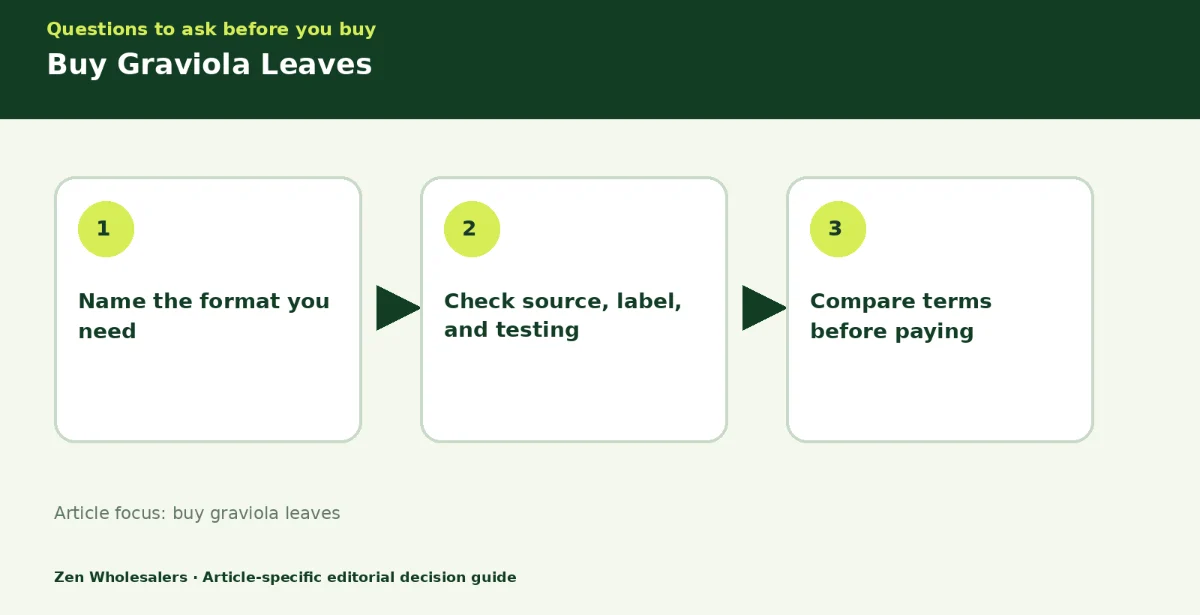
H2: Questions to ask when comparing sellers
- Can you confirm the product is graviola (Annona muricata)?
- How and where were the leaves harvested?
- How were leaves dried and packed?
- Can I see photos of the actual batch?
- Are there any additives or fillers?
- What is the shelf life and suggested storage?
- What is your return policy if the product arrives damaged?
H2: Shipping, packaging, and returns to consider
- Fresh leaves usually need fast shipping and refrigeration. Ask about shipping speed and how leaves are packed.
- Dried leaves are easier to ship. Still, confirm the package is sealed and moisture-resistant.
- Check the seller’s return policy before buying. A clear policy reduces risk if the product arrives in poor condition.
Continue reading
Frequently asked questions
What should I check first?
Start with the product or ingredient label, the source information, and whether the seller can answer clear questions.
Is this a replacement for professional advice?
No. Use this article as general education. Ask a qualified professional for personal medical, legal, or food-safety guidance.
Where can I learn more?
Use the Zen Wholesalers Learning Library to compare related guides and choose a useful next question.
References
- Harvard T.H. Chan School of Public Health, “Seaweed.” https://nutritionsource.hsph.harvard.edu/seaweed/ [used to note general seaweed/iodine context]
- Smyth PPA. “Iodine, Seaweed, and the Thyroid.” European Thyroid Journal, 2021. https://pmc.ncbi.nlm.nih.gov/articles/PMC8077470/ [used to note iodine can be present in seaweed products]
- Operation Supplement Safety, “Sea Moss in Dietary Supplements.” https://www.opss.org/article/sea-moss-dietary-supplements [used to note caution about supplement claims and testing]