
Short answer: Sea moss from St. Lucia can be safe, but it depends on where and how it was harvested, processed, and tested. Follow a few clear checks before you buy. If you have thyroid disease, are pregnant, or take medications, talk with a clinician first.
Why start with the short answer? People want to know if a product is safe right away. This article gives a plain yes/no summary, then shows how to check safety. It explains what science and food authorities say about risks like iodine and contamination. It also lists specific questions to ask a seller and steps to reduce risk.
How to read this page
- Quick overview first.
- Then: what sea moss is, common safety issues, evidence limits, and practical checks.
- Use the checklist and decision guide to act.
- See “Safety and when to ask a clinician” for health flags.
- Links at the end lead to buying or learning more.
What is sea moss and why origin matters
Sea moss is a name for certain red or brown seaweeds used as food in the Caribbean and elsewhere. People harvest it from shallow coastal waters. It is eaten fresh, soaked, or cooked into gels and drinks. Traditional use in the Caribbean has a long history as a food and ingredient, but tradition alone does not guarantee safety for every batch or every person.
Where the seaweed grows matters. Water quality, nearby industry, runoff, and tides all affect what the seaweed absorbs. Processing after harvest — cleaning, drying, and packaging — also changes safety risks.
Main safety concerns to know about
- Iodine content and thyroid effects.
- Seaweeds often contain high and variable iodine. Too much iodine can affect thyroid function in some people. This is a known risk with seaweed foods and supplements. [2] [5]
- Heavy metals and environmental contaminants.
- Seaweed can absorb elements such as arsenic, cadmium, lead, and mercury from seawater. Levels vary by location and species. Food safety guidance recommends testing seaweed products for these contaminants. [1]
- Microbial contamination and handling.
- If fresh sea moss is not cleaned and dried properly, bacteria and molds can grow. Proper drying and storage reduce this risk.
- Labeling and adulteration in supplements.
- Some retail supplements mix sea moss with other ingredients or use extracts. Labels and ingredient lists may not always match what is inside without third-party testing. Independent testing can reveal differences. [4]
- Processing chemicals and residuals.
- If processing uses chemical aids, or if packaging is poor, residues or spoilage are possible. Ask about processing methods.
What this list shows: safety is about more than the island of origin. It is about water, species, testing, and handling.
What the evidence says — clear facts and the limits
- Seaweed foods are a source of iodine. Iodine amounts differ a lot by species and location. For some seaweeds, a single serving can provide far more iodine than recommended. This can cause thyroid changes for susceptible people. citeturn0search2
- Scientific reviews show both benefits and risks of seaweed as a food. But rigorous clinical trials on health outcomes from sea moss specifically are limited. Food composition and lab testing are stronger evidence than health claims. citeturn0search1turn0search5
- Surveys of seaweed products in some regions found very wide iodine levels and occasional elevated contaminants. This shows the value of testing for each batch or supplier. (Regional surveys exist; levels vary by place and time.) citeturn0search3
Plain language: we know seaweed can have high iodine and pick up contaminants. But we do not have universal proof that all sea moss from St. Lucia (or any single place) is always safe. Safety must be checked for each harvest and product.
(Notes about citations: see References at end for full sources that support these points.)
Practical checks before you buy sea moss from St. Lucia
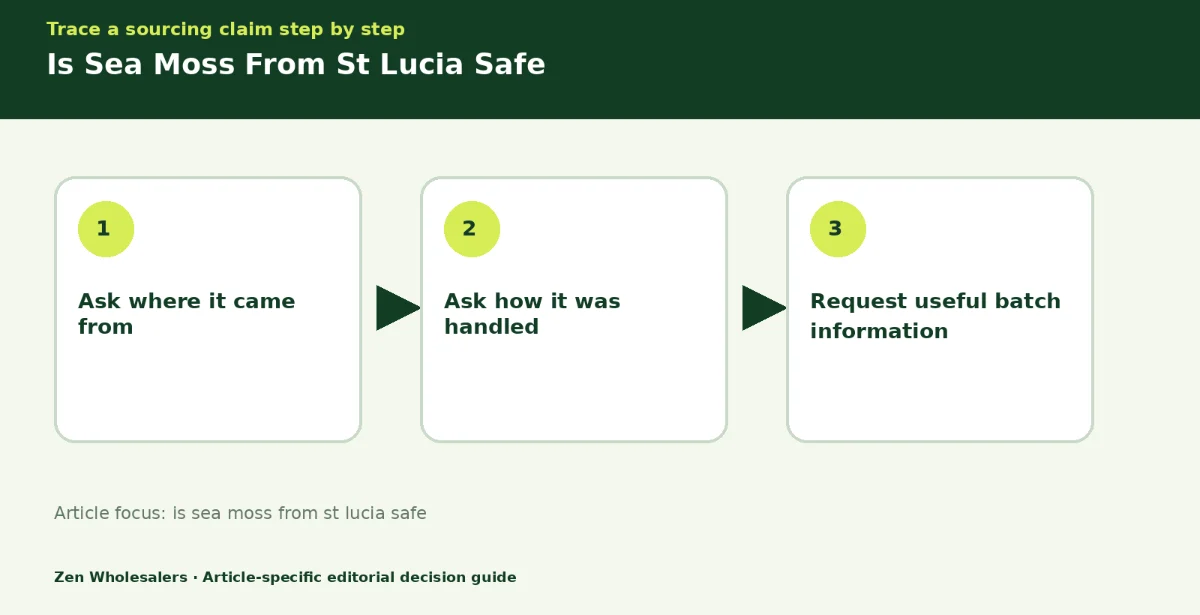
Ask the seller these questions. A reputable supplier should answer them or provide documents.
- Exact harvest location and date. Where in St. Lucia was it harvested? When? (Season and recent date matter.)
- Species identification. What species is the product (common or scientific name)? Different species have different iodine and contaminant profiles.
- Harvest method. Was it hand-harvested from shallow water or gathered from boats? Was any cleaning done on the beach?
- Processing steps. How was it cleaned, dried, or stored? Was sun-drying used, or low-temperature drying in a controlled facility?
- Certificate of Analysis (CoA). Can the supplier provide a third-party lab test for heavy metals (arsenic, cadmium, lead, mercury), microbiology (if fresh or rehydrated), and iodine content?
- Third-party lab accreditation. Was the testing done by an accredited lab? Can the lab name and report be shared?
- Packaging and shelf life. How is it packaged? Does it include a harvest/packaging date and storage instructions?
- Export and food safety permits. Does the supplier follow local export or food safety rules?
If the seller cannot answer these, treat the product as higher risk.
Decision guide: Should you buy this batch?
Use this simple table to decide. Check the items that are true for the product you are considering.
| Item to check | If yes — lower risk | If no — ask more or skip |
|---|---|---|
| Seller gives a harvest location and date | ✔ | ⛔ |
| Species or scientific name provided | ✔ | ⛔ |
| CoA for heavy metals and iodine available | ✔ | ⛔ |
| CoA is from an accredited third-party lab | ✔ | ⛔ |
| Processing/packaging details given (drying, storage) | ✔ | ⛔ |
| Clear label or batch number and shelf life | ✔ | ⛔ |
| Seller explains how product was cleaned | ✔ | ⛔ |
If you have 5 or more checks, the product is more likely to be acceptable for most people. If fewer than 3, consider asking for tests or choosing another supplier.
How testing helps — what to look for in a lab report
A Certificate of Analysis (CoA) should list the tests done and the numeric results. Look for:
- Heavy metals: arsenic (total and inorganic if listed), cadmium, lead, mercury.
- Iodine content (µg per gram or per serving).
- Microbial results for fresh or rehydrated products (e.g., total plate count, E. coli, Salmonella).
- Method used and reporting limits. Lower reporting limits are better for detecting small amounts.
If a CoA is several years old or lacks a harvest or batch number, it is less useful. CoAs should match the batch you are buying.
Handling and home preparation tips
- Rinse fresh sea moss thoroughly. Remove sand and debris.
- Dry properly if you plan to store it long term. Damp sea moss can grow mold.
- Store dried sea moss in a cool, dry place and follow seller storage guidance.
- If you rehydrate and make gels, use clean water and clean containers. Use gels quickly or refrigerate as the seller advises.
These steps reduce microbial risks but do not change heavy metal or iodine content.
Safety and when to ask a clinician
Sea moss can be a healthy food for many people. But some people should get medical advice before using sea moss regularly.
Ask a clinician if you have:
- Thyroid disease (hypo- or hyperthyroidism). Seaweed iodine can affect thyroid function. citeturn0search2turn0search5
- A history of radiation to the neck or thyroid issues.
- Pregnancy or breastfeeding. Pregnancy changes iodine needs. High iodine can affect the fetus. citeturn0search2
- Kidney disease or other conditions that limit how your body handles minerals.
- You take medicines that interact with iodine or thyroid function.
Also consult a clinician if you plan to use sea moss supplements frequently or in large amounts. We cannot give personal medical advice or doses here.
How sellers and regulators reduce risk
Good suppliers follow clear steps:
- Harvest from clean waters away from industrial runoff.
- Use species known to have lower contaminant risk when possible.
- Use controlled drying and hygienic processing.
- Test each batch or regularly test harvest zones.
- Provide transparent CoAs and batch information.
Regulatory bodies and food safety groups recommend monitoring iodine and contaminants in seaweed products and expect sellers to share test results on request. citeturn0search1turn0search4
What sellers often cannot prove
Be cautious if a seller claims:
- “100% pure” without tests — purity is only proven by testing.
- “Safe for everyone” — individual health factors matter.
- “Clinical proof” for broad health effects — evidence for specific health claims is limited.
- Location-based safety without harvest details — saying “from St. Lucia” alone does not show the harvest site or water quality.
Good sellers will offer evidence, not only marketing language.
Practical buying checklist (printable)
- [ ] Harvest location and harvest date provided
- [ ] Seaweed species named (common and scientific if possible)
- [ ] Batch number or identifier on the product
- [ ] Certificate of Analysis for heavy metals, iodine, and microbes (if fresh)
- [ ] CoA from an accredited third-party lab (lab name and date)
- [ ] Processing and drying method described (sun-dried vs. controlled-dry)
- [ ] Storage and shelf-life instructions included
- [ ] Clear labeling and contact info for the supplier
If three or more items are missing, ask for more information before buying.
Next steps and links
If you want to learn more about sea moss composition and potential benefits, see our learning pages: Learn about benefits (/learn/benefits/) and more background on sea moss (/learn/). If you want to inquire about wholesale orders or batch testing for sellers, visit our wholesale page (/wholesale/) or contact us for sourcing questions (/contact/). To browse products that include batch info and testing transparency, see our shop (/shop/). Return to home (/) at any time.
Conclusion
Is sea moss from St. Lucia safe? It can be. But safety is not automatic. You must check harvest details, species, and lab tests for iodine and contaminants. Look for a recent Certificate of Analysis from an accredited lab. People with thyroid conditions, pregnant people, or those on certain medications should speak with a clinician before using sea moss regularly. Use the checklist and decision guide to make a clear choice. If a seller cannot provide answers, choose a more transparent source.
Continue reading
Frequently asked questions
Is all sea moss from St. Lucia safe to eat?
No. The island origin alone does not guarantee safety. Safety depends on the harvest spot, time, species, processing, and lab testing.
Can sea moss cause thyroid problems?
Seaweed can contain high iodine. Too much iodine can affect thyroid function in some people. If you have thyroid disease, talk to a clinician. citeturn0search2turn0search5
Should I ask for a lab report before buying?
Yes. A Certificate of Analysis for heavy metals and iodine reduces risk and gives you facts about the specific batch.
Does drying sea moss remove heavy metals?
No. Drying reduces water and microbial risk but does not remove metals or iodine absorbed into the tissue. Testing is the only way to know metal levels. citeturn0search1
Are supplements safer than raw sea moss?
Not necessarily. Supplements may be concentrated or mixed. They can have strange label claims and variable content. Check third-party testing and transparency. citeturn0search4
Where can I learn more about sea moss safety and benefits?
Start with basic food safety and nutrition resources, and ask the seller for test reports. You can also read our guide on general sea moss benefits. (/learn/benefits/)
References
- [1] Harvard T.H. Chan School of Public Health, “Seaweed.” https://nutritionsource.hsph.harvard.edu/seaweed/
- [2] Smyth PPA. “Iodine, Seaweed, and the Thyroid.” European Thyroid Journal, 2021. https://pmc.ncbi.nlm.nih.gov/articles/PMC8077470/
- [4] Operation Supplement Safety, “Sea Moss in Dietary Supplements.” https://www.opss.org/article/sea-moss-dietary-supplements
- [5] Blikra MJ et al. “Consequences of acute and long-term excessive iodine intake: A literature review focusing on seaweed as a potential dietary iodine source.” 2024. https://doi.org/10.1111/1541-4337.70037