
Short answer: Sea moss may support skin health because it is a food source of minerals and skin-friendly polysaccharides. Scientific evidence for clear, clinical skin improvements is limited. Below we separate what is known from tradition, what early research suggests, and what is not proven. We also give practical checks, safety notes, and next steps.
What is sea moss (brief)
Sea moss is a common name for several red algae that grow in coastal waters. People eat it as food, make gels from it, and use extracts in cosmetics. Nutrients in seaweeds include minerals such as iodine, some trace elements, and polysaccharides (long-chain sugars) that act like natural thickeners. These features explain why seaweed is used in food and in some skincare products. [1]
How people think sea moss helps skin
There are three main ideas behind claims about sea moss for skin:
- As a food: nutrients from eating sea moss could support general skin health. Seaweeds contain minerals and small amounts of vitamins and polysaccharides that are part of normal nutrition. [1]
- As a topical: sea moss gel or extracts used on the skin could act like a moisturizer or film former because of its natural polysaccharides. These can help skin feel hydrated immediately. [1]
- As an active ingredient: some people expect anti‑inflammatory or anti‑microbial effects. Early lab work on seaweed compounds suggests potential actions in test tubes, but that does not prove clinical benefit on people.
We must be careful: lab findings or traditional uses do not guarantee real-world improvements in skin conditions such as acne, eczema, or aging. Controlled clinical trials directly testing sea moss for skin outcomes are limited.
What the science actually shows (and what it does not)
- Seaweed contains minerals and polysaccharides used in food and cosmetics. These ingredients can act as thickeners, humectants (help hold water), or film formers in topical formulas. This explains why seaweed extracts are found in cleansers, creams, and gels. [1]
- Some laboratory studies test isolated seaweed compounds for antioxidant or anti-inflammatory activity. These early studies are useful but do not prove sea moss cures acne, clears skin, or reverses aging in people.
- There are few well-controlled clinical trials that test oral sea moss or topical sea moss gel specifically for skin outcomes in people. That means claims like “sea moss clears acne” or “sea moss reverses wrinkles” are not supported by strong clinical evidence.
- Safety data are stronger in other areas: seaweed is a variable source of iodine. Too much iodine can affect thyroid function in some people. People who use concentrated seaweed supplements or eat large amounts may risk excess iodine intake. This is an important safety issue to consider. [2][5]
In short: composition and lab data give plausible ways sea moss might help skin. But good human trials that prove meaningful, reliable skin improvements from sea moss alone are scarce.
Topical vs oral sea moss: different routes, different checks
Topical use (applied on skin)
- How it might help: Polysaccharides can feel soothing and add moisture. They can act as a gentle film that reduces water loss from the skin surface.
- What to watch: Patch test new topical sea moss products first. Natural products can still cause irritation or allergic reaction.
- Evidence level: Low to moderate for short-term hydration effects; low for treating medical skin conditions.
Oral use (eating sea moss or taking supplements)
- How it might help: Nutrients in foods support overall skin health as part of a balanced diet.
- What to watch: Supplements and large servings of seaweed may deliver high and variable iodine amounts. Iodine can affect the thyroid. Some supplements are not well regulated and may contain contaminants. [2][4][5]
- Evidence level: Low — overall nutrition matters for skin, but there is little direct proof that eating sea moss by itself will reliably improve a skin condition.
Sea moss for skin before and after: what to look for
Before-and-after photos are common in marketing. They can help, but they are not proof. Use this simple checklist to judge before-and-after claims.
| Check | Why it matters |
|---|---|
| Same lighting and camera | Light changes can exaggerate or hide texture and color. |
| Same skincare routine except the product being tested | Other products can cause the change. |
| Timeframe noted and realistic | Skin turnover takes weeks. Quick changes often show surface effects, not deeper repair. |
| Clear description of product and ingredients | “Sea moss” is vague — know whether it’s a gel, extract, or combined formula. |
| Independent testing or lab results shared | Third-party tests can confirm safety (heavy metals, iodine) but do not prove clinical benefit. |
| Multiple people and skin types shown | One person’s result is not universal. |
A single before-and-after photo can be interesting. But it cannot prove a product works for most people.
Practical checklist: Should you try sea moss for skin?
- Do you want a topical mask or an edible product? Decide first.
- If topical: do a patch test behind the ear or on the inner forearm for 48 hours.
- If oral: check for thyroid issues or medications that interact with iodine. Ask a clinician first if you have thyroid disease, are pregnant, or are breastfeeding.
- Ask the seller for lab results for contaminants or heavy metals, especially for products labeled “concentrated.”
- Use the product for at least 4–8 weeks with a consistent routine before judging skin changes (short-term hydration can show sooner).
- Keep a photo log with consistent light and camera settings.
- Stop use if you have irritation, rash, hair loss, palpitations, or other unexpected symptoms and consult a clinician.
How to read product labels and quality signals
- Ingredient clarity: “Sea moss” should appear with a species name (for example, Chondrus crispus or Gracilaria spp.) or the Latin name, plus the form (raw, extract, gel).
- Third‑party testing: look for certificates that test for heavy metals, microbial contamination, and iodine content when possible.
- Avoid supplements that make strong disease claims. If a product promises cures, that is a red flag.
- For topical products: check if other active ingredients (retinoids, acids, salicylic acid) are present. Any improvement may come from those added actives instead of sea moss.
- For edible sea moss or supplements: check serving size and any warnings about iodine or thyroid.
Safety and when to ask a clinician
Sea moss can be part of a healthy routine, but take these safety notes seriously.
- Iodine variability and risk: Seaweeds vary widely in iodine content. Consuming high or unpredictable amounts of iodine can cause thyroid dysfunction in some people. If you have thyroid disease, are under medical care for hormone problems, or take thyroid medication, consult your clinician before starting concentrated seaweed products. [2][5]
- Supplements are unevenly regulated: Dietary supplements can vary in purity and ingredient accuracy. Some sea moss supplements have shown inconsistent labeling or contamination in broader supplement oversight discussions. Ask for testing when possible. [4]
- Heavy metals and contaminants: Seaweed can absorb metals from seawater. Quality testing helps reduce this risk.
- Pregnancy and breastfeeding: Because of iodine concerns and limited safety data for concentrated seaweed supplements, speak with a clinician before use during pregnancy or lactation.
- Allergic reactions and skin irritation: Apply a small patch test for topical preparations. Stop if you see redness, swelling, or rash.
- Stop and seek care if you notice signs of thyroid dysfunction (unexplained fatigue, heart-rate changes, weight change, or hair loss) after starting regular seaweed or concentrated sea moss products.
If you are unsure, a primary care clinician, dermatologist, or pharmacist can help you decide whether sea moss is safe for you based on your medical history and medications.
What credible sources say (short summary)
- Nutrition and composition: Trusted public-health summaries describe seaweed as a food source of minerals and polysaccharides used in food and cosmetics. Seaweed can be part of a varied diet but is not a medically proven skin treatment by itself. [1]
- Iodine and thyroid risk: Medical reviews note that seaweed can deliver high iodine doses and that both too much and too little iodine affect thyroid health. Use caution with concentrated products. [2][5]
- Supplement safety: Consumer safety organizations recommend caution with sea moss dietary supplements because of variability in composition and limited oversight. Ask for testing information. [4]
How to use sea moss safely for skin (practical tips — no dosing)
Topical:
- Do a patch test.
- Use sea moss products as part of a simple routine. If you already use active treatments (like prescription acne meds), add one product at a time so you can spot reactions or benefits.
- Rinse off masks after the time recommended by the product maker. Don’t leave potentially occlusive homemade gels on sensitive skin all night without testing.
Oral:
- Treat edible sea moss as a food, not a replacement for medical care.
- Avoid high and regular amounts of seaweed if you have thyroid disease unless cleared by your clinician.
- Prefer whole-food portions over unknown supplements when possible, and ask the supplier for testing if you choose concentrated extracts.
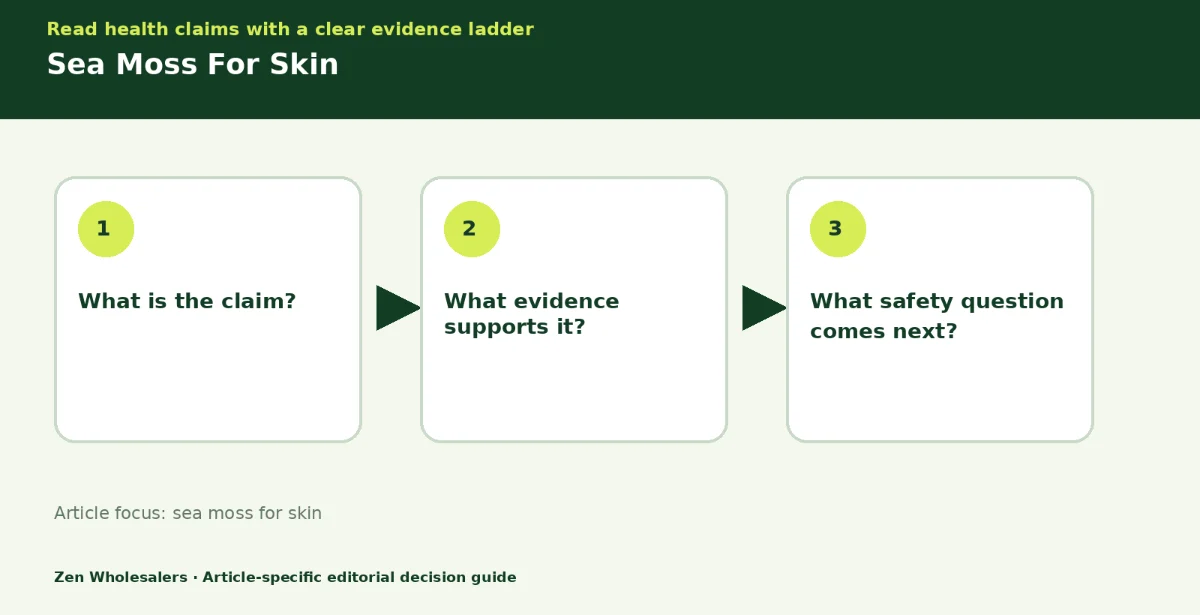
How to evaluate a “sea moss for skin” claim
Ask these four quick questions:
- Is the claim based on human clinical trials or only lab/traditional use?
- Are before/after photos standardized and multiple?
- Does the product provide third-party safety testing for iodine and heavy metals?
- Do you have health conditions (thyroid, pregnancy) that require clinician input?
If the answer to (1) is “no” or “unclear,” treat the claim as a hypothesis, not proof.
Conclusion
Sea moss has features that make it a plausible supportive ingredient for skin. Its polysaccharides can hydrate, and its minerals are part of normal nutrition. However, strong human clinical evidence that sea moss reliably improves skin conditions is limited. Safety matters: iodine content and supplement quality are the main risks to watch. If you try sea moss, choose tested products, do patch tests for topicals, and check with a clinician when you have thyroid concerns, pregnancy, or other health issues.
If you want to learn more about seaweed and nutrition, see our general benefits resources. If you want products or wholesale information, visit our shop or get in touch.
- Learn more about sea moss benefits on our /learn/benefits/ page.
- See product options in our /shop/ catalog.
- For bulk orders, visit /wholesale/ or contact us at /contact/.
- Explore more topics in our learning center at /learn/.
- Return to the site home at /.
Continue reading
Frequently asked questions
Is sea moss good for skin?
Sea moss contains minerals and polysaccharides that can help skin feel hydrated, but there is limited clinical proof that it reliably improves acne, scars, or aging. Consider it a supportive ingredient, not a cure. [1]
Does sea moss clear acne?
There is no strong clinical evidence that sea moss alone clears acne. Some lab work suggests anti-inflammatory properties, but human trials are lacking. If you have acne, a dermatologist can recommend proven treatments. [1]
Can I apply sea moss gel to my face every day?
You can try a topical product but start with a patch test. If you use prescription or strong active skincare (retinoids, acids), add new products one at a time and watch for irritation. Stop use if you get redness or rash.
Are sea moss supplements safe?
Supplements can vary in iodine content and purity. Excessive iodine intake can affect thyroid function. Ask for third-party testing and consult a clinician if you have thyroid disease, are pregnant, or take medication. [2][4][5]
How long before I can see skin improvements?
Short-term hydration can be noticeable in days. Structural skin changes take weeks to months. Because clinical evidence is limited, use careful tracking (photos, same lighting) and be realistic about expectations.
Where can I learn more about seaweed and safety?
Reliable public-health summaries discuss seaweed nutrition and variability in iodine. If you want product-level answers, ask suppliers for lab testing and ask a clinician about personal risks. [1][2][4]
References
- [1] Harvard T.H. Chan School of Public Health, “Seaweed.” https://nutritionsource.hsph.harvard.edu/seaweed/
- [2] Smyth PPA. “Iodine, Seaweed, and the Thyroid.” European Thyroid Journal, 2021. https://pmc.ncbi.nlm.nih.gov/articles/PMC8077470/
- [4] Operation Supplement Safety, “Sea Moss in Dietary Supplements.” https://www.opss.org/article/sea-moss-dietary-supplements
- [5] Blikra MJ et al. “Consequences of acute and long-term excessive iodine intake: A literature review focusing on seaweed as a potential dietary iodine source.” 2024. https://doi.org/10.1111/1541-4337.70037