
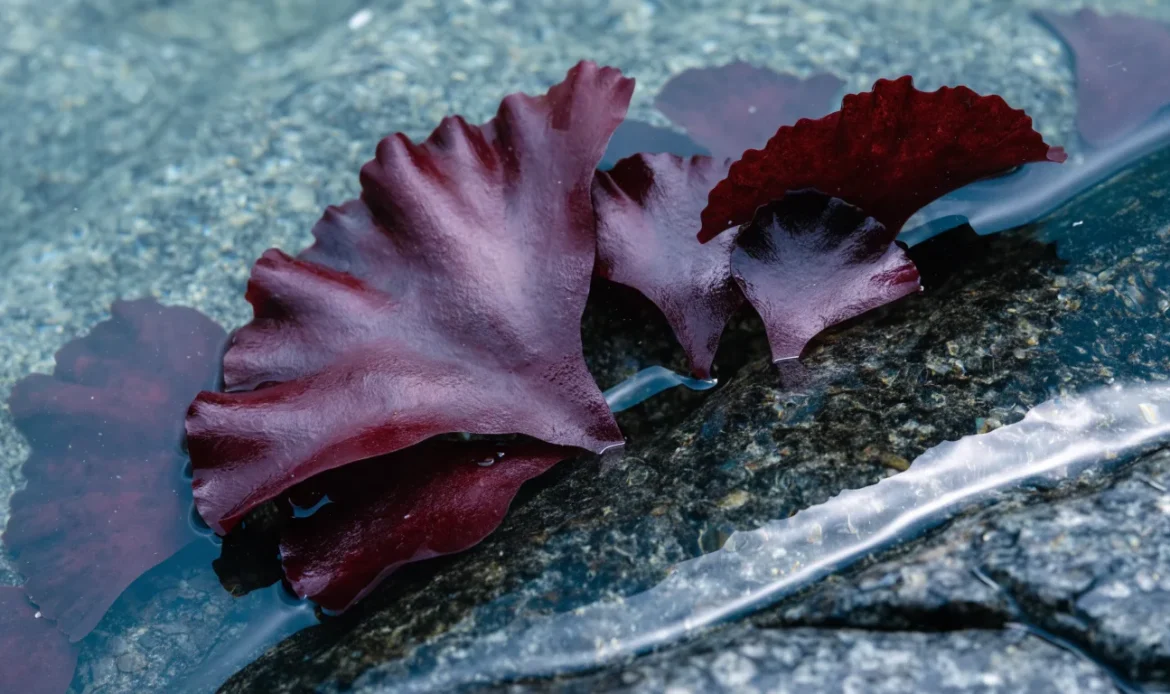
Before any list of benefits is worth reading, one thing has to be settled: most product sold as Irish sea moss is not the species the name refers to, and often has no connection to Ireland at all.
That matters here more than it does elsewhere, because the small body of human research that exists was done on the real species.
What Irish moss properly means
Irish moss is Chondrus crispus, a red alga native to cold North Atlantic waters around Ireland, Britain, Brittany and the north-east coast of North America. It is flat and fan-shaped, a few inches across, and grows on intertidal rock. It has been eaten in Ireland for centuries, boiled with milk into a thickened drink, and it is the original commercial source of carrageenan.
The overwhelming majority of what sells as sea moss — including most jars labelled Irish — is Eucheuma cottonii, a warm-water species from the Caribbean and Indo-Pacific. Thick, branched, gold or purple, quite different to look at. Ours from Saint Lucia is this species and we do not call it Irish for that reason.
If a listing says Irish sea moss from Saint Lucia or Jamaica, one of those two words is marketing rather than description.
The full species comparison is here. It is not that one is better — it is that the label should tell you which you are buying.
The benefits with human evidence
This is a short section, and its shortness is the honest headline.
Only two small randomised controlled trials have examined Chondrus crispus in humans. Each enrolled fewer than 60 adults and ran for less than 12 weeks. Between them they reported:
- Modest reductions in fasting glucose.
- Improved stool frequency.
- Slight increases in serum antioxidant capacity.
Those are real results from real trials, and they are also small, short and preliminary. Two studies under 60 people each is where a research question begins, not where it concludes. Nobody should describe those findings as proof, and a brand that cites them as such is overreaching.
Both findings that concern digestion and glucose are at least mechanistically sensible. Chondrus crispus is largely soluble fibre, and soluble fibre reliably improves regularity and slows carbohydrate absorption. The effect is the fibre doing ordinary fibre things.
What it genuinely supplies
Soluble fibre
The most defensible benefit and the least marketed one. Sea moss is mostly carrageenan and related polysaccharides — soluble fibre that adds bulk, holds water and feeds gut bacteria.
Iodine
Real and worth respecting. A 2020 risk assessment in Environmental Science and Pollution Research analysed 30 red seaweed samples and found iodine in Chondrus crispus averaging around 3.86 mg/kg dry weight (±1.49) — roughly 3 to 7 micrograms per gram of dried moss. The adult Tolerable Upper Intake Level is 1,100 micrograms a day.
Ordinary servings sit comfortably below that. The catch is the standard deviation: batches vary, and a large serving of dried red seaweed can approach the upper limit on its own. This is why lab testing matters more than provenance stories. Sea moss and thyroid health covers the consequences of getting it wrong.
Minerals, in trace amounts
Analytical work finds calcium, iron and zinc, plus amino acids, fatty acids, carotenoids and polyphenols. All genuinely present. Whether a spoonful of gel that is roughly 95% water delivers a nutritionally meaningful quantity of any of them is a separate question, and mostly the answer is no.
Claims resting on lab and animal work only
The majority of proposed sea moss benefits come from preclinical research — cell cultures and animal models — and have never been tested in people. That does not make them false. It makes them untested, which is a different thing, and the distinction is routinely erased in marketing.
- Immune support. Carrageenans show immunomodulatory activity in laboratory work. No human trial has shown that eating sea moss reduces infections.
- Antiviral effects. Isolated carrageenan has antiviral activity in vitro, mostly studied as a nasal spray ingredient. That is not a claim about eating seaweed.
- Joint and skin health. Mechanistically plausible, entirely untested in humans.
- Thyroid support. Sea moss supplies iodine, and the thyroid needs iodine. If you are deficient this helps. If you are not, more iodine is not better and can be worse.
The carrageenan question
Worth addressing directly, because it comes up constantly and both extremes are wrong.
Some laboratory and animal studies suggest certain forms of carrageenan may disrupt intestinal barrier integrity, activate inflammatory pathways and alter gut bacteria. Those studies typically use degraded carrageenan (poligeenan) or isolated carrageenan at high doses — not the intact polysaccharide inside a piece of seaweed.
Researchers note that food-grade carrageenan consumed within a whole food matrix behaves differently from isolated carrageenan used experimentally. So: not a reason for alarm about eating sea moss, and not a reason to dismiss the question either. If you have inflammatory bowel disease, it is worth raising with your doctor.
Heavy metals, and why testing is not optional
Seaweed absorbs what is in the water around it, including arsenic, cadmium, lead and mercury. Research published in 2025 in the Journal of Agriculture and Food Research found that consuming seaweed products can lead to heavy metal accumulation with real health consequences.
This is the exact inverse of the detox claim so often attached to sea moss. It is also entirely manageable: it is a reason to buy from a supplier who tests each lot and will show you the certificate, and a reason to be sceptical of product with no traceable origin. Where and how it was grown matters here.
So is it worth taking?
As a food, yes, on modest terms. A low-calorie source of soluble fibre and iodine that thickens what you put it in, with early signals on glucose and regularity from two small trials. That is a reasonable thing to add to a diet.
As the immune-boosting, thyroid-healing, 92-mineral superfood of the marketing, no. The claims substantially outpace the evidence, and the honest version is more useful to you than the inflated one.
If you want the genuine Chondrus crispus, buy from a supplier who names the species and the harvest region — Ireland, Brittany, Maine or Nova Scotia. If you want the Caribbean species, buy that on its own merits: it expands further per pound and makes a milder gel. Just do not pay a premium for an Irish label on Caribbean seaweed.