
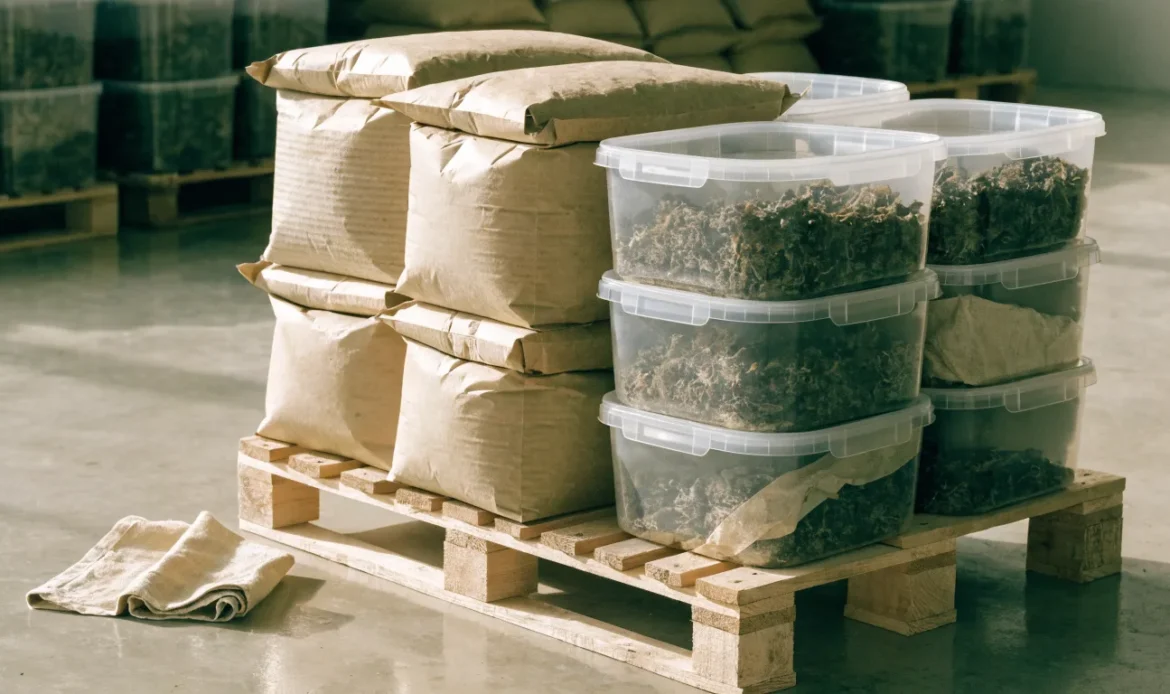
Short answer: If you need an organic Irish moss supplier in the USA for wholesale, focus on three things first — clear documentation, the exact product form and grade you need, and an explicit quote/account workflow. Ask for certificates, a product specification, sample policy, and a clear lead time. Below is a practical guide that tells you what to check, what those documents actually prove, and the next questions to ask.
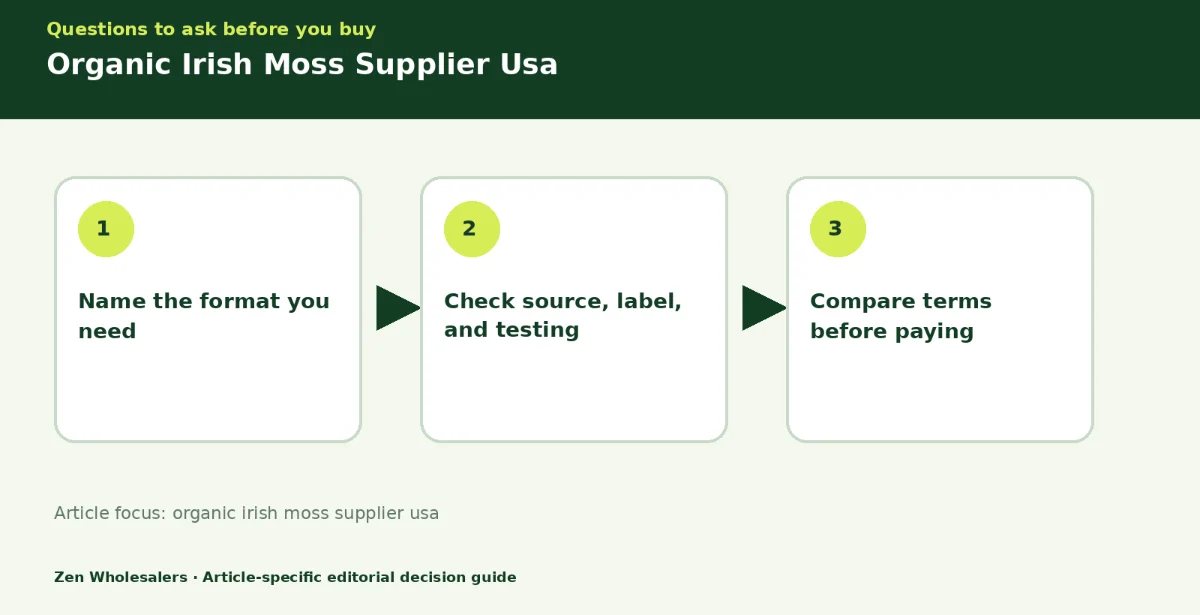
Why this guide helps a buyer
This page walks through real B2B checks. It shows what you can verify and what you cannot prove from papers alone. You will learn:
- Which documents to request and why.
- Which product features affect handling and cost.
- How a typical quote and account approval workflow runs.
- A checklist you can use when comparing suppliers.
This helps you decide which supplier to pursue. It also helps you prepare your procurement team.
Basic terms to know
- Organic Irish moss: Irish moss (a type of seaweed) sold with an organic claim. Verify the certifier and scope of the certificate.
- Supplier vs. distributor: A supplier may harvest or source the product. A distributor resells product sourced from someone else. Ask which role the company plays.
- COA (Certificate of Analysis): Lab report for a specific lot or sample. It shows test results for the sample submitted.
- Specification sheet: A document that lists product form, accepted tolerances, and key physical traits.
- MOQ: Minimum order quantity. This controls pricing and logistics.
What to check before you request a formal quote
H3: 1) How “organic” is documented
- Ask for a copy of the organic certificate. Check the certifier’s name and the certificate issue and expiry dates.
- Confirm which part of the supply chain the certificate covers (harvest, processing, or both).
- A certificate shows an auditor found compliance at a point in time. It does not guarantee future compliance or product composition.
H3: 2) Traceability and provenance
- Ask for documentation showing origin or chain of custody for the lots you will buy.
- If the supplier is a middleman, ask them to show traceability to the original harvester or processor.
- Traceability documents let you track where a lot came from. They do not alone prove quality unless accompanied by testing and specs.
H3: 3) Lab testing and safety concerns
- Ask whether the supplier provides a recent COA for each lot. Request the date, lab name, and method used.
- Seaweed iodine, heavy metals, and microbial levels can vary by source and season. Expect variation. For general information on seaweed and nutrient variability, see guidance from nutrition and regulatory studies [1][2][5].
- A COA shows results for the tested sample. It does not guarantee other lots will match unless the supplier tests every lot and uses consistent sourcing.
H3: 4) Product grade and form
- Decide if you need raw dried whole seaweed, cleaned broken pieces, powder, or pre-made gel.
- Each form has different handling, storage, and use requirements.
- Ask for a spec sheet that defines particle size, moisture or drying status, and acceptable foreign matter.
H3: 5) Packaging, storage, and handling
- Ask how product will be packed for transport.
- Confirm whether the product will be stored in climate-controlled conditions before shipping.
- Packaging can affect shelf life and contamination risk. Ask for an SDS (safety data sheet) if you plan to use the product in food or finished goods.
H3: 6) Quantity, lead times, and MOQ
- Ask the supplier to state clear MOQs and typical lead times.
- For larger buyers, ask if production can be scheduled or reserved.
- Lead time and consistent supply are as important as per-unit price for manufacturers.
H3: 7) Sample policy
- Ask how samples are provided and whether they come from the same lot you would buy.
- If possible, request a production lot sample and a COA for that lot.
Documentation suppliers commonly provide — and what it proves
H3: Common documents
- Organic certificate (if claiming organic).
- Certificate of Analysis (COA) for a lot or sample.
- Specification sheet (product description, accepted tolerances).
- Safety Data Sheet (SDS / MSDS) for handling and hazards.
- Packing list and bill of lading at shipment.
- Traceability or chain-of-custody records.
H3: What each document can and cannot prove
- Organic certificate: proves certification at the time and scope shown. It does not guarantee every shipment will meet the same standard unless the certificate covers ongoing operations and you verify for each lot.
- COA: proves test results for the sample tested. It does not prove every lot will match unless the supplier tests all lots.
- Specification sheet: defines expectations. It is a contract tool. It does not confirm the product shipped meets the spec unless tied to acceptance testing.
- SDS: provides handling and hazard information. It does not verify product quality.
Always ask for contact details of the certifier or testing lab so you can verify authenticity.
Typical wholesale quote and account approval workflow
Below is a common step-by-step workflow that many buyers and suppliers use. Use this to plan internal approvals.
- Initial inquiry: You send a request with product form, approximate annual volume, and preferred delivery terms.
- Supplier clarifies: Supplier asks about intended use (food, cosmetic, supplement) and required certifications.
- Sample request: You request a sample and ask for an associated COA and spec sheet.
- Lab review: Optionally, your lab or a third-party tests the sample.
- Formal quote: Supplier issues a quote with MOQ, lead time, payment terms, and incoterm or shipping terms.
- Quality agreement: For repeated orders, sign a quality agreement that defines acceptance tests, sampling plan, and corrective actions.
- Account setup: Supplier opens an account, collects required documents for billing, and confirms terms.
- Purchase order and production scheduling: You issue PO; supplier confirms production and delivery schedule.
- Pre-shipment checks: Supplier provides pre-shipment documents, packing list, and COA for the shipped lot.
- Receipt and incoming inspection: You or your lab test the received lot against the spec and COA.
This workflow can be faster or slower depending on volumes and regulatory needs.
Buyer checklist — what to verify when comparing suppliers
| Check | Why it matters | How to verify |
|---|---|---|
| Organic certificate | Confirms organic claim cover | Request full certificate; verify certifier contact and coverage dates |
| COA per lot | Shows recent test results | Ask for COA with lot number and lab contact |
| Product spec sheet | Sets acceptance criteria | Compare spec details (form, moisture, foreign matter) |
| Sample availability | Confirms product matches need | Obtain sample from the actual production lot |
| Traceability documents | Links product to source | Request chain-of-custody or supplier origin statement |
| Packaging & storage details | Affects quality in transit | Ask about packing materials and storage conditions |
| MOQ and lead time | Affects scheduling and cost | Ask for exact MOQs and typical lead times |
| Payment & return terms | Reduces commercial risk | Confirm payment method, returns, and dispute resolution |
| Insurance and shipping terms | Protects shipment value | Check incoterm, carrier options, and insurance |
| Third-party testing option | Independent verification | Ask if they accept third-party tests and sample split terms |
Use this checklist during supplier calls and store answers in a comparison sheet.
Grades, forms, and how they affect handling
H3: Forms you will encounter
- Whole dried seaweed: often the least processed. Requires rehydration for use.
- Cleaned/trimmed pieces: easier to process; may reduce foreign matter.
- Powder: used when uniform particle size is needed. Often requires milling.
- Gel or pre-hydrated product: ready for certain food uses but has different shelf life.
H3: Handling notes
- Dry forms are lighter and often cheaper to store. They may still require controlled humidity.
- Powders can create dust. They need dust control and adequate personal protection.
- Hydrated products need cold-chain or preservatives. These require more complex logistics.
H3: Quality attributes that matter
- Uniformity: particle size and color consistency affect processing.
- Moisture or drying status: affects storage and microbial risk.
- Cleanliness: foreign matter and smell can indicate poor cleaning or processing.
Questions to ask a supplier (short list)
- Do you provide an organic certificate and which certifier issued it?
- Do you test every production lot and can you share the COA for our lot?
- What is your typical MOQ and lead time for first orders and repeat orders?
- Can you provide a specification sheet and SDS for the product?
- How do you handle traceability and chain-of-custody?
- What are your packing options for sea freight and air freight?
- Do you accept a third-party lab to test a pre-shipment sample?
- What is your sample policy and sample lead time?
- Do you offer a quality agreement for recurring orders?
These questions focus on what you can verify and control.
What testing and safety topics to cover with your quality team
- Iodine: Seaweed iodine varies widely by species and origin. Monitor intake if you supply iodine-sensitive products or populations [1][2][5].
- Heavy metals: Ask for testing for relevant heavy metals. A COA will show results for the tested sample; discuss frequency of testing.
- Microbial testing: For hydrated or minimally dried products, microbial tests matter.
- Allergens and cross-contact: If processing occurs in a shared facility, ask about control measures.
Note: Scientific studies and surveys show that levels of nutrients and elements in seaweed can vary. Use testing to manage that risk rather than assuming uniform content [1][2][3][5].
Buyer decision guide (simple path)
- Are you making a food, supplement, or cosmetic product?
- Food: Require COAs, SDS, and supplier traceability.
- Dietary supplement: Also check regulatory needs and label claims; verify ingredients fit your formula. Consider third-party testing.
- Cosmetic: SDS, preservative system, and stability testing may be needed.
- Do you need organic certification?
- Yes: Request full organic certificate and verify certifier.
- No: Consider suppliers who can still provide consistent COAs and specs.
- Volume needs
- Small test orders: Ask for sample policy and small-lot options.
- Regular production: Ask about production scheduling and quality agreement.
- Logistics risk tolerance
- Low tolerance: Choose suppliers with reliable lead times and long storage before shipping.
- Higher tolerance: You may accept longer lead times for lower cost.
Use this to route supplier discussions and internal approvals.
How to take the next step
- List your must-have documents: organic certificate, sample COA, spec sheet, and SDS.
- Use the buyer checklist above in calls with each supplier.
- Request a sample from a lot bound for your first order if possible.
- Decide whether to run independent lab tests before placing a larger order.
- If you plan recurring orders, negotiate a quality agreement and a schedule for lot testing.
If you want to start a wholesale conversation, see our wholesale page to understand account setup and terms: /wholesale/. You can view our product range at /shop/ and learn more about sea moss basics at /learn/. If you’re ready to talk, reach out via /contact/ or explore our homepage: /.
Conclusion
Buying organic Irish moss in the USA for wholesale is a process of verification. Papers matter, but they are part of the story. Ask for organic certificates, lot COAs, spec sheets, and traceability records. Request samples from the actual lot you would buy. Use a written quality agreement for ongoing supply. Testing and clear specs will reduce surprises. If you follow the steps in this guide, you will have a practical path to pick a supplier that meets your product needs and risk tolerance.
Continue reading
Frequently asked questions
Does an organic certificate guarantee all shipments are organic?
No. A certificate shows certification for the entity and scope reviewed. It does not guarantee every shipment will be identical. Ask for lot-specific documentation and verify the certifier if you need ongoing assurance.
Can I rely on a supplier’s COA for every batch?
A COA proves results for the tested sample or lot. For recurring supply, ask the supplier if they test each lot. You can also arrange third-party testing on arrival or pre-shipment.
What are common safety concerns with seaweed products?
Variability in elements such as iodine and possible heavy metals are common concerns. Microbial issues can be a concern for hydrated products. Use testing and clear specs to manage these risks [1][2][5].
Should I require a quality agreement?
Yes, for ongoing orders. A quality agreement defines acceptance criteria, sampling plans, and corrective actions. It helps limit disputes after delivery.
How should I handle sample testing?
Request a sample from the actual production lot you might buy. Keep a split sample for your lab or for a third-party test. Confirm who pays for testing before shipping a paid sample.
Is there a standard grade system for Irish moss?
There is no single universal grade system. Suppliers may use terms like whole, cleaned, powdered, or food-grade. Ask for a specification sheet that defines the terms and acceptance limits.
References
- Harvard T.H. Chan School of Public Health, “Seaweed.” https://nutritionsource.hsph.harvard.edu/seaweed/
- Smyth PPA. “Iodine, Seaweed, and the Thyroid.” European Thyroid Journal, 2021. https://pmc.ncbi.nlm.nih.gov/articles/PMC8077470/
- Food Standards Australia New Zealand, “Survey of iodine levels in seaweed and seaweed containing products,” updated 2025. https://www.foodstandards.gov.au/science-data/monitoring-safety/surveyofiodinelevels
- Operation Supplement Safety, “Sea Moss in Dietary Supplements.” https://www.opss.org/article/sea-moss-dietary-supplements
- Blikra MJ et al. “Consequences of acute and long-term excessive iodine intake: A literature review focusing on seaweed as a potential dietary iodine source.” 2024. https://doi.org/10.1111/1541-4337.70037