
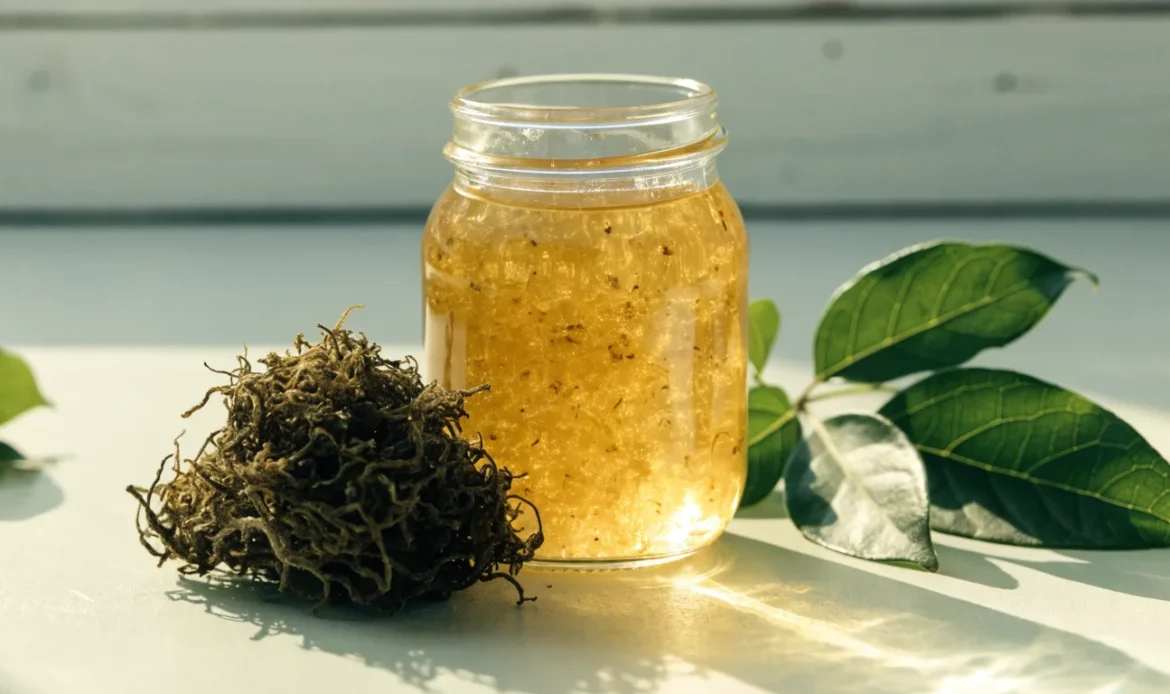
Short answer: Sea moss is a type of edible seaweed. It contains a mix of minerals, fiber, and gel-forming plant compounds. Which exact nutrients are present, and in what amounts, changes a lot by species, place it grew, and how it was processed.
Why a short answer first: many people want a quick, clear reply. The rest of this page explains details. It shows what you can check on a label. It shows what labels and product pages cannot prove. Then it gives a plain checklist to help you choose a format.
What sea moss is and the kinds people sell
“Sea moss” is a common name. It is used for several types of red algae. Two names you may hear are Irish moss and Gracilaria. Different species look and feel different. They also differ in what they contain.
Forms you will see in shops:
- Fresh or wet sea moss.
- Dried whole sea moss.
- Pre-made gels (sea moss blended with water).
- Powders and capsules.
- Processed ingredients in foods or supplements.
The raw seaweed itself is a plant-like organism that grows in saltwater. It pulls elements and minerals from the water as it grows. That is why sea moss composition varies by where it is harvested.
Common components found in sea moss
Sea moss is not a single chemical. It is a mix of plant parts and the molecules inside them. Common components include:
- Minerals: Seaweed often contains minerals that reflect the seawater where it grew. Iodine is one mineral frequently found in seaweed. Other minerals can include elements like potassium, calcium, and magnesium, though amounts vary by species and location (see sources on seaweed and iodine) [1][2][3].
- Polysaccharides (gel-forming compounds): Many red seaweeds contain long-chain carbohydrates. These help the seaweed hold water and form gels when cooked or blended. In red algae, these are often called carrageenans or agar-like substances. They are part of why sea moss becomes jelly-like after soaking and heating.
- Dietary fiber: Sea moss contributes fiber. Fiber is the structural carbohydrate in plants.
- Protein and amino acids: Seaweeds contain small amounts of protein compared with legumes or meat. The amount and profile change by species.
- Vitamins: Some seaweeds contain certain vitamins. The type and amount differ widely. Claims about one seaweed reliably supplying vitamin B12, for example, are uncertain and depend on the species and lab methods used to test it [1].
- Water and ash: Dried sea moss will still contain some water and mineral residue (often reported as ash in lab tests). These numbers change a lot with drying and processing.
These points come from broader reviews of seaweed nutrition. Seaweed species and harvest location cause large variation in what ends up in the product [1].
What matters most: iodine and why it gets attention
Iodine is a mineral that many seaweeds can contain in variable amounts. Because iodine affects thyroid function, it is the component people most often ask about.
Key facts:
- Iodine levels change a lot by species and where the seaweed grew. Some samples have much more iodine than others [3].
- High iodine intake can cause problems for some people if it is sustained over time. Both low and very high iodine intake can influence thyroid hormones in different ways (this is a topic for clinicians) [2][5].
- Testing and labeling are often inconsistent. Some seaweed products show iodine content on a nutrition label. Many do not. Recent surveys have found wide differences in iodine levels across products and batches [3].
What this means for you:
- Do not assume all sea moss has the same iodine. You cannot tell iodine level by color or smell.
- If you have a known thyroid condition, speak with a healthcare professional before adding regular seaweed products to your diet. They can advise based on your medical history and current iodine recommendations [2].
Other safety topics: contaminants and quality
Seaweed can pick up substances from seawater. That is normal. The list of possible contaminants includes naturally occurring elements and man-made pollutants. Whether a specific product contains a contaminant depends on where it was harvested, how it was processed, and the quality controls used by the company.
What companies can do:
- Test final products for heavy metals, iodine, and microbes.
- Share test results or certificates when asked.
What testing cannot prove for a product page:
- A single batch test does not guarantee that all future or past batches are identical.
- A product page that lists “lab tested” without a certificate or test date leaves unknowns.
Consumer safety groups and supplement-watch organizations note that some sea moss products sold as dietary supplements may lack consistent testing or make unsupported claims. Look for transparent third-party testing when safety is a top concern [4].
How processing and form change what is in a product
Processing changes water, texture, and sometimes nutrient measurements.
- Dried whole sea moss. This is the seaweed with most water removed. Drying concentrates minerals and other solids per gram.
- Fresh or wet sea moss. This contains more water by weight, so nutrient amounts per gram are lower than dry weight.
- Gel. Sea moss gel is sea moss blended with water and sometimes other ingredients. Added ingredients change the final composition. Gel-making also extracts polysaccharides that give the gel its texture.
- Powder and capsules. These are dried, milled seaweed or extracts. Powders concentrate solids. Capsules may have fillers or binders.
- Heat and cooking. Boiling, soaking, and blending change texture and can leach water-soluble minerals. That affects how much of a mineral is in a serving.
Because these processes change water and concentration, comparing different formats requires attention to serving size and whether values are reported per gram dry weight or per prepared serving.
How a label or product page can help — and what it cannot prove
What you can look for:
- Species name (scientific name is best).
- Harvest origin (general region or country).
- Processing method (dried, frozen, gel, smoke-dried, etc.).
- Ingredient list (for added sugars, preservatives, or other foods).
- Nutrition facts and any measured iodine value.
- Third-party testing statements or links to certificates.
What a label or product page cannot prove on its own:
- That every batch matches the listed lab numbers.
- That the product is free from all contaminants (unless recent batch tests are provided).
- The exact mineral levels without lab data for the specific batch you buy.
- That a product will produce a specific health effect for any individual.
When labels are missing detail, ask the seller for batch test results or a certificate of analysis (COA). A COA will show the date of testing and the lab used. If the seller cannot or will not provide clear testing, treat that as a gap in information.
Decision checklist: choosing a sea moss format and product
Use this checklist to compare products. It is practical and short. Tick what matters to you.
| Question to ask | Why it matters | If you want low risk, look for… |
|---|---|---|
| What format do I prefer? (dried, gel, powder, capsule) | Different formats change concentration, convenience, and storage needs. | Dried for long storage; gel for ready-to-use; powder or capsules for dosing convenience. |
| Is the species listed? | Species ties to known nutrient patterns and may affect texture. | Scientific name (e.g., Chondrus, Gracilaria) or clear species info. |
| Is iodine or mineral testing shown? | Iodine varies widely and may matter for health. | A recent COA showing iodine and mineral results. |
| Are there added ingredients? | Additives change nutrition and allergens. | Short ingredient list. No hidden sugars or thickeners unless you want them. |
| Is origin and harvest information given? | Source affects environmental exposures and quality control. | Named region and basic harvest method. |
| Is there third-party testing or a COA? | Independent testing reduces uncertainty about contaminants. | A COA from a recognized lab, ideally accessible by link. |
| Is storage and shelf-life clear? | You want safe storage for the format purchased. | Clear instructions and best-by date on the package. |
| Do return or contact options exist? | You may need to ask follow-up questions. | Clear contact info and return policy. |
This checklist focuses on verifiable facts you can see or request. It does not promise safety or specific health effects. It helps you reduce uncertainty.
Practical notes on serving and storage (what you can check, not medical advice)
- If you buy dried sea moss, it typically needs rehydration to use as a gel or in recipes. The seller should provide instructions for preparation and storage.
- Pre-made gels should show an ingredient list and a best-by date. Some gels include added ingredients that change the nutrition.
- Powders and capsules should show serving size and a list of inactive ingredients or fillers.
- Store dry sea moss in a cool, dry place. Store gels in the refrigerator and follow the seller’s guidance on how long they keep.
These are practical handling tips. For any personal health concerns, talk with a qualified clinician.
What you can ask a seller before buying
- Do you list the species and harvest region on the package?
- Can you show a recent certificate of analysis (COA) for iodine and heavy metals?
- When was this batch harvested and processed?
- Are any additives or preservatives included?
- What are storage instructions and expected shelf life?
If a seller cannot provide clear answers to basic questions, consider choosing a different product or format.
Where to learn more or shop
- Read more about seaweed basics in our learning hub: Learn more about seaweed and sea moss.
- If you are ready to compare products, see our collection: Shop sea moss.
- If you need bulk or business options, visit our wholesale page: Wholesale inquiries.
- Have questions about an order or product batch? Contact us directly: Contact Zen Wholesalers.
- Return to the main site for company info: [/].
Conclusion
Sea moss is a variable natural product. It contains minerals, fiber, and gel-forming polysaccharides. But what is in any given package depends on the species, the water where it was harvested, and how it was processed. You can reduce uncertainty by checking labels, asking for certificates of analysis, and thinking about the format you want (dried, gel, powder). If iodine or other minerals matter for your health, get specific test data for the batch you buy and talk with a clinician.
If you want product comparisons, preparation tips, or bulk options, start here: Learn more about seaweed and sea moss (/learn/), visit our shop (/shop/), or reach out through contact (/contact/). For business orders, see wholesale (/wholesale/).
Frequently asked questions
What exactly is “sea moss”?
Sea moss is a common term for several edible red algae. People use the term for different species that share a similar look or use. The term alone does not identify the species or the harvest location.
Does sea moss contain iodine?
Yes, many seaweeds can contain iodine. The amount varies widely by species and where the seaweed grew. Some seaweed products can be high in iodine, so it is wise to check labels or ask for testing if you need to manage iodine intake [1][2][3].
Is sea moss a reliable source of vitamin B12?
Claims about B12 in seaweed are inconsistent. Some analyses find B12-like compounds that are not active for humans. Do not assume a seaweed product reliably supplies usable vitamin B12 without clear lab evidence [1].
Are there safety risks with sea moss?
Sea moss can contain variable iodine, and it can pick up substances from the water where it grows. The degree of risk depends on the specific product and testing. Ask sellers for COAs and recent test results for contaminants and iodine if safety is a concern [3][4][5].
How should I store sea moss gel or dried sea moss?
Follow the seller’s stated storage instructions. Generally, frozen or refrigerated storage extends freshness for gels. Dried sea moss should be kept in a cool, dry place. Look for a best-by date or storage guidance on the package.
Can I trust labels on sea moss supplements?
Label quality varies. Some products list species and test results. Others do not. If a product claims testing, request a COA. Third-party lab results give more confidence than unlabeled claims [4].
References
- [1] Harvard T.H. Chan School of Public Health, “Seaweed.” https://nutritionsource.hsph.harvard.edu/seaweed/
- [2] Smyth PPA. “Iodine, Seaweed, and the Thyroid.” European Thyroid Journal, 2021. https://pmc.ncbi.nlm.nih.gov/articles/PMC8077470/
- [3] Food Standards Australia New Zealand, “Survey of iodine levels in seaweed and seaweed containing products,” updated 2025. https://www.foodstandards.gov.au/science-data/monitoring-safety/surveyofiodinelevels
- [4] Operation Supplement Safety, “Sea Moss in Dietary Supplements.” https://www.opss.org/article/sea-moss-dietary-supplements
- [5] Blikra MJ et al. “Consequences of acute and long-term excessive iodine intake: A literature review focusing on seaweed as a potential dietary iodine source.” 2024. https://doi.org/10.1111/1541-4337.70037